Blockchain Technology Explained: How It Works and Where Nigeria Is Using It (2026)

Last updated: 13 October 2026. This replaces an earlier version that quoted statistics we could not source, such as figures on how many businesses cite a skills shortage. We have kept to facts we can point to.
Blockchain is a way of keeping a record that many people share, that anyone with permission can check and that is very hard to change after the fact. It sits behind Bitcoin and other cryptocurrencies, but the idea is wider than money. Anywhere that people need to agree on who owns what, who did what or where something came from, a shared record can help.
How it works
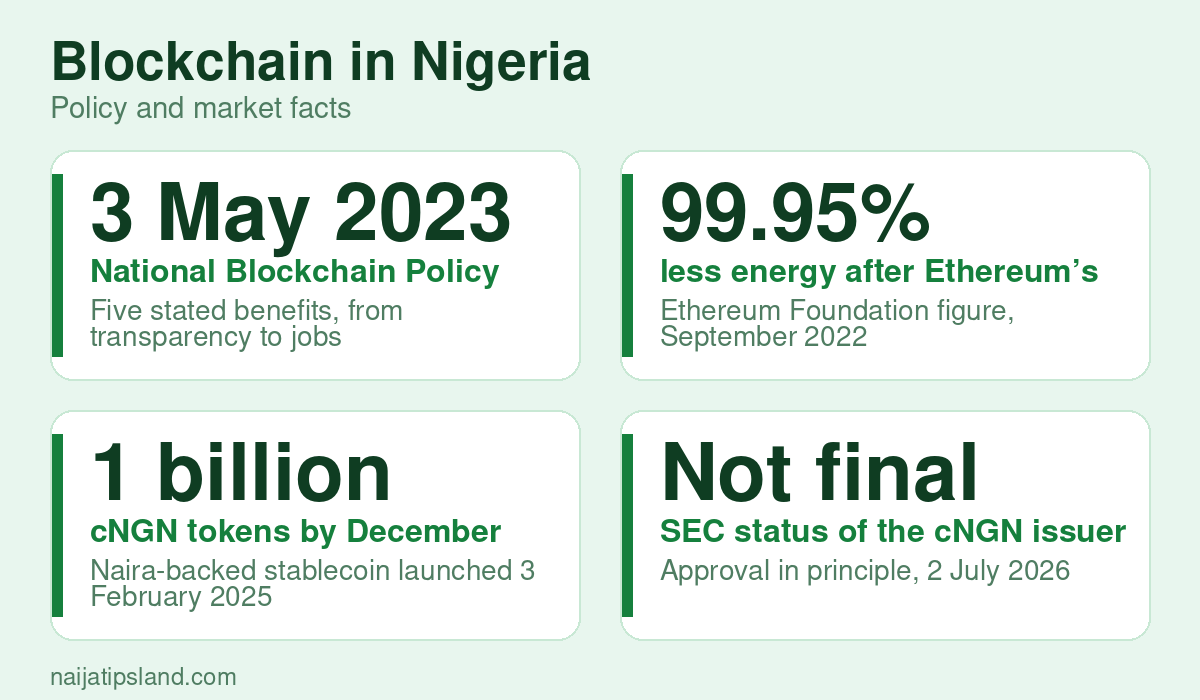
Think of a ledger that is copied across thousands of computers. When someone makes a transaction, they sign it with a private key, and the network checks that it follows the rules, for example that the sender actually has the money. Valid transactions are grouped into a block, and each block contains a fingerprint, called a hash, of the block before it. Because every block depends on the one before, changing an old record would break every block after it, and the other copies would reveal the tampering. That is why people say a blockchain is tamper-resistant.
Consensus: how the network agrees
- Proof of work: used by Bitcoin. Computers compete to solve puzzles, which secures the network but uses large amounts of electricity.
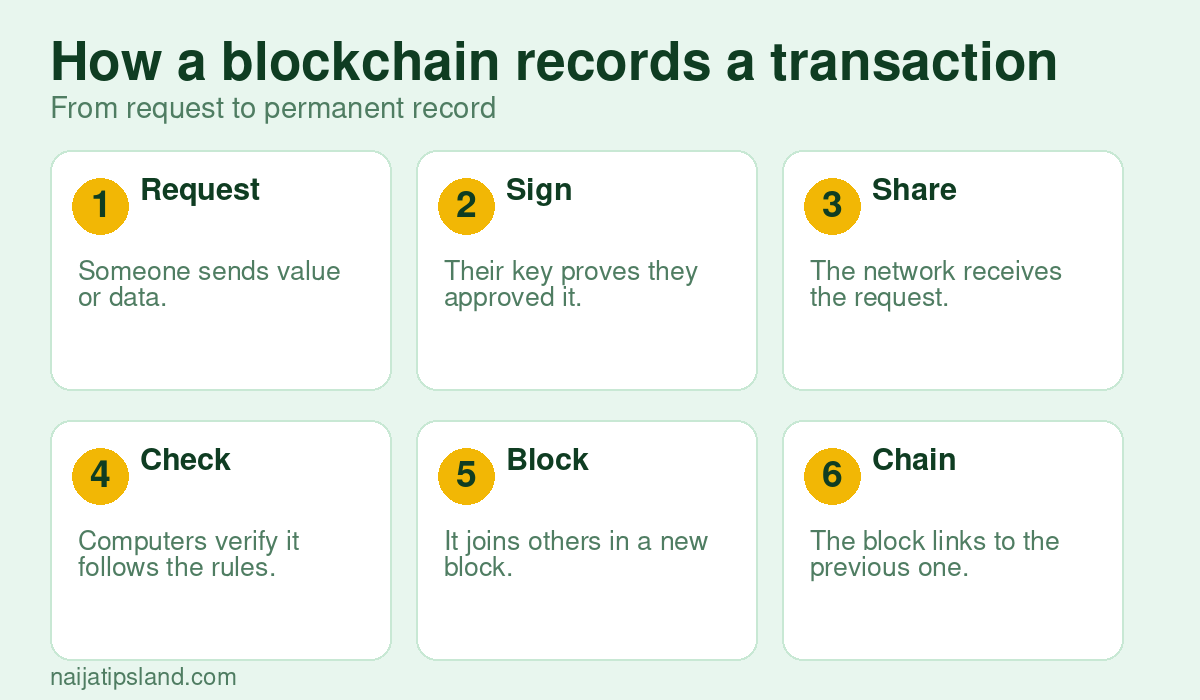
- Proof of stake: used by Ethereum since September 2022. Validators lock up coins as a guarantee of honesty. The Ethereum Foundation said the switch cut the network’s energy use by about 99.95%. An earlier version of this page said 95%, which understated the change.
Public blockchains such as Bitcoin and Ethereum are open to anyone. Private or permissioned blockchains are run by a defined group, for example banks or a government agency, and are closer to a shared database. The eNaira, for instance, runs on a private blockchain controlled by the CBN.
Smart contracts
A smart contract is a small program stored on a blockchain that runs automatically when its conditions are met. A simple example is an escrow: money is released to a seller only when a buyer confirms delivery, with no need for a middleman. Smart contracts can also contain bugs, and once deployed they can be hard to fix, so they should be tested and audited carefully.
Where Nigeria stands
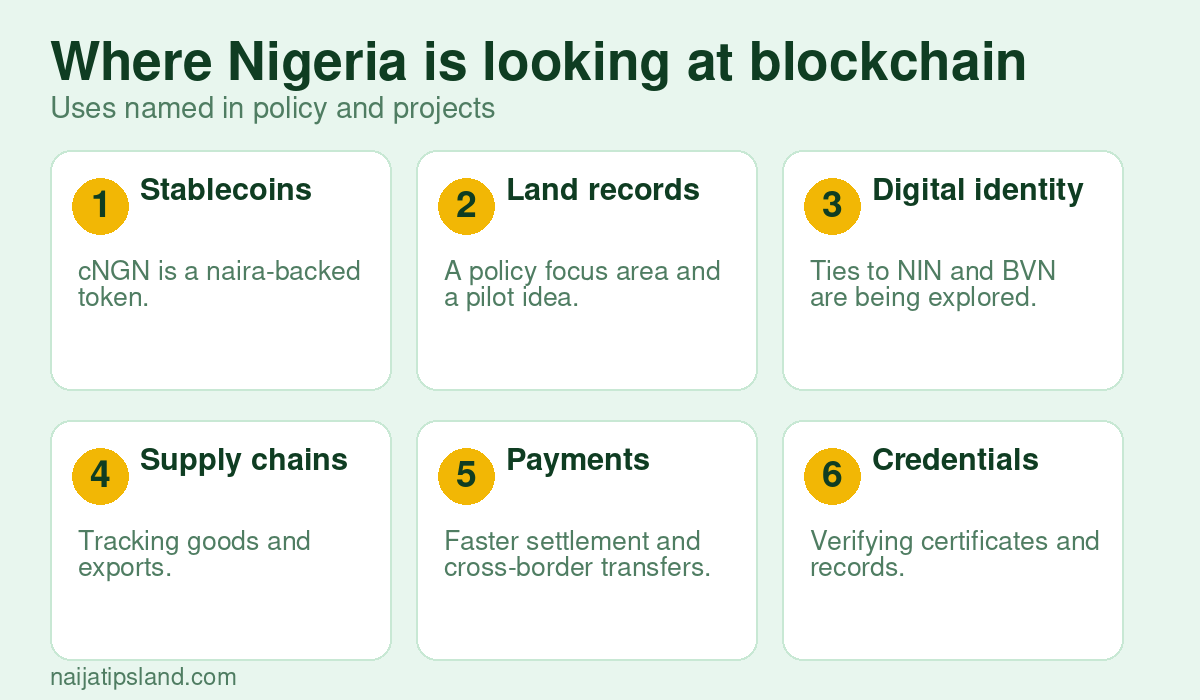
On 3 May 2023 the federal government approved a National Blockchain Policy. It lists five expected benefits: more transparency and accountability, greater efficiency in areas such as payments and supply chains, stronger security because of the decentralised design, financial inclusion and job creation. The areas it names for adoption include identity management, land registration and record systems, and supply chain services, and it commits the government to a framework for the safe use of cryptocurrencies. A steering committee was set up to implement it and was restructured in 2024, when NITDA’s director-general said the country was still at the development stage.
The most visible real-world use has been money. The cNGN, a stablecoin pegged one to one to the naira and backed by naira reserves held at licensed custodian banks, launched on 3 February 2025 and was reported to have around a billion tokens in circulation by December 2025. Its issuer, WrappedCBDC, was admitted to the SEC’s accelerated regulatory incubation programme on 2 July 2026, and the SEC says that approval in principle is not a final licence. Read our guides on digital currency and cryptocurrency for more.
Academics have also floated bigger ideas. A 2023 University of Hertfordshire white paper proposed a national blockchain nicknamed “Nigereum” and a pilot land registry in Lagos and the FCT built on an existing network such as Ethereum. These are proposals, not live systems.
The limits
- Infrastructure: reliable power and internet make a difference, and the National AI Strategy itself notes that Nigeria’s infrastructure is limited and unreliable. See our guide on responsible AI adoption.
- Cost and speed: some public chains are slow or expensive when busy.
- Garbage in, garbage out: a blockchain can prove a record has not changed, not that it was true to begin with. A forged land title written onto a chain is still forged.
- Privacy: public data is permanent, which must be reconciled with the Nigeria Data Protection Act 2023.
- Scams: the word “blockchain” is used to sell worthless schemes. See our guide on internet scams.
- Skills: developers and auditors are in short supply, which is why training programmes matter.
Do you really need a blockchain?
Often you do not. A normal database is faster and cheaper when one trusted organisation controls the data. A blockchain makes sense when several parties who do not fully trust each other need a shared record and no single one should be able to change it.
Learning and careers
Blockchain skills include programming smart contracts, security auditing, data analysis and compliance. See our guides on skills in demand and the digital skills checklist, and what fintech is.
Blockchain Versus an Ordinary Database
- Who controls it: a database has an owner who can edit or delete records. A public blockchain has no single owner, and records cannot be quietly changed.
- Speed and cost: databases are usually faster and cheaper, which is why banks, schools and shops mostly use them.
- Trust: a blockchain helps when the parties do not trust each other or a single middleman.
- Privacy: databases can hide or delete data. Public blockchains cannot erase what has been written.
Timeline: Blockchain Policy and Money in Nigeria
- 3 May 2023: the National Blockchain Policy is approved.
- May 2024: NITDA restructures the steering committee to review implementation.
- 3 February 2025: the cNGN stablecoin launches on a licensed exchange.
- March 2025: the Investments and Securities Act 2025 brings digital assets under the SEC.
- December 2025: cNGN passes about a billion tokens in circulation.
- 2 July 2026: the SEC grants the cNGN issuer approval in principle under its incubation programme.
Questions to Ask When Someone Pitches You a Blockchain Product
- What problem does it solve that a normal database cannot?
- Who runs the nodes, and who can change the rules?
- Is the company registered, and is the product regulated by the SEC or the CBN?
- Has the code been audited by an independent firm?
- Where does the money come from, and what happens if the token price falls?
- Are returns being guaranteed? If so, walk away.
A Short Glossary
- Node: a computer that holds a copy of the chain and checks new transactions.
- Hash: a fixed-length fingerprint of data. Changing the data changes the hash.
- Wallet: software or a device that stores your private keys.
- Token: a digital asset issued on a blockchain.
- Layer 2: a network built on top of a blockchain to make it faster or cheaper.
- Tokenisation: representing a real-world asset, such as property, as a token.
Frequently Asked Questions
Is blockchain the same as Bitcoin?
No. Bitcoin is a currency that uses a blockchain. The technology can be used for many other things.
Is blockchain unhackable?
The ledger itself is hard to alter, but the apps, wallets, exchanges and people around it can be hacked or tricked.
Is blockchain legal in Nigeria?
Yes. The government approved a National Blockchain Policy in 2023, while crypto-assets are regulated by the SEC.
What is a stablecoin?
A token designed to keep a steady value, such as the dollar or, in the case of cNGN, the naira.
Sources
- Mondaq: The Federal Government approves the blockchain policy for Nigeria
- Cointelegraph: NITDA restructures the National Blockchain Policy Steering Committee
- University of Hertfordshire: A Blockchain for Nigeria
- TechCrunch: Ethereum switches to proof-of-stake after the Merge
- Reuters via Business Standard: Ethereum slashes energy use with the Merge
- S&P Global: cNGN could intensify payment competition in Nigeria
- TechCabal: Inside WrappedCBDC’s plan to turn the naira into a high-speed digital rail
- DIA: cNGN issuer and SEC circular of 2 July 2026
Join the discussion
Have you tried this, or do you have a question we did not answer? Be the first to share your experience. Leave a comment below. Every comment is read by the editor before it appears.