


Government-backed programs like iDICE and BOI, catalytic grants, and local venture capital firms are the fastest, most reliable funding routes for Nigerian founders right now. Students and idea-stage builders should start with the S-VCG or a NITDA hub grant. Pre-seed founders should chase catalytic grants or local seed funds. Revenue-generating startups get more traction with venture debt or commercial paper than with a priced equity round.
TL;DR:
- Grants are ideal for pre-revenue startups needing validation, with amounts ranging from hundreds of thousands to six figures, and no equity loss.
- Catalytic and quasi-equity funding are early-stage options tied to product milestones, often used before traditional venture capital checks.
- Local Nigerian fund managers, startup hubs, and syndicates are the most accessible and active sources of investment, especially in seed and pre-seed stages.
- Most funding paths involve applying to programs like iDICE, BOI, or NITDA hubs, with application windows that are short and fast-moving.
- Revenue-generating startups increasingly prefer venture debt or commercial paper to fund growth while maintaining ownership.
Table of Contents
- What Are the Main Startup Funding Options in Nigeria?
- What Are Nigeria’s Major Startup Funding Programs?
- Where Do You Find Investors, Hubs, and Accelerators in Nigeria?
- How Do You Prepare to Raise Startup Funding in Nigeria?
- What Funding Timeline Should Nigerian Founders Expect?
- Naijatipsland’s Take: Prioritize Fit Over Headlines in 2026
- Where to Verify Startup Funding Programs and Data
- Sources
What Are the Main Startup Funding Options in Nigeria?
Nigerian founders have several capital routes, each fitting different business stages rather than founder personality.
Grants are non-dilutive cash, usually tied to a milestone or a cohort. They range from a few hundred thousand naira for student programs to six-figure dollar amounts for federal initiatives like iDICE’s Growth Lab. You give up nothing but time and reporting requirements, which makes grants the best first move for anyone without traction yet.
Catalytic or quasi-equity capital sits between a grant and an investment. A fund puts in early money, often convertible or revenue-linked, betting on a startup before it has enough data for a normal VC check. Programs modeled on vehicles like Cascador use this structure deliberately, tying disbursement to product milestones rather than a fixed valuation.
Equity financing comes from angel investors and venture capital firms in exchange for shares. Nigerian pre-seed rounds typically fall between $50,000 and $250,000; seed rounds often stretch past $500,000 when a local fund co-invests with a foreign lead.
Debt and commercial paper now serve revenue-generating businesses at scale once considered unusual for Nigerian startups, letting founders raise working capital without diluting ownership.
Corporate strategic investment comes from banks, telecoms, or conglomerates seeking a distribution partner rather than just financial return.
- Grants: best for pre-revenue, high validation need
- Equity: best for scalable models needing growth capital
- Debt: best for startups with predictable revenue
What Are Nigeria’s Major Startup Funding Programs?
Four public initiatives dominate the funding conversation in Nigeria, and founders who ignore them are leaving money on the table.
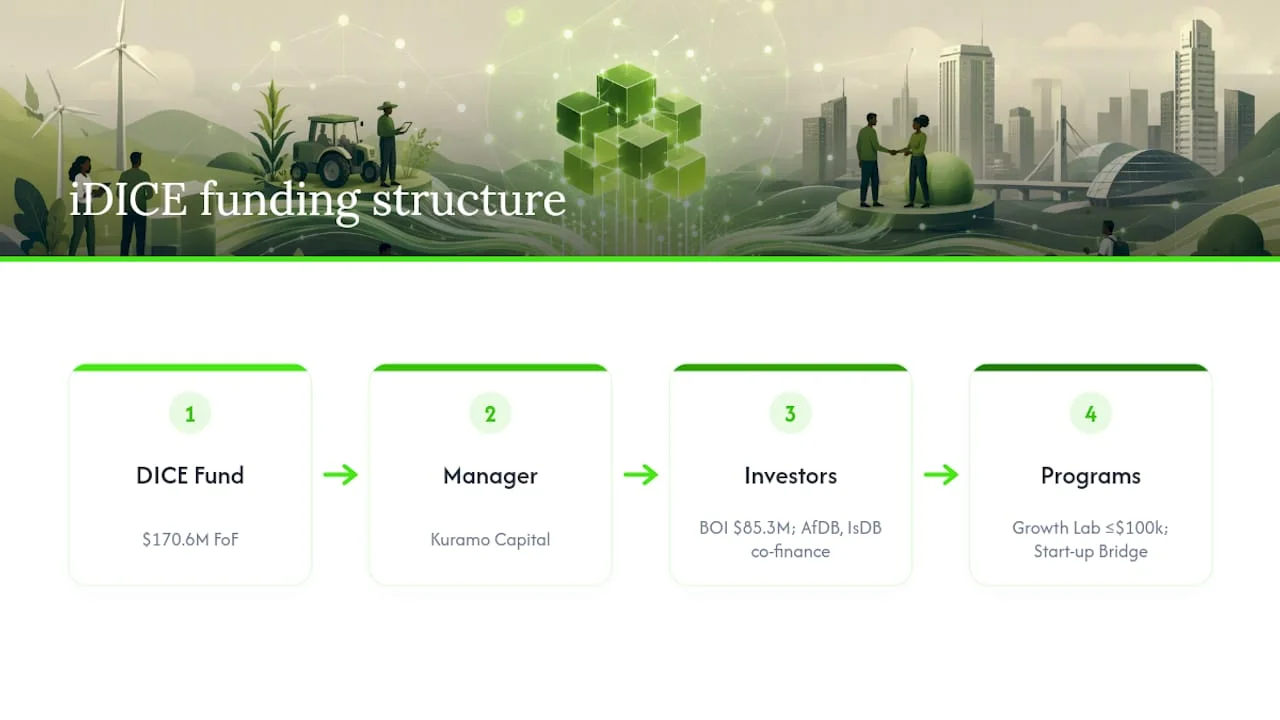
iDICE, the Investment in Digital and Creative Enterprises program, anchors a $170.6 million DICE Fund of Funds managed by Kuramo Capital, with the Bank of Industry committing $85.3 million as anchor investor. Its Growth Lab cohort can offer equity funding up to $100,000 per startup, while the Start-up Bridge track supports earlier-stage founders moving toward investment readiness. Development financiers including the African Development Bank and IsDB co-finance pieces of this pipeline.
Bank of Industry (BOI) runs its own debt facilities and sector-specific loan windows outside the iDICE structure, aimed at manufacturing, agribusiness, and creative-sector SMEs that need working capital rather than equity.
Startup Nigeria functions as the federal registration and incentive framework, giving qualifying startups tax breaks and formal recognition that many investors treat as a diligence shortcut.
The Student Venture Capital Grant (S-VCG) is a national program offering funding and validation support specifically for student-led businesses, with recurring application windows tied to the academic calendar.
NITDA’s Information Technology Hubs run incubation and capacity-building programs across the country, often channeling founders toward hub-linked grant and application support that never gets widely advertised.
Watch each program’s own page directly. Application windows open and close fast, and cohort slots fill before most news outlets even cover the announcement.
Where Do You Find Investors, Hubs, and Accelerators in Nigeria?
Most founders search for money in the wrong order. Start local, not global.
- Map local fund managers first. More than half of the fund managers deploying capital in Nigeria are locally headquartered, and 71% of those local managers focus specifically on venture capital. That means the fund most likely to say yes is probably based in Lagos, not London.
- Study active syndicate players. Firms like Ventures Platform and Ingressive Capital regularly co-invest in seed and pre-seed rounds, often alongside corporate or DFI partners anchoring larger pooled vehicles.
- Use hard data before cold outreach. Platforms like Tracxn track funding history by sector and stage, letting you see which funds actually wrote checks in your category last quarter instead of guessing.
- Show up at hub demo days. NITDA-linked hubs and independent incubators run office hours and cohort demo days that produce far more warm introductions than a cold email ever will.
Pro Tip: Investors rarely fund a stranger’s inbox message. Join a hub cohort or accelerator program first. The warm introduction that follows is worth more than a perfectly written cold pitch.
How Do You Prepare to Raise Startup Funding in Nigeria?
Diligence in Nigeria moves faster when your paperwork is already done before an investor asks for it.
Build this dossier before you start pitching:
- A pitch deck with a clear problem, market size, and unit economics
- A 12 to 18 month financial plan with realistic burn and runway assumptions
- A clean cap table showing existing ownership and any prior convertible notes
- Certificate of incorporation and CAC filings in good standing
- KYC/AML documentation if you operate in fintech, payments, or lending
- Evidence of traction: signed customer contracts, revenue history, pilot partnerships, or regulatory permits where applicable
Match your ask to the right instrument. A grant application should emphasize social or economic impact and milestone delivery. A debt pitch should lead with cash flow predictability and collateral. An equity pitch should lead with growth rate and market size. Pitching a bank-style debt story to a venture fund, or vice versa, wastes everyone’s time and signals you have not done the homework.
What Funding Timeline Should Nigerian Founders Expect?
Three common paths show up repeatedly among funded founders in Nigeria.
- Student or idea stage. A founder applies to the S-VCG or a NITDA hub grant, spends three to six months validating the product inside a cohort, then uses that credibility to approach a local pre-seed fund within a year.
- Revenue-generating SME. Once monthly revenue stabilizes, founders increasingly turn to venture debt or commercial paper instead of an early priced round, preserving equity while funding inventory or expansion.
- High-growth tech startup. These founders build a syndicate of local VCs first, then bring in a foreign lead investor for larger checks once traction is proven. Funding activity is uneven month to month. One July 2026 snapshot showed disclosed funding fall to just $4.9 million across six deals, a reminder that timelines slip even for strong teams.
Naijatipsland’s Take: Prioritize Fit Over Headlines in 2026
Chasing a headline valuation is the wrong game in Nigeria right now. The founders making real progress are the ones matching their ask to their actual stage, whether that means a grant, a debt facility, or a modest seed round from a local fund manager who understands the market better than a foreign lead ever will.
Hubs and student programs are not consolation prizes. They are often the fastest, least dilutive path to your first real capital. Read our breakdown of Nigerian startup models that attracted investor attention, and follow our coverage of tech trends shaping Nigeria and Africa to spot where capital is actually flowing before the crowd catches on. Naijatipsland’s community keeps tracking these shifts as they happen, not months later.
— Naijatipsland
Where to Verify Startup Funding Programs and Data
Check these sources directly before applying or citing any figure in a pitch deck.
- Student Venture Capital Grant: official application portal and cohort deadlines for student founders.
- NITDA Information Technology Hubs: hub locations, incubation programs, and application support.
- BOI iDICE Fund announcement: fund structure, anchor investors, and program scale.
- AVCA Country Spotlight: Nigeria: fund manager data and local investor activity.
- Tracxn Nigeria startup data: funding totals, deal counts, and sector trends, updated regularly.
For ongoing coverage of Nigeria’s startup and tech ecosystem, including which sectors are pulling investor attention, follow Naijatipsland’s continuing reporting on fintech in Nigeria and the broader current affairs shaping the country in 2026.