Last updated: 30 October 2026 · By Naijatipsland Editorial Team · Editorial policy
Nigerians living abroad can open and run a Nigerian bank account without flying home. Several banks accept online or emailed applications, and a Non-Resident BVN (NRBVN) route lets you register for the Bank Verification Number remotely. This guide explains who qualifies, how to get your BVN from overseas, the documents banks ask for, how GTBank, UBA, FirstBank and Zenith differ, and how to choose. Checked 30 October 2026 against each bank’s official pages. Requirements change, so confirm with the bank before you pay for notarisation or courier. We are not a bank or financial adviser.
Can you open a Nigerian bank account from abroad?
Yes. The banks below all advertise diaspora or non-resident Nigerian (NRN) accounts. GTBank says its NRN service lets Nigerians open and operate an account from anywhere in the world, and UBA says the same for its diaspora account. FirstBank and Zenith also run dedicated diaspora desks. What changes from bank to bank is the paperwork, whether you need references, and how much of the process is online.
If you already hold a Nigerian account from before you left, ask the bank to convert it. FirstBank, for example, says existing customers can migrate to a diaspora account by updating foreign details and supplying a notarised ID and proof of address, with no conversion charge stated on its page.
Who qualifies?
The accounts are meant for non-resident Nigerians. GTBank says its NRBVN service is for Nigerians living abroad and people who are Nigerian by descent, meaning a parent holds Nigerian citizenship. UBA accepts a foreign passport if your place of birth or country of origin is Nigeria, backed by some form of Nigerian ID even if expired. Foreign investors with no Nigerian connection do not qualify under these products.
Step 1: Get your BVN from abroad
Your BVN links you to every Nigerian bank account, so sort it first. There are two routes.
- Remote NRBVN: GTBank describes the Non-Resident BVN platform, run with the Central Bank of Nigeria and NIBSS, as a way to enrol for a BVN and open a GTBank account in naira, dollars or euros without visiting Nigeria. You upload ID, biodata and KYC documents and complete a liveness check. GTBank states that once approved, the NRBVN is issued within 72 hours.
- In-person enrolment abroad: NIBSS lists enrolment centres run by partners such as Online Integrated Solutions (OIS), VFS Global and others. You book an appointment, print the slip and attend with a valid ID (driving licence or international passport), one passport photograph and the fee. Fees on the NIBSS page vary by centre, for example $45 at listed US centres, 30 pounds at the OIS London centre (card only) and 40 euros in Paris, Rome and The Hague. After enrolment you receive login details by email to link the BVN to your accounts on the NIBSS site.
Zenith notes that enrolment at its own offices outside Nigeria is free, while partner centres charge and need online booking. Already have a BVN? See our guide to checking your BVN and linking it to your accounts. For the wider picture of Nigerian IDs, read digital identity in Nigeria: NIN, BVN and how to keep them safe.

Step 2: Gather your documents
Lists differ slightly, but these items appear across the banks’ pages.
- Valid identification: a Nigerian international passport, driver’s licence, residence permit or work permit. UBA also accepts a foreign passport showing Nigerian birth plus another Nigerian ID.
- Proof of address abroad: UBA asks for a utility bill from the last two months or a bank statement from the last six months. Zenith asks for a notarised utility bill or stamped bank statement issued within three months.
- Proof of source of funds: UBA lists a recent payslip, work ID, a letter from your current banker or business registration documents if self-employed.
- BVN: FirstBank says you may open without one but must provide it as soon as possible to operate the account fully. Zenith lists the BVN among its required documents.
- References: GTBank asks for two reference forms from Nigerian current account holders. It says customers with a GTBank UK current account do not need references. Zenith requires two references for current accounts only.
Copies usually need to be certified. GTBank says documents can be certified as true copies by a notary public, a lawyer, the Nigerian embassy, a post office or GTBank staff, and that foreign IDs, statements and utility bills must be notarised or sighted by an embassy or bank officer.

Step 3: Choose a bank and apply
Follow this order to avoid wasted money:
- Decide the account type: a naira savings or current account, a dollar, pound or euro domiciliary account, or both. Our guide to a dollar account in Nigeria explains domiciliary accounts in detail.
- Download the form or start the online application on the bank’s own site, never through a link sent by a stranger.
- Prepare and certify your documents, then email or upload them to the diaspora desk named on the bank’s page.
- Complete any video or liveness check and supply referees if asked.
- Fund the account with the minimum deposit and activate internet banking.
- Make a small test transfer before moving larger sums.
Bank-by-bank comparison
GTBank (NRN service and NRBVN)
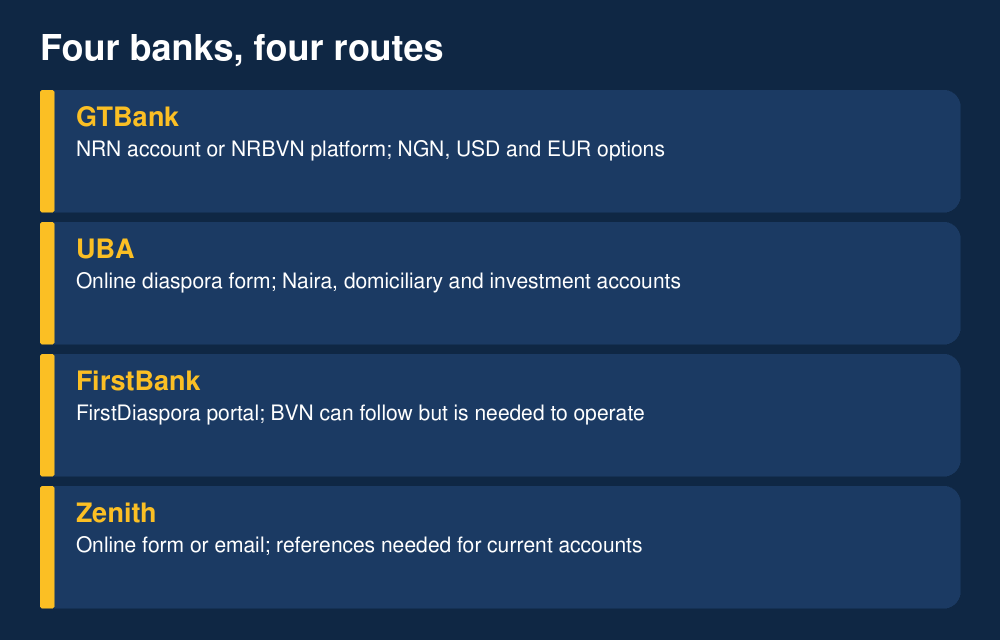
GTBank offers the NRN service for savings and current accounts, money market investment and e-banking, plus the NRBVN platform for remote BVN and account opening. The NRN page links forms for individual accounts, courier delivery of account items and a proxy pick-up form. Contact for NRN questions: nrnaccount@gtbank.com. Best for people who want a single remote route that covers both BVN and the account.
UBA Diaspora Account
UBA lists a non-resident naira account, a domiciliary account in USD, GBP and EUR, and an investment domiciliary account for eligible investments in Nigeria. Applications start on its online account-opening page. Best for people who want naira and foreign currency options under one diaspora product.
FirstBank FirstDiaspora
FirstBank runs a diaspora portal and says accounts can be opened online, with completed documents emailed to its diaspora banking team. It lists a minimum balance of 5,000 naira on diaspora savings accounts and says there is no limit on amounts transferred from abroad into FirstDiaspora accounts. Parts of its FAQ appear to be older, so check the current terms. Best for people who value a long-established bank and branch access when visiting Nigeria.
Zenith Bank Diaspora Banking
Zenith offers online opening or a downloadable form, interest on foreign currency balances, a dedicated relationship manager and a help desk. It publishes a note on the new tax Acts and Nigerians in the diaspora, which is worth reading if you hold investments. Best for people who want relationship-managed service.
Access Bank and others
Comparison site nairaCompare ranked Access Bank first among diaspora current accounts in a December 2025 article and listed monthly fees from about 750 to 1,500 naira across ten banks. That is a third-party summary, not a bank statement, and we did not verify Access Bank’s own page, so treat the figures as a starting point only.
How to pick the best bank for you
- You have no BVN and cannot visit a centre: start with the NRBVN route through GTBank.
- You need foreign currency to receive salary or rent: compare the domiciliary products at UBA and GTBank, and read our dollar virtual card guide if you also want a card.
- You will visit Nigeria often: choose a bank with branches near your family.
- You invest at home: ask about investment domiciliary accounts and the tax treatment before you move money. See treasury bills and fixed deposits in Nigeria.
- You send money to relatives: compare charges first using our bank transfer charges guide.
Costs to expect
Budget for notarisation or certification, courier fees for originals if the bank requests them, BVN enrolment if you use a partner centre, any minimum opening deposit and monthly maintenance or card fees. Charges differ by bank and change, so ask for the current fee schedule in writing before applying.
Stay safe
- GTBank warns of fake sites posing as the bank. Type the bank’s address yourself and never share passwords, tokens or card PINs.
- Send documents only to the diaspora email address shown on the bank’s own website.
- Confirm that any bank or fintech is licensed using our guide to checking a bank or fintech licence.
- If a card or account is compromised, follow our steps to block your ATM card or account immediately.
Common mistakes
- Uploading blurry scans or expired documents.
- Forgetting to certify copies, which delays approval.
- Using a name that differs between passport, BVN and bank form.
- Funding a large amount before a small test transfer succeeds.
- Assuming a rate or fee quoted on social media is current.
FAQ
Can I open a Nigerian bank account without visiting Nigeria?
Yes. The banks covered here advertise remote opening for non-resident Nigerians, though some steps such as certified documents or references may still apply.
Do I need a BVN to open a diaspora account?
Rules differ. FirstBank says you can open without one but must supply it soon to operate fully, while Zenith lists it among required documents. GTBank offers the NRBVN route to get one remotely.
How long does the NRBVN take?
GTBank states that, once documents are provided and approved, the NRBVN is issued within 72 hours.
Can someone born abroad to a Nigerian parent open an account?
GTBank says its NRBVN service covers people who are Nigerian by descent, meaning either parent is a Nigerian citizen. Confirm with the bank for your exact case.
Is a diaspora account the same as a domiciliary account?
Not exactly. A diaspora account is for non-resident customers and can be in naira or foreign currency. A domiciliary account holds foreign currency and can also be opened by residents.
Bottom line
Sort your BVN first, choose the account type you need, certify your documents and apply only through the bank’s official channels. GTBank is the most obvious starting point if you need a remote BVN, while UBA, FirstBank and Zenith offer strong alternatives. Compare current fees, start small and keep copies of everything you submit. If you are also planning your move or family finances, our guides on the cost of living in Nigeria and staying informed about Nigeria from abroad may help.