How to Open a Dollar Account Online in Nigeria (2026 Step-by-Step Guide)

Last updated: October 2026 | Reading time: 14 minutes | Written for Nigerians who earn, spend, save or study in dollars
If you want to learn how to open a dollar account online in Nigeria, here is the short answer: you can do it in one of three ways. You can open a traditional domiciliary account with a Nigerian bank (some banks let you start online, but many still need a branch visit to finish), you can sign up for a virtual USD account with a licensed fintech such as Grey, Payoneer, Geegpay or Raenest in a few minutes from your phone, or you can use a bank’s mobile app if your bank already knows you as a customer.
The right choice depends on what you want the account for. A freelancer collecting payments from US clients needs something different from a parent saving for tuition or an importer paying suppliers.
This guide walks you through every route, with the documents you need, step-by-step instructions, a comparison table, a breakdown of fees, a list of banks, and the mistakes that get applications rejected. It also covers the new 2026 foreign exchange rules from the Central Bank of Nigeria (CBN), which changed how dollar accounts work.
Important: Bank requirements, fees and fintech features change often. Always confirm current terms on the provider’s official website or app before you deposit money. Nothing here is financial advice.
What Is a Dollar Account in Nigeria?
A dollar account is a bank account that holds US dollars instead of naira. In Nigerian banking, the formal name is a domiciliary account, often shortened to “dom account.” It lets you receive, hold and spend foreign currency. Nairametrics explains that a domiciliary account works much like a normal account, except that it handles foreign currency payments.
Domiciliary accounts can usually be opened as savings or current accounts, and many banks also offer pound and euro versions. Most banks that offer them issue a foreign-currency debit card linked to the account.
There is also a newer category: virtual USD accounts. These give you US bank details (account number and routing number) so that clients abroad can pay you as though you had an American account. They are offered by fintech companies, not always by banks, and they work differently from a bank-issued dom account. More on that below.
Why people want a dollar account
- Receive international payments from clients, employers, platforms and family abroad.
- Protect savings against naira volatility.
- Pay for foreign services such as software subscriptions, online courses, visas and tuition.
- Shop online on global stores that charge in dollars.
- Run an import or export business without converting money repeatedly.
Can You Really Open a Dollar Account Online in Nigeria?
Yes, but it depends on which kind of account you mean, so it is worth being honest about the options.
Fully online (minutes to a day or two): Virtual USD accounts from fintechs. You sign up with your phone number and email, verify your identity with your BVN and often your NIN plus a selfie, and you get your dollar details after approval.
Partly online (online start, branch to finish): Many traditional banks let you begin online. Some let you download the form from their website and fill it in beforehand, then submit it at a branch. A guide from Condia notes that several banks, including UBA, have offered an online application route linked to your BVN, while others such as Zenith direct you to download an account form. Because banks change these processes regularly, check the bank’s own website for what is currently available.
Existing customers: If you already have a naira account with a bank, you can often request a dom account through the mobile app or internet banking, which is usually the fastest bank-based route because your KYC is already on file.
So when you read “open a dollar account online in Nigeria,” understand that online means different things. The key difference is who holds your money: a CBN-licensed bank or a fintech, and who regulates and insures it.
Why 2026 Is a Good Time: The New CBN Foreign Exchange Rules
The Central Bank of Nigeria released the Fourth Edition of its Foreign Exchange Manual, effective 1 June 2026, replacing the 2018 version. According to a legal summary on Mondaq, the new manual removes the Form A requirement for outward remittances from self-funded domiciliary accounts and lifts the cap on tuition remittances to up to USD 25,000 per semester (up from USD 15,000 under the old rules).
Other reported changes that matter to ordinary account holders:
- Individuals can use the foreign currency in ordinary domiciliary accounts without prior CBN approval, and can make telegraphic transfers of up to $10,000 per day, provided the bank records the purpose of the transaction, according to a summary reported by Aboki Forex.
- People opening or funding domiciliary accounts are reportedly not required to disclose the source of foreign currency deposits, per ng’s report.
- Export proceeds accounts are treated more strictly: transactions need supporting documents and cash withdrawals are not allowed. If you are an exporter, speak to your bank before choosing an account type.
- The definition of “Authorised Dealer” has widened to include other CBN-licensed financial institutions, which could extend foreign exchange dealing to more fintechs, according to Afriwise.
You can read the primary source on the Central Bank of Nigeria website. If the details affect a large transaction, ask your bank to confirm how the 2026 manual applies to you.
Documents and Requirements to Open a Dollar Account
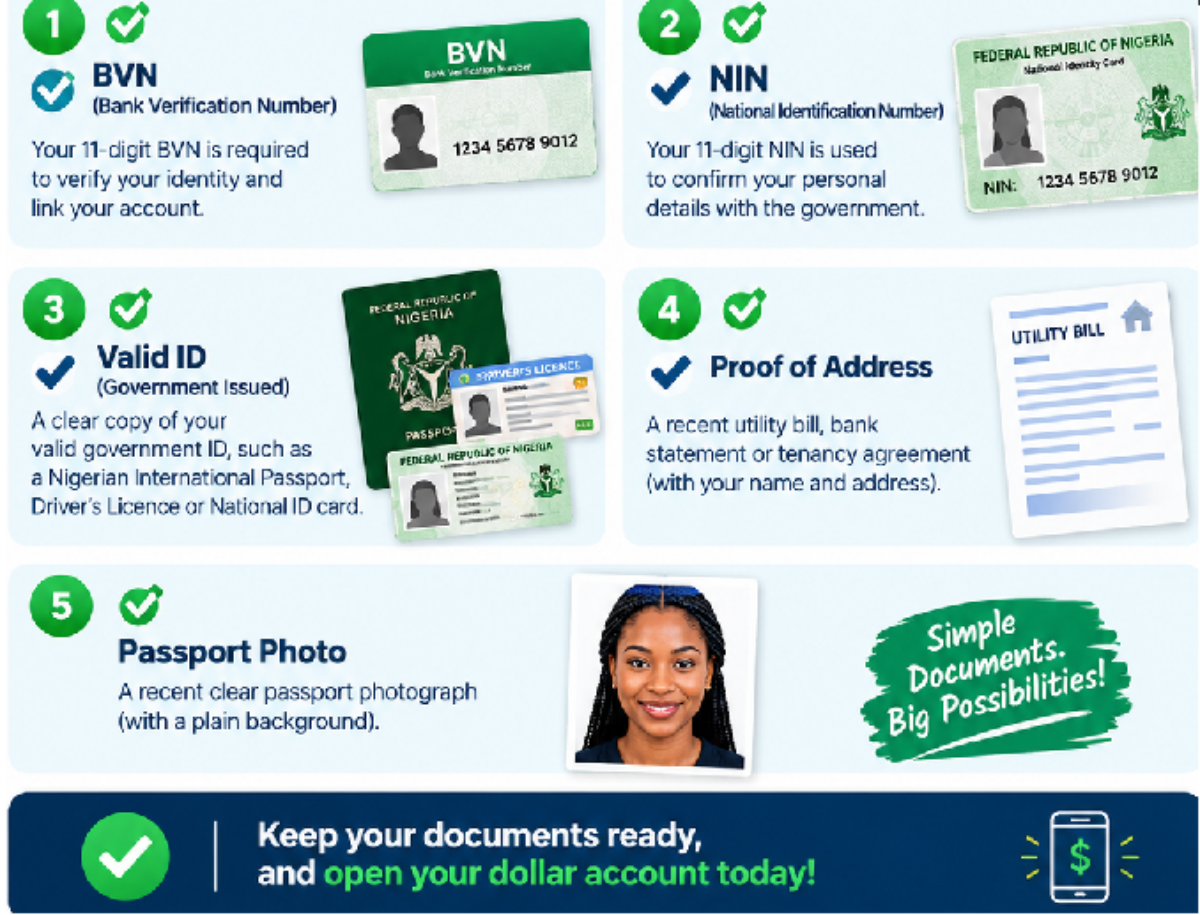
Requirements vary slightly between banks, but they are broadly similar. Expect to provide:
- Bank Verification Number (BVN). Issued through the Nigeria Inter-Bank Settlement System (NIBSS). Dial 5650# on the phone number linked to your BVN to retrieve it.
- National Identification Number (NIN). Issued by the National Identity Management Commission (NIMC). Many providers now require it.
- A valid government-issued ID. International passport, driver’s licence, national ID card or voter’s card.
- Passport photograph(s). Online applications use a live selfie instead.
- Proof of address. A recent utility bill, tenancy agreement or bank statement, usually dated within the last three months.
- Completed account opening form. Some banks let you download it from their website.
- An existing naira account with the bank. Many banks insist on this for dom accounts.
- Referees (for some current-type accounts). Some banks ask for two references from people with current accounts. A savings-type dom account often has lighter documentation, so ask whether one is available.
- Initial deposit. Most banks ask for a minimum opening deposit, commonly around $50 (or the euro or pound equivalent), although this varies by bank and account type.
For fintech virtual accounts, you typically need only your BVN, NIN, a selfie, email, phone number and sometimes proof of address.
How to Open a Dollar Account With a Nigerian Bank (Step by Step)
This is the route to choose if you want a CBN-regulated, bank-held account with a foreign-currency card and the legal standing of a traditional bank product.
Step 1: Decide which type of account you need
Choose between a savings dom account (simpler, good for personal use and saving) and a current dom account (better for business, frequent transactions or cheque use, often with stricter referee rules). If you receive money from foreign clients or want to pay suppliers abroad, ask which type handles incoming SWIFT payments with the lowest charges.
Step 2: Choose a bank
Compare at least three banks on minimum opening deposit, account maintenance charges, incoming and outgoing transfer fees, card availability, and how much of the process you can finish online. See the bank list later in this guide.
Step 3: Gather your documents
Use the checklist above. Scan your ID and proof of address as clear PDFs or photos in case the bank’s website or app asks for uploads.
Step 4: Start the application online
Visit the bank’s official website or app and look for “Open an account,” “Domiciliary account” or “Foreign currency account.” Depending on the bank you will either:
- Apply directly online by entering your BVN, personal details and uploading documents (for example, UBA has offered an online option linked to BVN), or
- Download the domiciliary account form from the website, complete it, and take it to a branch. GTBank, First Bank and Zenith have been among the banks that make forms available this way.
Only use the bank’s official website or verified mobile app. Fraudsters create fake account-opening pages, so type the URL directly instead of clicking links in messages or ads.
Step 5: Submit referees (if required)
If you chose a current-type account, line up your referees early. Delays here are the number one reason dom account openings drag on for weeks.
Step 6: Complete verification
The bank verifies your BVN and NIN, checks your documents and may ask you to visit a branch for biometric capture or a signature card. Even “online” applications sometimes require this final in-person step, so check before you set aside a day.
Step 7: Make your initial deposit
Fund the account with the minimum amount. You can usually do this by depositing cash or foreign currency at a branch, by transferring from another dollar account, or by receiving a foreign transfer. Some banks will convert naira to dollars to fund the opening deposit, subject to their rates and policies.
Step 8: Get your account number and activate digital banking
Once approved, you get a dollar account number. Register for the mobile app and internet banking, and ask about a dollar debit card.
Step 9: Test with a small transaction
Before you give your account details to a client or send a large amount, make a small test transaction. Check the received amount, any intermediary bank charges and the time it takes.
Typical timeline: one to three working days for simple applications, and one to three weeks when referees, form issues or branch capacity cause delays.
How to Open a Virtual USD Account With a Fintech (Step by Step)
Virtual USD accounts are the fastest way to get dollar payment details. They are popular with freelancers, remote workers, content creators and online sellers.
Platforms commonly used in Nigeria include Grey, Payoneer, Geegpay and Raenest. Features, fees and availability differ and change, so compare current terms.
Step 1: Pick a platform
Compare supported currencies, who issues the account, withdrawal methods to naira, card options, fees and customer support. Read recent user reviews, and check whether the platform names its licensed banking or payment partners.
Step 2: Download the app or visit the website
Use only the official app store listing or the company’s official domain. Check the developer name and the number of downloads.
Step 3: Sign up
Enter your name, email address and phone number. Create a strong password and turn on two-factor authentication.
Step 4: Verify your identity (KYC)
Provide your BVN, NIN and a government ID, and take a selfie or liveness video. Some platforms ask for proof of address for higher limits.
Step 5: Request your USD account details
After approval, request your virtual USD account. You will usually see an account number, routing number (ACH or wire) and bank name. Some platforms provide details only after you reach a certain verification level.
Step 6: Add the details to your payment platforms
Share the details with clients, add them to freelance marketplaces or use them for receiving payroll and remittances. Confirm which transfer types (ACH, domestic wire, SWIFT) are supported, because not every payer can send to every account type.
Step 7: Withdraw or convert
When money arrives, you can hold it as dollars, convert to naira and withdraw to your Nigerian bank account, or spend with a virtual or physical card where offered. Check the exchange rate, spread and fees before every conversion.
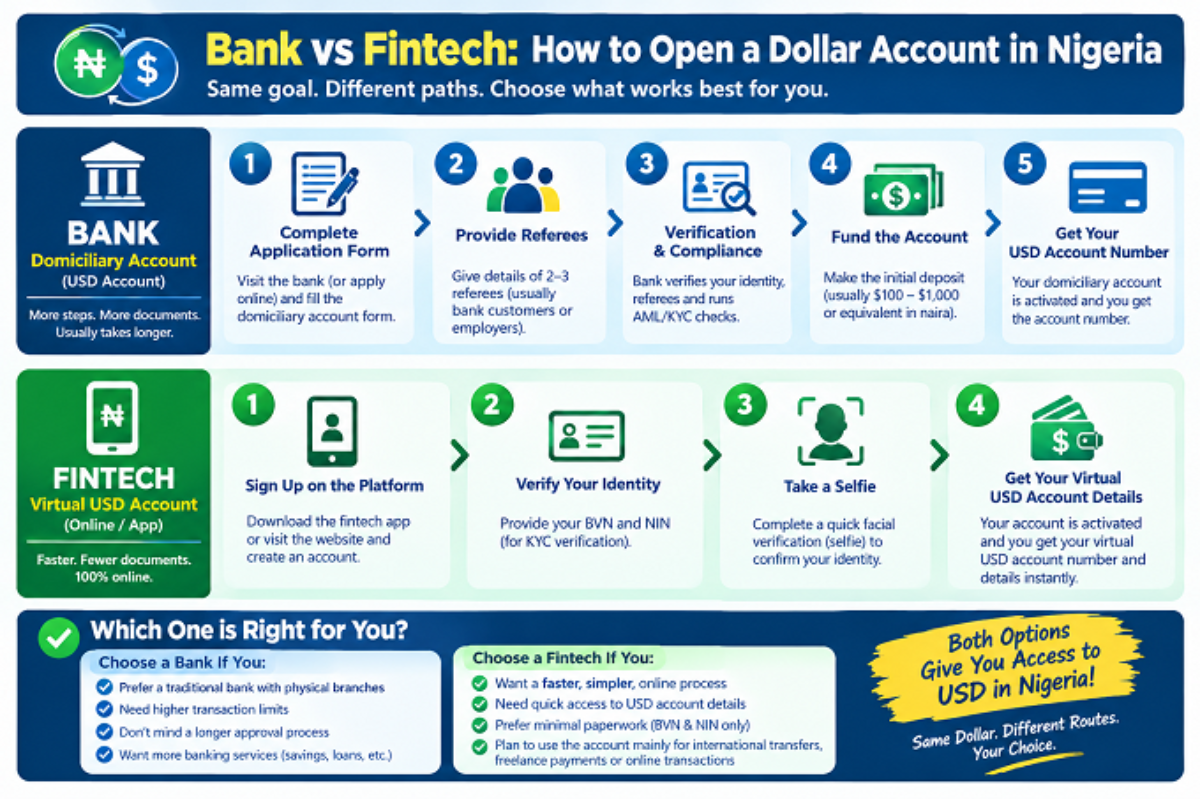
Bank vs Fintech: Comparison Table
| Feature | Traditional bank dom account | Fintech virtual USD account |
| Opening method | Online start, often branch to finish | Fully online |
| Speed | 1 day to 3 weeks | Minutes to a few days |
| Typical documents | BVN, NIN, ID, proof of address, form, sometimes referees | BVN, NIN, ID, selfie |
| Minimum opening deposit | Commonly around $50 (varies) | Often none |
| Regulation | CBN-licensed bank | Varies by provider and its partner institutions |
| Deposit insurance | Bank deposits may be covered by the NDIC within its limits | Generally not NDIC-insured; depends on the partner arrangement |
| Receiving US payments (ACH/wire) | Mainly SWIFT | Often ACH and wire via US account details |
| Foreign currency card | Often available | Virtual card common; physical card varies |
| Cash withdrawal in dollars | Restricted and varies | Generally not available |
| Best for | Savings, large transfers, tuition, formal business | Freelancers, quick payments, online spending |
A useful rule of thumb: use a bank dom account as your anchor for savings and larger or formal transactions, and add a fintech account if you need US-style payment details or faster setup. Many people use both.
Fees and Pricing: What to Expect
Because fees change, treat this section as a checklist of what to compare rather than a fixed price list. Always check the bank or platform’s current tariff.
Bank domiciliary account costs
- Opening deposit: commonly around $50 or equivalent, set by the bank.
- Account maintenance: some banks charge annual or monthly maintenance in dollars, while others waive it for savings-type accounts.
- Card charges: issuance, renewal and foreign-currency transaction fees.
- Incoming transfer charges: SWIFT payments can attract charges from intermediary banks as well as your own bank.
- Outgoing transfer charges: telegraphic transfer fees, plus possible correspondent bank fees.
- Conversion spread: the gap between the buy and sell rate if you convert dollars to naira.
Fintech virtual account costs
- Account opening: frequently free.
- Receiving fees: some platforms charge a percentage or flat fee per incoming payment.
- Conversion fees and spread: converting to naira usually carries a margin that matters more than headline fees.
- Withdrawal fees: to your Nigerian bank account.
- Card fees: creation, funding and decline fees for virtual cards.
- Inactivity or maintenance fees: check the fine print.
How to compare real cost
Simulate a typical month. If you receive $500 and convert it to naira, add up receiving fees, the exchange rate difference compared to the market, and withdrawal charges. The cheapest account on paper is not always the cheapest in practice.
Which Account Suits You?
Freelancers and remote workers: A fintech virtual USD account for quick onboarding and US-style payment details, plus a bank dom account for savings and formal records.
Students and parents paying tuition: A bank dom account is usually better. Under the 2026 manual, tuition remittances can go up to USD 25,000 per semester according to the Mondaq summary, though nursery to A-level programmes are reportedly excluded from official foreign exchange access.
Savers hedging against naira volatility: A bank dom account, because deposits at licensed banks may fall under NDIC coverage, subject to its limits. Confirm what applies to dollar deposits with your bank.
Small online sellers: A fintech account with a virtual card makes it easier to pay for ads, tools and platforms in dollars.
Importers and exporters: A bank-based account. Exporters should ask specifically about export proceeds accounts, which face stricter documentation under the 2026 rules.
List of Nigerian Banks Offering Dollar Accounts
Most Nigerian commercial banks offer domiciliary accounts. Banks commonly mentioned in comparison guides include:
- GTBank (Guaranty Trust Bank)
- Zenith Bank
- United Bank for Africa (UBA)
- First Bank of Nigeria
- Access Bank
- Sterling Bank
- Union Bank
- Ecobank Nigeria
A Grey comparison of Nigerian banks lists minimum deposits and features for popular options. Remember that Grey also sells a competing product, so cross-check with each bank’s own page.
How to choose between banks:
- If you already bank with one of them, start there. Existing KYC makes approval faster.
- Pick the bank with the most flexible online process if you live far from a branch.
- Compare card availability and incoming transfer charges.
- Ask whether they offer a savings-type dom account with fewer referee requirements.
How to Fund and Withdraw From Your Dollar Account
Funding options
- Foreign transfers (SWIFT/wire) from clients, relatives or your overseas accounts.
- Transfer from another dollar account in Nigeria.
- Cash deposit of foreign currency at a branch, subject to bank policy.
- Naira-to-dollar purchase through your bank, at the bank’s rate and subject to availability.
- Fintech platforms that let you send converted funds to a linked dollar account.
Withdrawal and spending options
- Sell to naira at your bank or via a fintech platform, and credit your naira account.
- Spend with a dollar card online or abroad.
- Send abroad by telegraphic transfer. Per reports on the 2026 manual, self-funded dom account holders can send up to $10,000 per day, with the purpose recorded.
- Cash dollar withdrawals depend on the bank’s policy and available cash, so ask before you rely on this.
Common Mistakes and Why Applications Get Rejected
- BVN and NIN name mismatch. A spelling difference between your ID, BVN and NIN is the most common cause of failed verification. Fix the mismatch first through your bank or NIMC.
- Blurry or expired documents. Upload clear, current scans.
- Old proof of address. Use a document dated within the last three months.
- No naira account or no referees. Check these requirements before you apply.
- Using the wrong account type. A current dom account may demand more paperwork than you need.
- Not reading the fee schedule. Maintenance and conversion charges add up quietly.
- Giving out details before testing. Always run a small test payment first.
- Using unofficial agents. Anyone who promises a guaranteed account for a fee, or asks for your login details, is a red flag.
How to Stay Safe From Scams
- Open accounts only through official websites and verified app store listings.
- Never share your OTP, PIN, password or full card details with anyone, including “support agents” who contact you first.
- Be wary of platforms promising unusually high dollar returns or rates far better than the market.
- Enable two-factor authentication and use a unique password.
- Confirm that a provider is licensed or partnered with a licensed institution on the CBN website before depositing large sums.
- Keep screenshots and records of every transaction.
Final Checklist
- ☐ Decide what you need the account for (receiving, saving, spending, paying abroad)
- ☐ Confirm your BVN and NIN match your ID
- ☐ Shortlist two banks and one fintech and compare fees
- ☐ Gather ID, proof of address, passport photo and any referees
- ☐ Apply through the official website or app
- ☐ Make your opening deposit and activate digital banking
- ☐ Send and receive a small test transaction
- ☐ Review fees after your first month
Conclusion
Learning how to open a dollar account online in Nigeria is easier now than it has ever been. If you want speed and US-style payment details, a virtual USD account can be live in minutes. If you want a bank-held account for savings, tuition and larger transfers, a domiciliary account is the stronger foundation, and the 2026 CBN rules make it more flexible to use. For many people the best answer is a combination of both.
Start by deciding the purpose of the account, compare current fees on official websites, and test with a small transaction before you move real money.
Disclaimer: This article is for general information only and is not financial, legal or tax advice. Rules, fees and product features change, so verify details with your bank or provider.
FAQ
- How do I open a dollar account online in Nigeria? Choose a provider, then apply on its website or app with your BVN, NIN, ID and proof of address. Fintech virtual USD accounts can often be opened fully online in minutes. Traditional bank domiciliary accounts may start online but sometimes need a branch visit for final verification.
- What is a domiciliary account? A domiciliary account is a bank account that holds foreign currency such as US dollars, pounds or euros. It lets you receive, hold and spend money in that currency, and can usually be opened as a savings or current account.
- What documents do I need to open a dollar account in Nigeria? You typically need your BVN, NIN, a valid government ID, a passport photograph or selfie, proof of address and a completed form. Some banks also ask for an existing naira account and referees for current-type accounts.
- What is the minimum deposit for a dollar account in Nigeria? Many banks ask for a minimum opening deposit of around $50 or the equivalent, but this varies by bank and account type. Many fintech virtual USD accounts have no opening deposit. Confirm the current figure with your provider.
- Can I open a dollar account without a referee? Sometimes. Savings-type domiciliary accounts often have lighter requirements than current-type accounts, which commonly ask for two referees. Fintech virtual accounts usually need none. Ask your bank which account types waive referees.
- Can I open a dollar account with just my phone? Yes, with a fintech virtual USD account: you verify with your BVN, NIN and a selfie in the app. For a bank domiciliary account you can usually begin on your phone, but some banks still require a branch visit.
- Is a virtual dollar account the same as a domiciliary account? No. A domiciliary account is held in a licensed Nigerian bank. A virtual USD account is offered by a fintech and gives you US-style payment details. They differ in regulation, insurance, fees and usage, so read the provider’s terms.
- How long does it take to open a dollar account in Nigeria? Fintech virtual accounts can take minutes to a few days. Bank domiciliary accounts typically take one to three working days if documents are complete, and longer if referees, form errors or verification delays occur.
- How much does it cost to open a dollar account in Nigeria? Opening is often free or needs a small minimum deposit, but ongoing costs vary. Compare maintenance fees, card fees, incoming and outgoing transfer charges and the exchange rate spread when you convert dollars to naira.
- What are the new CBN rules for domiciliary accounts in 2026? The CBN’s Foreign Exchange Manual, effective 1 June 2026, reportedly removes Form A for outward remittances from self-funded domiciliary accounts and allows daily telegraphic transfers of up to $10,000 with the purpose recorded. Export proceeds accounts face stricter rules. Confirm details with your bank.
- Which bank is best for a dollar account in Nigeria? There is no single best bank. Compare minimum deposit, fees, card options, the online process and branch access. If you already bank with a major Nigerian bank, starting there is often quickest because your details are already verified.
- Is my money safe in a dollar account? Deposits in licensed banks may fall under NDIC coverage, within its limits. Fintech virtual accounts are not always covered the same way. Use licensed providers, turn on two-factor authentication and never share OTPs or passwords.
- Can I withdraw dollars in cash from my domiciliary account? It depends on the bank’s policy and cash availability. Many banks prefer transfers, card payments or conversion to naira. Ask your bank about cash limits and fees before relying on cash withdrawals.
- Can students and freelancers open a dollar account? Yes. Students often use bank dom accounts for tuition payments, while freelancers commonly use fintech virtual USD accounts to receive client payments. Both need valid ID, a BVN and a NIN.
- Why was my dollar account application rejected? Common causes are mismatched names across your BVN, NIN and ID, expired or blurry documents, outdated proof of address, missing referees or an incomplete form. Fix the mismatch, upload clear documents and reapply or contact support.