Last updated: 14 October 2026. Banks set their own opening deposits and fees, and these change, so treat the figures below as reported guidance and confirm with your bank before you go. The CBN’s Foreign Exchange Manual 2026 took effect on 1 June 2026.
Opening a domiciliary account: the short version
- What it is: a foreign-currency account at a Nigerian bank that can hold US dollars, pounds or euros.
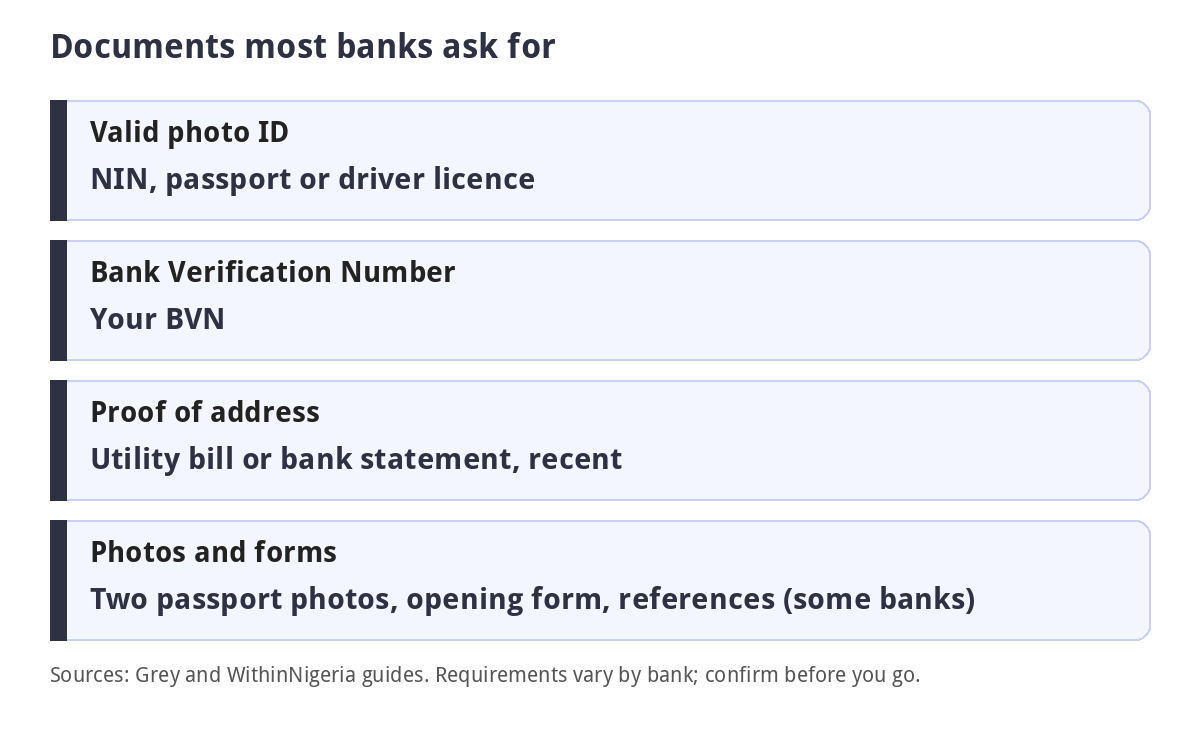
- Documents: a valid photo ID (NIN, passport or driver’s licence), your BVN, proof of address, two passport photos and the bank’s form. Some banks also ask for references or proof of source of funds.
- Opening deposit: often about US$50 to US$100, depending on the bank (reported figures below).
- Time: verification typically takes two to five business days.
- Fintech alternative: apps such as Grey, Geegpay and Cleva offer virtual USD accounts that open online in minutes, but they are not bank domiciliary accounts.
A domiciliary (dom) account lets you receive, hold and spend foreign currency without converting it to naira, which matters when the naira moves against the dollar. With the dollar trading at about ₦1,332 officially and about ₦1,373 on the street this week (see our weekly dollar to naira tracker), many Nigerians want a safe place to keep foreign income, remittances or savings. This guide explains how to open a dom account, what you need, what banks reportedly charge, how the 2026 CBN rules affect you, and when a fintech USD account is the better tool. For daily rates, see dollar to naira exchange rate today.
What is a domiciliary account?
A domiciliary account is a foreign-currency bank account operated by a Nigerian commercial bank. It can hold US dollars, British pounds or euros, and some banks offer other currencies. There are two main types: a savings dom account, used for personal remittances and foreign income, and a current dom account, usually for businesses and high-volume users. Your balance stays in the original currency unless you ask the bank to convert it.
It is different from a fintech virtual USD account. A bank dom account can receive SWIFT transfers when the bank supports the transaction and you give the right details, but it does not give you US routing and account numbers, so it cannot receive ACH payments. Fintech platforms such as Grey provide US account details for ACH and wire transfers, but describe themselves as technology companies, not banks.
Documents you need
- Valid photo ID: National ID (NIN), international passport or driver’s licence. Some banks also accept a voter’s card.
- Bank Verification Number (BVN).
- Proof of address: a recent utility bill (not older than three months) or a bank statement.
- Two recent passport photographs and the bank’s completed opening form.
- References: some traditional banks still ask for two reference forms from current account holders.
- Source of funds: some banks, such as UBA according to one guide, may ask for proof of where the money comes from.
- For a business account: certificate of incorporation, board resolution and tax identification number (TIN).
How to open a dom account step by step
- Choose a bank. Compare minimum opening deposits, fees and whether you can start online or must visit a branch.
- Gather your documents (above).
- Complete the opening form with your personal details and how you expect to use the account.
- Submit the form, ID, BVN, proof of address and photos through the bank’s app or website, or at a branch.
- Wait for verification. This typically takes two to five business days but can take longer.
- Receive your account details and instructions for receiving foreign-currency payments.
- Fund the account with the opening deposit if the bank requires one, then test it with a small incoming transfer.

Minimum opening deposits reported by banks
Published and reported figures differ, so check with the bank before you visit. The figures below come from two consumer guides and may be out of date.
| Bank | Reported minimum opening balance |
|---|---|
| Access Bank | US$100 (also £100 and €100 for pounds and euros), no monthly maintenance fee on the dom current account |
| First Bank | US$100, £50 or €100 per one guide; another says US$50 to US$100 depending on branch and account type |
| UBA (Dom Advantage) | US$50 per one guide |
| Zenith Bank | US$100 per one guide, with some branches reportedly offering zero-balance opening |
| GTBank | No mandatory opening balance reported for personal accounts, though US$50 to US$100 is typically expected |
One guide reports that GTBank charges about 0.05% on cash withdrawals and 0.5% on transfers, and Access Bank a 0.5% cash handling fee, with VAT on most fees. Treat these as indicative and ask your bank for its current fee schedule in writing.
What the CBN’s 2026 rules mean for you
The CBN’s Foreign Exchange Manual 2026 came into effect on 1 June 2026. According to summaries by law firms and Nigerian media:
- Self-funded dom accounts no longer need Form A for outward remittances.
- Telegraphic transfers of up to US$10,000 per day can be made without heavy trade documentation, and banks must report the purpose of the transaction to the CBN.
- Ordinary dom account holders are described as having “unfettered and unrestricted access” to their funds.
- Export proceeds accounts are treated differently: cash withdrawals from them are no longer permitted.
- Cash withdrawals of inbound transfers: one law-firm summary says these are capped at the naira equivalent of US$200 per transaction, while another guide says cash withdrawals of up to US$10,000 a day are allowed. Because these accounts disagree, ask your bank what cash limit applies to you.
One guide also reports a May 2026 directive requiring international money transfer operators to settle in naira, so remittances through these operators may no longer fund a dom account directly. Wire transfers from foreign banks and cash deposits are still reported as valid. We could not confirm this directive on a primary CBN document, so check with your bank.
How to fund and use a dom account
- Cash deposit: over the counter at your bank. Larger notes may get extra anti-money-laundering scrutiny.
- Wire transfer: from a foreign sender, using your account number and the bank’s SWIFT code. Ask the bank for the full details in writing, including any intermediary bank.
- Payoneer or Wise: compatibility depends on the bank, so confirm before you give the details to a client.
- Spending: some banks offer a dollar debit card, and you can make telegraphic transfers abroad.
- Converting to naira: the bank uses its own rate, which can differ from the official and the street rate. Compare with the rates on our weekly tracker.
Dom account or fintech USD account?

If you need to hold dollars in a licensed bank, withdraw foreign cash, pay for foreign trade or have deposit insurance, a bank dom account is the standard choice. One guide notes that bank dom accounts are covered by NDIC deposit insurance, while fintech accounts do not clearly share that protection. If you mainly receive payments from US clients or platforms, a fintech virtual USD account is often easier because it provides US account details and opens online. Grey, for instance, reports a receiving fee of 0.8% on ACH, SEPA or FPS payments (minimum US$2, maximum US$10) and free or low-cost conversion on some routes. Fees change, so check the provider’s current page. See also our comparison of fintech apps in Nigeria.
Need a card for online payments? See how to get a dollar virtual card in Nigeria.
Common mistakes and risks
- Giving your account details to someone who promises a “better rate” in return for your BVN or one-time codes.
- Assuming every bank accepts ACH or Payoneer transfers.
- Letting the account sit inactive. Under rules described in one guide, a current account with no customer-initiated transactions for a year and a savings account for two years can be classed as dormant, with possible inactivity fees.
- Ignoring the bank’s fee schedule, especially cash withdrawal and transfer charges.
Frequently asked questions
Can I open a domiciliary account with only a BVN and ID?
Most banks also want proof of address, passport photos and a completed form, and some ask for references or proof of source of funds.
How much do I need to open a dom account?
Reported minimums range from about US$50 to US$100, depending on the bank and branch. Some banks reportedly allow zero-balance opening.
Is it legal to hold dollars in Nigeria?
Yes. Holding foreign currency in a domiciliary account at a Nigerian bank is legal. Follow your bank’s rules and anti-money-laundering checks.
Can I withdraw dollars in cash?
It depends on the bank’s available cash and the limits that apply to your account. Reports about the 2026 limits differ, so ask your bank.
How long does it take to open a dom account?
Typically two to five business days after you submit complete documents.
Is a Grey or Geegpay account a domiciliary account?
No. These are fintech virtual USD accounts. They are useful for receiving US payments but are not bank domiciliary accounts.
Bottom line
Open a bank dom account if you want regulated, bank-held dollars with cash and SWIFT access. Pick a fintech USD account if you mainly receive payments from abroad and want a quick online setup. Either way, prepare your documents, ask for the fee schedule in writing, and confirm current rules with the bank, because limits and charges have been changing in 2026.
This guide is general information, not financial or legal advice. We are not a bank.
Sources: Grey, how to open a domiciliary account; WithinNigeria, guide to using a domiciliary account (5 Jun 2026); TheNigeriaLawyer, CBN grants domiciliary account holders unrestricted access (2 Jun 2026); Mondaq, CBN Foreign Exchange Manual 2026.