


TL;DR:
- Digital identity is a verified profile comprising attributes and credentials that represent individuals, devices, or organizations online. It enables access control, authentication, and federation across systems, influencing security, privacy, and user convenience. Managing and protecting this multi-faceted ecosystem through regular audits, strong authentication, and awareness is essential for safeguarding digital presence.
Digital identity is a verified digital profile that uniquely represents a person, device, or organization across online systems, used to confirm who or what is requesting access to a service. Every time you log into a banking app, register on a forum, or unlock a smartphone with your fingerprint, your digital identity is doing the work. NIST SP 800-63-4 defines the technical requirements governing how these identities are proofed, authenticated, and federated across information systems. Understanding digital identity is no longer optional. It shapes your security, your privacy, and your access to the digital world.
What is digital identity and what makes it up?
Digital identity is not a single password or username. IBM describes digital identity as a set of attributes tied to a user or device that enables access control, authentication, and authorization across systems. Think of it as your online fingerprint, made up of dozens of data points that together confirm you are who you claim to be.
There are three main types of digital identities you will encounter:
- Human digital identities: These belong to individual users. They include your name, email address, login credentials, behavioral patterns, and biometric data like facial recognition or fingerprints.
- Machine identities: Devices, applications, servers, and Internet of Things (IoT) sensors each carry their own digital identity. A hospital’s patient monitoring device, for example, has a machine identity that grants it access to specific data streams.
- Entity identities: Organizations, government agencies, and businesses also hold digital identities used to authenticate their systems and sign documents electronically.
The core building blocks of any digital identity are identifiers, attributes, and credentials. Identifiers are unique labels like an email address or National Identification Number (NIN). Attributes are descriptive data points such as your date of birth, job title, or location. Credentials are the proof you present, including passwords, one-time passcodes, digital certificates, or biometric verification.
All three elements work together inside Identity and Access Management (IAM) systems. IAM frameworks manage the full identity lifecycle, covering enrollment, authentication, authorization, auditing, and revocation. When you register on Naijatipsland, for instance, you create an identifier and set a credential. The platform’s IAM layer then uses those elements to control what you can see and do.

Pro Tip: Your digital identity exists across many platforms simultaneously. Audit your active accounts at least once a year and deactivate any you no longer use. Dormant accounts are a common entry point for unauthorized access.
How does digital identity actually work?
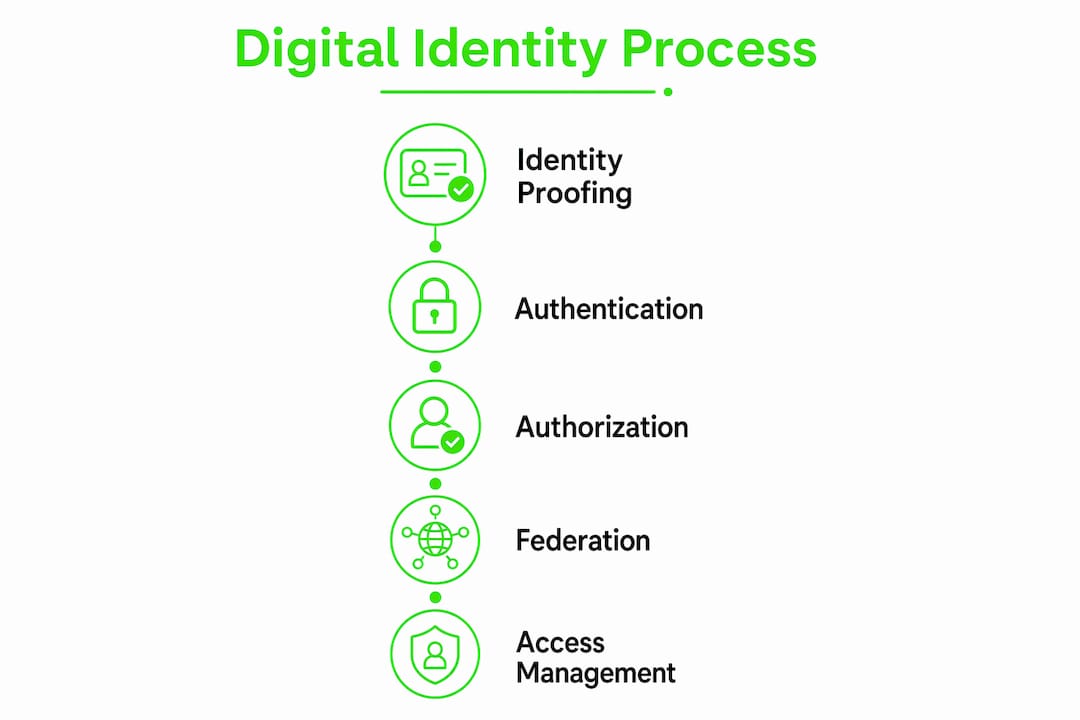
The technical process behind digital identity runs through three distinct phases: identity proofing, authentication, and federation. Each phase has a specific job, and confusing them is one of the most common mistakes people make when trying to understand this topic.
Entrust clarifies that identity proofing establishes who someone is, while authentication confirms that valid credentials are being used during an access attempt. These are separate processes with separate standards.
Here is how each phase works in practice:
| Phase | What it does | Real-world example |
|---|---|---|
| Identity proofing | Verifies the applicant’s real-world identity before issuing credentials | Uploading a government ID and selfie to open a bank account online |
| Authentication | Confirms that the credential presented matches the one on record | Entering a password plus a one-time SMS code to log in |
| Federation | Shares verified identity attributes across multiple services | Using a Google account to sign into a third-party app |
NIST SP 800-63A-4 details that identity proofing requires applicants to provide evidence to a Credential Service Provider (CSP) at defined Identity Assurance Levels (IAL). IAL1 requires no real-world identity verification. IAL2 requires remote or in-person evidence review. IAL3 requires in-person verification with a trained representative.
Authentication Assurance Levels (AAL) follow a similar structure. AAL1 accepts a single factor. AAL2 requires multi-factor authentication. AAL3 demands hardware-based cryptographic proof. The higher the risk of a transaction, the higher the assurance level required.
Federation, governed by NIST SP 800-63C-4, allows a verified identity from one system to be trusted by another through assertions. This is what makes single sign-on (SSO) possible. When you use your Facebook login to access a news site, a federation assertion carries your verified attributes from Facebook to that site without requiring a new registration.
Pro Tip: When evaluating any digital service that asks for identity verification, check which assurance level it operates at. A service claiming strong security but only requiring a username and password operates at AAL1, which offers minimal protection.
Why digital identity matters for security and privacy
Digital identity is the foundation of every cybersecurity control that protects your data and accounts. IAM systems enforce permissions and authentication policies based on verified digital identities, making them the first line of defense against unauthorized access and fraud.
The importance of digital identity shows up in four concrete ways:
- Access control: Your verified identity determines which systems, files, and services you can reach. Without it, there is no reliable way to separate authorized users from attackers.
- Fraud prevention: Banks, telecom providers, and e-commerce platforms use identity verification to detect account takeovers and synthetic identity fraud, where criminals combine real and fake data to create new identities.
- Privacy management: Your digital identity controls what data you share and with whom. Understanding it gives you the power to limit unnecessary data exposure. Naijatipsland’s guide on online privacy protection covers this in practical detail.
- User convenience: Technologies like digital wallets and SSO reduce friction by letting you authenticate once and access multiple services. The EU’s Digital Identity Wallet, governed by regulation CELEX 2026/798, sets “substantial” and “high” assurance levels for remote onboarding, showing how governments are formalizing these convenience tools.
“Digital identity forms the foundation for reliable authentication and authorization, making it critical for security and fraud prevention.” — IBM
The privacy dimension deserves special attention. Every service you register with collects attributes that become part of your digital identity. Over time, those attributes can be aggregated, sold, or exposed in a data breach. Knowing what data you have shared, and with which platforms, is the first step toward controlling your own digital presence. Your digital image shapes opportunities in ways that extend far beyond security, reaching into employment, credit access, and social reputation.
How to manage and protect your digital identity
Managing your digital identity means taking deliberate control of the data, credentials, and permissions that represent you online. Effective management focuses on data binding, assurance levels, and the attributes you share with services, not just the usernames you remember.
Follow these steps to take control:
- Map your digital footprint. List every platform where you have an active account. Include social media, banking apps, government portals, and community forums like Naijatipsland. This inventory is your starting point.
- Enable multi-factor authentication (MFA). MFA moves your accounts from AAL1 to AAL2 protection. Use an authenticator app like Google Authenticator or Microsoft Authenticator rather than SMS codes, which are vulnerable to SIM-swap attacks common in Nigeria.
- Use a password manager. Tools like Bitwarden or 1Password generate and store unique passwords for every account. Reusing passwords across platforms is one of the fastest ways to lose control of your digital identity.
- Review app permissions and privacy settings. Check what data each app accesses. Revoke permissions that are not necessary for the app’s core function.
- Understand the identity lifecycle. Your digital identity goes through onboarding, active use, and deprovisioning. When you stop using a service, formally delete your account rather than abandoning it. An abandoned account with your data still attached is a liability.
- Evaluate identity solutions carefully. When a service offers a digital ID wallet or verification tool, check its assurance level and binding method before trusting it with sensitive attributes.
Understanding registration in online communities is also part of identity management. Every registration creates a new node in your digital identity network, and each one carries risk if left unmanaged.
Pro Tip: Set a calendar reminder every six months to review your active accounts, update passwords, and check for any breach notifications using services like Have I Been Pwned. Consistent maintenance beats reactive damage control every time.
Key takeaways
Digital identity is a multi-layered ecosystem of identifiers, credentials, and attributes managed through IAM frameworks, and protecting it requires understanding both its technical structure and your own data footprint.
| Point | Details |
|---|---|
| Digital identity defined | A verified profile of attributes and credentials representing a person, device, or organization online. |
| Three core phases | Identity proofing, authentication, and federation each serve a distinct role in verifying and sharing identity. |
| Assurance levels matter | NIST’s IAL, AAL, and FAL frameworks match the level of verification to the risk of each transaction. |
| Security and privacy linked | IAM systems use digital identity to enforce access control, prevent fraud, and manage what data is shared. |
| Active management required | Auditing accounts, enabling MFA, and deprovisioning unused identities are the most effective protective steps. |
Naijatipsland’s take on digital identity and trust
Digital identity is the topic that most people think they understand until something goes wrong. An account takeover, a data breach, or a rejected loan application tied to incorrect identity data brings the concept into sharp focus very quickly.
What strikes me most about the current state of digital identity is how passive most people are about it. You create accounts, accept terms, and move on. But the attributes you deposit into each platform accumulate into a profile that others use to make decisions about you, often without your awareness. The NIST framework’s risk-based approach is the right mental model here. Not every interaction needs IAL3 verification, but you should consciously know which of your accounts hold sensitive attributes and protect those at a higher standard.
The EU Digital Identity Wallet regulation is a signal worth watching, even from Nigeria. It shows that governments are moving toward formalized, portable digital identities with defined assurance levels. Nigeria’s own digital identity infrastructure, anchored by the National Identity Management Commission (NIMC) and the NIN system, is heading in a similar direction. The question is not whether digital identity will become more central to your daily life. It already is. The question is whether you will manage it deliberately or let it manage you.
The most empowered position you can take is to treat your digital identity the way you treat your physical ID documents: know what you have, know who holds copies, and act immediately when something looks wrong.
— Naijatipsland
Stay informed and secure with Naijatipsland
Understanding your digital identity is the first step. Staying current with how it affects your security, privacy, and access to digital services is the ongoing work.
Naijatipsland covers the topics that matter to Nigerian internet users, from cybersecurity practices to media access and digital rights. Whether you want to understand why cybersecurity matters for Nigerians or follow how digital communities shape identity online, the platform brings it together in one place. For a broader look at how media and digital access intersect with identity and power, explore Naijatipsland’s coverage of media and political dynamics. Register, participate, and stay informed with a community built for you.
FAQ
What is digital identity in simple terms?
Digital identity is the collection of data points, including usernames, passwords, biometric data, and behavioral patterns, that represent you or your device in online systems. It is used to verify who you are and control what you can access.
What are examples of digital identity?
Common examples include your email login credentials, a biometric profile stored on your smartphone, a digital certificate issued by a bank, and your National Identification Number (NIN) linked to a government portal. Machine identities, such as a device certificate on a corporate laptop, also count.
How does digital identity differ from a username?
A username is a single identifier. Digital identity is the full ecosystem of identifiers, attributes, and credentials that together verify and represent you. NIST SP 800-63-4 defines this as a multi-component system covering proofing, authentication, and federation.
Why is digital identity important for security?
Digital identity is the basis for access control, fraud detection, and authorization policies. Without verified digital identities, systems cannot reliably distinguish legitimate users from attackers, making every account and data store vulnerable.
How can I protect my digital identity?
Enable multi-factor authentication on all important accounts, use a password manager, audit your active accounts regularly, and delete accounts you no longer use. Reviewing app permissions and understanding what data each service holds are equally important steps.