
How to Start a Phone Accessories Business in Nigeria (2026): Capital, Suppliers, Margins, Fake Goods and Registration

Last updated 20 November 2026. Wholesale prices, exchange rates and stock quality change quickly, so every naira figure below is a planning estimate taken from published guides, not a quote. This is general information and not financial advice.
Almost everyone in Nigeria has a phone, and almost everyone has lost a charger, cracked a screen or needed a power bank in a hurry. That steady demand is why phone accessories are one of the first businesses people think of when they have a little capital. It is also why the market is crowded, and why a lot of sellers earn far less than the guides promise. This article covers what you need to start, where traders buy stock, what markups are realistic, how to avoid fake goods and what registration and standards rules to know about.
What you are actually selling
Phone accessories cover chargers, cables, earphones and wireless earbuds, power banks, phone cases, screen protectors, memory cards, car chargers and holders, Bluetooth speakers, smartwatches and small items such as pop sockets and cleaning kits. A Nigerian Informer guide (10 October 2026) splits the trade into three levels: retailers selling to the public, wholesalers selling to other traders, and importers bringing goods in from abroad. Most beginners should start as retailers. It teaches you which items move and which sit on the shelf, and it costs far less than a mistake at wholesale level.
A LinkedIn practitioner post from April 2026 suggests keeping roughly 80% of stock in accessories and a small share in phones, so that slow-moving handsets do not tie up your cash. That is one person’s view, but the point about cash flow is sound.
How much capital you need
Guides disagree because they describe different businesses, so read the numbers as ranges.
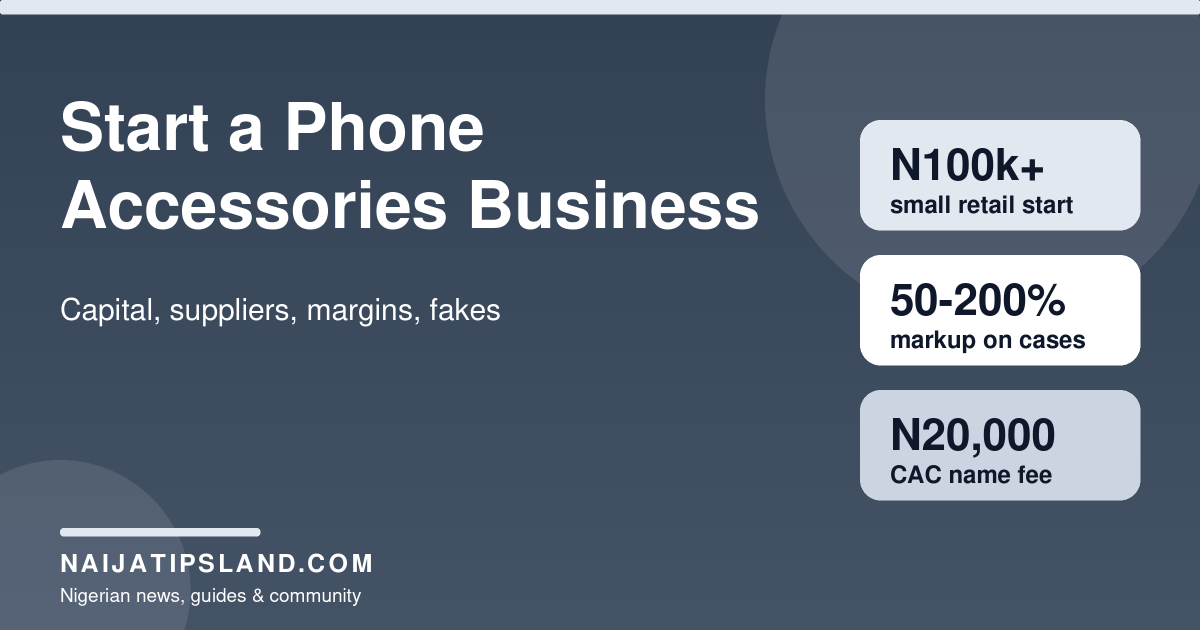
- Entrepreneurs.ng (31 March 2025) puts a small start, a kiosk or online store selling chargers, power banks and earphones, at ₦100,000 to ₦500,000. A medium shop with a wider range and premium items is ₦500,000 to ₦2 million, and a large store with imports and wholesale is ₦2 million and above.
- The LinkedIn post (April 2026) gives the same small band of ₦100,000 to ₦500,000, a medium band to ₦2 million and ₦5 million or more for bulk importing.
- Nigerian Informer (10 October 2026) says about ₦100,000 to ₦500,000 for a retailer, ₦1 million or more to wholesale and ₦3 million to ₦5 million to import.
- Ebony Bank’s Zmega blog (24 June 2026) goes lower. It says you can start with ₦50,000 for cables, cases, chargers and screen protectors, add earbuds and power banks at ₦100,000 and reach a mixed store at ₦500,000.
My reading is that ₦100,000 is a very thin start and ₦200,000 to ₦300,000 is more comfortable for a table or small kiosk, because you need some stock depth in each category and a little cash for packaging, transport and the first returns. Keep some money aside for rent if you open a shop, since none of these guides include it. If you need a loan, read our guide to small business loans in Nigeria before you borrow.
Where traders buy stock in Lagos
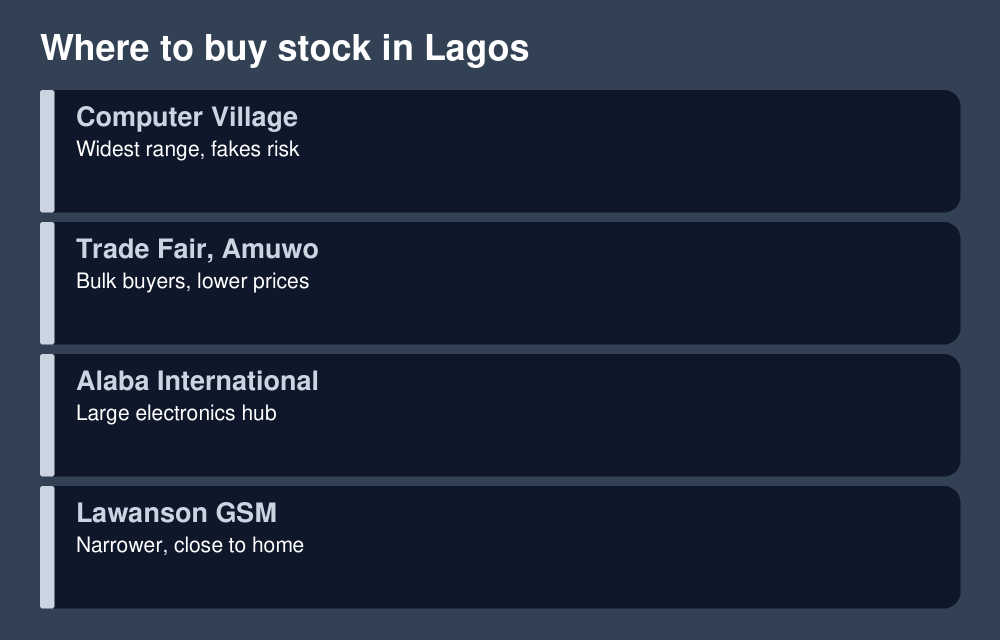
Nairametrics’ guide to Lagos phone accessory markets (11 October 2025) names several. Computer Village in Ikeja is described as the largest technology market in West Africa, with chargers, cases, batteries, screen guards, earphones and smartwatches. Trade Fair Market in Amuwo Odofin is a large wholesale and retail complex popular with bulk buyers and resellers, and the article says its prices tend to be lower than city-centre stores. Alaba International Market in Ojo is a big electronics hub, Lawanson GSM Market in Surulere has a narrower range, and Saka Tinubu in Victoria Island serves the island customers. Outside Lagos, the LinkedIn post names Iweka Road in Onitsha and Farm Centre in Kano.
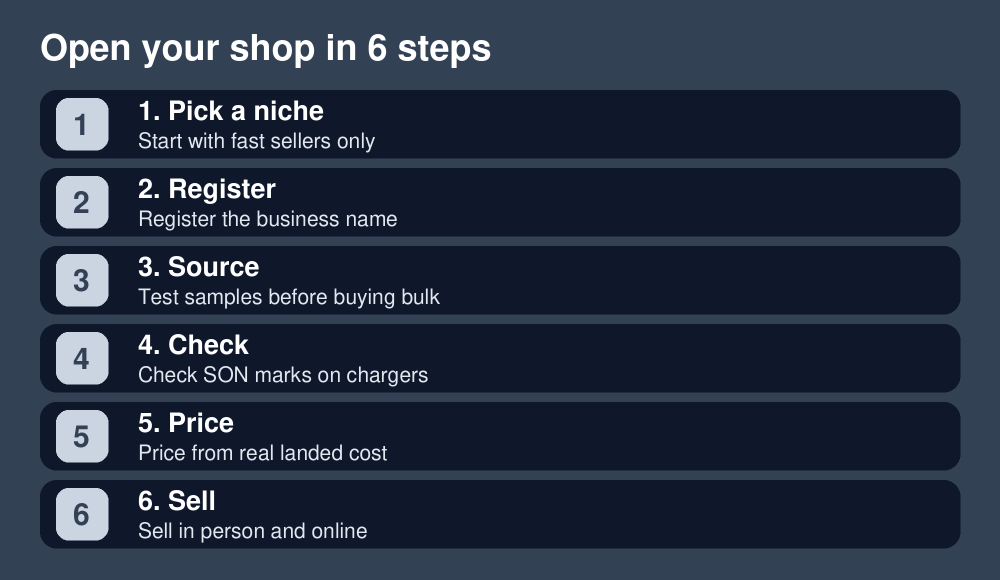
The same guides warn about quality. The Ebony Bank blog lists Computer Village’s risk of fakes as a drawback, and Alaba as a place where inexperience can cost you. Visit more than one market, ask the same price from several traders and buy small first. Buying sample units of each item, then testing them before you place a large order, is the cheapest lesson in this business.
Importing from China
Many sellers move on to mini-importation from platforms such as Alibaba and 1688, usually through a sourcing or shipping agent. Entrepreneurs.ng advises choosing suppliers with strong ratings, verified certifications and good buyer reviews. Costs add up beyond the item price: shipping, customs and clearing, agent fees and the exchange rate on the day you pay, so work out your landed cost per unit before you decide that an import is cheaper. Our guide to importing goods from China to Nigeria covers the steps, costs and scams. For small amounts bought online, our guide to buying from Shein, Amazon and Temu explains payment and duties.
What markups are realistic
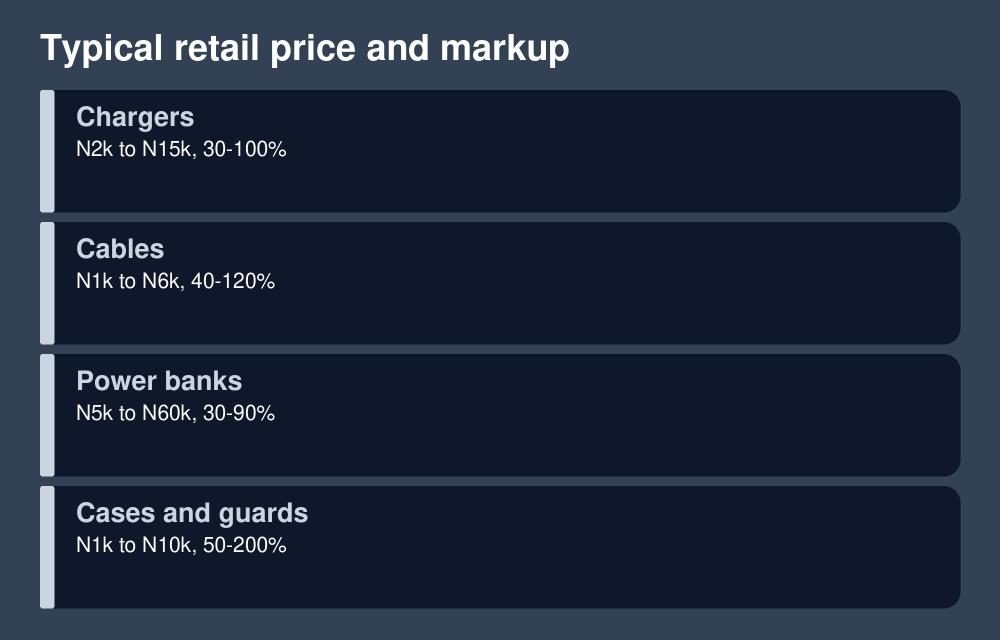
Published margins vary a lot. Entrepreneurs.ng gives 30% to 50% on low-cost items like cables, chargers and cases, 50% to 100% on premium items such as earbuds and smartwatches, and 10% to 30% for wholesale supply, which makes up for it in volume. The Ebony Bank blog lists higher figures: 30% to 100% on chargers, 40% to 120% on cables, 30% to 90% on power banks and 50% to 200% on cases and screen protectors, with retail price ranges of about ₦2,000 to ₦15,000 for chargers, ₦1,000 to ₦6,000 for cables, ₦5,000 to ₦60,000 for power banks and ₦1,000 to ₦10,000 for cases and screen protectors. Nigerian Informer notes that wholesalers may make only ₦50 to ₦100 per charger or earphone unit.
Those ranges are wide for a reason. The top figures are best cases on small, cheap items sold to walk-in customers, and they assume you buy well and the item does not fail. Treat the middle of each range as the more honest guide.
Be careful with the word margin. A ₦4,000 item sold at ₦6,000 has a markup of 50% on cost, but your profit is only a third of the selling price (₦2,000 of ₦6,000). When a guide says 50% profit, check whether it means markup or margin. Then subtract returns, damaged screen protectors, discounts, transport and the time your cash sits in unsold stock. As a simple illustration with assumptions only, if ₦100,000 of stock sells through at an average 30% markup, you gross ₦30,000 on that round. A single batch of faulty chargers that you refund can wipe out most of it.
Fakes, standards and the law
Fake and substandard chargers and power banks are the biggest risk, for your customers and your shop. Cheap uncertified chargers and batteries can overheat or fail, and our guide to the best power banks in Nigeria explains how to spot fakes before you pay.
The Standards Organisation of Nigeria (SON) has been open about the problem. In October 2026 its Director General said at World Standards Day in Abuja that SON is strengthening market surveillance and product tracing, and he urged traders and market associations to stock only products with proper SON certification marks (ThisDay, 12 October 2026). The FCCPC said at the 2026 World Consumer Rights Day event in Abuja that product safety is not optional and that failure to comply will bring regulatory sanctions. Neither report names phone accessories directly, but the message applies to anyone selling electrical goods. For context, in 2019 SON said it seized substandard phone chargers and adapters worth over ₦480 million from a Lagos warehouse, that most lacked SONCAP certificates, and that the SON Act 2015 lets it enter premises, confiscate goods and arrest owners. That report is old, but it shows the stakes.
What this means in practice: buy from traders who can give you receipts, ask about certification on chargers and power banks, avoid unbranded bulk lots that look too cheap, and keep your invoices. Offer a short exchange window for faulty goods, as the Ebony Bank blog suggests, because it builds trust and shows you stand behind what you sell.
Register the business
Registration is not just paperwork. It lets you open a business bank account and list properly on marketplaces. Legit.ng (14 May 2026) puts CAC business name registration at ₦20,000, plus ₦1,000 to ₦5,000 for name reservation, with accredited agents charging ₦20,000 to ₦40,000 on top. Our CAC registration guide has the steps, and you can check if a supplier’s company is registered. The Federal Government has also announced free business name registration for 250,000 small businesses through SMEDAN (Legit.ng, 29 and 30 June 2026), though no deadline was published, so check the official portal and never pay someone for a ‘free’ slot. Get a Tax Identification Number too.
Location and selling channels
Nigerian Informer advises retailers to choose a small or mobile shop on busy roads with a lot of foot traffic, and wholesalers to locate near established markets and plazas where they can meet other traders and follow trends. Near campuses, bus stops, offices and phone repair shops all work for retail.
Selling online costs little. The Ebony Bank blog recommends WhatsApp, Instagram, TikTok and Jiji, plus bundles such as a charger, cable and case together. Short videos that show an unboxing or a charge test help prove quality. The LinkedIn post says content creation gear, such as ring lights, lapel microphones and tripods, is in strong demand, though it is only a single practitioner’s view, so test it with a small order before you stock heavily. If you want to sell without holding stock, read our dropshipping in Nigeria guide for the risks.
Mistakes that cost new sellers money
- Buying a large mixed order from the first cheap trader without testing samples.
- Stocking dozens of slow items instead of ten fast ones.
- Mixing shop money with personal money, so you cannot see real profit.
- Ignoring returns and damaged goods when you set prices.
- Selling chargers and power banks with no certification and no receipts.
- Putting all your capital into stock and leaving nothing for rent, packaging or restocking.
For other low-cost options to compare, see 10 small businesses that succeed in Nigeria, our guide to starting a shawarma business and the complete guide to starting a business in Nigeria.
If you are in the UK and want to help a relative start
Some readers abroad ask whether to ship chargers and gadgets from the UK instead. Consumer electronics bought in the UK are priced for the UK market and shipping, customs and duty add cost, so compare the landed cost with buying in Lagos before you send anything. If you are funding a relative, agree the budget in writing, ask for photos of receipts and stock, and ask for a simple weekly list of sales and returns. Use a regulated transfer provider and keep the transfer records.
FAQ
How much money do I need to start a phone accessories business in Nigeria?
Published guides give ₦50,000 to ₦500,000 for a small retail start, ₦500,000 to ₦2 million for a shop, and ₦1 million to ₦5 million or more to wholesale or import. A practical small start is ₦200,000 to ₦300,000.
Where do I buy phone accessories wholesale?
Computer Village in Ikeja, Trade Fair Market, Alaba International Market, Lawanson GSM Market and Saka Tinubu in Lagos are the usual places, and Onitsha and Kano have their own hubs. Buy samples first and keep receipts.
How much profit can I make?
Guides quote markups from 10% to 30% at wholesale and 30% to 200% at retail depending on the item. The middle of each range is the safer planning figure, and returns and slow stock reduce it.
Do I need to register the business?
You can trade without it, but CAC registration lets you open a business account and sell through more channels. Business name registration is about ₦20,000 plus reservation and agent fees, and a free SMEDAN scheme was announced in June 2026.
How do I avoid fake chargers and power banks?
Buy from traders who give receipts, ask about SON certification, test sample units and avoid unbranded bulk lots that are priced far below the rest. SON has urged traders to stock only certified products.
Is it better to sell online or from a shop?
Start with whichever costs you least. Many sellers begin on WhatsApp, Instagram and Jiji and open a shop once they know which items sell.
This article gives general information and is not financial or legal advice. Prices, rules and supplier quality change, so confirm current figures with suppliers and the relevant agencies before you invest.
Sources
- Nigerian Informer: How to start phone accessories business in Nigeria (10 October 2026)
- Ebony Bank Zmega: Most profitable phone accessories to sell in Nigeria (24 June 2026)
- Entrepreneurs.ng: How to start a phone accessories business in Nigeria (31 March 2025)
- LinkedIn: Starting a phone accessories business in Nigeria, a practical guide (April 2026)
- Nairametrics: Top Lagos markets to buy affordable phone accessories (11 October 2025)
- ThisDay: SON deploys authentication technology amid proliferation of fake products (12 October 2026)
- Channels TV: FCCPC cracks down on unsafe products (26 March 2026)
- Economic Confidential: SON seizes N480m substandard phone accessories (25 October 2019)
- Legit.ng: Everything to budget for CAC registration fees in Nigeria in 2026 (14 May 2026)
- Legit.ng: FG approves free CAC registration for 250,000 businesses (June 2026)
Join the discussion
Have you tried this, or do you have a question we did not answer? Be the first to share your experience. Leave a comment below. Every comment is read by the editor before it appears.





Editor note: do you sell phone accessories, or are you planning to start? Tell us in the comments which market you buy from, which items sell fastest for you and how you check for fakes. Please leave out phone numbers and exact addresses. We read every comment. – Ade