
How to Start a Snail Farming Business in Nigeria (2026): Costs, Housing, Feed, Prices and Real Risks

Last updated 20 November 2026. Prices, feed costs and snail supply move with the season, so every naira figure below is a planning estimate from published guides, not a promise. This is general information and not financial advice.
Ask anyone in the South what they order with their pepper soup, and snail comes up fast. Big snails have always been sold at roadside stalls, but most of those are picked from the bush after rain, which means supply crashes in the dry months and prices jump. Farming them yourself is possible, cheap to begin and slow to pay. This guide explains what you actually need, what it costs in 2026, and why so many first farms lose their stock in their first Harmattan.
What snail farming involves
Snail farming, also called heliciculture, means raising giant African land snails in pens instead of picking them from the wild. In Nigeria that mostly means Archachatina marginata, with Achatina achatina as the other common choice. You keep breeders in a protected pen with damp soil, feed them plants and a calcium source, collect and hatch the eggs, grow the young ones to market size and sell.
It sits well beside other small livestock work. If you are weighing options, compare it with fish farming on low capital and poultry farming. Snails need far less feed money and no electricity, but they take much longer to grow and they punish carelessness with the climate.
How snails breed and how long it takes
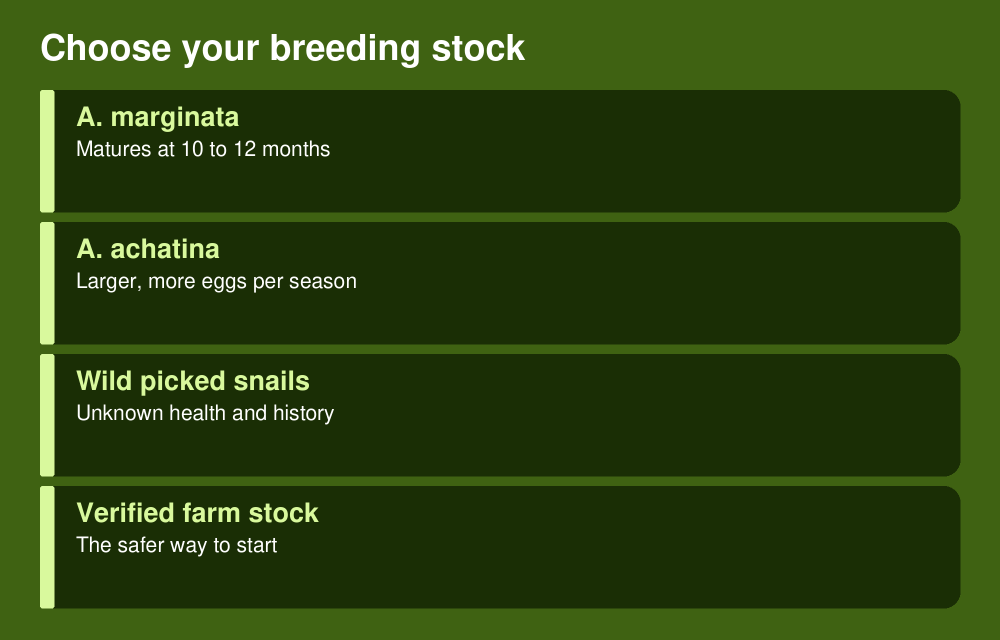
Be ready for patience. A snail manual published through Access Agriculture and CTA says Archachatina marginata reaches sexual maturity at around one year, at roughly 100 to 125 g live weight, and that two snails must mate for viable eggs. Clutches of this species are small, about 4 to 18 eggs, and the eggs take around four weeks to hatch. A study in Cameroon recorded an average of 5.66 eggs per clutch and a hatching rate of about 76%, so do not expect every egg to become a snail. Nigerian extension guidance says a well-fed snail is usually ready for harvest within 12 to 24 months of stocking, and that A. achatina can lay far more eggs per season than A. marginata.
What this means for your plans: you will probably not sell your first table-size snails until well into the second year, and the first sales may only repay what you spent setting up.
Pick the right stock
Many beginners start by picking wild snails after rain because they are free. Practitioners warn against it, because wild snails can carry disease and come with no breeding history. Buy mature breeders from an established farm or a training centre where you can see the pens and ask about losses. Start with large, healthy adults, since they begin laying sooner, and keep new arrivals apart from your main pen for about two weeks before mixing.
Housing: pens, hutch boxes and trenches
Common options are wooden hutch boxes, drums or old tyres stacked and filled with soil for a micro start, concrete block pens, and trench pens for larger farms. The Access Agriculture manual puts breeding snails at no more than 10 to 15 per square metre, with young snails kept much denser. Whatever you choose, build for three things.
- Escape-proofing. Snails climb, so use mesh lids and smooth upper edges.
- Drainage. Soil should be damp, not waterlogged, so give water a way out.
- Predator control. Fence the site with sheeting and mosquito net, and put the pen on a base that ants cannot cross easily.
Use dark loamy soil. Sandy soil dries out too fast, clay holds water, and hard laterite is poor for egg laying. Aim for warm, steady conditions of about 25 to 30°C and high humidity, and give the pen shade because direct sun dries it out.
Feed, water and calcium
Snails eat plant material, and a Nigerian study found pawpaw (papaya) leaves gave the best growth among the natural diets tested, with cocoyam leaves and growers mash as alternatives. Okra, banana, cabbage and the leaves of low-cyanide cassava are also commonly used. Guidance in the manual is for about 20% protein in the diet, with powdered calcium (crushed oyster shell, limestone, egg shells, bone meal or wood ash) making up around 15% to 20% of the dry feed. Calcium shortage shows up as thin or deformed shells and is one of the most avoidable causes of losses.
Feed after sunset, because snails are active at night, and take out leftovers the next morning. Food that rots in a warm pen attracts pests and mould. Keep water available, and mist the soil rather than flooding it.
What it costs to start
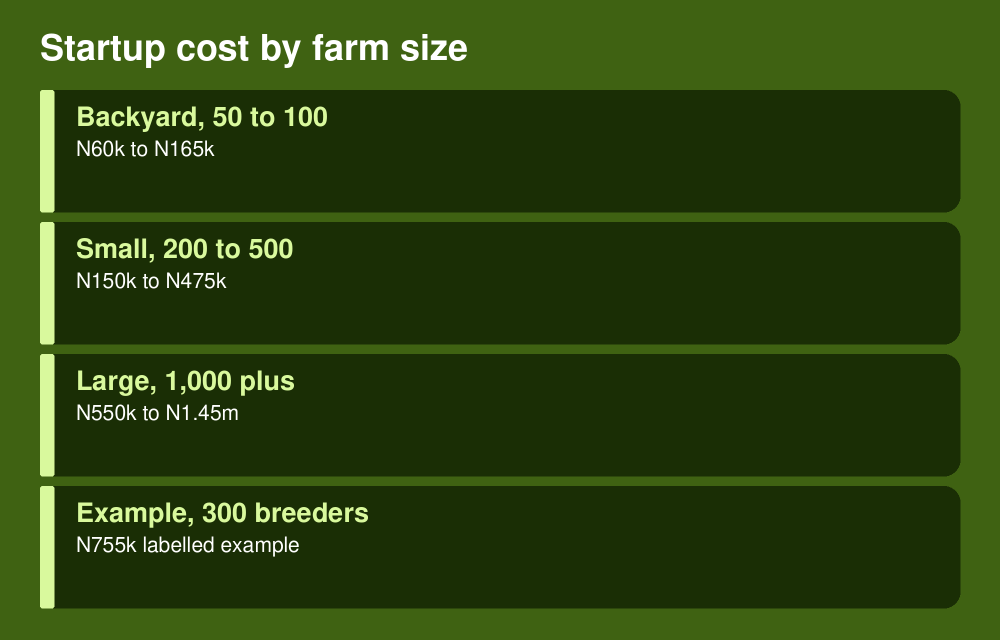
Published 2026 guides give wide ranges, which is normal for a business where housing and stock prices vary by town. WithinNigeria (July 2026) puts a small start of 100 to 200 snails at ₦50,000 to ₦150,000, including a hutch pen at ₦20,000 to ₦60,000 and stock at ₦30,000 to ₦80,000. It puts 200 to 500 snails at ₦150,000 to ₦400,000 and 1,000 or more at ₦500,000 to ₦850,000 and above. Toolbase gives ₦60,000 to ₦165,000 for a backyard start of 50 to 100 snails, and up to about ₦1.45 million for a large start. A Pryme worked example for about 300 breeders, with a block pen, ant control and the first months of feed and labour, came to ₦755,000. That one is clearly labelled as an example with assumed prices.
Before you spend, get quotes from at least three suppliers. Prices in Lagos, Abuja, Port Harcourt, Benin and Ibadan differ, and an online figure from six months ago can already be wrong. If you need to borrow, our guide to small business loans in Nigeria explains safer options.
Prices and who buys
WithinNigeria reports big snails selling for about ₦1,000 to ₦4,000 each in Lagos and Abuja in 2026. Another guide gives ₦800 to ₦2,500 per snail depending on size and place. Prices follow the seasons. In the rains, roughly April to September or October, bush-picked snails flood the market and roadside prices can drop to ₦300 to ₦500 in the South. In the dry months of November to March, supply falls and city prices climb to around ₦800 to ₦2,000. Plan your cash around that swing.
Likely buyers are restaurants and pepper soup joints, hotels, market traders buying in bulk, and supermarkets if you sell frozen or processed. Restaurants pay the most per snail but want regular supply. Selling breeding stock to new farmers is another income line once your stock is proven.
Is it profitable? Honest numbers
Be wary of any page that promises a monthly income. Pryme’s worked example assumes 2,400 young snails in the first season, 60% surviving to table size (1,440 snails) and a sale price of ₦600 each, which gives ₦864,000. Against a ₦755,000 set-up budget plus feeding and labour, it concludes that the first harvest only just covers the spending and that profit comes in later seasons once the pens and breeders are paid for. Another guide warns against borrowing someone else’s selling price as your guaranteed income. Treat all projections as examples, track your own numbers and expect a slow first year.
The risks that wipe out new farms
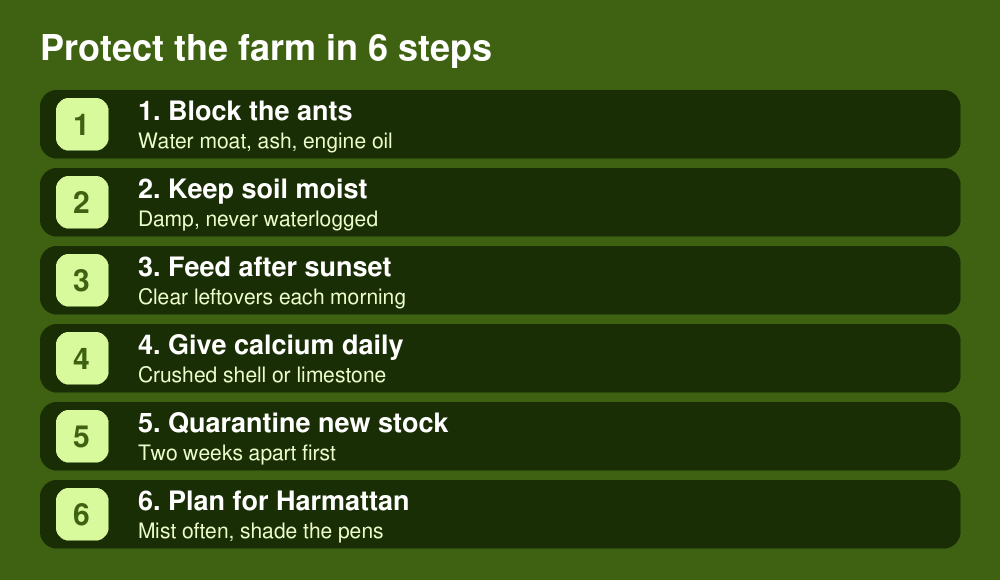
Soldier ants are widely described as the number one killer. A column can clear a pen overnight, and snails cannot run away from them. Farmers use a water or used-engine-oil moat around the pen legs, a ring of wood ash, petroleum jelly on stands and a concrete base. Do not spray insecticide inside the pen, because it will kill the snails.
Dryness is the second big risk. In the dry season, from about November to March, snails seal their shells and go dormant. They stop eating, growing and breeding, and a poorly managed pen can lose a large share of its stock. Practitioners advise starting as the rains begin, in April or May, so the animals settle before the dry months. In Harmattan, mist more often, shade the pens and keep sacking damp around the sides.
Other threats include rats, lizards, frogs, snakes and ants getting to eggs and young snails, a parasitic fly (Alluaudihella flavicornis) that lays eggs on the shell, which nylon mesh over the pen helps to stop, bacterial infection of the gut and a fungus that turns eggs red-brown. Remove dead snails at once, change soil regularly and keep the pen clean.
Rules, registration and export
There are no snail-specific farming regulations at the national level that I could find, according to a 2026 market report, but that does not mean you can ignore the usual business steps. Register your business name through the CAC process, get a Tax Identification Number and keep records. If you package processed snail meat for sale, expect to need NAFDAC registration.
Exporting is a separate and demanding path. Published export guides list a CAC registration, an NEPC exporter’s certificate, a veterinary health certificate from the relevant federal authorities for live or raw snails, and NAFDAC certification for processed products. The Nigerian Agricultural Quarantine Service said in 2021 that the UK accepts live and frozen snails that are free from pests and disease, while the US prohibits live snails but accepts cleanly processed frozen ones. Rules change, so confirm with NAQS and the destination country before you plan an export, and do not carry snails in luggage.
Handling and health
Snails can carry bacteria such as salmonella, and authorities have warned about a rare form of meningitis linked to snails. Wash your hands after handling them, keep children away from the pens and cook snail meat thoroughly. See a doctor if you feel unwell after handling or eating snails.
Watch out for scams and weak training
Snail farming attracts offers of paid “starter packs” and courses that promise large, fixed returns. Be careful with any of these. Visit the farm in person, ask to see breeders and pens, compare the price per snail with at least three other sellers, never pay the full amount for stock you have not inspected, and ignore anyone who guarantees income. Free learning is available. The Access Agriculture and CTA snail manual is a good start, and Nigerian extension services have published snail bulletins. For the wider picture on registering and funding a farm business, see our complete guide to starting a business in Nigeria, and for more ways to earn on the side, our side hustle guide for Nigerians.
FAQ
How much does it cost to start snail farming in Nigeria?
Published 2026 estimates run from about ₦50,000 to ₦165,000 for 50 to 200 snails to well over ₦500,000 for 1,000 or more. Get three local quotes because stock and housing prices vary by town.
How long before I can sell snails?
Breeders reach maturity at around a year, and extension guidance says harvest comes 12 to 24 months after stocking. Plan for a slow first year.
Which species should I choose?
Archachatina marginata is the most commonly farmed in Nigeria. Achatina achatina is the other main choice. Buy verified breeders from a farm you have visited.
When is the best time to start?
As the rains begin, around April or May, so your snails settle before the dry months. Dry season starts cost more in losses.
What kills snails most often?
Soldier ants, dryness, calcium shortage, overcrowding and dirty pens. Good pen design and regular misting prevent most of it.
Can I export snails from Nigeria?
Yes, but you need business registration, an NEPC exporter’s certificate and the right health certificates, and destination countries set their own rules. Check with NAQS before you start.
Do I need a licence to keep snails?
No snail-specific national farming licence was found, but you should register the business, get a TIN and, for packaged processed products, register with NAFDAC.
This article gives general information and is not financial or veterinary advice. Costs, prices and rules change, so confirm current figures with suppliers and the relevant agencies before you invest.
Sources
- WithinNigeria: How to start snail farming in Nigeria, capital required in 2026 (8 July 2026)
- Toolbase: Snail farming in Nigeria, profitable or hype? 2026 costs and profits (22 October 2026)
- Pryme: Snail farming in Nigeria, start-up cost and profit (19 October 2026)
- Naijasabi: Snail farming in Nigeria 2026 (15 September 2026)
- Lawrence Orjime: Small scale snail farming cost in Nigeria 2026/27 (9 August 2026)
- Bytelk: Snail farming in Nigeria, the complete beginner guide (20 April 2026)
- Access Agriculture and CTA: Snail farming manual
- PubMed Central: Production performance of Archachatina marginata in Cameroon (2022)
- Nigerian Journal of Animal Production: Influence of feeding regimes on Archachatina marginata
- NAERLS: Snail farming techniques in Nigeria, Extension Bulletin No. 108
- NTA Lagos Business Matters: From backyard to business, snail farming (18 September 2026)
- IndexBox: Nigeria snails market analysis (25 September 2026)
- NEPC: Export documents and procedures
- Blueprint: NAQS charges exporters and travellers to scrutinise products (8 August 2021)
- Kikis Agroplace: How to run a profitable snail exportation business in Nigeria (12 July 2024)
Join the discussion
Have you tried this, or do you have a question we did not answer? Be the first to share your experience. Leave a comment below. Every comment is read by the editor before it appears.









Editor note: do you keep snails, or are you planning to start? Tell us in the comments which species you chose, what housing you use and how your losses were in the last dry season. Please leave out phone numbers and exact addresses. We read every comment. – Ade