
Best Mutual Funds in Nigeria for Beginners (2026): Money Market, Fixed Income and Dollar Funds Compared

Last updated: 11 November 2026 · By Naijatipsland Editorial Team · Editorial policy
If you have savings sitting in a bank account earning very little, a mutual fund is one of the easiest ways to start investing in Nigeria. You do not need millions, you do not need to pick individual shares, and your money is managed by a licensed professional under the supervision of the Securities and Exchange Commission (SEC). This beginner guide explains how mutual funds work, which types suit beginners, what yields look like in late 2026, what you pay in fees and how to start safely.
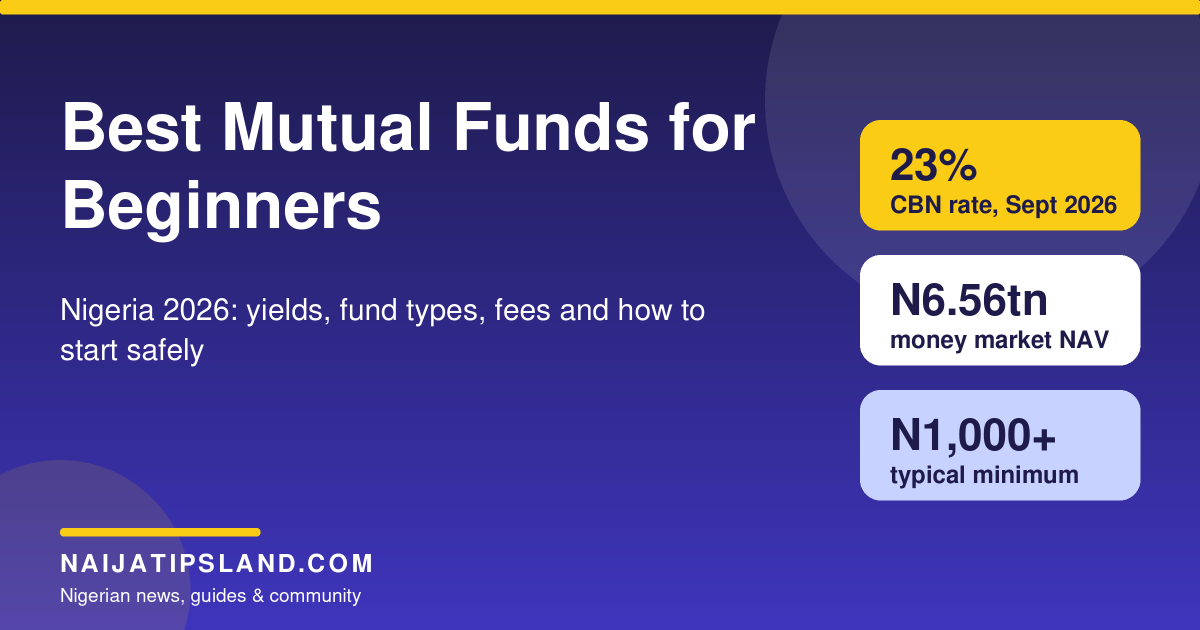
Quick answer: for most beginners, a money market fund from a well-established, SEC-registered manager is the best first mutual fund. It is the lowest-risk type, you can usually withdraw within a few working days, and leading funds were still reporting yields of roughly 16% to 21% a year in October 2026. Once you have an emergency fund in place, you can add a fixed income, dollar or equity fund for longer-term goals.
This guide is general information, not financial advice. Yields change weekly and past returns do not guarantee future returns.
What is a mutual fund?
A mutual fund (also called a collective investment scheme, or CIS) pools money from many investors and invests it in a portfolio chosen by a fund manager. When you invest, you buy units in the fund. The value of each unit rises or falls with the value of what the fund holds. Every fund has a trustee (usually a bank or trust company) and a custodian that holds the assets, so the manager cannot simply walk away with investors’ money. All of this is regulated by the SEC, which publishes weekly valuation reports for registered funds.
Money market funds dominate the Nigerian market. According to Nairametrics’ analysis of SEC data, money market funds held about N6.56 trillion across 49 funds as of 25 September 2026, about 68% of all mutual fund assets in the country. Equity funds held about N243.8 billion and balanced funds about N191 billion at the same point, so most Nigerians are clearly using funds as a safer home for savings rather than a bet on the stock market.
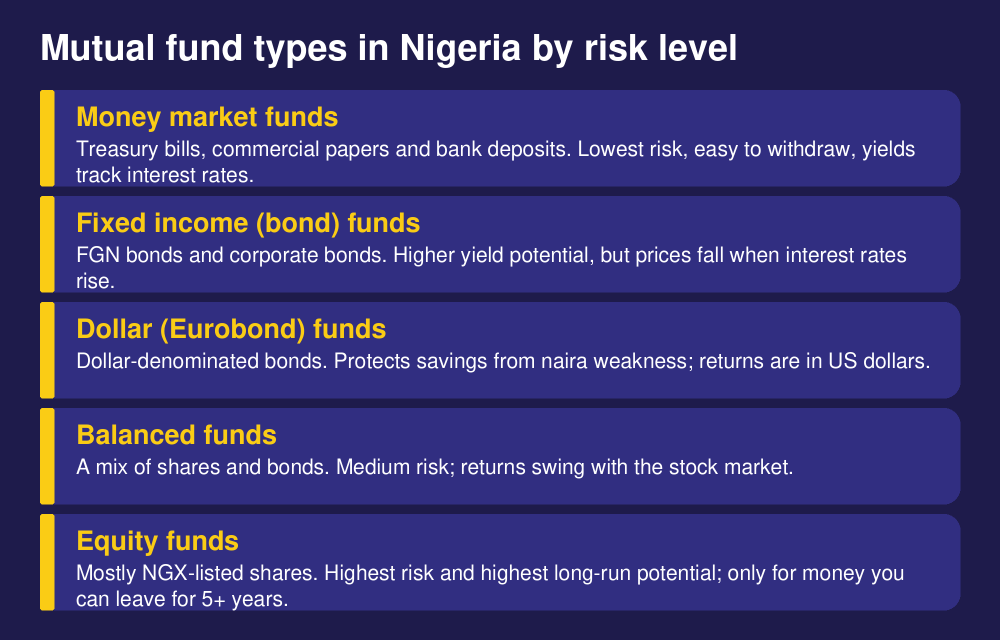
The five main types of mutual funds in Nigeria
1. Money market funds (best for beginners and emergency savings)
These invest in short-term instruments such as Treasury bills, commercial papers and fixed deposits. Returns follow interest rates closely. They are the right home for an emergency fund or money you may need within a year. The main risk is that yields fall when interest rates fall.
2. Fixed income or bond funds
These hold FGN bonds and corporate bonds with longer maturities. They can earn more than money market funds, and when interest rates fall, bond prices tend to rise, which can boost returns. When rates rise, the opposite happens. Plan to hold for at least one to three years.
3. Dollar funds (Eurobond funds)
These invest in dollar-denominated bonds issued by the Federal Government and Nigerian companies. They suit people saving for school fees abroad, travel or relocation, or anyone who wants part of their savings protected from naira weakness. Returns are quoted in dollars and usually lower than naira funds. nairaCompare’s review of SEC data in August 2026 showed leading dollar funds with year-to-date returns of roughly 9% to 15%. Minimum investments are often higher, commonly from about $100 to $1,000.
4. Balanced funds
A mix of shares and bonds. Some balanced funds posted very large returns in 2026 because the stock market rallied strongly, but those returns can reverse just as fast. Treat them as medium-to-high risk.
5. Equity funds
These hold mostly NGX-listed shares. They have the highest potential over five years or more, and the highest chance of short-term losses. If you prefer to pick shares yourself, see our guide to the best Nigerian stocks for long-term investing.
What are money market funds paying in late 2026?
Yields have been unusually high because of the Central Bank of Nigeria’s tight policy. The CBN’s Monetary Policy Committee cut the Monetary Policy Rate (MPR) from 26.5% to 23% on 22 September 2026, its largest cut on record, as headline inflation eased to 15.39% in August. Lower policy rates feed into lower Treasury bill rates, and money market yields follow as older, higher-yield holdings mature. Expect a gradual decline rather than a sudden drop.
For context, Nairametrics reported that the SEC figures for 23 October 2026 showed selected money market yields ranging from 16.53% (ARM Money Market Fund) to 21.30% (First Ally Money Market Fund), with Coronation at 20.36%. In its September ranking, First Ally moved to the top for the first time in 2026, CardinalStone recorded 19.31%, and DLM, STL and Greenwich Plus money market funds were the only three to appear in every monthly top 10 from January to September.
Money market funds beginners often shortlist
The list below is not a recommendation. It is a starting point for your own checks, drawn from funds that have featured in 2026 rankings based on SEC data or that are run by large, long-established managers:
- DLM, STL and Greenwich Plus money market funds: notable for staying in the monthly top 10 throughout January to September 2026.
- Coronation Money Market Fund: led the rankings in parts of 2026; nairaCompare listed a minimum of N10,000.
- First Ally and CardinalStone money market funds: strong 2026 performers in the September ranking.
- Trustbanc Money Market Fund: nairaCompare listed a N1,000 minimum, useful for small monthly savers.
- Large-bank and long-standing managers such as Stanbic IBTC, ARM, FBNQuest, United Capital and Meristem: yields are sometimes lower than the leaders, but the funds are large, widely held and simple to access.
A small fund with a top yield is not automatically better than a giant fund paying one or two percentage points less. Consistency, the quality of the manager and how quickly you can withdraw matter more for money you might need in an emergency.
How to choose the right fund for you
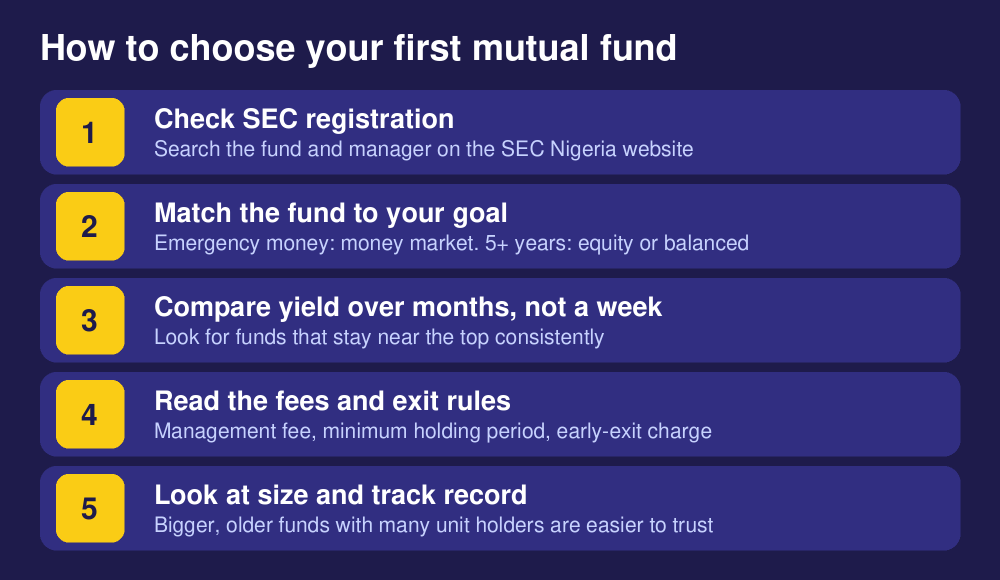
- Confirm SEC registration. Search the fund and the manager on the SEC Nigeria website. If an “investment” is not registered, do not touch it.
- Match the fund to the goal. Emergency fund and money you need within 12 months: money market. Two to three years: money market plus fixed income. Five years or more: add equity or balanced funds. Foreign school fees or relocation: a dollar fund.
- Compare yields over several months. Use the SEC weekly report or monthly rankings, and look for funds that stay near the top rather than the one that topped a single week.
- Read the fees. Most funds charge an annual management fee, commonly around 1% to 1.5% of assets, which is already deducted from the yield you see. Check for minimum holding periods and charges for withdrawing early, especially in bond and equity funds.
- Check how withdrawals work. Many money market funds pay out within one to three working days. Some apps offer instant withdrawals; read the terms.
- Look at the size and number of unit holders. Larger funds with many investors are easier to sell out of and usually have more experienced teams.
How to start investing in a mutual fund, step by step
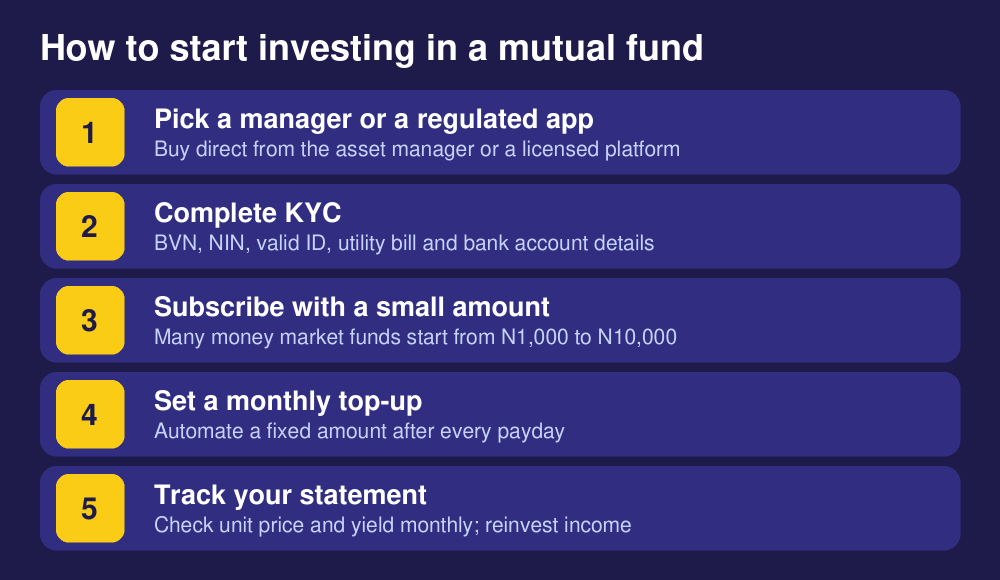
- Choose where to buy. You can subscribe directly through the asset manager’s website or app, through your bank’s asset management arm, or through a licensed investment app. Always check that the platform is regulated and that the fund name on your statement matches an SEC-registered fund.
- Complete KYC. You will usually need your BVN, NIN, a valid ID, proof of address and your bank details. Nigerians abroad can often complete KYC online.
- Make your first subscription. Many money market funds start from N1,000 to N10,000. Pay only into the fund’s official collection account or through the official app, never to a personal account.
- Set up automatic monthly top-ups. A fixed amount every payday builds the habit and averages out changes in returns.
- Reinvest income and review quarterly. Check your statement, the unit price and the fund’s yield. Switch only for good reasons, not because of one bad week.
A simple beginner plan
Here is one way a salary earner could structure savings. Adjust the numbers to your income:
- Step 1: build three to six months of expenses in a money market fund.
- Step 2: once the emergency fund is full, split new savings, for example 50% money market or fixed income, 30% equity or balanced fund, 20% dollar fund if you have foreign expenses coming.
- Step 3: review once a year and rebalance back to your target mix.
For example, putting N20,000 a month into a money market fund yielding 17% a year would grow to roughly N260,000 after 12 months before any fees or tax not already reflected in the yield. If yields drift down, the figure will be lower. Compare that with our guide to Treasury bills, fixed deposits and savings bonds if you prefer to buy government securities directly.
Risks and red flags
- Yields are not guaranteed. Money market yields are already falling from their peak after the September rate cut.
- Bond and equity funds can lose money in the short term. Only use them for money you can leave alone.
- Inflation matters. A real return is your yield minus inflation. With inflation around 15% in 2026, a 17% yield is a modest real gain, not a windfall.
- Fake funds and Ponzi schemes promise fixed monthly returns of 5% to 10% or more and ask you to pay into personal accounts. Genuine mutual funds never guarantee those returns. Read our guide to spotting Ponzi schemes in Nigeria.
- Tax rules changed in 2026. Nigeria’s new tax laws took effect in 2026. Ask the fund manager how distributions are taxed before you invest a large sum.
Mutual funds vs other beginner options
Compared with a savings account, a money market fund usually pays far more interest and is almost as easy to access. Compared with buying Treasury bills directly, a fund lets you start with less money and withdraw any time rather than waiting for maturity. Compared with picking shares, a fund spreads your risk across many companies. For a wider view of beginner options, see the best investment opportunities in Nigeria for beginners. Nigerians abroad can also read our guide on investing in Nigeria safely from the diaspora.
FAQ
Which mutual fund is best for beginners in Nigeria?
A money market fund from a large, SEC-registered manager with a consistent track record. It is low risk, flexible and a good place for an emergency fund.
How much do I need to start?
Many money market funds accept N1,000 to N10,000 as a first investment. Dollar funds and some bond funds have higher minimums.
Can I lose money in a mutual fund?
Money market funds rarely lose money, but returns can fall. Bond, balanced and equity funds can lose value in the short term.
How quickly can I withdraw?
Money market funds typically pay out within one to three working days. Other funds may have a minimum holding period or an early-exit charge.
Are mutual funds safe?
Registered funds are regulated by the SEC and the assets are held by a custodian, which protects investors. They are not insured like bank deposits, so choose reputable managers.
Will yields keep falling?
After the CBN cut its rate to 23% in September 2026, most analysts expect money market yields to drift lower if inflation keeps easing. Nobody can promise the direction.
Sources
- Nairametrics: Best performing money market funds in Nigeria as of September 2026
- Nairametrics: Where to invest in November 2026
- Nairametrics: Best performing balanced mutual funds, September 2026
- Central Bank of Nigeria: 307th MPC communique, September 2026
- nairaCompare: Best performing money market funds in Nigeria (Q3 2026)
- nairaCompare: Best performing dollar funds in Nigeria (Q3 2026)
- Securities and Exchange Commission Nigeria
Join the discussion
Have you tried this, or do you have a question we did not answer? 1 reader has already shared their view. Naijatipsland members help each other with real, first-hand experience.









Editor’s note: I wrote this guide for readers who keep asking me where to keep money that is safer than shares but earns more than a savings account. Please confirm any fund on the SEC website before you pay, and never invest through someone who sends you a personal account number. Questions are welcome below. – Ade