Last updated: 24 October 2026 · By Naijatipsland Editorial Team · Editorial policy
Few dishes start an argument faster than jollof rice. Nigerians will tell you that a proper pot has a deep red-orange colour, separate grains that are soft but not mushy, and a faint smoky edge that tastes like a party. This guide shows you how to get there at home on an ordinary stove, in one pot, without firewood. It gives you a scalable recipe for 6 to 8 people, the reasoning behind each step, how to fake the smoky “party” flavour, fixes for the usual mistakes, and the safe way to store the leftovers.
If you are planning jollof for a crowd and want to know what it will cost, read our party jollof rice budget and cost-per-plate calculator alongside this recipe. This article is about the cooking.
Recipe at a glance
- Serves: 6 to 8 people
- Time: allow about 1 hour 15 minutes, including blending and frying the stew (a published Food Network Kitchen recipe lists 1 hour 10 minutes in total for a smaller batch)
- Difficulty: easy, but it rewards attention to heat and liquid
- Pot: a large, heavy pot with a tight lid, so the rice has room to expand
What makes Nigerian jollof different
Jollof most likely began in the Senegambia region and spread across West Africa, according to Britannica and Saveur. The name is linked to the Wolof (Jolof) people, and the dish also goes by names such as benachin, a Wolof word that Quartz Africa translates as “one pot”. Every country now has its own version, and Quartz Africa’s history of the dish summarises the differences like this:
- Nigeria: parboiled long-grain rice cooked in a puree of tomatoes, habanero-type peppers, red bell peppers and onions. Party versions are cooked over firewood in cast-iron pots, which gives a smoky flavour.
- Ghana: basmati or Thai rice, with warm spices such as clove, nutmeg or cinnamon, and chicken or beef stock.
- Senegal: tamarind and extra palm oil at the base of the pan, which creates a crusty edge.
- Cameroon and Liberia: Cameroon’s version is usually made with beef and served with carrots and green beans, while Liberia’s uses plenty of hot pepper with mixed vegetables and proteins.
The rivalry is part of the fun. Quartz dates the #JollofWars hashtag to 2014, when Nigerians and Ghanaians in particular traded banter online, and notes that West African communities united in criticism when British chef Jamie Oliver published a version with non-traditional ingredients that same year. Football fans and entertainers keep it alive too, as in this story about iShowSpeed declaring Nigerian jollof better than the Senegalese version.
Ingredients
This recipe pulls together the common structure of several published Nigerian jollof recipes, including those from Sisi Jemimah, Dash of Jazz and Food Network Kitchen. Quantities are a starting point, because rice brands, stock cubes and peppers all differ.

Rice and liquid
- 3 cups (about 600 g) long-grain parboiled rice
- 2 cups beef or chicken stock, plus a little extra water or stock for adjusting
Tomato and pepper base
- 4 medium red bell peppers (tatashe), deseeded
- 3 plum tomatoes (or half a can of plum tomatoes)
- 1 to 2 scotch bonnets (ata rodo), depending on your heat tolerance
- 1 onion, for blending
- 3 heaped tablespoons tomato paste
Fat and seasoning
- 6 tablespoons vegetable oil
- 1 more onion, sliced, for frying (and a few rings for the end)
- 3 stock cubes
- 2 teaspoons curry powder and 1 teaspoon dried thyme
- 1 teaspoon white pepper
- 3 bay leaves
- Salt to taste
- Optional: 1 to 2 tablespoons butter and 1 tablespoon minced ginger, as used in Sisi Jemimah’s version
Choosing your rice
Nigerian jollof traditionally uses long-grain parboiled rice, which holds its shape and forgives a heavy hand with the stew. Dash of Jazz advises rinsing it in warm water until the water runs clear. If you only have easy-cook or ordinary long-grain rice, Saveur suggests boiling it in plenty of water for about five minutes and then draining it, and Sisi Jemimah notes that parboiling can shorten the cooking time but may leave the rice less firm. In the UK, parboiled long-grain rice is easy to find in African and Caribbean shops and many supermarkets. Avoid basmati and sticky rice if you want the classic Nigerian texture.
Step-by-step method
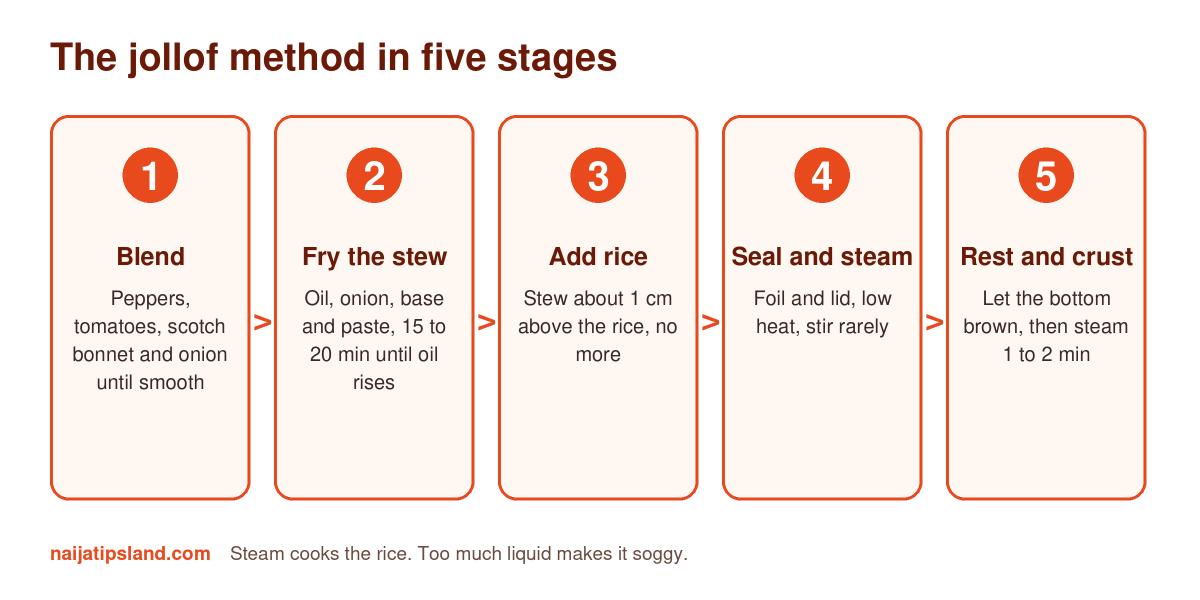
- Prepare the rice. Rinse it until the water runs clear, then drain well. If it is not parboiled, boil it for about five minutes first and drain.
- Blend the base. Blend the red bell peppers, tomatoes, scotch bonnet and one onion until smooth. Sisi Jemimah recommends using lots of paste but less fresh tomato, because too much fresh tomato makes the stew watery and too much paste makes it sour.
- Fry the onion and paste. Heat the oil over medium heat and fry the sliced onion until fragrant. Add the tomato paste and fry it for a few minutes until it darkens and separates from the oil. The Food Network recipe cooks its paste for 3 to 5 minutes.
- Cook the stew. Pour in the blended base, then add the stock cubes, curry powder, thyme, white pepper and bay leaves. Cover and cook for 15 to 20 minutes, stirring now and then, until a layer of oil rises to the top. This is the step that decides the flavour, so do not hurry it.
- Loosen and taste. Add about a cup of the stock and simmer for another 8 to 10 minutes. Taste and add salt if needed, remembering that stock cubes are salty.
- Add the rice. Stir the rice into the stew, adding the stew and stock gradually until the liquid sits only about 1 cm above the rice. Stir in the butter and ginger if using.
- Seal and steam. Cover the pot with foil and a tight lid, turn the heat to low (Food Network uses medium-low) and leave it for about 20 minutes without stirring. Then turn the rice gently with a wooden spoon, reseal and cook for 10 to 20 more minutes, stirring only occasionally, until the grains are tender. If the rice is still hard and the pot is dry, add a small splash of hot stock and cover again.
- Finish. Mix in a few onion rings and sliced tomato in the last two minutes if you like. Turn off the heat and let the pot rest for a minute or two before serving.
Sisi Jemimah puts the principle in one line: “Jollof rice needs steam to cook and not water.” Resist the urge to add extra liquid early on. It is easier to add a splash later than to rescue soggy rice.
How to get the smoky party flavour at home
The smoky taste of party jollof comes from firewood and the scorched layer at the bottom of a heavy pot. Without a fire, you have two options, both described by Saveur and Sisi Jemimah:
- Let the bottom catch. Near the end of cooking, leave the pot undisturbed for a few extra minutes on low heat so a thin crust forms on the base. Then stir it through to spread the toasted flavour. A little sticking and burning at the base is expected, and Sisi Jemimah says it creates the smoky flavour. Remove any badly blackened bits if you prefer.
- Roast the vegetables first. Saveur suggests roasting the tomatoes, onions and peppers before pureeing and frying them.
Jollof can burn quickly, so use plenty of oil or a non-stick pot, and keep the heat at medium-low rather than high. Dash of Jazz advises reducing the heat and adding stock, water or oil if the rice starts to burn too early.
Common mistakes and quick fixes

- Soggy or gummy rice: too much liquid, or starch that was not rinsed off. Rinse well and keep the stew about 1 cm above the rice.
- Sour or raw taste: too much tomato paste or a stew that was not fried long enough. Cook the stew until the oil rises.
- Burning too early: the heat is too high. Lower it and add a splash of stock or oil.
- Hard or dry rice: add a little hot stock, cover tightly and let it steam on low heat.
- Pale colour or bland taste: add tomato paste or stock and taste before the final steam.
Adjusting the heat and the recipe
- Spice level: Dash of Jazz uses one or two scotch bonnets for mild-spicy, three for “daring” and four for family-level heat. Wash your hands after handling them, and do not touch your eyes.
- Protein: Saveur notes that jollof is made with chicken, beef, pork or fish, or can be vegetarian. Cooking the meat separately and adding the stock to the stew gives you the best of both.
- Bigger batches: use a larger pot rather than a fuller one. The rice needs room to expand and steam evenly. If you are catering, work out portions and costs with our party jollof budget guide, and see Christmas food prices in Nigeria for current ingredient costs.
What to serve with jollof
Food Network Kitchen suggests a salad, meat or fish and fried plantain, or simply eating the rice on its own. At Nigerian parties it is usually served with fried chicken, beef or fish, dodo (fried plantain) and a cold drink, and often with coleslaw or salad. If you are planning an event, see our guide to festivals in Nigeria for the seasons when jollof is everywhere.
Storing and reheating jollof safely
Cooked rice needs care. The UK Food Standards Scotland guidance explains that uncooked rice can carry Bacillus cereus spores that survive cooking, and that the longer cooked rice sits at room temperature, the more likely the bacteria are to produce a toxin. Its advice for leftovers is:
- Chill the rice as quickly as possible, ideally within one hour. Spread it out or divide it into smaller portions to cool it faster.
- Put it in the fridge once it reaches room temperature.
- Eat it within 24 hours.
- Reheat it until it is steaming hot all the way through, and never reheat it more than once.
Some recipe blogs advise keeping jollof in the fridge for several days. For safety, follow the official guidance above, especially when feeding children, older people or anyone who is pregnant.
A note on health
Jollof is a hearty, rice-and-oil dish, and stock cubes add salt. If you are managing blood pressure or blood sugar, use fewer stock cubes, measure the oil, add vegetables or a side salad and keep portions sensible. Our guide on how Nigerian food culture affects diabetes and hypertension and our affordable healthy meal plan for Nigerian families have more detail.
Cooking Nigerian jollof abroad
Cooking jollof is one of the simplest ways for families in the diaspora to keep Nigerian food culture alive. Tatashe (red bell peppers), scotch bonnets, curry powder, thyme and parboiled rice are all available in most UK supermarkets and African shops. Our piece on how diaspora couples keep their Nigerian culture alive looks at food alongside language, faith and community.
Frequently asked questions
What kind of rice is best for Nigerian jollof?
Long-grain parboiled rice is the traditional choice because it stays firm and separate. Rinse it first to remove excess starch.
Why is my jollof rice mushy?
The usual causes are too much liquid, starch that was not rinsed away, or stirring too much. Keep the stew about 1 cm above the rice and let it steam.
How do I get that smoky taste without a fire?
Let a thin crust form on the bottom at the end of cooking, then stir it through, or roast the tomatoes, onions and peppers before blending.
Can I make jollof ahead of time?
You can make the stew ahead and cook the rice when you are ready. Cooked rice must be cooled quickly, stored in the fridge, eaten within 24 hours and reheated only once until steaming hot.
Is Nigerian jollof the same as Ghanaian jollof?
No. Nigerian versions typically use parboiled long-grain rice and a pepper-heavy base, while Ghanaian versions often use basmati or Thai rice with warmer spices. The difference is part of the friendly rivalry.
Recipe adapted from commonly used methods and tested ratios published by the sources below. Adjust seasoning and heat to your own taste and stove. Last checked on 24 October 2026.