Buying land is one of the biggest investments most Nigerians will ever make, and one of the riskiest. Land fraud is widespread. The same plot is sold to several buyers, sellers use forged or borrowed documents, and buyers lose land to government acquisition or “omo onile” demands. In February 2026 alone, the FCT Minister cancelled 485 Abuja land applications after they were found to be forged.
The good news is that most land scams can be avoided with proper checks. This guide explains the land documents you will come across in Nigeria, ranked from safest to riskiest, the exact steps to verify land before you pay, the red flags of a scam, and the costs of buying and perfecting your title.
Last updated: 21 October 2026. This guide is general information, not legal advice. Land law and fees vary by state, so always use a qualified property lawyer and a registered surveyor for your transaction.
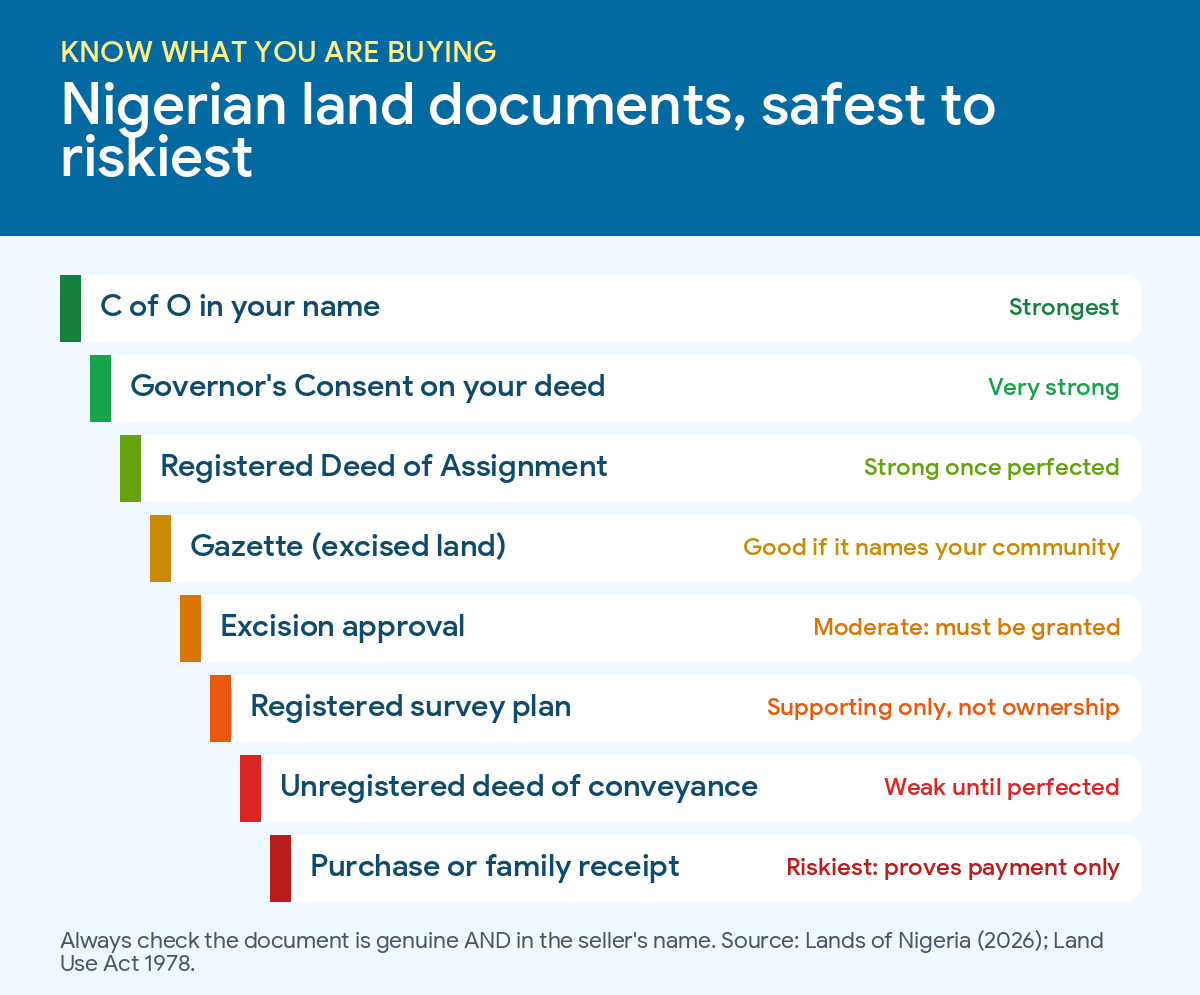
Land documents in Nigeria, from safest to riskiest
Under the Land Use Act of 1978, all land in each state is held by the state governor, and individuals hold a right of occupancy. That is why government-issued and government-approved documents give the strongest protection.
| Document | What it means | Strength |
|---|---|---|
| Certificate of Occupancy (C of O) in your name | The state has granted you a statutory right of occupancy | Strongest |
| Governor’s Consent on your Deed of Assignment | The state has approved the transfer of an existing title to you | Very strong |
| Registered Deed of Assignment | The agreement transferring the land from seller to buyer, stamped and registered | Strong once perfected |
| Gazette (for excised land) | Official publication confirming that land has been released from government acquisition to a named community | Good, if it names the right community |
| Excision approval | Government has released part of acquired land to the original community | Moderate; must be granted, not “in process” |
| Registered survey plan | Shows the land’s location and boundaries | Supporting only; does not prove ownership |
| Unregistered Deed of Conveyance | An older private transfer document not yet registered | Weak until perfected |
| Purchase receipt or family receipt | Proof that money was paid | Riskiest; proves payment, not ownership |
The most common losses come not from obviously fake papers but from a real document that belongs to someone else, or a genuine deed that was never perfected. Always verify the person as well as the paper.
Key terms explained
- Governor’s Consent: under Section 22 of the Land Use Act, transferring a right of occupancy without the governor’s consent is void. If a seller tells you consent is “not necessary”, treat it as a red flag.
- Excision: when the government has acquired a large area, it may later release (excise) parts of it back to the original communities. Only land covered by a gazetted excision can be safely bought from the community.
- Government acquisition: land the government has acquired for public use. It cannot be validly sold by families or individuals, and buildings on it can be demolished.
- Charting: a check by the state Surveyor-General’s office that shows whether a plot is free, under government acquisition, or covered by an existing title, based on the survey coordinates.
- Omo onile: a Yoruba term for members of land-owning families. Some sell the same land to multiple buyers or demand illegal fees from people building on it.
Step-by-step: how to buy land safely
- Hire a property lawyer and a registered surveyor before you pay anything. Do not use the seller’s lawyer or surveyor. Their fees are small compared with the cost of losing your land.
- Ask for copies of all title documents, then insist on seeing the originals. Photocopies can hide alterations and missing pages.
- Get the survey plan checked (charting). Your surveyor takes the coordinates to the Office of the Surveyor-General to confirm the plot is not under government acquisition, on a road or drainage setback, or overlapping someone else’s land.
- Conduct a search at the state land registry. Your lawyer checks that the title is genuine, who it belongs to, and whether it has a mortgage, a court case or another sale registered against it. A registry search typically costs about ₦10,000 to ₦50,000 and takes about 5 to 14 working days.
- Visit the land in person, more than once, including during the rainy season. Check the beacons match the survey plan, look for flooding, and ask neighbours who owns the land and whether there are disputes.
- Verify the seller. Match the seller’s ID to the name on the title. For family land, confirm the family head and principal members, who must sign the documents. For estates, check the developer’s own title and registration.
- Check for court cases at the relevant High Court registry if there is any sign of a dispute.
- Pay into a traceable account, never cash. Pay in the seller’s or company’s verified name, and keep every receipt.
- Sign a properly drafted Deed of Assignment (or Contract of Sale for estates), prepared by your lawyer.
- Perfect your title. Pay stamp duty, apply for the Governor’s Consent and register the deed at the land registry. Until you do this, your ownership is not fully protected.
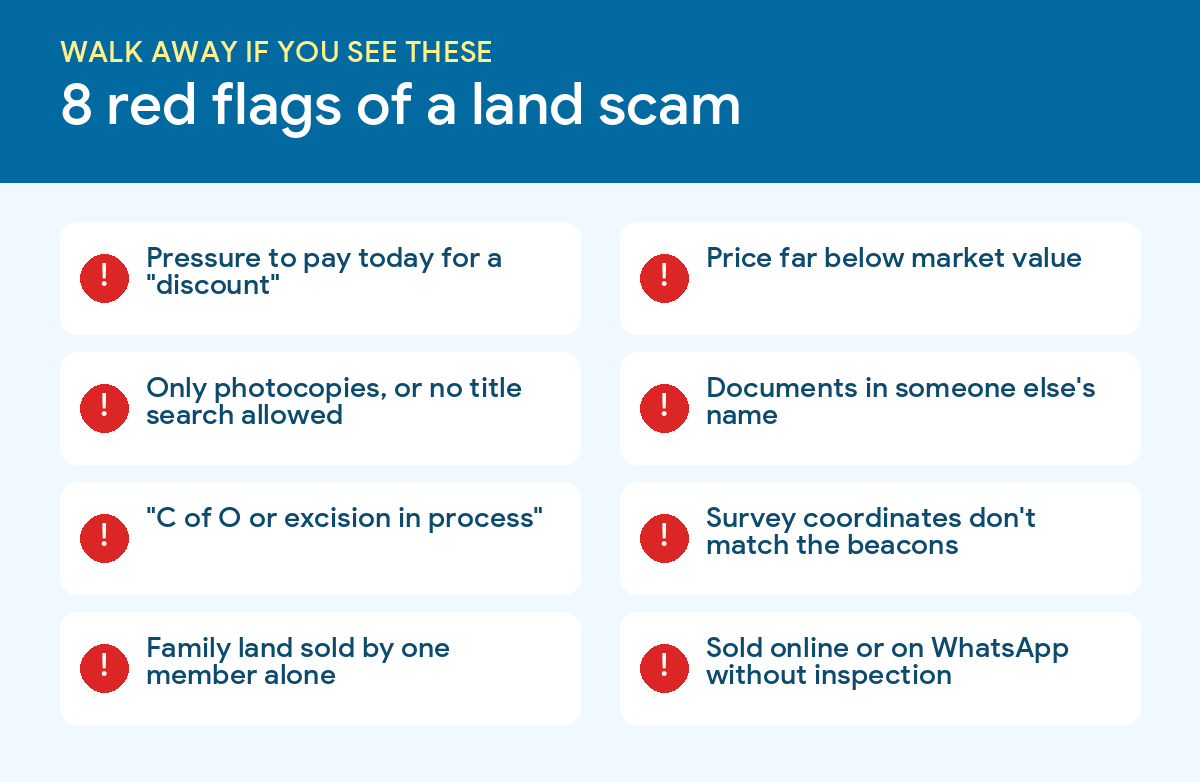
Red flags of a land scam
- The seller pressures you to pay quickly, offering a “discount” if you pay today.
- The price is far below the market value for the area.
- The seller can only show photocopies, or refuses to let your lawyer search the title.
- The documents are in someone else’s name and the seller cannot explain the chain of ownership.
- The seller offers only a receipt and survey plan, or says the C of O or excision is “in process”.
- The survey plan coordinates don’t match the beacons on the ground.
- Family land sold by one family member without the family head and principal members.
- Land sold online or via WhatsApp without an in-person inspection. See our guide to common WhatsApp scams in Nigeria.
- Very cheap plots in an area where you know the government has acquired land.
How much does it cost to buy and perfect land?
Besides the price of the land, budget for:
| Cost | Typical amount |
|---|---|
| Land registry search | About ₦10,000 to ₦50,000 |
| Survey plan verification (charting) | About ₦15,000 to ₦30,000 for the check |
| New survey plan (if needed) | From a few hundred thousand naira; in Lagos about ₦425,000 to over ₦4 million depending on location |
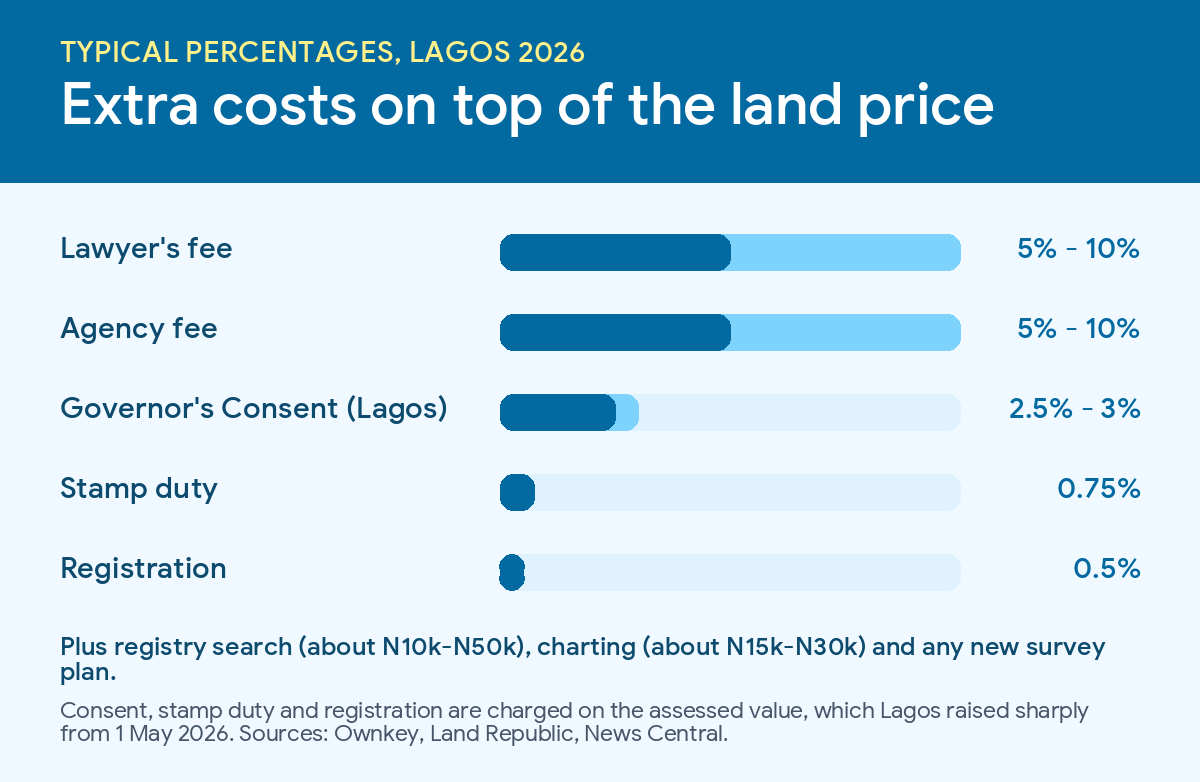
| Lawyer’s fee | Often 5% to 10% of the price, or a flat fee for smaller transactions |
| Agency fee | Often 5% to 10% of the price |
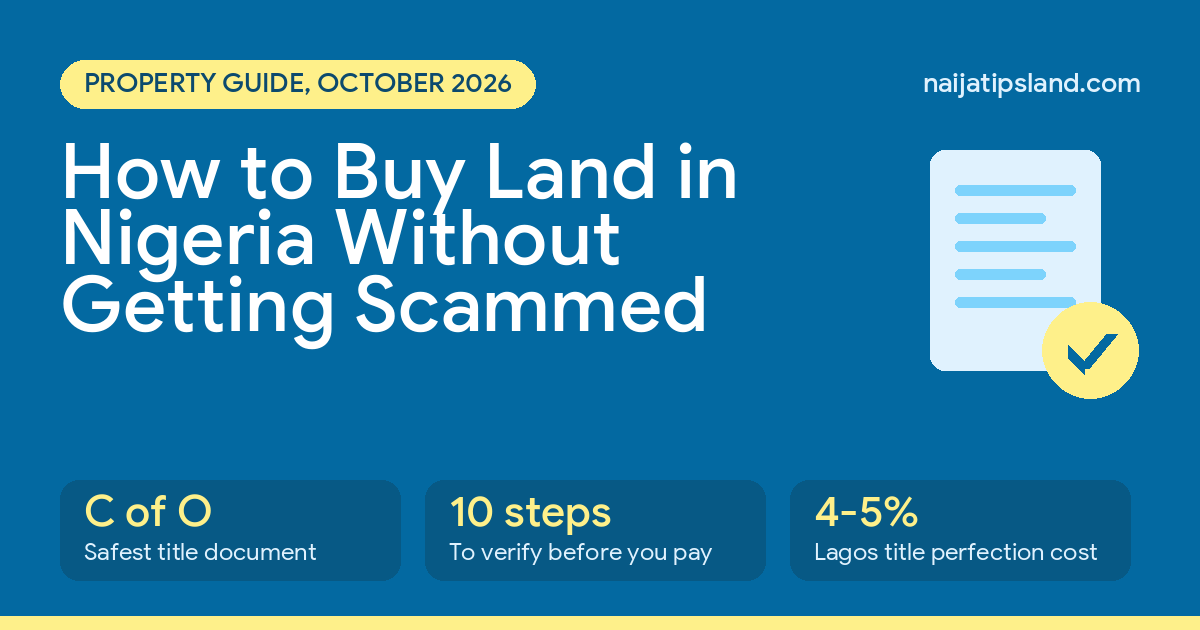
| Title perfection in Lagos (Governor’s Consent, stamp duty, registration) | About 4% to 5% of the assessed value |
| Development levy or community fees | Varies; some estates charge these |
In Lagos, the Governor’s Consent costs about 2.5% to 3% of the assessed value (including the consent fee and other charges), stamp duty is 0.75% for residential property above ₦3 million, and registration is about 0.5%. Note that from 1 May 2026, Lagos raised its official land valuations (the “Blue Book”) by roughly 300% to 525% in many locations. The percentages did not change, but because they now apply to much higher assessed values, consent and registration costs in areas like Lekki and Ikoyi have risen sharply. Getting the Governor’s Consent in Lagos typically takes 6 to 9 months for a complete file.
What the law says about land grabbers
Lagos State’s Properties Protection Law of 2016 makes land grabbing a crime. Among other things:
- Using force or threats to take over land can lead to up to 10 years’ imprisonment.
- Selling land you have no title to can attract a fine of up to the full value of the land, up to 5 years in prison, or both, and the land goes back to the rightful owner.
- Selling family land without the consent of the family head and principal members, selling government land, or reselling land already sold can attract up to 21 years.
- Demanding illegal fees or levies from people building on their land (“omo onile” fees) can attract a fine of up to ₦1 million, 2 years in prison, or both.
Lagos has a task force to enforce the law. If you face land grabbers, report to the police and the Lagos State Task Force on Land Grabbing, and talk to your lawyer. Other states have similar laws or are introducing them.
Buying land in Abuja and other states
- Abuja (FCT): land is administered by the FCT Administration, and titles are recorded by the Abuja Geographic Information Systems (AGIS). Search the title at AGIS through your lawyer, and be very careful with Area Council allocations and “regularisation” papers, which are a common route for forgery.
- Ogun State: popular with buyers working in Lagos. It runs an online land registry and e-consent system. Check excision and acquisition status carefully around the Lagos-Ogun border, the Lagos-Ibadan Expressway and Mowe-Ibafo.
- Other states: the documents and steps are similar, but fees, offices and timelines differ. Use a lawyer and surveyor who know the local registry.
Buying land from abroad
Many Nigerians in the diaspora have lost money buying land through relatives or online agents. To protect yourself:
- Hire your own independent lawyer and surveyor in Nigeria, and ask for their search reports in writing.
- Ask for a live video call from the land, with GPS coordinates, and compare them with the survey plan.
- Give a lawyer a specific power of attorney only if necessary, and limit what it allows.
- Pay directly to the verified seller’s account, not to relatives or agents, and send money in stages tied to documents. Compare the costs of sending money in our guide to the cheapest ways to send money between Nigeria and abroad.
- Prefer estates and developers with a proper C of O and a track record you can verify.
After you buy
- Perfect your title as soon as possible.
- Fence the land and put up a sign with your name and “not for sale”.
- Get building approval before you start construction. See our guide to the cost of building a house in Nigeria.
- Keep original documents safely and store scanned copies in the cloud.
- Visit regularly, or have someone you trust check on the land, to prevent encroachment.
If you plan to build and rent out, see our guide to the mistakes first-time landlords make in Nigeria.
Frequently asked questions
What is the safest land document in Nigeria?
A Certificate of Occupancy in your own name, or a registered Deed of Assignment with the Governor’s Consent when you buy land that already has a C of O.
Is a survey plan proof of ownership?
No. A survey plan only shows the location and boundaries of the land. It does not prove who owns it.
Can I buy land with only a receipt?
A receipt proves only that you paid money. It is the riskiest way to buy land. If you buy family or community land, make sure it is covered by a gazetted excision, and get a properly signed deed and survey plan.
How do I check if land is under government acquisition?
Ask a registered surveyor to chart the survey coordinates at the state Surveyor-General’s office. The report shows whether the land is free, under acquisition or already titled.
How long does it take to get the Governor’s Consent?
In Lagos, typically 6 to 9 months for a complete application, and longer if documents are missing.
Sources
- Lands of Nigeria: land title documents ranked safest to riskiest (August 2026)
- Land Republic: how to verify land ownership in Nigeria, 2026 checklist
- Ownkey: property title perfection in Nigeria, 2026
- News Central: Lagos raises property transaction fees (July 2026)
- LawPavilion: Lagos State Properties Protection Law 2016
- AllAfrica: Wike nullifies 485 Abuja land documents over forgery (February 2026)
- Lagos State Lands Bureau: schedule of fees