Affiliate Marketing in Nigeria With No Money (2026): How to Start Free, Best Programmes and How You Get Paid

Last updated: 28 October 2026 · By Naijatipsland Editorial Team · Editorial policy
Affiliate marketing is one of the few online income routes that really can be started with no capital: you recommend someone else’s product, and you earn a commission when a customer buys. There is no stock to buy and no shop to rent. But it is also surrounded by hype, fake gurus and “join for a fee” schemes, so it pays to know exactly how it works, which programmes are real and what the money looks like before you spend a single hour on it.
This guide explains affiliate marketing for Nigerians in plain terms, using the programmes’ own published rules where possible. It also covers how you actually get paid, which is the part most beginner guides skip.
What affiliate marketing is, in one minute
A company wants customers. You have an audience, even a small one, such as a WhatsApp group, a TikTok page, a blog or a circle of friends who trust your advice. You recommend the product with a tracked link or code. If someone buys, the company pays you a share. You do not handle money, delivery or customer service.
Two things decide whether you earn: whether people trust you, and whether the product genuinely suits them. Links dropped into random groups almost never work. Helpful, honest recommendations do.
Programmes you can join without paying
Jumia JForce
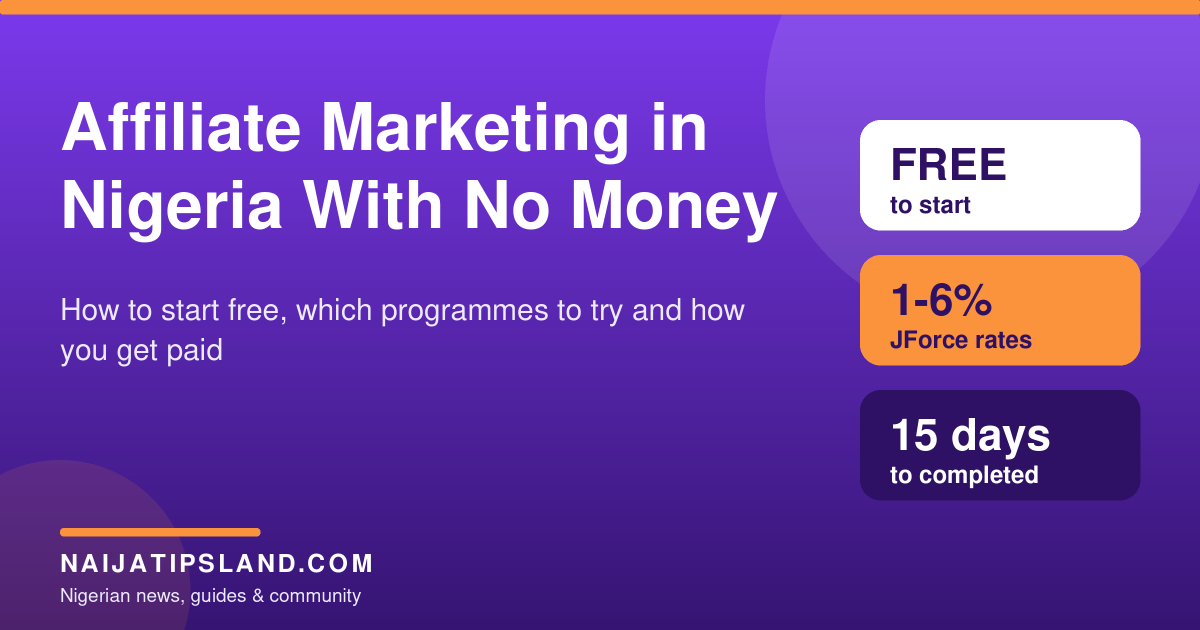
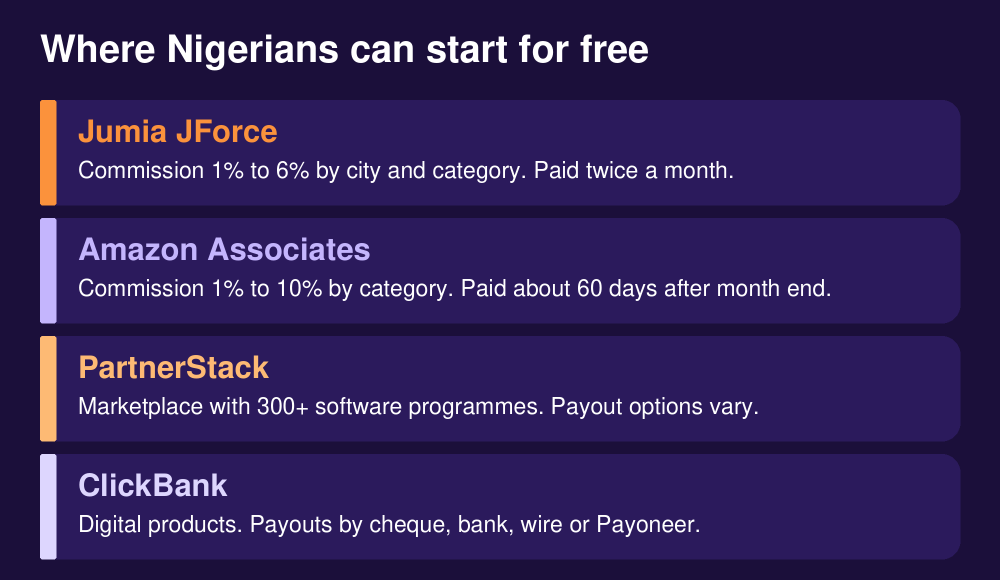
Jumia runs JForce, which it describes as a way to earn as a sales consultant and affiliate marketer. According to Jumia’s page, joining is free and Jumia says it will never ask for money to become a consultant. Commission depends on where you are and what is sold. In Lagos, Abuja and Ibadan the published rates are 1%, 2% and 3% for low, medium and high categories; in other cities they are 2%, 4% and 6%. Mobile phones and computers sit in the low bucket, televisions in the medium bucket, and beauty items in the high bucket.
The rules matter more than the headline rates. Jumia states that consultants must place delivered orders worth at least ₦65,000 twice a month to be eligible, commission is paid only on items that reach “completed” status 15 days after delivery, and flash sale items earn nothing. Payouts are listed for the 15th to 18th of the month and the 2nd to 5th of the following month. In practice it works best if you already help friends, family or a campus community buy things, since orders are placed through your JForce account. Some third-party guides still describe a separate link-based Jumia affiliate scheme at higher percentages through an affiliate network, so check Jumia directly for what is open today.
Amazon Associates
Amazon pays commission of roughly 1% to 10% depending on product category, and its help pages say commissions are paid about 60 days after the end of the month in which they are earned, by direct deposit, gift card or cheque. The catch for Nigerians is the payment side: Amazon’s direct deposit instructions refer to US-style bank details, and the programme’s country rules can change. Many guides mention Payoneer as a workaround, but you should confirm in Associates Central what your country and account allow before building content around it.
PartnerStack and ClickBank
PartnerStack is a marketplace with more than 300 programmes, mostly software, which are free to join; commission and payout rules vary by company. ClickBank sells digital products such as courses and software, with commission rates set by each seller, and lists cheque, direct deposit, wire transfer and Payoneer as payout options with a default payout threshold of USD 100, according to third-party roundups. Digital products can pay far higher percentages than shop products, but they are also where low-quality offers live, so read reviews and refund terms and never promote what you would not buy yourself.
Local digital-product programmes
Some Nigerian course and e-book platforms advertise commissions of 50% or more. These figures come from the sellers and from affiliate roundups, so treat them as claims to test. Check that the product is real, that the seller is reachable, and that you will be paid before you promote it.
How to start with no money, step by step
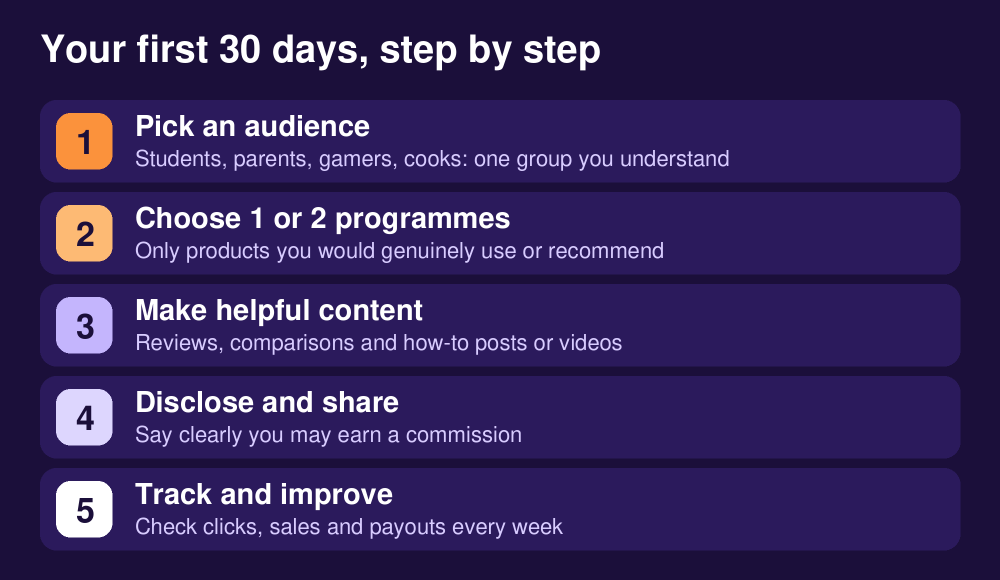
- Choose an audience you understand. Students, new parents, gamers, home cooks, small business owners. A narrow audience beats “everyone”.
- Pick one or two products you would use yourself. Your credibility is your only asset.
- Create something useful for free. A short video reviewing the product, a comparison, a “how I fixed X” post, or a helpful answer in a group. Our guides on earning online in Nigeria and user-generated content show formats that work.
- Add your link and say you may earn a commission. Honest disclosure builds trust and is also expected by law and by platforms.
- Share where your audience already is. WhatsApp status, a Facebook group where you are a genuine member, TikTok or YouTube. See how to make money on TikTok in Nigeria and how to start a YouTube channel for the platform rules.
- Track results weekly. Clicks, orders and cancellations tell you what to repeat.
What can you realistically earn?
Honestly, most beginners earn little or nothing in the first months. Percentages of 1% to 6% on shop products mean that a ₦200,000 sale earns a few thousand naira, and you only get that after delivery and the completion period. Programmes with higher percentages on digital products can pay more per sale, but you still need real buyers. Anyone who quotes you a guaranteed monthly figure is selling a course, not describing the market.
A better way to think about it: affiliate income is a side income that grows with the trust you build. Start with a small audience, learn what they buy, and keep the work consistent. Our pieces on side hustles, passive income and online business ideas put this in context.
How you get paid
- Local programmes such as Jumia pay in naira, normally to a bank account you verify with them.
- International programmes usually pay in dollars. Look at the payout methods before joining: bank transfer, Payoneer, cheque, gift card or PayPal availability differ by programme and country.
- Thresholds. Many programmes hold your earnings until you pass a minimum, such as USD 10, 50 or 100, so small earners can wait months.
- Waiting periods. Amazon pays about 60 days after month end; Jumia pays after the item completes.
- Tax. Income is income. Keep records and ask a qualified adviser about your obligations in Nigeria or the UK if you are based there.
Disclosure and the rules
If you earn from a link, say so next to the link, in plain words such as “I may earn a commission if you buy through this link”. The US Federal Trade Commission asks for exactly this, and Nigerian law firms point out that the Federal Competition and Consumer Protection Act prohibits misleading endorsements, including undisclosed sponsorships. Platforms such as YouTube and TikTok also expect it. This is general information, not legal advice.
Scams that use the word “affiliate”
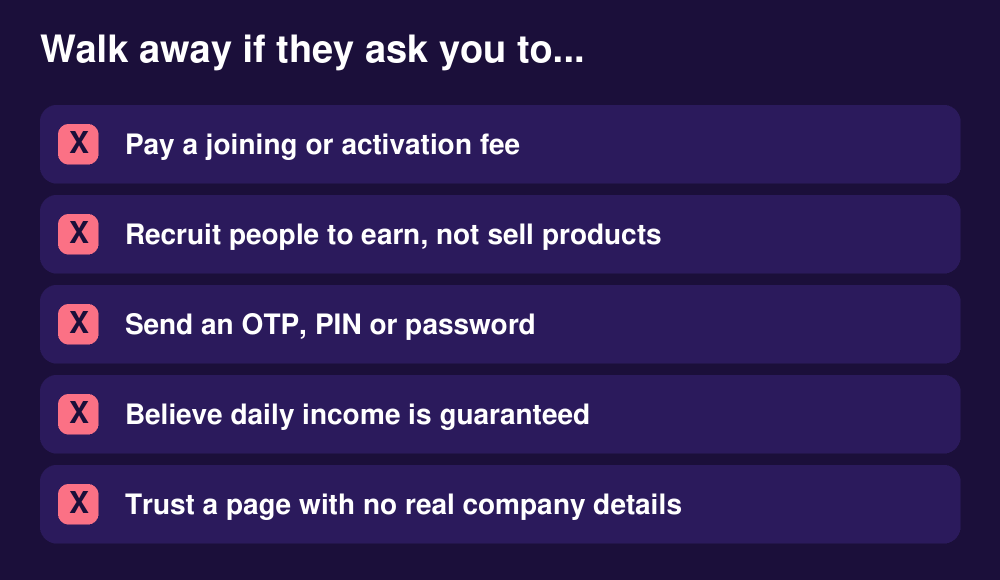
Real affiliate programmes are free to join and pay you for sales. Many scams borrow the name. Be very careful if someone asks you to pay to activate an account, promises daily income, pays you mainly for bringing in other people, asks for an OTP, PIN or password, or sends you to a page with no real company details. That pattern is a Ponzi or pyramid scheme; read how Ponzi schemes work and how internet scams operate. If you are thinking about what to do with money you earn, our beginner investing guide is a safer place to start than any “double your money” offer.
Mistakes beginners make
- Spamming links in groups, which gets you muted and removed.
- Promoting five programmes at once instead of mastering one.
- Choosing products only for the commission rate.
- Ignoring cancellations and returns, which can cancel commission.
- Quitting after the first quiet month.
A worked example, with honest numbers
Say you help students at your campus buy phones and accessories through JForce. Suppose you place one delivered order of ₦300,000 for a phone in a city outside Lagos, Abuja and Ibadan. Phones sit in the low bucket, so the published rate there is 2%. That is ₦6,000, paid only after the order is completed, and only if you also meet the ₦65,000 twice-monthly delivered-order requirement. Now compare a ₦20,000 beauty order in the high bucket outside the big three cities at 6%: ₦1,200. The lesson is that volume and repeat customers matter far more than any single sale, and that your own rules and category mix change the result. Do the arithmetic for your own situation before you promise yourself an income.
Niche ideas that suit Nigerian audiences
- Student life. Laptops, power banks, data-saving apps and study tools, sold to a campus audience you already belong to.
- Home and cooking. Kitchen appliances, cookware and ingredients, paired with recipes such as party jollof rice.
- Phones and gadgets. Honest comparisons of phones in a budget range beat generic “best phone” lists.
- Skills and software. Tools for freelancers, designers and small businesses, where programmes pay by the sale or subscription.
- Diaspora needs. Travel, money transfer and shopping products for Nigerians abroad, who often have a higher budget.
Content you can make this week
- A 60-second video reviewing one product you own, saying what you liked and what you did not.
- A comparison of two products in the same price range, with a clear recommendation for each type of buyer.
- A “things I wish I knew before buying” post.
- A short WhatsApp status with a single useful tip and your link, no more than once or twice a week.
- An answer to a question in a group where you are a real member, mentioning the product only if it genuinely helps.
Affiliate terms in plain English
- Commission: the percentage or fixed amount you earn per sale.
- Cookie window: how long after a click a purchase still counts for you. Third-party guides list 30 days for some programmes and 24 hours for Amazon, so check the programme itself.
- Payout threshold: the minimum balance before the company pays you.
- Completed or approved: the stage after delivery and any return period, when commission becomes payable.
- Clawback: commission removed when an order is cancelled or returned.
Frequently asked questions
Can I do affiliate marketing in Nigeria without money?
Yes. Reputable programmes are free to join. You need a phone, data and time, and some way to reach an audience.
Which affiliate programme is best for beginners in Nigeria?
Jumia JForce is a natural first step if you already help people buy things, because it pays in naira. Digital-product programmes pay higher percentages but need more care.
How do Nigerians receive affiliate payments?
By local bank transfer for Nigerian programmes, and through bank transfer, Payoneer or other methods for international ones. Check each programme’s payout rules first.
Do I need a website?
No. A social page, a YouTube channel or WhatsApp broadcast can work, although a simple blog helps long term. See small business ideas for ways to build a brand around it.
Programme terms, commissions and payout rules change often. Confirm the current terms with each company before you start. This guide is general information and not financial advice.
Sources
- Jumia Nigeria: JForce programme page
- Amazon Associates Central: When will I get paid?
- Amazon Associates Central: Direct deposit
- Reclaim: affiliate programme payout roundup
- Shopify Nigeria: best affiliate programmes
- US FTC: Disclosures 101 for social media influencers
- Trusted Advisors: influencer marketing regulation in Nigeria