
TL;DR:
- User-generated content (UGC) increases engagement and trust more than traditional branded ads in Nigeria.
- Effective UGC campaigns involve community identification, simple prompts, incentives, moderation, rights clearance, and cross-platform sharing.
- UGC’s true power lies in its cultural authenticity, fostering loyalty through relatable, locally influenced content.
Most Nigerian marketers spend heavily on polished branded ads, yet UGC drives 28% higher engagement than that content, and between 79% and 92% of consumers trust it more. That gap is significant. User-generated content (UGC) is reshaping how brands connect with audiences across Nigeria, from Lagos street markets to Abuja tech hubs. Yet many digital marketers and content creators still treat it as an afterthought. This guide walks you through exactly what UGC is, how it works, why it matters in the Nigerian context, and the practical steps you need to launch your own successful UGC campaign.
Table of Contents
- What is user generated content (UGC)?
- How UGC works: Mechanics and best practices
- Why UGC matters: Business impact and Nigerian case studies
- Challenges and risks: Moderation, authenticity, and Nigerian nuances
- Getting started: Actionable steps for Nigerian marketers
- Expert perspective: The real power of UGC and what most guides miss
- Ready to supercharge your brand with UGC?
- Frequently asked questions
Key Takeaways
| Point | Details |
|---|---|
| UGC is authentic and trusted | User-generated content earns more trust and drives higher engagement than branded content alone. |
| Local campaigns boost results | Nigerian brands using culturally relevant UGC see real business impact and resilient communities. |
| Effective UGC needs strategy | Success comes from clear incentives, moderation, and adapting content for diverse platforms. |
| Risks require management | Legal, cultural, and quality risks demand proactive rights, moderation, and compliance processes. |
What is user generated content (UGC)?
Now that you know UGC can drive impressive engagement, let’s start with what it actually means.
User-generated content is any content such as photos, videos, reviews, blog posts, or social media posts created by unpaid users or customers about a brand, product, or service, rather than by the brand itself. In simple terms, it is your audience speaking on your behalf without being paid to do so. That distinction matters enormously for trust.
UGC shows up in many forms across digital platforms. Here are the most common types Nigerian marketers encounter:
- Social media posts: A customer sharing a photo of your product on Instagram or Twitter
- Video reviews: TikTok clips where users demonstrate or react to a product
- Written reviews: Google, Jumia, or forum reviews from real buyers
- Comments and forum threads: Discussions on platforms like Naijatipsland.com where users share opinions
- Blog posts: Independent write-ups created by customers or fans
- Memes and humor content: Locally flavored creative content that spreads organically
Why does authenticity matter so much? Because Nigerian consumers, like consumers everywhere, are increasingly skeptical of polished advertising. When a real person from Ibadan or Port Harcourt shares their experience with your brand, it carries social proof that no studio-produced ad can replicate.
| Content type | Trust level | Engagement potential |
|---|---|---|
| Branded ads | Low to moderate | Moderate |
| Influencer posts (paid) | Moderate | Moderate to high |
| Organic UGC | High | High |
| Peer reviews | Very high | Very high |
The table above shows a clear pattern. The less a brand controls the message, the more audiences tend to believe it. That is a counterintuitive reality that smart Nigerian marketers are beginning to act on. UGC is not just cost-effective; it is structurally more persuasive than content your team produces in-house.
How UGC works: Mechanics and best practices
With the basics clear, let’s look at how marketers and brands actually source and manage UGC.
Effective UGC processes include community identification, branded hashtag challenges, incentives, moderation, rights clearance, and repurposing. That is the full cycle. Here is how to move through it step by step:
- Identify your community. Know who your most engaged followers are. On Instagram and TikTok, look at who tags you organically. On forums, track who mentions your brand name.
- Launch a branded hashtag. Create a simple, memorable hashtag tied to your campaign. Make it easy to spell and relevant to Nigerian culture. Think of something that invites participation rather than just promotion.
- Offer the right incentives. In Nigeria, airtime, data bundles, product discounts, and public shoutouts work well. Monetary prizes attract volume, but recognition often drives quality.
- Moderate actively. Set clear community guidelines before launching. Assign someone to review submissions daily. Remove content that is offensive, misleading, or off-brand.
- Secure rights before reposting. Always ask for permission in writing, even if it is a simple direct message. Screenshot the approval. This protects your brand legally.
- Repurpose across platforms. A strong TikTok video can become an Instagram Reel, a website testimonial, and a WhatsApp status. Maximize each piece of UGC across channels.
Pro Tip: Keep your submission process as simple as possible. If users need to fill out a long form or jump through multiple steps, participation drops sharply. One hashtag and one clear prompt is often enough to get started.
The most overlooked step is rights clearance. Many Nigerian brands repost UGC without asking, which creates legal exposure. A quick comment or DM asking for permission takes 30 seconds and protects you from future disputes.
Why UGC matters: Business impact and Nigerian case studies
Understanding mechanics is only half the story. Next, let’s see real-world impact and Nigerian success examples.

The numbers make a strong case. UGC yields up to 100% conversion lifts and 28% higher engagement than branded content. For Nigerian brands operating in a competitive and cost-sensitive market, those figures translate directly to better return on ad spend and stronger community loyalty.
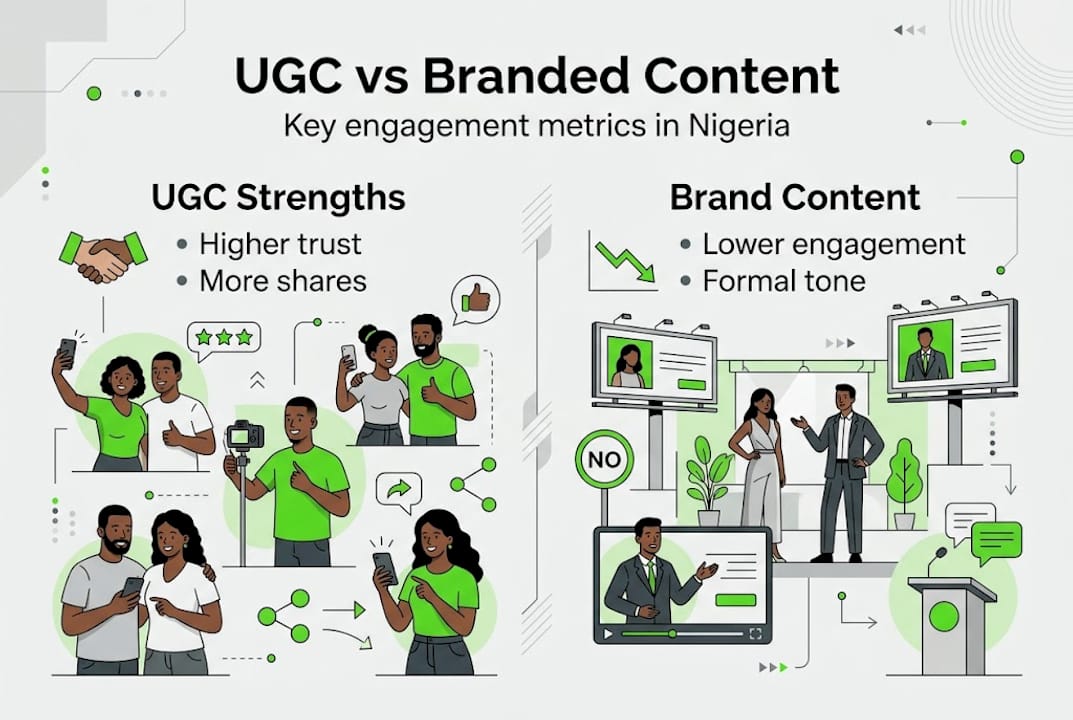
Look at what Nigerian brands have already achieved. Indomie’s #MyIndomieMyStyle campaign generated thousands of posts and millions of impressions across social platforms. Guinness Nigeria used UGC-style storytelling to connect with football fans during major tournaments. Jumia encouraged product reviews and photos from buyers, which boosted purchase confidence among new shoppers. MTN ran community challenges that rewarded customers for sharing creative content tied to their network experience.
These campaigns worked because they tapped into something real. Nigerian consumers responded because the content felt local, relatable, and human.
“The most powerful marketing in Nigeria is not what a brand says about itself. It is what Nigerians say to each other.”
| Metric | Branded content | UGC campaigns |
|---|---|---|
| Average engagement rate | 1.5% to 3% | 4% to 6% |
| Consumer trust | Moderate | High |
| Cost per piece of content | High | Low to none |
| Conversion lift | Baseline | Up to 100% higher |
Understanding how influencer impact in Nigeria compares to organic UGC also helps you allocate budget wisely. And if you are running paid campaigns alongside UGC, knowing the digital ads impact on Nigerian brands helps you build a complete strategy rather than relying on one channel alone.
Challenges and risks: Moderation, authenticity, and Nigerian nuances
As UGC’s influence rises, understanding risks becomes critical. Let’s address the challenges Nigerian marketers face.
UGC is powerful, but it is not without risk. Key risks include intellectual property violations, false claims, privacy breaches, cultural misinterpretations, spam, negative reviews, AI-generated fakes, and the need for hybrid moderation systems.
Here are the most pressing challenges for Nigerian brands specifically:
- Copyright issues: Users may post content featuring third-party music, images, or logos. Reposting that content exposes your brand to IP claims.
- Cultural misinterpretation: Nigeria is diverse. Content that resonates in one region may offend in another. Yoruba humor may not land the same way in the North, and vice versa.
- Misinformation: Users may make false claims about your product, either intentionally or accidentally. Without moderation, this spreads quickly.
- AI-generated fakes: In 2026, AI tools make it easy to fabricate reviews or testimonials. Brands need to verify authenticity before amplifying content.
- Negative review floods: A single bad experience, amplified by social media, can spiral. Having a response protocol ready is essential.
Content moderation is not optional. Unmoderated UGC can become toxic quickly, and that toxicity reflects on your brand. The solution is a hybrid approach: automated filters for obvious violations, combined with human review for context-sensitive content.
Pro Tip: Before launching any UGC campaign, review your brand’s position on sensitive topics like religion, ethnicity, and politics. Nigeria’s social landscape is complex, and a campaign that accidentally touches a cultural nerve can do more harm than good. Reading up on social media etiquette in Nigeria and understanding internet communities in the local context will help you set better community guidelines from day one.
Getting started: Actionable steps for Nigerian marketers
With pitfalls in mind, here’s how you can confidently launch your own UGC initiative.
Successful UGC strategies use clear goals, simple submission processes, incentives, AI-assisted and human moderation, and omnichannel repurposing. Here is your step-by-step launch plan:
- Define your goal. Are you building brand awareness, driving sales, or growing your community? Your goal shapes every other decision. Be specific: “We want 500 user posts in 30 days” is better than “We want more engagement.”
- Choose the right platform. Instagram and TikTok work best for visual and video UGC. Twitter (now X) suits opinion-based content and trending topics. WhatsApp groups and forums like Naijatipsland.com are strong for community discussions and reviews.
- Create a simple prompt. Tell your audience exactly what to do. “Share a photo using our product with #BrandNameNaija for a chance to win N50,000 in airtime” is clear, motivating, and easy to act on.
- Set up moderation before launch. Assign a team member or use a moderation tool. Define what content gets approved, flagged, or removed. Have a response template ready for negative submissions.
- Secure rights and permissions. Before reposting any user content, request explicit permission. Document it. This is non-negotiable.
- Promote and amplify. Share the best submissions on your official channels. Tag the creators. This motivates more participation and rewards your community publicly.
- Measure results. Track reach, engagement rate, conversion, and volume of submissions. Compare against your baseline branded content performance.
Pro Tip: If you are just starting out, consider learning how to start a blog in Nigeria as a complementary channel. Blogs are excellent for hosting long-form UGC like guest stories, testimonials, and community case studies that social media cannot accommodate well.
Expert perspective: The real power of UGC and what most guides miss
Having covered the practicalities, let’s dig deeper into what truly makes UGC work in the Nigerian context.
Most guides treat UGC as a cost-cutting tool. Get free content from your audience, repost it, save money. That framing misses the point entirely.
The real power of UGC in Nigeria is cultural resonance. When a brand invites Nigerians to express themselves, with their humor, their slang, their local references, it stops being a transaction and becomes a conversation. That shift is what drives genuine loyalty. Campaigns that perform best are not the most polished ones. They are the ones that gave people creative freedom.
Over-moderation is a silent campaign killer. When brands filter out anything that does not match their brand guidelines perfectly, they strip out the personality that made the content valuable in the first place. You want some rough edges. That is what makes it feel real.
Understanding the meaning of viral news in Nigeria also helps you see why UGC spreads the way it does. Nigerians share content that makes them laugh, that reflects their reality, or that gives them something to debate. Build campaigns that invite those responses, and the organic spread takes care of itself.
Ready to supercharge your brand with UGC?
If you have read this far, you already understand that UGC is one of the most effective tools available to Nigerian digital marketers in 2026. The next step is putting it into practice.
Naijatipsland.com is built for exactly this kind of community-driven engagement. Whether you want to learn how to get starting online discussions going or understand the impact of digital ads alongside your UGC efforts, you will find practical, Nigeria-specific resources here. Explore more guides on our platform and start building the kind of audience participation that turns casual followers into loyal brand advocates.
Frequently asked questions
What types of UGC work best in Nigeria?
Short videos, memes, authentic reviews, and campaign hashtags on TikTok and Instagram drive high engagement locally, as Nigerian UGC campaigns consistently show that local culture and humor are the strongest engagement drivers.
How can brands encourage people to create UGC?
Brands should use simple prompts, offer rewards, and spotlight community stories. Clear goals and frictionless submission processes, combined with strong incentives, significantly increase participation rates.
Are there legal risks with UGC in Nigeria?
Yes. IP violations, privacy breaches, and cultural misinterpretations are real risks, so always moderate actively, secure permissions, and consider local cultural contexts before reposting any user content.
Is paid influencer content considered UGC?
Paid influencer content is generally less authentic than organic UGC. Unpaid organic UGC is considered the most credible form and should be managed and amplified differently from paid creator partnerships.