

Last updated: 16 October 2026 · By Naijatipsland Editorial Team · Editorial policy
Every few weeks a new message does the rounds on WhatsApp, Facebook and email: a government agency is hiring, the application is open, and you only need to send your CV, your NIN and a small fee. Thousands of Nigerians looking for work respond, because the need is real and the message looks official. Then the agency says it never sent it. In 2026 alone, the Federal Ministry of Finance, the Nigeria Revenue Service and the Ministry of Foreign Affairs have all had to publicly disown fake recruitment messages. This guide covers the recruitment scams that target job seekers in Nigeria, what the agencies themselves say, the red flags that give them away, how to verify a real vacancy, and how to report a scam if you have been caught.
Our separate guide to fake job ads in Nigeria covers adverts on job boards and social media. This one focuses on recruitment scams that impersonate real employers, especially government bodies, and on reporting. Everything below comes from official statements reported in the news and from reporting guides, and we say where a source is a commercial site. This is general information, not legal advice.
The short answer
- Real recruitment does not charge you. The Federal Ministry of Finance said in July 2026 that federal civil service recruitment does not require payment at any stage, and the Ministry of Foreign Affairs said the same about its postings.
- Check the official website. Genuine government vacancies are announced on the agency’s own site and official accounts, not through private messages.
- Be suspicious of any “offer” you did not apply for, any form that asks for a fee, and any request for your NIN, ID and birth certificate by email or WhatsApp.
- If you paid, contact your bank straight away, keep your evidence and report through official channels.
What government agencies have said in 2026
Fraudsters keep reusing the names of real agencies. Recent public warnings include:
- Federal Ministry of Finance (July 2026). The ministry disowned a message titled “Administrative Update and Compliance Notice for Newly Recruited Staff” that demanded a non-refundable N50,000 “administrative fee” before new staff could resume duty. It said the message did not come from its offices and told people to ignore it, make no payments and not share personal or financial information.
- Nigeria Revenue Service (October 2026). The NRS said a circulating graduate job advert was fraudulent. The advert used the old name, the Federal Inland Revenue Service, offered posts for a “2026/2027 session”, set a 24 October deadline and told applicants to email CVs to an address with no connection to the NRS. It asked for a birth certificate, an ID and a National Identification Number (NIN). The NRS said it had not authorised any recruitment or appointed any agent to recruit for it, and that real vacancies appear on its official website and channels.
- Ministry of Foreign Affairs. The ministry disowned a message saying people had been shortlisted for consular roles abroad, asking for a fee for a “credence note” and referring to DSS clearance. It said it does not recruit by email, WhatsApp or unsolicited contact, that no fees are required, and that legitimate recruitment goes through official government channels. It told people who received such messages or were asked to pay to report to the Nigeria Police Force and the Department of State Services.
- Federal Character Commission (July 2026). In a public awareness post reported by Legit.ng, the commission listed ways to stay safe. Genuine recruitment never requires paying individuals outside official channels, information from unknown links, private messages or unofficial groups should be treated with caution, government openings follow open and transparent processes, no individual can guarantee a job, and people should verify before acting.
- EFCC (2023). The Economic and Financial Crimes Commission has previously warned about a fake recruitment portal built to look like its own website, and said people promoting such schemes risk arrest and prosecution.
The pattern is the same: a notice that looks official, a deadline, a request for money or documents, and a contact that is not the agency’s own.
The common recruitment scam tactics
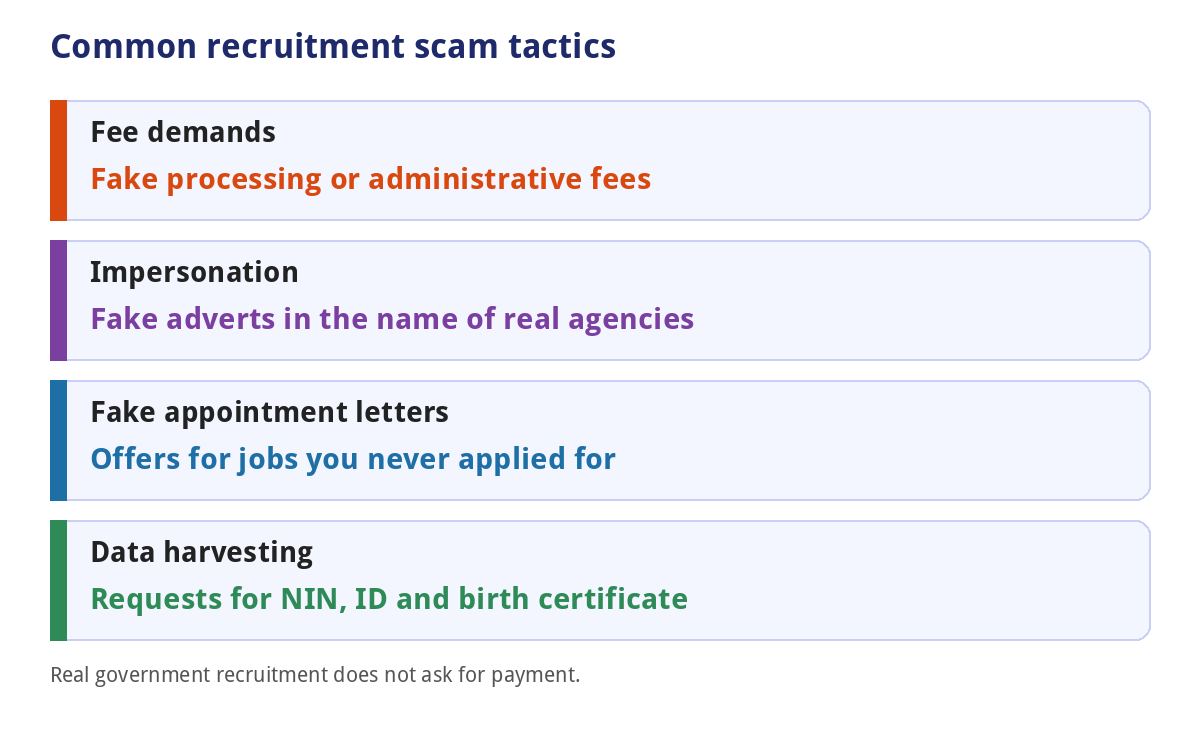
- The “administrative” or “processing” fee. You are told you have been shortlisted or employed, but must pay a fee for a form, a uniform, clearance, a medical or a “credence note”. The fee is the scam.
- The impersonated agency. The message copies the name, logo and sometimes the old name of a real body. The NRS case used the former FIRS name, which should make you ask why a 2026 advert uses an outdated name.
- The fake appointment letter. You get a letter for a job you did not apply for, with a start date and a request for payment or personal data.
- The data grab. The aim is not money but your NIN, ID, birth certificate, BVN or bank details, which can be used for identity fraud. See our guides on data privacy in Nigeria and digital identity.
- The shady recruiter or agent. A person claims they can “get you in” for a fee, using contacts. The Federal Character Commission says no individual can guarantee a job.
- The WhatsApp or Telegram group. A channel “for applicants” collects numbers, pushes deadlines and sends payment links. See our guide on WhatsApp scams.
- The fake portal. A website that looks like the real one, with a look-alike address, collects your details and a fee. Always type the official address yourself.
Red flags
- You are asked to pay anything to be considered, hired, cleared or to “resume”.
- You did not apply, or the employer is not one you applied to.
- The message comes through WhatsApp, a private message, a personal email or an unknown link, not the agency’s website.
- The email address does not match the organisation’s official domain.
- The advert uses an old agency name, spelling mistakes or an urgent deadline.
- You must send your NIN, birth certificate and ID before any interview.
- The payment goes to a personal account, not an organisation.
- Someone promises a guaranteed job or says you will be “given a slot”.
How to check a vacancy
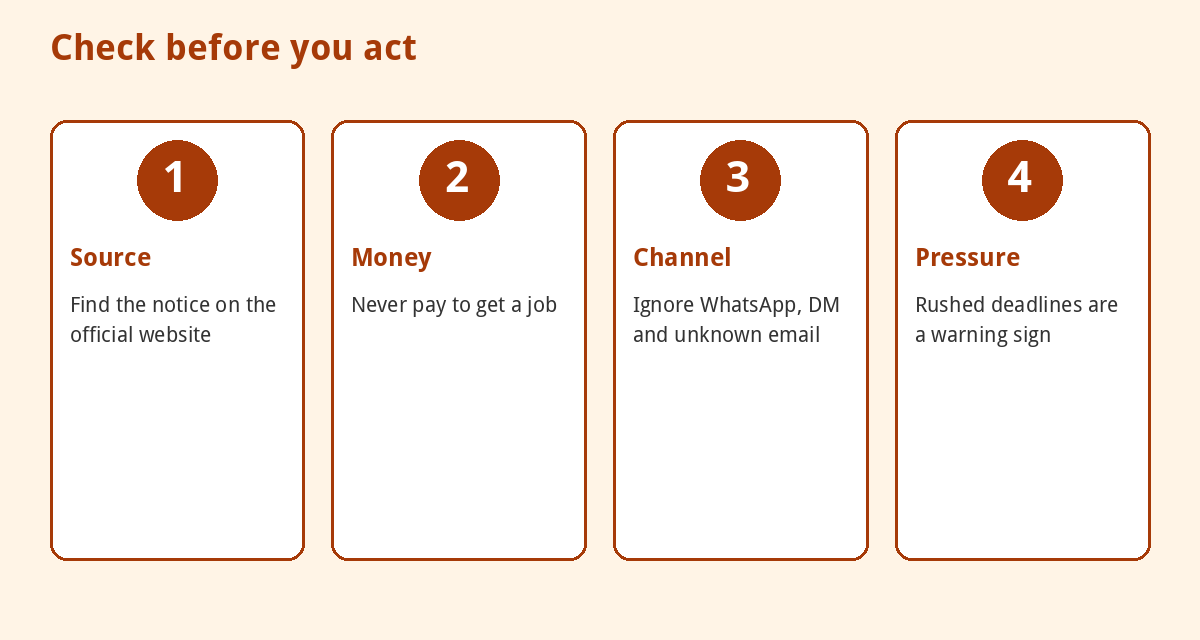
- Go to the organisation’s official website yourself. Type the address; do not click the link in the message. Federal vacancies are listed on official sites such as the Federal Character Commission’s website and the agency’s own pages.
- Look at the agency’s official social media accounts for a notice or a warning about fakes.
- Compare the details. Names, deadlines, email addresses and application steps should match the official page.
- Call or message the official contact you found yourself, not the numbers in the message.
- Search the exact wording of the message. Agencies often post disclaimers, and news sites repeat them.
- Slow down. Scammers use deadlines to stop you checking.
For private-sector jobs, see our guides to writing a cover letter and your LinkedIn profile, and check the company’s own careers page. A real employer will not ask you to pay for a job, an interview or a laptop.
If you have already paid or shared your details
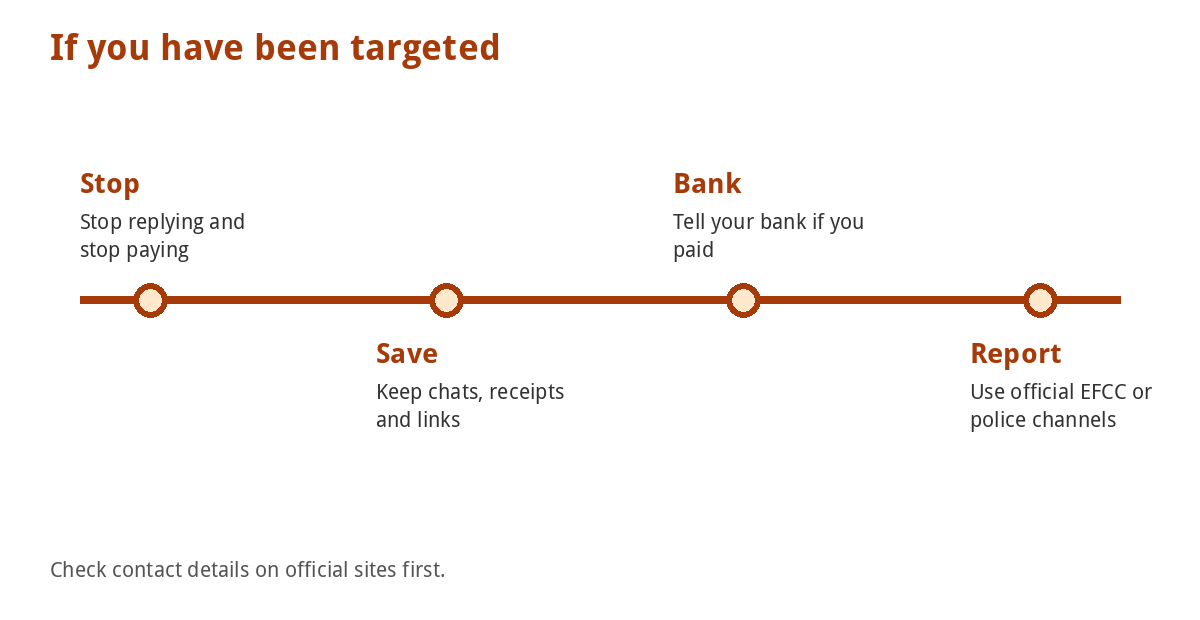
- Stop replying and stop paying. Scammers often ask for more once you have paid.
- Save everything. Screenshots of chats, phone numbers, usernames, links, receipts, transaction references and the recipient’s account details.
- Tell your bank immediately if you transferred money. Give them the details and ask what they can do. See our guide to recovering money sent to the wrong account for how banks handle disputes.
- Protect your identity. If you sent your NIN, BVN or ID, watch for unexpected accounts or loans in your name and change passwords. Our guide to verifying your NIN explains how to check your records.
- Report it. The Ministry of Foreign Affairs advises reporting to the Nigeria Police Force and the DSS, and the Ministry of Finance advises law enforcement agencies or the ministry’s official channels. The EFCC also accepts reports. A reporting guide from Naijasabi lists the EFCC website, a toll-free line, an email address and zonal offices, but warns that scammers set up fake EFCC pages and numbers, so check the details on the EFCC’s official site first.
- Tell the agency being impersonated, through its official channels, so it can warn others.
- Warn friends and groups where the message is circulating.
For a general approach to online fraud, see our guides to internet scams in Nigeria and online safety.
Common mistakes
- Paying a fee because the notice looks official.
- Trusting a forwarded WhatsApp image without checking the agency’s website.
- Sending your NIN and documents to a free email address.
- Not reading the sender’s address and spelling.
- Feeling embarrassed and not reporting, which lets the scam continue.
- Sending the same documents to many “recruiters”.
- Using a contact from the message to “verify” the message.
Frequently asked questions
Does the federal government charge for jobs?
The Ministry of Finance said federal civil service recruitment does not require payment at any stage, and the Ministry of Foreign Affairs said no fees are required for recruitment or postings.
How do I know a vacancy is real?
Find it on the organisation’s official website or verified social media account, which you reach by typing the address yourself, and compare every detail.
What if I already sent my NIN?
Monitor your accounts, change passwords, be careful of calls and messages that use your details, and report it. Do not send more documents.
Can a recruiter really get me a slot?
The Federal Character Commission says no individual can guarantee a job and that selection follows official procedures.
Is an email from a Gmail address always fake?
Government agencies normally use their official domains. A personal email address claiming to be an agency is a serious warning sign.
Where should I report?
Law enforcement such as the police, the DSS or the EFCC, your bank if you paid, and the agency that was impersonated. Use contact details from official websites.
Will I get my money back?
Not always. Reporting quickly gives you the best chance, but recovery is not guaranteed.
Bottom line
If a job needs money first, it is not a job. Verify every vacancy on the organisation’s official website, ignore messages that rush you or ask for documents by email or WhatsApp, and never pay anyone to be hired. If you are caught, act fast: stop paying, keep evidence, tell your bank and report through official channels, and warn others so the scam stops with you.
Sources
- Premium Times via allAfrica: Finance Ministry warns job seekers against extortion (30 Jul 2026)
- Rio Times: Nigeria Revenue Service says recruitment advert is fake (Oct 2026)
- Voice of Nigeria: Nigeria warns against fake diplomatic recruitment
- Legit.ng: Federal Government lists 5 ways to stay safe from recruitment scams (30 Jul 2026)
- ICIR: Again, EFCC warns against fake recruitment portal (2023)
- Naijasabi: How to report a scammer to the EFCC (June 2026) (commercial; contact details unverified)
Join the discussion
Have you tried this, or do you have a question we did not answer? 4 readers have already shared their views. Naijatipsland members help each other with real, first-hand experience.






Notice the outdated name. The fake NRS advert still called the agency FIRS, which should make anyone ask why a 2026 notice uses an old name. What small detail has tipped you off about a fake vacancy?
Some of these scams aren’t after money at all. They want your NIN, BVN and ID for identity fraud. Have you ever been asked to send personal documents before an interview, and what did you do?
The Federal Ministry of Finance said in July 2026 that federal civil service recruitment does not require payment at any stage. Have you or someone you know been asked to pay for a job, and how did you respond?
Be suspicious of any offer you didn’t apply for and any request for your NIN or birth certificate by email or WhatsApp. What was the strangest fake job offer you’ve received?