
How to Write a CV for UK Jobs as a Nigerian (2026): Format, What to Leave Out, Visa Wording and a Sample Layout

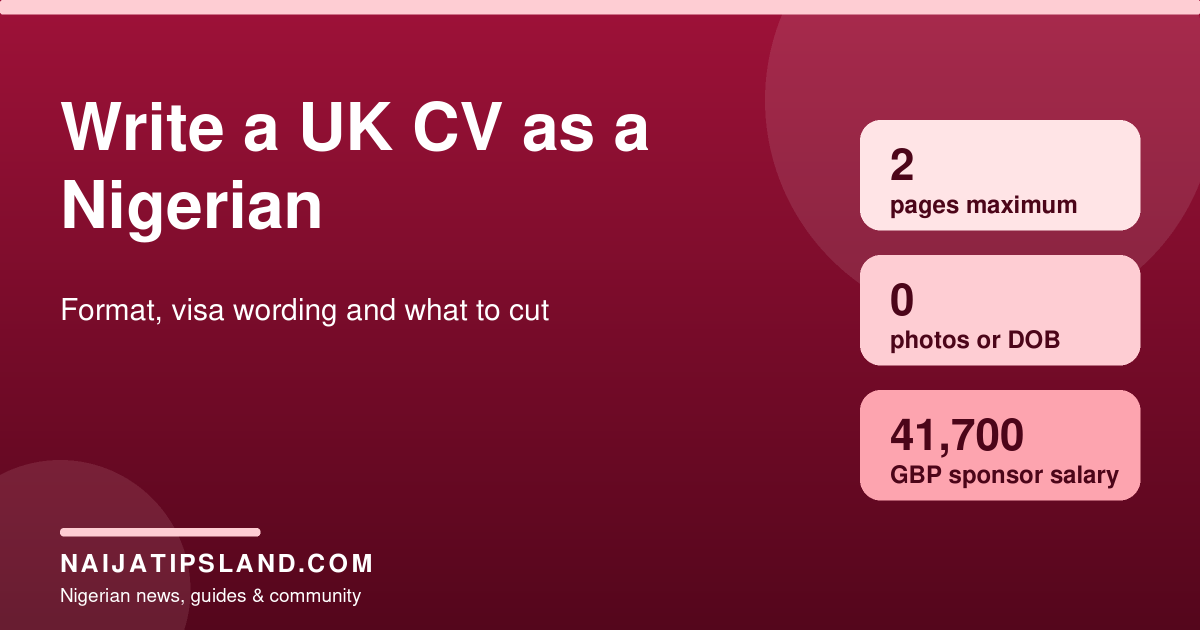
Last updated 27 November 2026. Visa salary figures and fees are the ones published at the time of writing. Check GOV.UK and UK ENIC before you rely on them.
Many Nigerians send UK employers the same CV that worked in Lagos or Abuja, and then wonder why nobody calls back. The problem is rarely your experience. A Nigerian CV and a UK CV follow different rules, and a recruiter in Manchester who sees a passport photo, a date of birth and “State of Origin: Ogun” on page one will often move straight to the next applicant.
I live and work in the UK, and I have watched friends go from months of silence to interviews within weeks after fixing a handful of things on their CVs. This guide covers those things: the format UK employers expect, what to cut, how to present WAEC, NYSC and a Nigerian degree, what to say about your visa, and how to get past the software that screens CVs before a human reads them.
If you are applying for jobs inside Nigeria, our CV writing guide for Nigerian jobs is the better fit. This one is for UK roles.
What a UK CV looks like
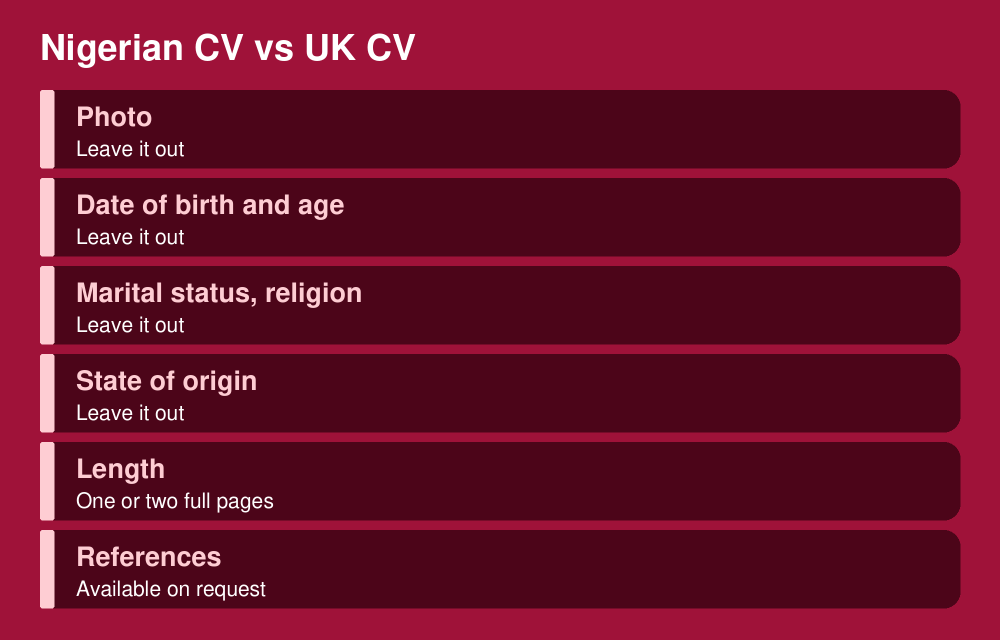
A UK CV is short and plain. The University of Dundee careers service, which advises many international students, says a standard CV should run to one or two full pages and that half pages look unfinished. Two pages is the normal ceiling for most jobs. Academic CVs, medical CVs for NHS roles and some senior technical roles run longer, but if you are not sure, stay at two.
The order the National Careers Service recommends is:
- Contact details
- A short introduction, often called a personal profile
- Work history, most recent first
- Education
- Skills, certifications and training
- References, or a line saying they are available on request
If you are a recent graduate with little work experience, put education above work history. Everyone else should lead with work.
Don’t write “Curriculum Vitae” at the top. Your name is the heading. Use a clean font such as Arial or Calibri at 10 to 12 point, normal margins and no tables, text boxes, icons or skill bars. Those designs look nice on Canva but many screening systems can’t read them.
What to leave out
This is where most Nigerian CVs go wrong. UK equality law, mainly the Equality Act 2010, makes employers careful about information that could lead to discrimination, and the National Careers Service tells candidates to leave out age, date of birth, marital status and nationality. Recruiters expect you to know this.
Take these off your CV:
- Your photo
- Date of birth or age
- Marital status, number of children and religion
- State of origin, LGA and hometown
- Gender and nationality
- Hobbies like “reading, travelling and making friends” (keep a hobby only if it shows a skill, for example captaining a football team or running a church media unit)
- Your full home address in Nigeria (city and country, or your UK town, is enough)
- Full referee names and phone numbers, unless the advert asks for them
Also drop the old “Career Objective” paragraph that says you want “a challenging position in a reputable organisation.” UK recruiters see that line every day and it tells them nothing.
Contact details and the profile
At the top put your name, a UK mobile number if you have one (or your Nigerian number with +234), a sensible email address and a LinkedIn link. If you are still in Nigeria, write the city, for example “Lagos, Nigeria (relocating to the UK, available from March 2027)”. That one line answers the first question a recruiter has.
Your LinkedIn profile should match your CV. Our LinkedIn profile guide for Nigerian job seekers walks through the headline and About section.
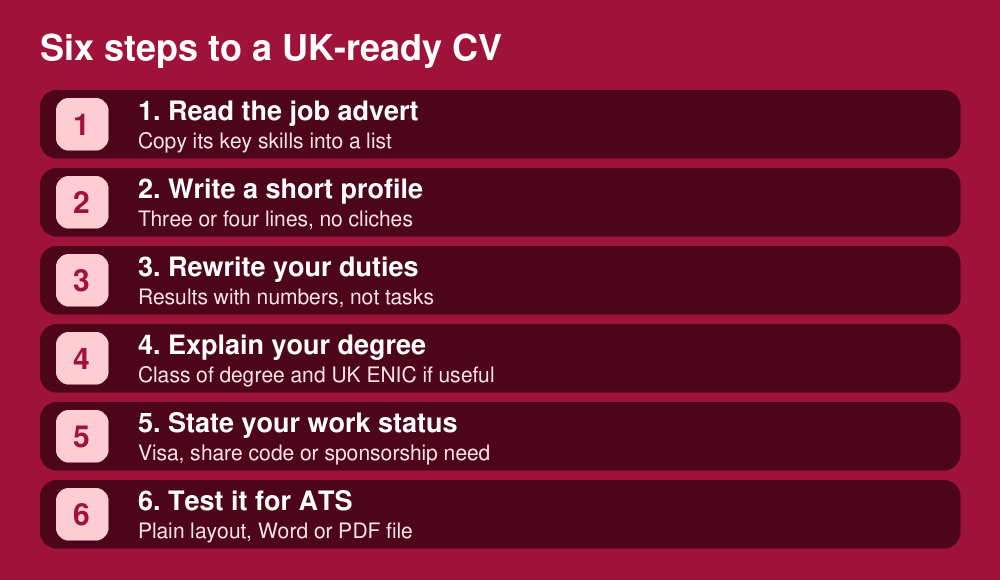
The profile is three or four lines about who you are, what you are good at and what you want next. Write it for the job you are applying for. A weak one says: “Hardworking and result-oriented professional with excellent communication skills.” A better one says: “Chartered accountant with six years in audit at a Big Four firm in Lagos, including IFRS reporting for banks with assets over N2 trillion. Looking for an audit senior role in the UK. Eligible to work under a Graduate visa until 2028.”
Writing your work history the UK way
For each job give the employer, your job title, the dates (month and year) and the town. Then write three to six bullet points. UK careers services push the STAR method: situation, task, action, result. In practice, that means each bullet should say what you did and what came of it.
Compare these two lines:
- “Responsible for managing customer accounts.”
- “Managed 140 SME customer accounts and cut overdue payments by 30% in 12 months by setting up weekly reminder calls.”
The second one gets interviews. Numbers, sizes and outcomes do the work for you.
Explain Nigerian employers the recruiter may not know. “Access Bank” may mean nothing to a hiring manager in Leeds. Write “Access Bank Plc (one of Nigeria’s largest commercial banks, over 50 million customers)” the first time. The same goes for government agencies, oil service firms and family businesses.
Gaps are fine if you explain them in a line: “Career break: relocation to the UK, June to October 2026.” Don’t leave a year blank and hope nobody notices.
How to present WAEC, NYSC and a Nigerian degree
List your highest qualification first. Write the degree as it appears on your certificate, then add what a UK reader needs: “BSc Mechanical Engineering, Second Class Upper, University of Lagos, 2016.”
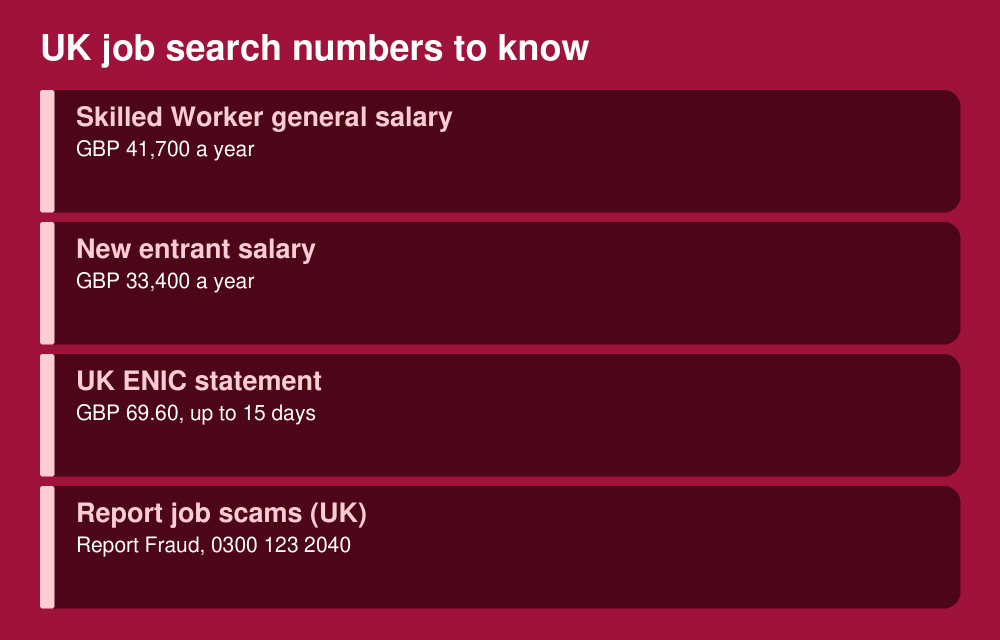
If an employer asks how your degree compares with a UK one, or if you are applying for a regulated or graduate scheme job, a UK ENIC Statement of Comparability helps. UK ENIC lists the standard service at £69.60 with a processing time of up to 15 working days once it has all your documents. Many employers don’t ask for it, so don’t buy one for every application. Add a line such as “UK ENIC: comparable to a UK Bachelor (Honours) degree” only after you have the statement and it says that.
WAEC or NECO results only need one line unless the job is entry level: “WASSCE, 2010, including English Language and Mathematics.” Some employers ask for GCSE English and Maths “or equivalent”, so mentioning that you passed both helps.
NYSC is worth including. Put it under work history as “National Youth Service Corps (NYSC), one-year national service” with your place of primary assignment and what you did there. Teaching at a secondary school or working in a ministry for a year is real experience.
Professional bodies matter in the UK. If you are ICAN, CIPM, COREN, NMCN or CITN qualified, say so and add the UK body you are working towards, for example “ACCA exemptions applied for” or “NMC registration in progress.” Our guide on moving abroad from Nigeria lists the main UK regulators by profession.
What to say about your visa and right to work
UK employers must check that every worker has the right to work. If you don’t tell them your status, many will assume you need sponsorship and reject you without asking. Put one clear line under your contact details or at the end of your profile.
Examples that work:
- “Right to work in the UK: Graduate visa valid until September 2028. Share code available.”
- “Right to work in the UK: Skilled Worker dependant visa, no restrictions on work.”
- “Requires Skilled Worker visa sponsorship.”
The share code comes from the GOV.UK “Prove your right to work” service, which uses your eVisa. You give it to the employer when they ask, not on the CV itself.
If you need sponsorship, be honest and aim your search well. The employer must hold a sponsor licence, which you can check on the GOV.UK register of licensed sponsors. The job usually has to meet the general salary threshold of £41,700 a year, or the new entrant rate of £33,400 for people under 26, recent graduates and some others, as well as the going rate for that occupation. Those figures have applied since 22 July 2025. Check GOV.UK for the occupation codes and going rates before you apply. Our list of the easiest work visas for Nigerians covers routes with and without a job offer, and our guide to UK recruitment agencies for Nigerians lists agencies that place sponsored workers.
Getting past applicant tracking systems
Most large UK employers and agencies use an applicant tracking system (ATS) that reads your CV and ranks it before a recruiter looks. Recruiters often spend only a few seconds on the first scan of the CVs that get through. To get through:
- Use the job title and key skills from the advert, word for word where they are true for you. If the advert says “stakeholder management”, don’t write only “working with partners”.
- Stick to standard headings: Profile, Work experience, Education, Skills.
- Save as Word (.docx) or a text-based PDF, whichever the site asks for. Never upload a scanned image.
- Name the file properly: “Adeola-Bakare-CV.pdf”, not “CV final final 2.pdf”.
- Spell out abbreviations once: “Central Bank of Nigeria (CBN)”.
Use British spelling (organise, programme, colour) and UK date formats. Small things like that tell the reader you have done your homework.
A sample UK CV layout
Here is a simple outline you can copy into Word:
- Name (large, bold)
- Town, country | phone | email | LinkedIn
- Right to work line
- Profile: three or four lines
- Work experience: job title, employer, town, dates, then three to six result bullets per role
- Education: degree, class, university, year; professional qualifications; WASSCE in one line
- Skills: software, languages (English, Yoruba, Igbo, Hausa and others count), certifications
- References available on request
Write a cover letter or supporting statement for every application, even when it says optional. It is where you explain why you want that employer and how your Nigerian experience fits. NHS and council jobs score the supporting statement against the person specification, so answer each point in turn.
Common mistakes I see
- A four-page CV listing every training course since 2012
- Sending the same CV to every job without changing the profile or keywords
- American spelling and “resume” instead of CV
- Writing duties copied from a job description instead of results
- No mention of visa status, so the employer assumes the worst
- Unprofessional email addresses such as “sweetboy4real@…”
- Paying a stranger on WhatsApp who promises a UK job plus a sponsored visa for a fee
That last one matters. In February 2026 the British High Commission and NAPTIP warned Nigerians to verify overseas job offers, naming recruitment only through social media and demands for upfront payment as red flags. A real UK employer doesn’t charge you for a job. If you are already in the UK and get a suspicious offer, report it to Report Fraud, the service that replaced Action Fraud, on 0300 123 2040.
Once the interviews start
A good CV gets you a call, so prepare for it. UK interviews lean on competency questions (“Tell me about a time you handled a difficult customer”), and the STAR bullets you wrote for your CV are your answers. Have your share code or visa details ready, keep copies of your certificates, and if you are moving soon, read our guide to renting in the UK as a new Nigerian arrival so the housing side doesn’t catch you out.
Frequently asked questions
Should I put a photo on my CV for UK jobs?
No. UK employers don’t expect a photo and many prefer not to receive one, because it can open them to discrimination claims. Models, actors and some customer-facing roles are the exceptions, and the advert will say so.
How long should a UK CV be?
One or two full pages for most jobs. Academic and some medical CVs are longer.
Should I mention that I need visa sponsorship?
Yes. Hiding it wastes your time and the employer’s. Apply mainly to licensed sponsors whose salaries meet the Skilled Worker rules.
Do UK employers accept Nigerian degrees?
Many do. If an employer wants a comparison, a UK ENIC Statement of Comparability shows how your degree compares with UK levels.
Do I need a cover letter?
Send one whenever the application allows it. For NHS, civil service and council jobs, the supporting statement often decides who gets shortlisted.
Should I list my referees’ phone numbers?
No. Write “References available on request” and give details when the employer asks, usually after an interview.
Sources
- National Careers Service: CV sections
- University of Dundee: CV writing guidance for international students
- UK ENIC: Statement of Comparability cost
- GOV.UK: Skilled Worker visa going rates for eligible occupations
- DavidsonMorris: Skilled Worker visa minimum salary
- GOV.UK: Report Fraud, new service from City of London Police
- Vanguard: Verify overseas job offers before accepting, UK and FG warn Nigerians
Join the discussion
Have you tried this, or do you have a question we did not answer? Be the first to share your experience. Leave a comment below. Every comment is read by the editor before it appears.




Editor note: are you applying for UK jobs from Nigeria or already here on another visa? Tell us your field and the part of your CV that keeps getting rejected, and we will try to help. Please do not post your full CV, phone number or address in the comments. – Ade