Last updated: 16 October 2026 · By Naijatipsland Editorial Team · Editorial policy
The UK Skilled Worker visa lets you work in Britain for an employer that has been approved to sponsor overseas staff. For Nigerians it has been one of the most searched routes abroad, but it has changed a lot since July 2025. Most care jobs no longer qualify, the job must now be at degree level, the salary bar is higher, and English must be at B2 level. This guide explains who can apply, what it costs, what documents you need, how long it takes and how to avoid the fake job-offer scams that have caught many Nigerians.
The figures below come from UK immigration advisers, law firms and news reports dated 2025 to 2026, and where they disagree we say so. The Home Office changes rules often, so check GOV.UK before you apply or pay anyone. This is general information, not legal advice.
The short answer
- You need a job offer from a licensed UK sponsor and a certificate of sponsorship (CoS) that the employer gives you.
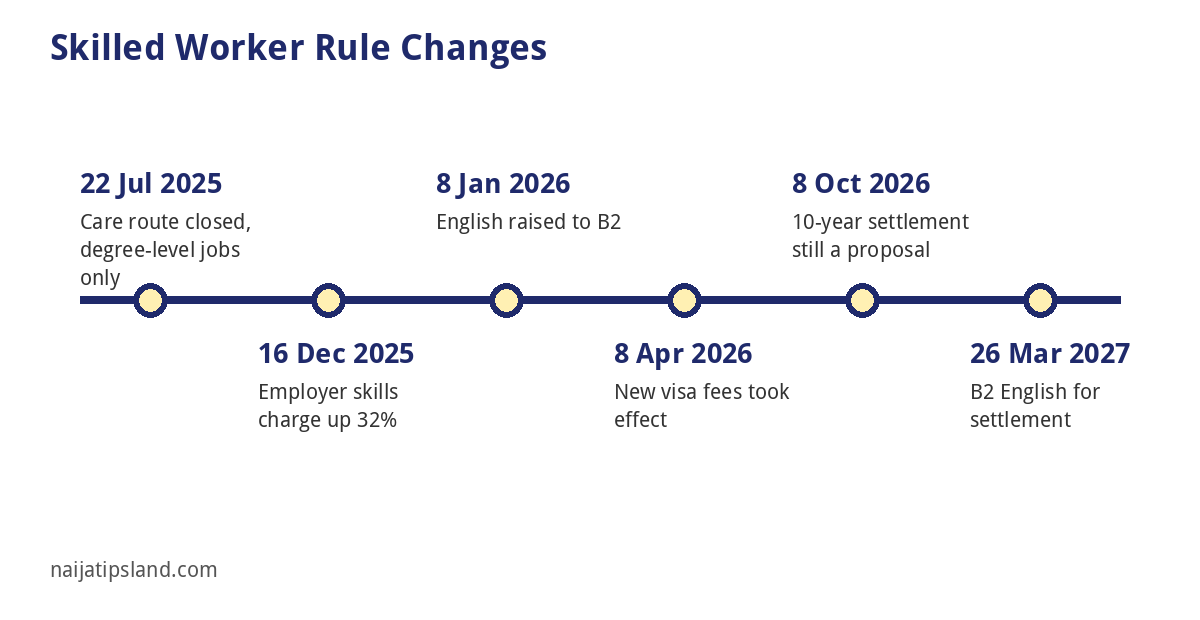
- The job generally must be at degree level (RQF level 6). Overseas care worker recruitment through the Skilled Worker route ended on 22 July 2025.
- The general salary threshold is reported at £41,700 a year, or the going rate for your job if that is higher. A lower new entrant rate of £33,400 is reported for people under 26 and some recent graduates.
- New applicants need English at B2 level from 8 January 2026, up from B1.
- Nigerians applying from Nigeria also need a tuberculosis (TB) test certificate for stays over six months.
- The proposed move to a 10-year wait for settlement was still a proposal, not law, in an adviser summary dated 8 October 2026.

Who can apply
To qualify, you need a job offer from an employer on the Home Office’s register of licensed sponsors, a job that is on the list of eligible occupations at the required skill level, and a salary that meets both the general threshold and the going rate for that job. The higher figure applies. You also need to meet the English requirement and, if the Home Office asks, show you can support yourself.
Skill level and salary
Since 22 July 2025, sources say the job must be at RQF level 6, which is bachelor’s degree level, or above. Many roles at lower levels, including most care, hospitality, admin and trade jobs, no longer qualify for the standard route. One adviser says 111 occupations lost eligibility. Workers who were already on a Skilled Worker visa before 22 July 2025 can reportedly keep using the old rules until 22 July 2028 if their permission stays continuous.
The general salary threshold rose from £38,700 to £41,700. One adviser article gives a different date in its FAQ, but the main body and another source both say 22 July 2025. The new entrant rate of £33,400 applies to under-26s, people in a first job after study and those switching from a Student or Graduate visa. Special rates exist for some PhD holders and for jobs on the Immigration Salary List. Check the exact figure for your job code on GOV.UK.
English
Nigeria is not on the list of majority English-speaking countries, so being Nigerian does not exempt you. New applicants since 8 January 2026 need B2 English, shown with a UKVI-approved test or, in some cases, a degree taught in English that the UK checks through its qualification-recognition service. One adviser says B2 equals an IELTS score of 5.5 in each component, but another gives a wider 5.5 to 6.5 range, so confirm what your test must show. Existing visa holders extending can usually stay on the older B1 level.
How the application works
- Find a licensed sponsor. Search the Home Office register of licensed sponsors. Only employers on it can lawfully offer sponsored work.
- Get a job offer and a CoS. The employer assigns you a certificate of sponsorship with a reference number. For applicants outside the UK it is a defined CoS that states your job and salary, so check they match your offer.
- Take an English test if you are not exempt, and book your TB test with an approved clinic.
- Apply online and pay the visa fee and health surcharge.
- Attend your biometrics appointment at the visa application centre and upload your documents.
- Wait for a decision. One adviser says standard processing takes about three weeks, with faster paid options. These are guides, not promises.
Documents to have ready
- Valid passport and your CoS reference number.
- Proof of English, such as an approved test result.
- TB test certificate from an approved clinic. The UK government lists IOM centres in Lagos and Abuja for this. A 2014 notice put the cost at US$130 for adults, so check the current price when you book.
- Proof of funds if your sponsor is not covering your costs. A 2023 report put this at £1,270 held for 28 days, but your sponsor can certify that it will cover your first month. Check the current rule on GOV.UK.
- Degree certificates, a criminal record certificate if your job requires one, and your partner and children’s documents if they are applying with you.

What it costs
One adviser lists these application fees, effective from 8 April 2026:
- Skilled Worker, applying from outside the UK: £819 for a visa up to 3 years, and £1,618 for over 3 years.
- Skilled Worker, applying from inside the UK: £885 up to 3 years, and £1,751 over 3 years.
- Jobs on the Immigration Salary List, outside the UK: £628 up to 3 years and £1,235 over 3 years.
- Dependants pay the same fee as you.
You also pay the Immigration Health Surcharge, listed at £1,035 per person per year of leave. For one adult that is £3,105 for three years. Health and Care Worker visa holders are exempt from it. For your employer, a certificate of sponsorship costs £525 and sponsors pay an Immigration Skills Charge, which rose by 32% on 16 December 2025 to £1,320 a year for medium and large sponsors and £480 for small and charitable ones. The family totals in one adviser source did not add up, so work out your own total from the official GOV.UK fee page.
Important: a legitimate sponsor pays for the certificate and the skills charge. Be very suspicious of anyone who asks you to pay for a CoS, a ‘sponsorship slot’ or a job placement.
Bringing family
Your partner and children can apply as your dependants, and they pay the same visa fee and health surcharge as you. Each needs a TB test if they are over the age threshold and stay more than six months. Check their documents match yours, especially names and dates of birth.
Settlement: what is confirmed and what is not
Time on a Skilled Worker visa counts toward indefinite leave to remain (ILR). The government has proposed an ‘earned settlement’ system that would move the usual wait from five years to ten, and up to fifteen for some lower-skilled jobs. A summary dated 8 October 2026 says this is not yet in force and has no confirmed start date. It also says a separate rule raising the English requirement for settlement to B2 is due from 26 March 2027. A solicitor summary dated 29 September 2026 says the latest immigration rules change, HC 584, does not move the Skilled Worker settlement period from five to ten years. The ILR fee has been reported at £3,226 since 8 April 2026. Plan for the possibility that the wait will be longer, and recheck the rules before you commit.
Beware of sponsorship scams
Fake job offers have caught many Nigerians, especially in care. The UK media have reported middlemen taking large sums for jobs that do not exist, and agents and fake employers sometimes belong to the same network.
- Check the employer on the Home Office register of licensed sponsors yourself, and make sure the company name and address match.
- Do not pay for a CoS or a job. Employers pay those costs.
- Be wary if the pay or job looks odd, such as a salary far above or below normal for the role.
- Ask for the CoS reference and make sure the job and salary on it match your contract.
- Remember you cannot easily switch employers if the sponsor lets you down, so a bad sponsor can trap you.
If you are weighing other routes abroad, see our guides to the cheapest UK universities for Nigerian students, the Canada study permit and the US visa interview for Nigerians.
Frequently asked questions
Can a Nigerian get a UK care worker visa in 2026?
Overseas recruitment for care workers through the Skilled Worker route ended on 22 July 2025. The Health and Care Worker visa has its own rules, so check GOV.UK for what is open to new applicants.
What is the minimum salary?
Reported at £41,700 a year or the going rate for your job, whichever is higher, with a £33,400 new entrant rate for some applicants.
What English level do I need?
B2 for new applicants since 8 January 2026.
Do I need a TB test?
Yes, if you apply in Nigeria for a UK visa lasting more than six months. Book with an approved clinic.
Can I pay someone to find me a sponsor?
Be very careful. Licensed sponsors pay their own costs, and many fraud cases involve agents who take money for fake jobs.
Is the 10-year wait for settlement in force?
Not as of the latest summaries we found, dated early October 2026. It was still a proposal.
Bottom line
The Skilled Worker route now suits Nigerians with a degree-level job offer from a real sponsor, B2 English and a salary above the threshold. Verify the employer yourself, never pay for a certificate, add up the costs on GOV.UK and recheck the settlement rules before you move.
Sources
- Relocly: Skilled Worker visa changes 2026
- Davidson Morris: Skilled Worker visa fees and sponsor costs 2026
- Centuro Global: UK immigration 2026 changes
- Migrate UK: ILR rule changes 2026, what is confirmed
- NW Solicitors: UK immigration rules changes October 2026 (HC 584)
- BusinessDay: how to protect yourself from UK Skilled Worker visa scams
- GOV.UK: pre-entry TB screening for Nigeria applicants
Related: Schengen visa for Nigerians in 2026.