Last updated: 16 October 2026 · By Naijatipsland Editorial Team · Editorial policy
Once your business is registered with CAC, the next practical step is a business bank account. Without one, you will struggle to accept payments from customers, get paid by companies, work with payment platforms, apply for credit, or keep business money separate from your own. Opening one is not hard, but banks check a lot of documents, and a small mismatch such as a different spelling of a name or an address that does not match your utility bill can delay you for days. This guide explains which documents you need for a business name and for a limited company, how banks verify you, what the process looks like, how long it takes, and how to avoid the common delays.
We compared recent guides from legal, registration and media sites and checked the Central Bank of Nigeria’s (CBN) customer due diligence rules as summarised by a law firm. Banks set their own requirements within CBN rules, and several sources conflict on deposits, timelines and references, so we mark those as unconfirmed. Ask your chosen bank for its current checklist before you go. This is general information, not legal or financial advice.
The short answer
- Register first. Banks ask for your CAC documents. See our guides to registering a business name and registering a limited company.
- Bring identity, BVN, tax and address documents. Guides list a valid ID, BVN, a tax identification number and a utility bill dated within three months for the business address.
- Limited companies need more. Typically the certificate of incorporation, MEMART, status report, a board resolution naming signatories, and details of directors and signatories.
- Expect KYC and checks. Banks verify your CAC details, tax number and signatories, and may ask for beneficial ownership information.
- Timelines vary. One guide says 24 hours to five business days, another says two to ten business days for full verification. Plan for up to two weeks to be safe.
- Some businesses also need a SCUML certificate before banks will proceed.
Why you need a business account
- Customers and companies prefer paying an account in the business’s name. Paying a personal account can look unprofessional or suspicious.
- Payment platforms often require it. One guide says services such as Flutterwave, Paystack, Moniepoint and OPay require a registered corporate account for settlements or higher-level onboarding.
- It separates business and personal money, which helps with bookkeeping, tax and loans.
- It builds a record that banks and lenders can use when you ask for credit.
Documents for a business name account

For a business registered as a business name (BN number), guides commonly list:
- CAC certificate of registration and a CAC status report.
- Tax identification number (TIN). See our guide to getting a Tax Identification Number.
- A valid ID of the proprietor: international passport, national ID, driver’s licence or voter’s card.
- The proprietor’s BVN. See our guide to the BVN.
- Passport photographs.
- A recent utility bill (not more than three months old) showing the business address.
- The bank’s account opening form, and sometimes a specimen signature card.
- One or two references from existing account holders, if the bank asks.
Documents for a limited company account
For a company with an RC number, guides add:
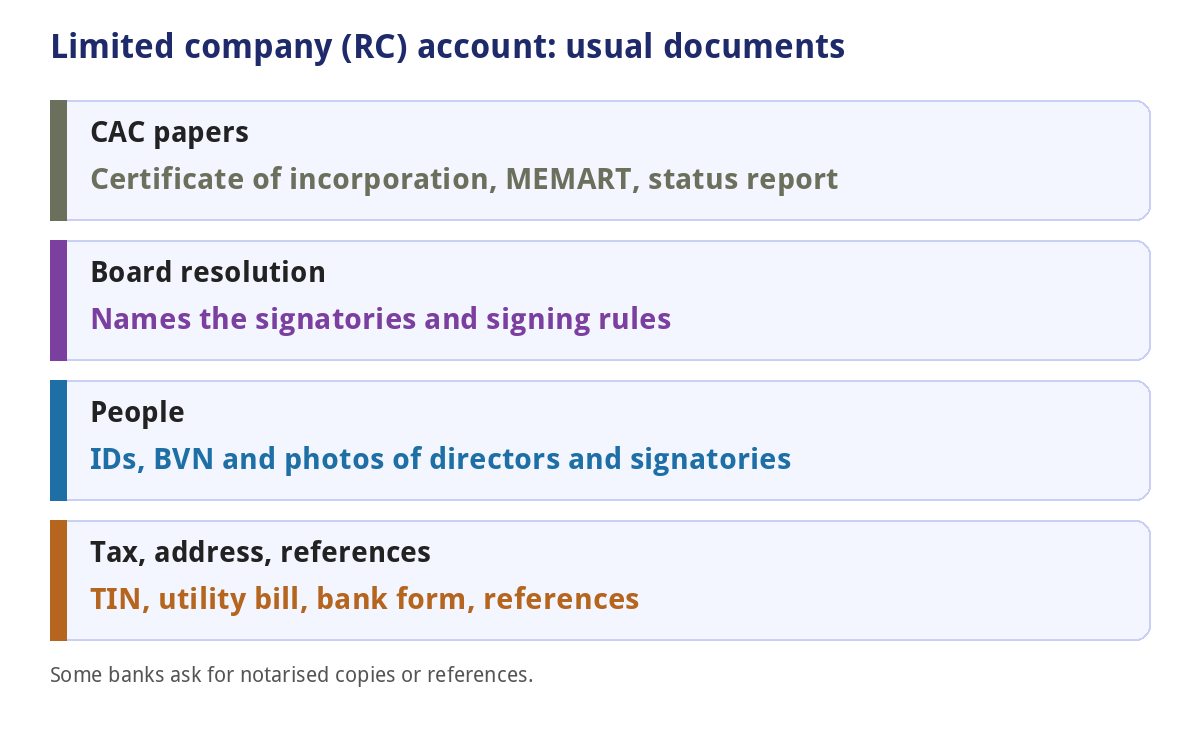
- Certificate of incorporation and the Memorandum and Articles of Association (MEMART).
- CAC status report.
- A board resolution authorising the account and naming the signatories and signing rules. Guides say it should include the company name, registration number, the bank and branch, the signatories, the mandate and a date, and some banks have their own template.
- Valid IDs, BVN and passport photographs for all directors and signatories.
- TIN and a recent utility bill for the registered office.
- The account opening form and specimen signatures.
- Two references from corporate account holders, which one guide says some banks require.
Foreign-owned companies usually need more, such as documents for resident foreign signatories, business permits and notarised foreign documents. Ask the bank for its list. Incorporated trustees (NGOs, churches, associations) have their own requirements, and the guides we found did not give a reliable list, so ask the bank directly.
What banks check and why
The CBN’s Customer Due Diligence Regulations 2023, as summarised by a law firm, require banks to verify the identity of corporate customers and the people who run them, to apply a risk-based approach, and to identify beneficial owners, meaning the real people who own or control the company. For companies, banks may check public and private databases, confirm your CAC and tax details, and visit your office. Penalties for banks that fail to comply are described as ranging from N50,000 to N20 million, which explains why they are strict.
In practice this means:
- Names must match everywhere. Spelling differences between your CAC record, ID, BVN and utility bill are a common cause of delay.
- Your BVN must be in order. One guide notes BVNs not linked to the NIN can cause delays. See our guide to verifying your NIN if yours needs checking.
- Directors and signatories are checked individually.
- The bank may interview you or ask about the business, its income and its customers.
Do you need SCUML?
One guide says the Special Control Unit against Money Laundering (SCUML) certificate is required for designated businesses such as real estate, accountants, car dealers, jewellers, luxury goods sellers, casinos and some consultants, and that banks will not proceed without it. Another guide says registration is free and warns against agents charging extra, with approval sometimes taking weeks, but gives no source for the timing. If your business is in a regulated category, check the registration requirements first, so you do not wait at the bank.
Step by step

- Compare banks. Look at monthly charges, transfer fees, minimum balance, whether you can open an account online, how many signatories you need, and how the bank treats small businesses. Our guide to bank transfer charges in Nigeria explains typical charges.
- Collect your documents and make sure names and addresses match. Keep originals and photocopies.
- Visit the business or corporate desk or start the application online if the bank offers it, and collect the form.
- Submit your file. The officer checks it and may take biometrics and issue an acknowledgement.
- The bank does KYC. It may check CAC, confirm your tax number, run background checks on directors or signatories and ask follow-up questions.
- Approval and account number. You then receive the account details, online banking access or token, and usually a business debit card. Cheque books are available on request.
- Test the account. Make a small deposit and transfer, confirm that signatories and limits are right, and set up alerts.
How long does it take and what does it cost?
Sources differ. A June 2026 guide says generally 24 hours to five business days, with tier-one banks often needing two to three working days in simple cases. Another guide says account creation can take one to three business days and full verification two to ten business days, with cheque books and tokens taking another three to seven days. Treat these as rough ranges and budget up to two weeks.
Minimum opening deposits are not consistent either. One guide says typically N5,000 to N100,000 depending on account type, another says one bank product has no mandatory opening deposit, and neither gives an official figure. Ask the bank for its deposit, monthly maintenance and transaction charges in writing. Also ask what it charges for transfers, cheque books, tokens, cards and statements, because these ongoing fees matter more than the opening deposit.
Choosing the right bank
- Your customers. If most customers use one bank, an account there can make payments smoother.
- Charges. Compare transfer fees, monthly fees and POS settlement terms.
- Digital tools. Check the app, statements, bulk transfers and integration with accounting tools.
- Support. Ask how quickly the bank resolves failed transactions and disputes.
- Foreign currency. If you earn in dollars, ask about domiciliary options. See our guide on domiciliary accounts.
- Safety. Use only banks and fintechs licensed in Nigeria, and keep every request within the bank’s official channels.
Common mistakes
- Going to the bank before your CAC papers and tax details are ready.
- Mismatched names, addresses or dates between documents.
- An expired or old utility bill.
- Forgetting the board resolution for a limited company.
- Not checking if your business type needs SCUML.
- Using a stranger or fake “bank agent” who asks for money to speed up approval.
- Assuming the opening deposit is the only cost.
- Mixing personal and business money after the account is open.
Frequently asked questions
Can I open a business account without CAC registration?
Banks usually ask for CAC documents for a business account. Without registration you may only be able to use a personal account, which is not ideal for a business.
Do I need a TIN?
Guides list a tax identification number among the required documents, and banks may verify it electronically. Check with your bank.
How many signatories can a company account have?
That depends on the bank and your board resolution. Ask the bank how many it allows and how approvals work.
Can I open an account online?
Some banks and fintechs offer online onboarding for businesses, but they still verify your documents. Check the bank’s official site and be careful of fake links.
How long does it take?
Guides give a few days to about two weeks, depending on the bank and how complete your file is.
Is a minimum deposit required?
It depends on the account type and the bank. Ask for the figure in writing.
Do I need a business account for Paystack or Flutterwave?
One guide says such platforms require a registered corporate account for settlements or higher-level onboarding. Check each platform’s current rules.
Bottom line
Register the business, get your tax number and BVN in order, match names and addresses across all documents, prepare a board resolution if you are a company, and compare bank charges before choosing. Ask each bank for its checklist and fees in writing, expect verification to take days, and keep the business account separate from your personal one from day one.
Sources
- Within Nigeria: How to open a corporate bank account in Nigeria after CAC registration (June 2026)
- Smart SMS Solutions: Documents needed to open a business bank account in Nigeria (company blog; some figures unsourced)
- Templars: CBN Customer Due Diligence Regulations 2023, key highlights
- Central Bank of Nigeria: Customer Due Diligence Regulations 2023