
How to Receive International Payments as a Nigerian Freelancer (2026): Payoneer, Wise, Grey, Bank Domiciliary and Fees


Last updated: 3 November 2026 · By Naijatipsland Editorial Team · Editorial policy
Checked 3 November 2026. Landing a foreign client is only half the job. The other half is getting the money into your hands in Nigeria without losing a big slice to fees, poor exchange rates or scams. In 2026 Nigerian freelancers have more options than ever: Payoneer for marketplaces, dollar-account apps such as Grey, Cleva and Raenest, bank domiciliary accounts, and, since January 2026, PayPal inbound payments through Paga. This guide compares how each one works, what it costs, what verification you need, what the CBN’s 2026 foreign exchange rules mean for you, how to invoice, and how tax applies under the new tax law.
If you are still looking for work, start with our guides to remote jobs for Nigerians paid in dollars and the best freelance websites for Nigerians. This article is about the payment side.
The main ways to receive international payments
Payoneer
Payoneer is still the most common route for Upwork, Fiverr and many other marketplaces, and it can also give you receiving account details in several currencies for direct clients. According to Payoneer’s pricing as summarised in January 2026, payments from another Payoneer user are free, a client paying by US ACH debit costs 1%, card payments cost up to 3.99% plus $0.49, and withdrawing to a local bank in a different currency costs between 1.2% and 4%. An annual fee of $29.95 applies if your account receives less than a set amount in 12 months. Fees vary by country, so check the fee page inside your own account.
Grey
Grey gives you US, UK and EU account details so clients can pay you as if you were local. Its fee page, last updated in October 2026, lists 0.8% on incoming USD ACH payments (minimum $2, maximum $10), a flat $20 on USD wires, 0.8% on GBP Faster Payments and EUR SEPA payments, and ₦35 to withdraw naira to a Nigerian bank. Conversion fees depend on the currency pair and rates include a margin above the mid-market rate, which is shown before you confirm. Grey says there is no fee for opening an account or holding balances.
Cleva
Cleva focuses on USD accounts for Nigerians. In a March 2026 comparison on its own blog, Cleva listed a $1 fee on deposits under $300 and $3 on deposits over $300, no conversion markup and free naira withdrawals. Because that comparison was written by Cleva, check the live fees in the app before you rely on them. Cleva is USD only, so it will not help with pounds or euros.
Raenest (formerly Geegpay)
Raenest offers USD, GBP and EUR account details for freelancers and remote workers. In November 2025 TechCabal reported that it had removed deposit fees under a promotion, and later comparisons describe a limited number of free deposits a month with $1 on extra deposits. Promotions change, so read the current pricing page and check the exchange rate in the app before converting.
PayPal through Paga
For years Nigerians could send money with PayPal but not receive it. In January 2026 PayPal and Paga announced a partnership that lets users link a PayPal account to a Paga wallet, receive payments from more than 200 countries (and from Venmo users in the US), hold dollars or withdraw instantly in naira at market rates, according to TechCabal. Launch reports did not publish full fees or limits, so check them in the Paga app. This is useful when a client will only pay by PayPal, but PayPal’s buyer-protection rules mean payments for services can still be reversed in some disputes.
Wise
Wise is popular with Nigerians abroad, but it has not offered Nigerian residents the same account features available in the UK or US. In 2022 Wise’s USD transfers to Nigeria were reported as suspended, and in 2024 it re-enabled payouts to Nigerian banks in naira for some customers with UK or EU profiles. If you live in Nigeria, treat Wise as a way for someone abroad to pay you in naira, not as your main receiving account, and check eligibility on Wise’s own site.
LemFi and other remittance apps
LemFi and similar apps are built mainly for Nigerians abroad sending money home. They can be a cheap way for a client or relative overseas to send you naira, but they are not designed as freelance receiving accounts with invoices and foreign account details.
Bank domiciliary account (SWIFT)
A dollar domiciliary account at a Nigerian bank is the most formal option. Clients send a SWIFT wire, which suits larger invoices but often carries the sender’s fee, intermediary bank fees and your bank’s charges, and can take several days. See our guides on opening a domiciliary account and opening a dollar account online.
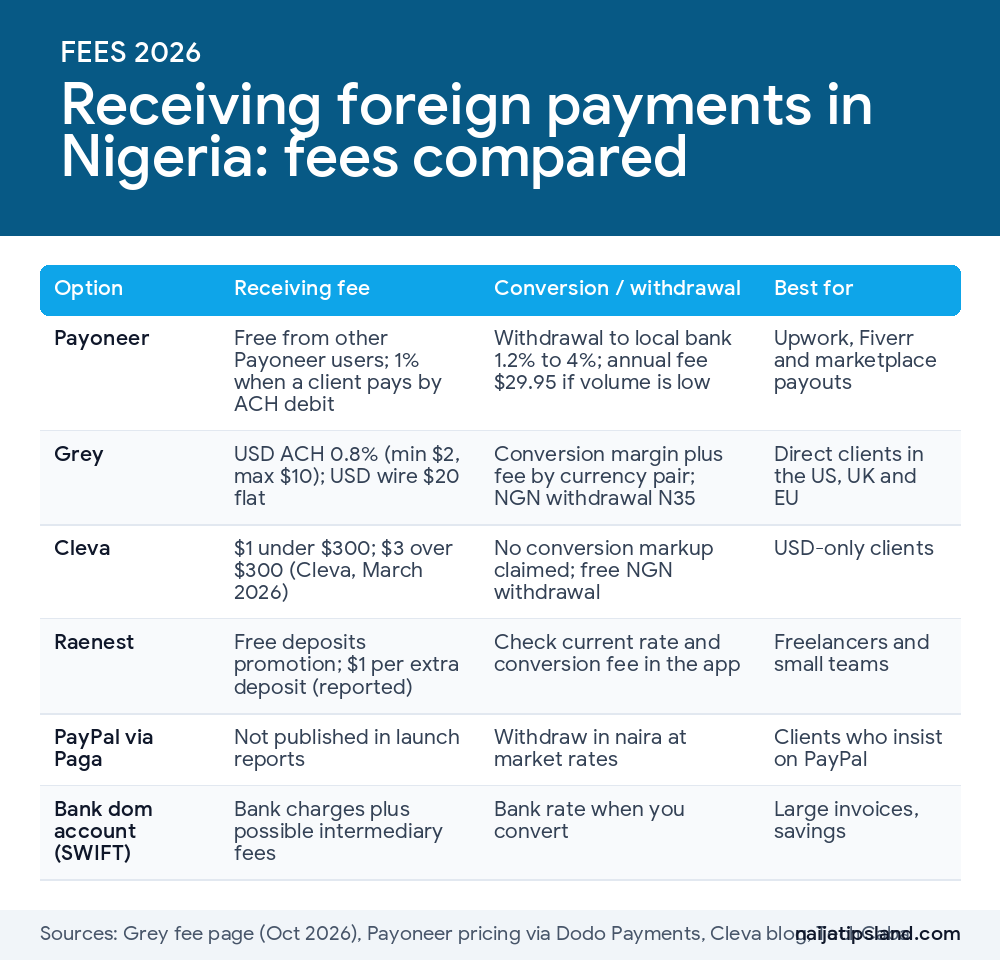
Comparison table
| Option | Currencies | Receiving cost (reported) | Getting naira | Watch out for |
|---|---|---|---|---|
| Payoneer | USD, EUR, GBP and others | Free from Payoneer users; 1% ACH debit; up to 3.99% + $0.49 on cards | 1.2% to 4% to a local bank | Annual fee on low-volume accounts |
| Grey | USD, GBP, EUR | 0.8% (min $2, max $10) on ACH; $20 on USD wire | ₦35 withdrawal plus conversion margin | Wire fees on small payments |
| Cleva | USD only | $1 under $300; $3 over $300 (Cleva’s figures) | Free withdrawal claimed | No GBP or EUR |
| Raenest | USD, GBP, EUR | Free deposits under promotions; check current terms | Check in-app rate | Promotions can end |
| PayPal via Paga | Many currencies in, naira out | Not published at launch | Instant naira withdrawal (reported) | Disputes and reversals |
| Bank dom account | USD, GBP, EUR | Bank and intermediary charges | Bank’s rate | Slow, fees on small wires |
Upwork and Fiverr: how withdrawals usually work
Upwork and Fiverr pay you into your platform balance after their own service fees (Upwork’s freelancer fee varies by contract; Fiverr takes 20% of each order). You then withdraw using the methods the platform offers for Nigeria, which you can see on the withdrawal page of your account. For most Nigerians that means Payoneer, which can then send naira to your local bank or dollars to a domiciliary account. Some freelancers add their Grey or other US account details where a platform allows US bank withdrawals, but check the platform’s rules first, because withdrawal details must match your verified identity.
The real cost: fees plus the exchange rate
The headline fee is often the smaller part of what you lose. When you convert dollars to naira, every provider uses its own rate, and the gap between that and the market rate (the spread) can cost more than the fee. Before you convert:
- Compare the naira you will actually receive, not just the fee, across two or three apps.
- Convert larger amounts in fewer batches if each conversion has a minimum fee.
- Ask clients to pay by ACH or local transfer rather than card or wire where possible, since card and wire fees are usually higher.
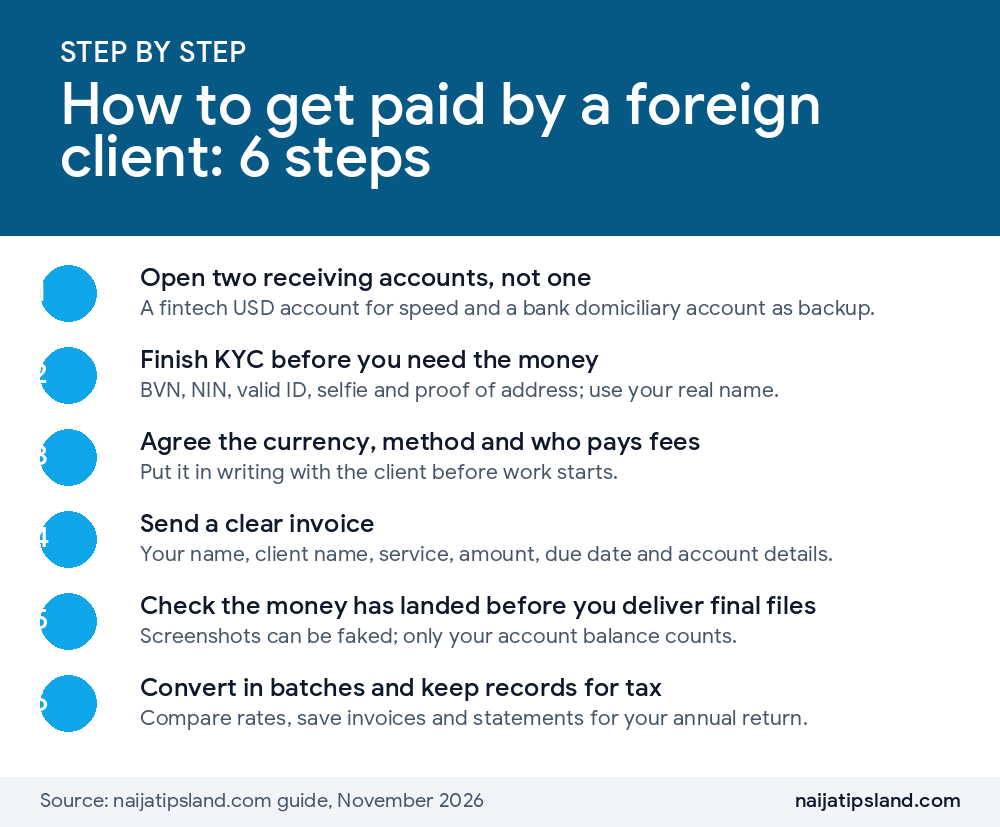
- Agree in writing who pays transfer fees, especially for SWIFT payments.
KYC: what you need to open an account
- Bank Verification Number (BVN) and National Identification Number (NIN).
- A valid ID: international passport, driver’s licence, voter’s card or NIN slip, depending on the provider.
- A selfie or short video for identity checks.
- Proof of address for some providers and all banks.
- For a business account: CAC documents and a tax identification number.
Use your real name exactly as it appears on your ID and on your freelance profile. Mismatched names are one of the most common reasons payments are held.
What the CBN’s 2026 rules mean for freelancers
The CBN’s Foreign Exchange Manual 2026 took effect on 1 June 2026. According to summaries reported by Nigerian media and law firms, holders of ordinary domiciliary accounts can use their funds without prior CBN approval, and banks can process transfers of up to $10,000 a day with the purpose recorded. Reports differ on cash withdrawal limits for inbound transfers, so ask your bank. Fintech USD accounts are generally run through partner institutions rather than as Nigerian bank deposits, so they are usually not covered by NDIC deposit insurance. Keep large savings in a regulated bank and use fintech apps mainly for receiving and converting.
How to invoice a foreign client
A clear invoice gets you paid faster and helps at tax time. Include:
- Your full name or business name, address and email.
- The client’s name and company.
- An invoice number and date.
- A description of the work, hours or milestones.
- The amount and currency, with the due date (for example, 14 days).
- Payment details: the account name, bank or provider, account number and routing or IBAN as given by your app.
- Who pays transfer fees, and any late-payment terms.
Free tools such as Google Docs templates, Wave or the invoice features built into some receiving apps are enough to start.
Tax on foreign freelance income
Under the Nigeria Tax Act 2025, which took effect on 1 January 2026, Nigerian residents are taxed on their income wherever it comes from, and a foreign client will not deduct tax for you. The first ₦800,000 of annual taxable income is taxed at 0%, and rates then rise in bands from 15% to 25%. As a self-employed person you register with your State Internal Revenue Service, keep records of income and allowable business expenses (data, power, equipment, platform fees), and file a self-assessment return. Our guide to personal income tax in Nigeria in 2026 explains the bands. Speak to a tax adviser if your income is large or comes from several countries.
Scams and chargebacks: how to protect yourself
- Overpayment scams: a “client” sends more than agreed and asks you to refund the extra. The first payment is later reversed and you lose what you sent.
- Fake payment emails: emails that look like Payoneer or PayPal saying money is “pending” until you pay a fee. Only trust the balance in your app.
- Card chargebacks: card payments can be disputed weeks later. For new clients, prefer bank transfer or platform escrow.
- Account renting: never let anyone use your receiving account or BVN to “help them collect payments”. You could be linked to fraud and have the account frozen.
- Off-platform requests: clients who want to move from Upwork or Fiverr to WhatsApp before any payment are a red flag, and moving can break platform rules.
- Fake exchange agents: do not sell dollars to strangers on social media who promise better rates. Use licensed apps or your bank.

If you need to spend dollars online rather than convert them, see our guide to dollar virtual cards in Nigeria, and for sending money out, the cheapest ways to send money abroad from Nigeria.
Frequently asked questions
What is the cheapest way to receive dollars in Nigeria?
For direct clients in the US, a local ACH payment into a USD account app such as Grey, Cleva or Raenest is usually cheaper than a SWIFT wire or card payment. For marketplace earnings, Payoneer is often the only practical route. Compare the naira you receive after the rate, not just the fee.
Can Nigerians receive money on PayPal in 2026?
Yes, through the PayPal and Paga partnership announced in January 2026, which lets you link PayPal to a Paga wallet and withdraw in naira. Check fees and limits in the Paga app.
Can I open a Wise account in Nigeria to receive USD?
Wise does not offer Nigerian residents the same receiving accounts as UK or US users. Someone abroad can often send you naira through Wise, but check eligibility on Wise’s site.
Is my money safe in a fintech dollar account?
Established apps use regulated partner banks, but these balances are generally not NDIC-insured Nigerian bank deposits. Use them to receive and convert, and keep larger savings in a regulated bank.
Do I have to pay tax on money from foreign clients?
Yes. From January 2026 Nigerian residents are taxed on worldwide income, with the first ₦800,000 a year at 0%. Register with your state tax office and file a return.
What should I do if a client’s payment is reversed?
Contact the provider’s support immediately with your invoice, contract and proof of delivery. On platforms, raise a dispute through the platform. This is why escrow and deposits matter with new clients.
Disclaimer: this guide is general information based on provider fee pages, news reports and CBN and tax summaries available on 3 November 2026. Fees, exchange rates, product availability and rules change often. It is not financial, tax or legal advice; check each provider’s current terms and speak to a qualified adviser before making decisions.









Editor’s note: compare the naira you actually receive after conversion, not just the headline fee. On a $500 payment the exchange-rate spread can cost more than the receiving fee, so check two apps before you convert.