Sending money out of Nigeria is a different job from receiving it. Plenty of apps will bring money home from London or Houston, but very few are allowed to move naira the other way. Whether you are paying a child’s tuition in Manchester, helping a relative in Accra, settling a supplier in China or paying a freelancer in Kenya, the cheapest route depends on how much you are sending, what it is for and whether you already hold dollars.
This guide compares every legal way to send money abroad from Nigeria in 2026: fintech apps that support outbound transfers, domiciliary account wires, bank Form A payments for school and medical fees, travel allowances and virtual dollar cards. It also explains the rules the Central Bank of Nigeria (CBN) changed in June 2026 and shows you how to work out what a transfer really costs. Need the other direction? See our guide on how to send money to Nigeria safely.
Last updated: 21 October 2026. Fees, exchange rates and limits change often. Check the figures in the app or with your bank before you send. This is general information, not financial advice, and Naijatipsland is not paid by any provider mentioned.
The short answer
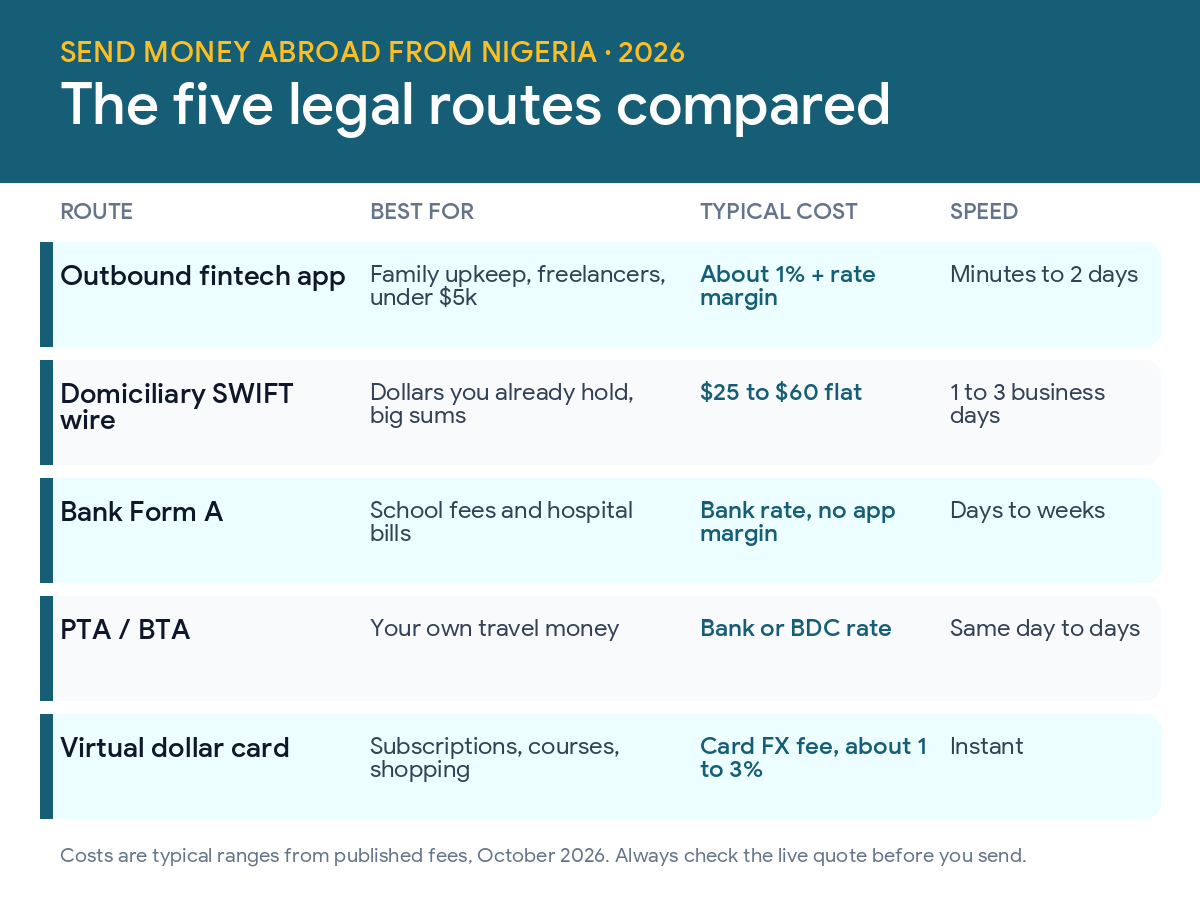
- For everyday amounts (roughly $50 to $5,000) to family or friends: a fintech app that supports outbound transfers from Nigeria, such as Grey, Flutterwave’s Send App, Eversend or Pesa, is usually the cheapest and fastest option. You fund it in naira, convert and send to a bank account or mobile wallet abroad.
- If you already hold dollars, pounds or euros: a wire (SWIFT transfer) from your domiciliary account is simple and, since June 2026, no longer needs Form A when the account is self-funded. Expect flat bank charges of about $25 to $60 per transfer.
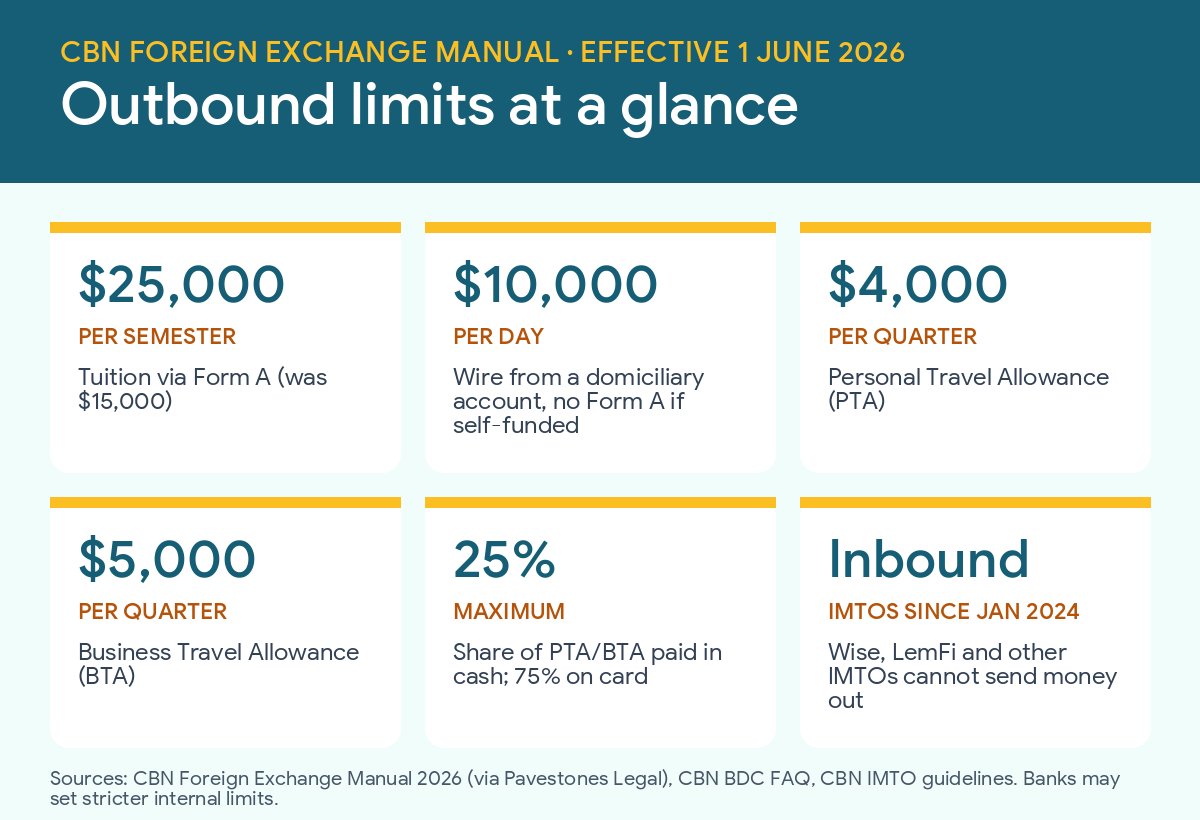
- For school fees and medical bills: use your bank’s Form A route. The new CBN limit for tuition is $25,000 per semester, up from $15,000.
- For travel: buy Personal or Business Travel Allowance (PTA/BTA) from your bank or a licensed bureau de change: up to $4,000 (PTA) or $5,000 (BTA) per quarter.
- Wise, LemFi, WorldRemit and Remitly do not send money out of Nigeria. They only bring money in.
Why sending money out of Nigeria is harder than receiving it
Most of the famous remittance brands are International Money Transfer Operators (IMTOs). Under the CBN’s revised IMTO guidelines of 31 January 2024, licensed IMTOs may only handle inbound transfers into Nigeria; outbound transfers were removed from what they are allowed to do, and banks and fintechs may not hold IMTO licences themselves. That is why Wise, LemFi, WorldRemit, Remitly and Western Union work well for the diaspora sending home but will not let you send naira abroad from Lagos or Abuja.
Outbound payments instead go through authorised dealer banks (your bank’s foreign exchange desk or online banking), licensed bureaux de change for travel cash, and a small number of fintech apps that partner with licensed banks or BDCs to convert naira and pay out abroad. Flutterwave’s Swap, for example, was set up with Wema Bank and Kadavra BDC specifically to offer foreign exchange and outbound payments to Nigerians, and it is available inside the Send App.
The good news is that the foreign exchange market has calmed down a lot. The official Nigerian Foreign Exchange Market (NFEM) rate has hovered around ₦1,330 per dollar through late September and October 2026, with the parallel market only about ₦25 to ₦60 higher. Banks that once made customers wait up to 120 days for school-fee dollars are processing requests much faster, and some now let you pay tuition straight from a naira account. You can track the latest rate on our dollar to naira rate page.
Route 1: Fintech apps that send money out of Nigeria
A handful of apps let you deposit naira, convert it and pay a bank account or mobile wallet abroad, all from your phone. These are the main ones in October 2026:
- Grey: sends from Nigeria to 50+ countries by bank transfer, mobile money and, for India, UPI. Its published price is a 1% conversion fee capped at the naira equivalent of $6 on major currencies, plus a payout fee on some destinations.
- Flutterwave Send App (Swap): converts naira to dollars, pounds or euros and sends to recipients in 30+ countries. A competitor’s September 2026 comparison lists its fee as 1% with no cap and a limit of $20,000 per transaction; check the figure in the app before you send.
- Eversend: sends to dollar, pound and euro accounts in about 18 countries and supports USDC and USDT wallets. Personal fees are shown in the app before you confirm.
- Pesa: advertises no transfer fee to 50+ countries. As with any “zero fee” offer, the cost is built into the exchange rate, so compare how much your recipient actually gets.
How it works: download the app, verify with your BVN and a valid ID (international passport, NIN slip or driver’s licence), fund your wallet by bank transfer in naira, convert at the rate shown, then enter your recipient’s details. For the UK you need a sort code and account number; for the US a routing and account number; for Europe an IBAN; for Kenya or Ghana usually a mobile money number.
Speed: transfers to mobile money in Kenya and Ghana, Interac in Canada and UPI in India can land within minutes or the same day. US bank (ACH) payments usually take one to two business days, and UK Faster Payments the next business day.
Watch out for: monthly limits that depend on how far you have verified your account (often around $5,000 to $10,000 a month), requests for proof of where large sums came from, and weekend rates that may be wider than weekday ones. Before you deposit any money, check that the company or its partner bank is properly licensed using our guide on how to check that a fintech is licensed.
Route 2: Wire money from a domiciliary account
If you already receive dollars, pounds or euros into a domiciliary account, for example from a remote job, an overseas client or family abroad, you can send them anywhere by SWIFT, exactly like a bank transfer from London or New York. GTBank, Zenith, Access, First Bank, UBA and most other big banks process outward domiciliary wires, either at the branch or through internet banking.
The CBN’s new Foreign Exchange Manual, which took effect on 1 June 2026, made this route easier in two ways:
- It removed the Form A requirement for outward transfers from self-funded domiciliary accounts.
- Domiciliary account holders can send telegraphic transfers of up to $10,000 a day without heavy trade documentation.
What it costs: banks charge a transfer commission plus SWIFT and correspondent charges, commonly $25 to $60 in total depending on the bank. An intermediary (correspondent) bank in the US or Europe may also deduct a fee on the way, so your recipient can get slightly less than you sent. If the exact amount matters, for example a rent deposit or an invoice, ask your bank to send with charges marked “OUR” (you pay all charges) rather than “SHA” (shared).
When it makes sense: larger transfers (a flat $40 charge is 4% of $1,000 but only 0.4% of $10,000), payments where the recipient needs a formal SWIFT confirmation, and money you already hold in foreign currency, because you avoid converting naira twice.
Watch out for: deposits of foreign cash. Banks may ask where large cash deposits came from, and some limit how much cash-funded balance you can wire out. Funds received by transfer are much easier to send on.
Route 3: School fees and medical bills through Form A
Form A is the CBN application your bank uses for “invisible” payments such as tuition, student upkeep, medical bills and travel allowances. You apply through your bank’s online portal or at a branch, upload supporting documents and the bank pays the school or hospital directly.
- Tuition limit: the 2026 Foreign Exchange Manual raised the limit from $15,000 to $25,000 per semester.
- Documents usually needed: your BVN, the admission or offer letter, the school’s invoice with its bank details, the student’s passport data page and visa (where issued), and the completed Form A. For medical bills, a referral letter, the hospital’s invoice and the patient’s details.
- Paying from a naira account: after dollar supply improved, several banks, including GTCO and Ecobank, began letting customers pay foreign tuition and medical bills directly from naira accounts through Form A, with processing taking days rather than months.
- Through a payment platform: many universities use Flywire. You generate the payment request on Flywire first, then copy Flywire’s bank details into the beneficiary section of your Form A.
Form A is usually the cheapest legal way to pay a large school bill, because the bank pays the school directly at its own rate without an app’s margin on top. Plan ahead anyway; processing times vary by bank and can stretch during the busy September and January intakes. If you are still choosing a school, our guides to the cheapest UK universities and the cost of studying in Canada set out what you will need to budget for.
Route 4: Travel allowances (PTA and BTA)
If the money is for your own trip, buy it as a travel allowance rather than trying to send it ahead. Under the CBN’s rules for bureaux de change, travellers can buy up to $4,000 per quarter as Personal Travel Allowance or $5,000 per quarter as Business Travel Allowance, with a valid passport, visa and ticket. Medical travellers can also buy up to $5,000 at a BDC, and approach a bank for anything above that.
Cash payouts were banned in February 2024. The 2026 manual relaxed this: now up to 25% can be paid in cash and at least 75% must go onto a card or other electronic channel. In practice you receive most of your allowance on a prepaid dollar card you can use abroad.
Route 5: Virtual dollar cards for paying merchants
If you need to pay a company abroad rather than a person, such as a course provider, software subscription, hotel, airline or online shop, a card is often simpler than a transfer. A naira card with international spending enabled works on many sites, and a virtual dollar card from a reputable fintech works on most others. Cards cannot be used to pay an individual’s bank account, so they do not replace a transfer for family support. For shopping, see our guide to buying from Shein, Amazon and Temu in Nigeria.
What about crypto and peer-to-peer dollars?
Some Nigerians buy USDT or USDC with naira from a peer-to-peer seller, send it abroad and have the recipient sell it there. It can be fast, but it carries risks the other routes do not: payments from strangers can later be reported as fraud, leading to frozen bank accounts; prices swing; scams are common; and the recipient still has to convert into local currency abroad, often at a poor rate. Crypto is now regulated by the Securities and Exchange Commission, so only use registered platforms if you go this way, never send large sums, and never “release” coins before the naira has truly landed in your account. Our guide on whether forex trading is legal in Nigeria covers the regulators and common scams.
How to work out the real cost of a transfer
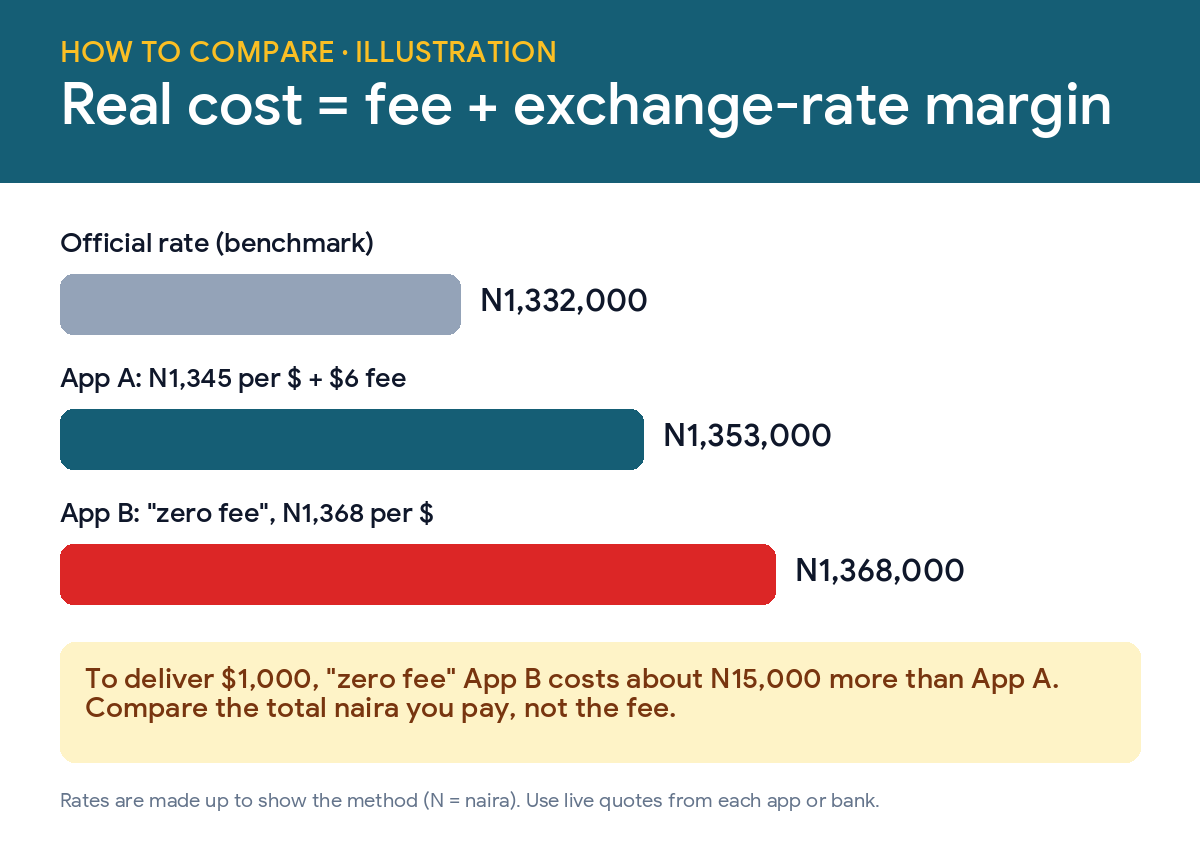
The headline fee is only half of what you pay. The other half is the exchange rate. Every provider converts your naira at its own rate, which is usually a little worse than the official NFEM rate, and that gap is a cost even when the app says “zero fees”. To compare options fairly:
- Decide how much must arrive. For example, exactly $1,000 or exactly £500 in your recipient’s account.
- Ask each option for the total naira cost of delivering that amount, including all fees. Most apps show this on the confirmation screen before you pay.
- Divide the naira cost by the amount delivered. This gives your effective rate. The lowest effective rate is the cheapest route.
- Add any receiving fees. Some banks abroad charge to receive international payments, and intermediary banks can deduct charges from SWIFT transfers.
- Check speed and limits if the money is urgent.
Worked example (illustration only): say the official rate is ₦1,332 per dollar, so $1,000 is “worth” ₦1,332,000. App A quotes ₦1,345 per dollar plus a $6 fee: you pay about ₦1,353,000, an effective rate of ₦1,353. App B advertises no fee but quotes ₦1,368: you pay ₦1,368,000. App B looks free but costs you about ₦15,000 more. Rates in this example are made up to show the method; use live quotes.
Which route is best for what you need?
| What you are paying for | Usually cheapest legal route | Typical speed |
|---|---|---|
| Upkeep for family or friends abroad (under $5,000) | Outbound fintech app (Grey, Send App, Eversend, Pesa) | Minutes to 2 business days |
| University tuition | Bank Form A, paid direct to the school or via Flywire | Days to a few weeks |
| Hospital bills abroad | Bank Form A with the hospital’s invoice | Days to a few weeks |
| Large payment from dollars you already hold | Domiciliary account SWIFT wire | 1 to 3 business days |
| Your own travel money | PTA or BTA from your bank or a licensed BDC | Same day to a few days |
| Subscriptions, courses, online shopping | Naira card with international spending, or a virtual dollar card | Instant |
| Paying a freelancer or supplier in Africa | Fintech app to bank or mobile money | Minutes to same day |
Documents you will need
- For every route: your BVN, your NIN and a valid ID (international passport, national ID or driver’s licence). Make sure the names on your BVN, NIN and bank account match; mismatches are the most common reason verification fails. Our guide on NIN modification explains how to fix errors.
- For larger app transfers: proof of source of funds, such as a payslip, bank statement, invoice or contract.
- For Form A tuition: admission letter, school invoice with bank details, student’s passport and visa.
- For Form A medical payments: medical referral or report, hospital invoice, patient’s passport.
- For PTA/BTA: passport, valid visa and return ticket; for BTA, a letter from your company.
- For a SWIFT wire: the recipient’s full name as on the account, account number or IBAN, SWIFT/BIC code, bank name and address, and the purpose of payment.
Mistakes and scams to avoid
- Using an unlicensed “dollar agent”. People who offer to “send it for you” on WhatsApp or Telegram are a frequent source of fraud. If something goes wrong you have no protection.
- Trusting “zero fee” without checking the rate. Always compare what arrives, not the advertised fee.
- Getting recipient details wrong. International transfers to the wrong account are slow and costly to recover. Copy details from the recipient’s own bank app or statement, and double-check the name, IBAN and SWIFT code.
- Splitting a large payment across many people’s accounts to dodge limits. Banks treat this as suspicious and may freeze the accounts involved.
- Sending crypto to a “buyer” before the naira clears, or accepting naira from strangers whose payments later turn out to be stolen.
- Clicking links in SMS or emails that claim your transfer is “on hold” and ask you to log in. Open the app directly instead. See our guide to fake credit alerts and phishing SMS.
Frequently asked questions
Can I use Wise to send money from Nigeria?
No. Wise does not support naira as a sending currency, so you cannot send money out of Nigeria with it. The same applies to LemFi, WorldRemit and Remitly, which only bring money into Nigeria.
What is the cheapest way to send money from Nigeria to the UK or US?
For everyday amounts, an outbound fintech app usually costs least. For large sums of foreign currency you already hold, a domiciliary account wire can be cheaper because the flat fee is small compared with the amount. For tuition, Form A through your bank is usually best. Always compare the total naira cost for the same amount delivered.
Can OPay, PalmPay or Moniepoint send money abroad?
Not as of October 2026. These are domestic payment apps for transfers, bills and airtime within Nigeria. See our comparison of the best fintech apps in Nigeria for what each one does.
How much can I send abroad from Nigeria?
It depends on the route. Domiciliary account holders can wire up to $10,000 a day without extensive trade documents; tuition through Form A is capped at $25,000 per semester; PTA is $4,000 and BTA $5,000 per quarter; and apps set their own monthly limits based on your verification level.
Do I need Form A to send money from my domiciliary account?
Not if the account is self-funded. The CBN removed that requirement in its 2026 Foreign Exchange Manual, effective 1 June 2026. Your bank may still ask about the purpose of the payment and, for cash-funded balances, the source of the money.
Is it legal to send money abroad from Nigeria?
Yes, through authorised channels: banks, licensed bureaux de change and fintechs that work through licensed partners. What is not allowed is dealing through unlicensed agents or disguising the purpose of a payment.
Sources
- Pavestones Legal via Mondaq: Key changes in the CBN Foreign Exchange Manual 2026 (June 2026)
- Aluko & Oyebode: CBN guidelines on international money transfer services
- Aluko & Oyebode: IMTOs limited to inbound transfers
- Economic Confidential: CBN limits cash payout at 25% for PTA/BTA (BDC FAQ)
- MSME Africa: CBN revises PTA and BTA rules (2026)
- BusinessDay: FX liquidity revives naira payment for school fees and medical bills
- Flywire Help Centre: Paying from Nigeria with Form A
- Finextra: Flutterwave’s Swap now accessible through Send App
- Grey: How to send money from Nigeria in 2026 (September 2026)
- Aboki Forex: How to send money abroad from Nigeria (July 2026)
- Techeconomy: Dollar to naira exchange rate, 14 October 2026
Some fee figures come from Grey, which sells an outbound transfer service and compares itself with competitors. We have used its figures only as published prices; confirm every fee in the app before you send.