
Best Websites to Sell Photos Online From Nigeria (2026): Commissions, Payouts and What Sells

Last updated: 6 November 2026 · By Naijatipsland Editorial Team · Editorial policy
A decent camera, or even a modern phone, can earn money while you sleep if you sell photos online. Stock agencies license your images to designers, bloggers and companies around the world, and print and portfolio sites let you sell directly to buyers. If you are a Nigerian photographer, the real questions are which sites are worth your time, how much you actually keep from each sale, and how you get paid in naira. This guide compares the main places to sell photos online from Nigeria, with the commission rates and payout rules that were published at the time of writing, plus practical tips on what sells, model releases and tax forms.
About the figures in this guide: commission rates and payout rules come from the agencies’ own contributor pages (Adobe Stock and Shutterstock help pages we read on 6 November 2026) and from published comparisons by Expert Photography and BizToolkit. Agencies change terms often, so confirm on each site before you upload. Income ranges are third-party estimates, not guarantees, and we could not verify earnings for Nigerian contributors specifically.
Quick answer: where should a Nigerian photographer sell photos?
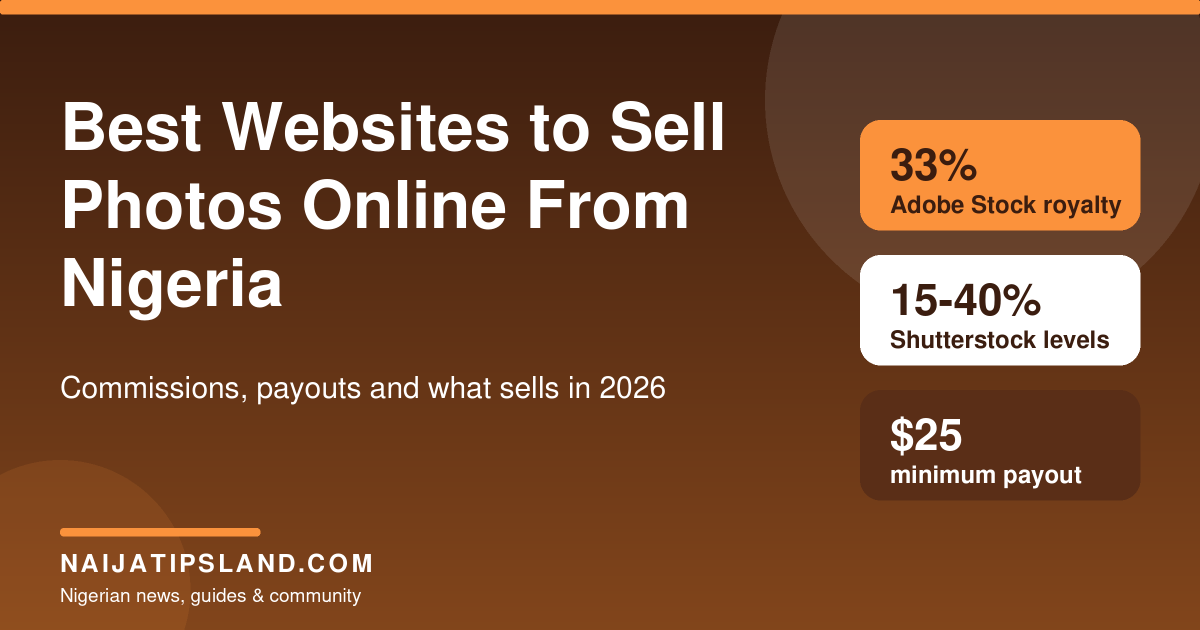
For passive income from a growing library, start with the big stock agencies: Adobe Stock (a flat 33% royalty on photos), Shutterstock (15% to 40%, depending on yearly sales) and Alamy (tiered). For selling prints or downloads straight to buyers, use your own website or a service such as SmugMug. Most photographers use more than one agency, because each has different buyers and different payment methods. Plan for slow, compounding income rather than a quick win: one article’s published estimate puts about 1,000 well-keyworded images at roughly $100 to $400 a month, and a few hundred random images at much less.
The main places to sell photos online
| Platform | Type | Published commission | Payout notes |
|---|---|---|---|
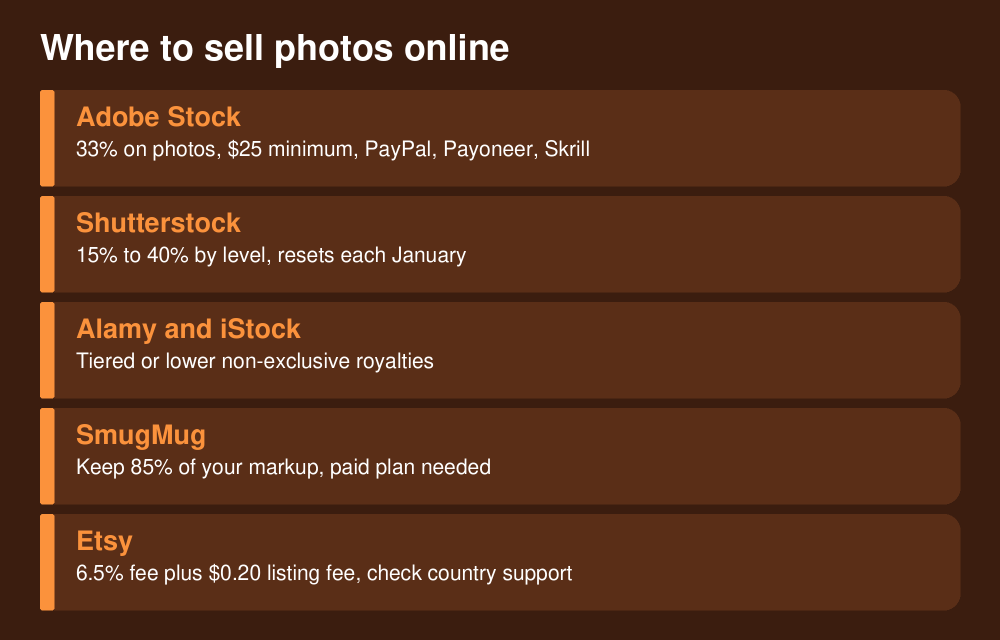
| Adobe Stock | Stock agency | 33% on photos, 35% on video | $25 minimum; first payout 45 days after first sale; PayPal, Payoneer or Skrill |
| Shutterstock | Stock agency | 15% to 40% across six levels; resets each January | PayPal, Skrill or Payoneer; no bank transfer or cheque |
| Alamy | Stock agency | Tiered; reported 15% to 50% (higher tiers tied to exclusive images) | Check current payout terms |
| iStock (Getty) | Stock agency | Reported 15% non-exclusive, 25% or more exclusive | Check current terms |
| Dreamstime | Stock agency | Reported 25% to 50% of net revenue | Reported $100 payout threshold |
| SmugMug | Own portfolio and print sales | You keep 85% of the markup you set | Needs a paid Portfolio or Pro plan |
| Etsy | Marketplace for prints or digital downloads | 6.5% transaction fee plus $0.20 listing fee, plus payment processing | Check whether it supports sellers in your country |
Stock agencies explained
A stock agency hosts your images and licenses them to customers. You upload photos with titles and keywords, the agency’s reviewers approve or reject them, and you earn a royalty each time someone licenses one. Because you earn a small share per download, volume and relevance matter more than any single photograph.
Adobe Stock
Adobe Stock pays a flat 33% on photos, vectors and illustrations and 35% on video, with no yearly tiers. Royalties are calculated in credits (one credit equals one US dollar). You need at least $25 to request a payout, and the first payout is available 45 days after your first sale. Adobe lets you choose PayPal (available globally), Payoneer (available outside the United States) or Skrill. If you do not submit a valid tax form, Adobe may withhold up to 30% of your earnings depending on your country of residence. One comparison estimated about $0.25 per download on Adobe Stock against about $0.10 on Shutterstock for the same files, but treat per-download figures as rough.
Shutterstock
Shutterstock pays between 15% and 40% per download depending on your yearly earnings level, and the level resets to the entry level every January. Per-download earnings also vary by the customer’s plan and licence type, so many sales are only cents. Its help centre says payments are made through PayPal, Skrill or Payoneer and that it does not support wire transfer, bank transfer or cheques. Check which of those services works for you in Nigeria before you rely on it.
Alamy, iStock, Dreamstime
Alamy uses commission tiers that depend on your sales and on whether images are exclusive to Alamy. iStock’s published non-exclusive royalty is lower, and Dreamstime reports a wider range with a higher payout threshold. These can be worthwhile once you have a library, but read each contract carefully for exclusivity, because exclusive deals tie your images to one seller.
Selling directly: your own site, SmugMug and Etsy
Direct sales give you the highest share but require you to find buyers. On SmugMug you set prices for downloads and prints and keep 85% of the markup over the base price on a paid plan. On Etsy you can list original prints or digital downloads at a 6.5% transaction fee plus a $0.20 listing fee and payment processing, but you must check whether Etsy supports sellers and payouts in your country before building a shop. You can also sell through your own website: a gallery with a clear licence page, a payment link and a mailing list, using the same steps we cover in our guide to creating a WordPress website in Nigeria. If you want photos as a wider business, see our guide to digital products you can sell online in Nigeria.
What sells and what gets rejected
Buyers want images they can use: clean backgrounds, space for text, real people doing everyday things, work, food, technology, travel and festivals. For Nigerian photographers, authentic local scenes can stand out, because many stock libraries have fewer images of everyday life in Nigerian cities, markets, offices, schools and homes than of Western settings. We could not verify demand figures, so test with a small batch and watch what sells.
Reviewers reject images for technical and legal reasons. Common causes include soft focus, noise, heavy filters, visible logos and trademarks, recognisable private property, and missing releases. If a recognisable person appears in your photo, you need a signed model release, and many agencies require a property release for private buildings. Never upload photos of people who have not agreed, and never upload another photographer’s work. Agencies also have rules on AI-generated content, so read their current policies before submitting anything made with AI tools.
Step-by-step: start selling in a weekend
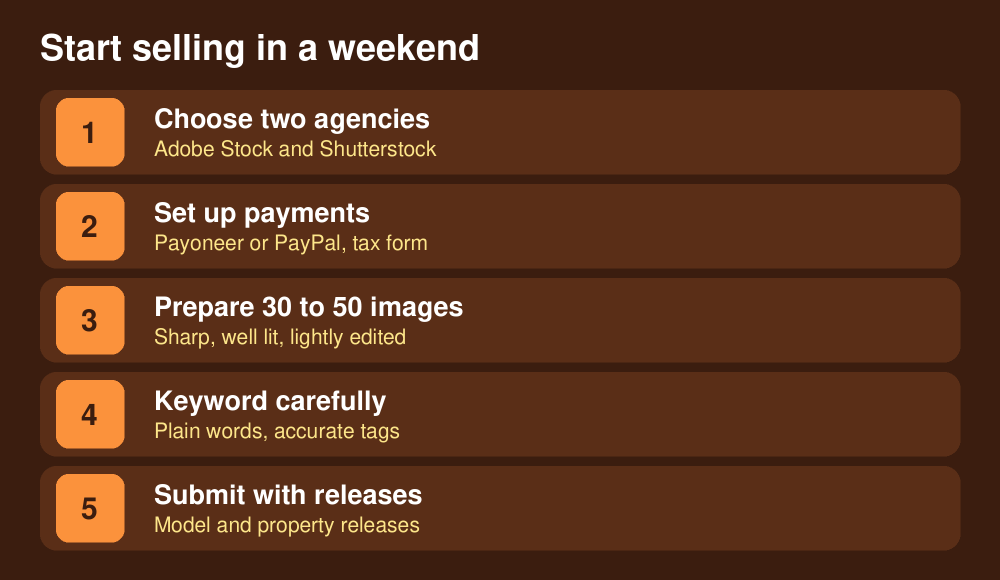
- Choose two agencies. Adobe Stock and Shutterstock are the usual starting pair.
- Set up payments first. Open Payoneer or PayPal as the agency allows, and complete your identity checks and tax form. Our guide to receiving international payments as a Nigerian freelancer compares Payoneer, Wise, Grey and domiciliary accounts.
- Prepare 30 to 50 strong images. Shoot sharp, well-lit photos and edit lightly.
- Write titles and keywords carefully. Describe what is in the photo in plain words; accurate keywords drive sales.
- Submit with releases. Attach model and property releases where needed.
- Review results. Note which images sell, then shoot more of that kind.
- Keep going. Income grows as your library grows.
Getting paid in Nigeria
Stock agencies pay in US dollars, usually into PayPal, Payoneer or Skrill rather than directly into a Nigerian bank. You then withdraw to a domiciliary or naira account, and fees and exchange rates apply, so compare the cost before choosing. PayPal in Nigeria has had limited features over the years, and one guide we read said Nigerian accounts cannot generally withdraw straight to a local bank, so check current rules on PayPal before relying on it. Payoneer is available outside the US and is accepted by Adobe Stock and Shutterstock. Keep records of your earnings: tax on income from photography applies like other self-employment income, so see our personal finance hub and consider advice from a qualified accountant.
How much can you realistically earn?
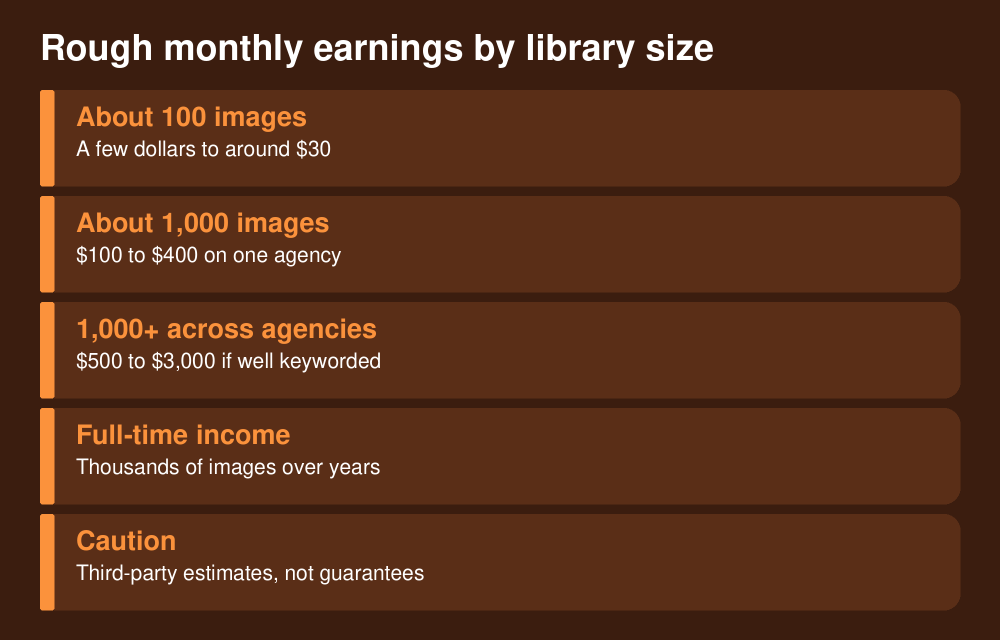
Honest answer: it varies a lot, and most beginners earn very little at first. One published estimate says roughly 100 mixed images may bring a few dollars to around $30 a month, about 1,000 focused images may bring $100 to $300 on Adobe Stock and $150 to $400 on Shutterstock, and 1,000 or more well-keyworded images across several agencies may bring $500 to $3,000, with full-time income needing thousands of commercially relevant images built over years. These are third-party estimates without cited sources, so use them as a rough guide only.
Photography also pairs well with other online income. Use your images on your own blog or social pages (see how to grow an Instagram page in Nigeria organically), offer paid shoots, and explore the wider options in our make money online hub.
Mistakes to avoid
- Uploading without releases. It leads to rejection or legal trouble.
- Chasing quantity over quality. Agencies reject poor images and a low acceptance rate hurts you.
- Ignoring tax forms. Missing forms can mean up to 30% withholding at Adobe Stock.
- Signing exclusive deals too early. Test non-exclusive first.
- Trusting get-rich claims. Be wary of anyone selling a course that guarantees stock income.
- Using other people’s work. Only sell images you created and have rights to.
Frequently asked questions
Can I sell photos online from Nigeria?
Yes. Agencies such as Adobe Stock and Shutterstock accept contributors from many countries, but you must pass identity checks, accept their terms, and use a supported payment method. Check each site’s current country rules.
Which site pays the most per photo?
Rates vary by image, buyer and plan. Adobe Stock pays a flat 33% on photos; Shutterstock pays 15% to 40% by level; direct-sale sites let you set your own prices but you must find buyers.
How do I get paid?
Adobe Stock supports PayPal, Payoneer and Skrill, and Shutterstock supports PayPal, Skrill and Payoneer. Neither pays by bank transfer, so you will need one of those wallets.
Do I need an expensive camera?
Not necessarily. Agencies set technical standards for sharpness, noise and resolution, so check their requirements. Good light and composition matter more than the brand.
Do I need a model release?
Yes, if a person is identifiable and the image is for commercial licensing. Many agencies also want property releases for private buildings.
How long before my first payout?
Adobe Stock needs $25 in royalties and allows the first payout 45 days after your first sale. Timing elsewhere varies.
Is stock photography still worth it?
It can be, as a long-term side income, but competition is high and per-sale earnings are small. Treat it as one income stream among several.
Should I be exclusive to one agency?
Exclusivity can raise your commission at some agencies but ties your images to them. Start non-exclusive until you know what sells.
Sources and notes: Adobe Stock contributor help, payment requirements; Shutterstock contributor help, earnings payment method (both viewed 6 November 2026); Expert Photography, places to sell photos online; BizToolkit, stock photo contributor earnings in 2026. Commission rates, thresholds and income ranges are as published by these sources and change often. This article is general information, not tax or legal advice, and we do not endorse any platform.





Do you take photos already, on a phone or a camera? Tell us what you usually shoot (food, events, city life, products) and I will suggest which agency and which kind of images to test first.
— Ade Adeniyi