
Best Digital Products to Sell Online in Nigeria (2026): Ideas, Platforms and How to Get Paid


Last updated: 3 November 2026 · By Naijatipsland Editorial Team · Editorial policy
Checked 3 November 2026. A digital product is something you make once and sell many times: a template, a guide, a course, a pack of photos or a beat. There is no stock to buy, no delivery bike and no shop rent, which is why so many Nigerians are building income this way. Selar alone reported paying out more than $26 million to creators in 2025, according to TechEconomy. This guide explains the best digital products to sell online from Nigeria in 2026, which ones sell to Nigerian buyers and which sell abroad, the real fees on Selar, Paystack, Flutterwave Store, Gumroad, Payhip and Amazon KDP, how to price in naira and dollars, and the copyright and refund basics.
The best digital products to sell in 2026
1. Ebooks and guides
Short, practical guides on a clear problem sell best: how to pass a professional exam, how to start a specific business, how to relocate for study or work. Keep it focused and better than free blog posts. We will publish a full step-by-step guide to writing and selling ebooks in Nigeria soon, so this section stays short.
2. Templates (Canva, Notion, CV and spreadsheets)
Templates save buyers time. Nigerian job seekers buy CV and cover letter templates, small businesses buy flyer, menu and price-list designs, and global buyers pay for Notion planners, social media kits and Excel or Google Sheets budgets. Canva templates are shared as a link, so you sell access, not the Canva file itself.
3. Printables and planners
Wall art, kids’ worksheets, wedding checklists, devotionals and planners sell to buyers who print at home. These sell mostly to buyers in the US, UK and Europe, so price in dollars and use a platform that accepts international cards.
4. Online courses and workshops
If you have a skill people pay to learn, such as baking, Excel, graphic design, makeup or data analysis, record a short course or run a paid live class. Nigerian buyers respond well to courses priced in naira with WhatsApp or Telegram community support.
5. Photo presets and stock photos
Photographers can sell Lightroom presets and authentic African stock photos. Global brands look for real Nigerian faces, homes, markets and offices. Get signed model releases from anyone recognisable in your photos.
6. Music beats and sound packs
Producers sell beats with different licence levels (for example, a basic lease and an exclusive licence) and drum or sample packs. Spell out what each licence allows, including streaming limits and credit requirements.
7. Software, plugins and scripts
Developers can sell WordPress plugins, website themes, spreadsheet tools, automation scripts or simple apps. These sell well globally but need updates and support, so price for your time.
8. Exam prep and study packs
Study guides, summaries and practice questions for JAMB, WAEC, professional exams and university courses have a big Nigerian market. Be careful: official past questions belong to the exam bodies, so write your own practice questions and explanations, or get permission, rather than copying official papers.
9. Recipe guides and meal plans
Nigerian meal plans on a budget, soup recipe books, small chops business recipes and diet-friendly Nigerian meals sell to Nigerians at home and abroad.
10. Business kits
Business plans, proposal templates, contract templates (reviewed by a lawyer), pricing calculators and social media content calendars sell to small business owners. If you already run a business, package what you use yourself.
Nigerian buyers or global buyers?
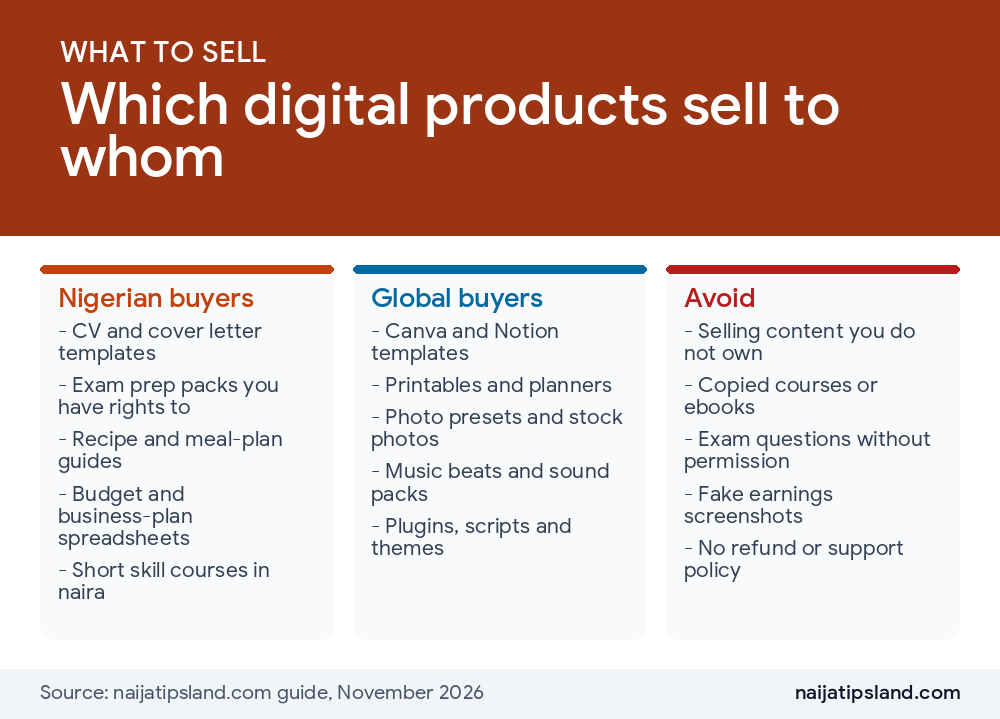
Decide who your buyer is before you choose a platform. Nigerian buyers usually pay by bank transfer, card or USSD in naira, prefer prices under about ₦10,000 for first purchases, and want support on WhatsApp. Global buyers pay by card or PayPal in dollars, pounds or euros, find products through search, Pinterest and marketplaces, and expect instant downloads and clear licences. Many sellers do both: a naira version on Selar or Paystack for local buyers and a dollar version on Gumroad or Payhip for buyers abroad.
Platforms to sell digital products from Nigeria, with fees
Selar
Selar is the best-known Nigerian platform for digital products. A May 2026 seller guide puts its fee on naira sales at 4% plus ₦50, with no monthly subscription and naira payouts to your bank the next business day. Selar’s own blog says processing fees range from 4% for naira to 10% for USD and Ghanaian cedi sales, and it supports payouts in several currencies including USD and GBP. Buyers can pay by card, bank transfer and other local methods.
Paystack payment pages and storefront
If you want to collect payments yourself, Paystack’s published Nigerian pricing is 1.5% plus ₦100 for local transactions, with the ₦100 waived under ₦2,500 and fees capped at ₦2,000, and 3.9% plus ₦100 for international payments. You have to deliver the file yourself (by email or a download link), so it suits sellers with a simple product and a small number of orders.
Flutterwave Store
Flutterwave Store lets you set up a free online shop that accepts cards, bank transfers and mobile money, including from buyers abroad. Standard Flutterwave transaction fees apply, so check its current pricing page before you set prices.
Gumroad
Gumroad is popular with global creators. According to a 2026 fee breakdown, it charges 10% plus $0.50 on direct sales, plus card processing of about 2.9% plus $0.30, and a flat 30% when a new customer finds you through its Discover marketplace. Check its help centre for which payout methods work for Nigeria-based sellers before you rely on it.
Payhip
Payhip’s 2026 plans are Free (5% transaction fee), Plus ($29 a month, 2%) and Pro ($99 a month, 0%), with payment processor fees on top. It handles EU VAT for you, which matters if you sell to European buyers.
Amazon KDP (for ebooks)
Nigerian authors can publish ebooks on Amazon Kindle Direct Publishing. KDP pays a 35% royalty on most prices, or 70% on ebooks priced between $2.99 and $12.99 (minus a small delivery fee). Whether you can be paid directly to a Nigerian bank depends on KDP’s payout options for your country, so many authors use a foreign-currency receiving account. See our guide on receiving international payments as a Nigerian.
Etsy
Etsy is a big market for printables, but Etsy Payments is not available in Nigeria and new shops from unsupported countries are generally restricted from joining, according to seller-tool provider Alura. Do not use someone else’s identity or address to open a shop, because Etsy can close it and hold your money.

Quick comparison
| Platform | Reported fee | Monthly cost | Best for |
|---|---|---|---|
| Selar | 4% + ₦50 (naira); up to 10% (USD) | None | Nigerian and African buyers |
| Paystack page | 1.5% + ₦100 local (capped at ₦2,000); 3.9% + ₦100 international | None | Simple products, direct sales |
| Flutterwave Store | Standard Flutterwave fees | None | Local and some international buyers |
| Gumroad | 10% + $0.50 plus processing; 30% on Discover | None | Global creators |
| Payhip | 5%, 2% or 0% by plan, plus processing | $0, $29 or $99 | Global buyers, EU VAT |
| Amazon KDP | Royalty 35% or 70% | None | Ebooks for global readers |
How to price in naira and dollars
- Look at what similar products sell for on Selar, Gumroad and Etsy, then price on value, not on the hours you spent.
- Start with a low-priced entry product for Nigerian buyers and offer a bigger bundle or course for those who want more.
- Price separately for buyers abroad. A ₦5,000 template is under $4 at the rates reported in October 2026 (about ₦1,330 to ₦1,385 to the dollar), which many global buyers would see as cheap. Use round dollar prices such as $9, $19 or $29.
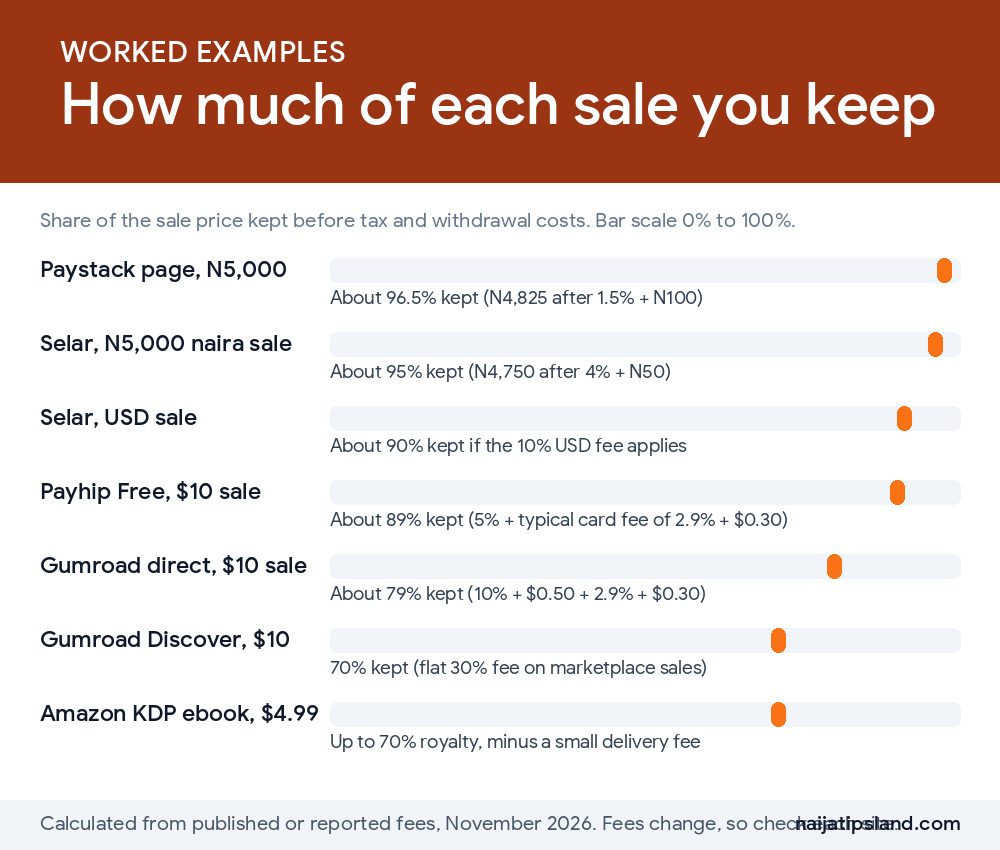
- Work out what you keep after fees. On a ₦5,000 sale you keep about ₦4,825 through a Paystack page and about ₦4,750 on Selar. On a $10 Gumroad direct sale you keep roughly $7.91.
- Use launch discounts and bundles, not permanent price cuts.
Copyright, licences and refunds
- Only sell what you own or have the right to sell. Copying someone else’s ebook, course or design is copyright infringement under Nigeria’s Copyright Act 2022, and platforms remove infringing products.
- Read the licence for fonts, images and music you use inside your products. Free for personal use does not mean free to resell.
- Be careful with “PLR” and resell-rights packs. Many are low quality or the seller does not hold the rights they claim.
- Write a licence that says what buyers can and cannot do (for example, personal use only, no resale).
- Have a clear refund policy on the product page, such as refunds within 7 days if a file is faulty. Honest refunds protect your reputation and reduce chargebacks.
- Protect your brand name if it starts to grow. See how to register a trademark in Nigeria.
How to market digital products
- Teach for free, sell the shortcut. Post useful tips on TikTok, Instagram, X or LinkedIn and link to your product. Our guide to making money on TikTok in Nigeria covers growing an audience.
- Build an email or WhatsApp list with a free sample, checklist or mini-guide.
- Start a blog that ranks on Google for your topic. See how to make money blogging in Nigeria.
- Use affiliates. Let others promote your product for a commission. If you are on the other side, read affiliate marketing in Nigeria with no money.
- Use Pinterest for printables and templates aimed at buyers abroad.
- Use AI tools carefully. They can speed up outlines, mock-ups and product descriptions, but check facts and add your own expertise. See how to use ChatGPT to make money in Nigeria.
Mistakes and scams to avoid
- Paying for “done-for-you digital product stores” that promise passive income with no work.
- Posting fake sales screenshots. It damages trust and can break consumer protection rules.
- Selling a product that solves no clear problem. Ask your audience what they need first.
- Leaving download links public so anyone can share them. Use the platform’s secure delivery.
- Ignoring tax. Income from digital products is taxable under the Nigeria Tax Act 2025, which took effect in January 2026.
For other places to sell, including physical products, see where to sell online in Nigeria.
Frequently asked questions
What is the best platform to sell digital products in Nigeria?
For Nigerian buyers, Selar is the most widely used because it accepts naira, pays out the next business day and charges no monthly fee. For global buyers, Gumroad and Payhip are common choices, but check payout options for Nigeria first.
How much does Selar charge?
Seller guides in 2026 report 4% plus ₦50 on naira sales, and Selar’s own blog says fees range up to 10% for USD sales. There is no monthly fee.
Can Nigerians sell on Etsy?
New sellers based in Nigeria generally cannot open Etsy shops, because Etsy Payments is not available in Nigeria.
Can I sell ebooks on Amazon from Nigeria?
Yes. Amazon KDP accepts authors from Nigeria, with royalties of 35% or 70% depending on the price. Check KDP’s payout options for Nigeria and consider a foreign-currency receiving account.
Do I need to register a business to sell digital products?
Not to start, but registering a business name with CAC helps you open a business account and look professional as sales grow.
Disclaimer: this guide is general information based on platform pricing pages, seller guides and news reports available on 3 November 2026. Fees, payout options and platform rules change often, and nothing here is financial or legal advice. Check each platform’s current terms before you sell.









Editor’s note: if you sell to buyers both in Nigeria and abroad, keep a naira listing on Selar or a Paystack page and a separate dollar listing on Gumroad or Payhip. A ₦5,000 product is under $4 abroad, so price your dollar version on its own value.