


TL;DR:
- Effective political commentary relies on clear arguments, credible evidence, and respectful engagement.
- Starting locally helps build a strong portfolio before tackling national or international platforms.
Political commentary is defined as evidence-backed analysis and opinion on current political events, designed to influence public understanding and shape civic discourse. For young Nigerians engaging in digital spaces, mastering this craft means more than sharing opinions. It means building credibility, driving real conversations about governance, policy, and accountability across Nigeria and Africa. This political commentary guide covers the core principles, analytical techniques, and publishing steps you need to move from casual observer to respected voice in Nigerian political discourse.
What is a political commentary guide and why does it matter?
A political commentary guide is a structured framework that teaches you how to analyze political events, form evidence-based arguments, and communicate them clearly to a public audience. The standard industry term for the written form is the op-ed, short for “opposite the editorial page,” though political commentary now spans podcasts, social media threads, newsletters, and video essays. Understanding both terms helps you navigate editorial guidelines and digital platforms with equal confidence.
Political commentary matters because it shapes how citizens understand power. When young Nigerians write and publish informed analysis, they contribute directly to national political development and hold leaders accountable. Passive consumption of news is not the same as active participation in discourse. The difference between the two is the ability to construct and communicate a reasoned argument.
What are the foundational principles of effective political commentary?
The single most important principle is clarity of argument. A publishable op-ed must state its core argument, called the nut graph, by the 3rd or 4th paragraph. Burying your thesis past that point loses editors and readers before they reach your best point. The formula is direct: state what most people believe, then state what is actually true, then explain why it matters.
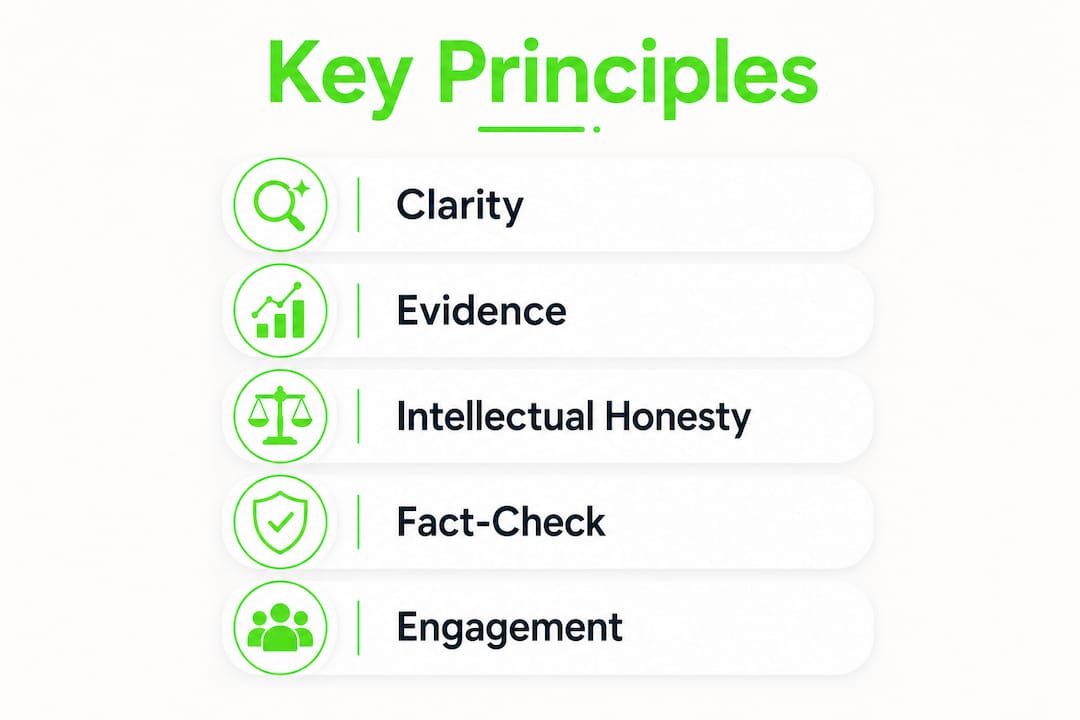
Evidence is the second pillar. Statements built only on “I think” without supporting data, research, or specific examples are considered blogging, not journalism. Every claim you make needs a source, a statistic, or a documented event behind it. This distinction separates commentary that influences from commentary that is ignored.
The third principle is steel-manning opposing views. Steel-manning means presenting your opponent’s argument in its strongest possible form before you refute it. This builds credibility with readers who hold different views and signals intellectual honesty. Readers who disagree with you are far more likely to engage seriously when they see you have treated the other side fairly.
Key principles to apply in every piece:
- State your thesis by paragraph 3 or 4, never later
- Support every claim with data, a named event, or credible research
- Use clear, direct language and active voice throughout
- Acknowledge the strongest version of opposing arguments before countering them
- Keep sentences short and paragraphs focused on one idea each
Pro Tip: Read your draft aloud before submitting. If you stumble over a sentence, your reader will too. Fact-check every claim in the same session.
How do you analyze Nigerian and African political discourse effectively?
Political analysis differs from opinion writing in one critical way. Effective analysis uses structured causal reasoning and theoretical frameworks rather than ideological positioning. This means you ask “why did this happen and what are the mechanisms?” rather than “which side is right?” That shift in question produces commentary that informs rather than inflames.

For Nigerian and African contexts, comparative politics is a particularly useful lens. You can compare how Nigeria’s federal structure handles resource allocation against South Africa’s or Ghana’s approach. You can trace how policy decisions in Abuja ripple into local governance in Kano or Enugu. Narrative-driven analysis, which examines how political stories shape public opinion, adds another layer of depth that resonates with digital audiences.
Build a pre-analysis checklist before you write:
- Identify the specific political event or policy you are analyzing
- List the key actors and their stated positions
- Gather at least three credible sources (government documents, academic papers, reputable news outlets)
- Note gaps in available evidence and acknowledge them in your piece
- Identify the causal mechanism: what caused this outcome and what does it affect next?
Intellectual honesty is the discipline that separates good analysis from partisan noise. If the data contradicts your initial position, update your position. Nigerian readers, especially younger digital audiences, are increasingly skilled at spotting selective use of facts. Credibility built on honest analysis compounds over time. Credibility built on spin collapses quickly.
What steps should you follow to write and publish political commentary?
Structure your commentary in this order:
- News hook: Open with a current event or debate that makes your argument timely. Editors prioritize timeliness, and evergreen commentary without a news peg is harder to place.
- Nut graph: State your core argument clearly by paragraph 3 or 4.
- Evidence block: Present two or three supporting points, each backed by data or documented examples.
- Steel-man and rebuttal: Acknowledge the strongest counterargument, then explain why your position still holds.
- Conclusion: End with a specific call to action or a clear statement of what should change and who should act.
Word count matters. Most regional Nigerian publications accept op-eds between 600 and 900 words. National outlets typically want 700 to 1,000 words. International platforms often require 800 to 1,200 words. Staying within the requested range signals professionalism and saves editors editing time.
Starting with local publications is the fastest path to building a portfolio. Local and regional outlets actively seek community voices and have higher acceptance rates than national platforms. Publishing three strong pieces in a regional outlet gives you the credibility to pitch The Punch, Vanguard, or Premium Times with a track record behind you.
| Publication type | Typical focus | Best for |
|---|---|---|
| Community/regional outlets | Local governance, state politics | Beginners building a portfolio |
| National newspapers | Federal policy, national elections | Writers with 3+ published pieces |
| Pan-African platforms | Regional policy, cross-border issues | Writers with established credibility |
| Digital news platforms | Breaking analysis, trending topics | All levels, fast turnaround required |
Pitching tips that work: write a subject line that names the issue and your argument in one sentence. Keep your pitch email under 150 words. Follow up once after seven days if you receive no response. A compelling pitch subject line paired with a timely news hook is what gets editors to open your email in the first place.
Pro Tip: Submit to one outlet at a time. Simultaneous submissions to multiple editors create conflicts if two accept the same piece. Most editorial guidelines prohibit it.
How do you engage respectfully in online political discussions?
Respectful engagement in Nigerian digital spaces is not just a courtesy. Respectful discourse reduces polarization and directly increases your influence within online communities. Readers trust voices that stay calm and factual even when the conversation gets heated. That trust translates into a larger, more loyal audience over time.
Practical habits for online political engagement:
- Verify facts before sharing or responding. Use primary sources, official government documents, or established news outlets.
- Avoid inflammatory language, personal attacks, and tribal framing. These undermine your argument regardless of how strong the underlying point is.
- Acknowledge valid points made by people who disagree with you. This signals confidence, not weakness.
- Separate the person from the position. Critique the policy or argument, not the individual making it.
- Know when to disengage. Not every thread deserves your energy, and some conversations are designed to provoke rather than inform.
Nigerian digital spaces carry specific cultural dynamics. Ethnic and regional identities often shape how arguments are received before a single word is read. Being aware of this does not mean avoiding difficult topics. It means framing your arguments around shared civic values, such as accountability, transparency, and equitable governance, rather than identity markers. That framing reaches a wider audience and builds cross-community credibility.
Developing a consistent voice focused on a specific niche, such as education policy, electoral reform, or economic governance, improves both credibility and audience retention. Readers follow commentators who are reliably good on a specific subject, not those who comment on everything with equal confidence.
Key Takeaways
Effective political commentary requires a clear thesis, credible evidence, and intellectual honesty applied consistently across every piece you publish.
| Point | Details |
|---|---|
| State your thesis early | Place your core argument in paragraph 3 or 4 to keep editors and readers engaged. |
| Back every claim with evidence | Data, documented events, or credible research separates journalism from opinion. |
| Steel-man opposing views | Present the strongest counterargument before refuting it to build reader trust. |
| Start local to build credibility | Regional outlets have higher acceptance rates and help you build a portfolio fast. |
| Engage respectfully online | Calm, factual discourse reduces polarization and grows your audience over time. |
What I have learned writing about Nigerian politics
The hardest lesson I learned at Naijatipsland was this: the commentators who shout the loudest rarely build the most influence. The ones who last are the ones who stay accurate, stay consistent, and stay honest even when it costs them likes or retweets.
Polarization in Nigerian digital spaces is real. Ethnic and partisan loyalties create invisible filters that shape how your words land before anyone reads them carefully. The way through is not to pretend those filters do not exist. It is to write with such clarity and fairness that readers on both sides of a debate have to engage with your argument on its merits.
Building credibility from local to national platforms takes time. I have seen writers rush to pitch major outlets before they have a single published piece behind them. The rejection is predictable. Start where you are accepted, do excellent work, and the larger platforms follow. Consistency matters more than any single viral piece.
The digital media environment in Nigeria is shifting fast. Short-form video, audio commentary, and newsletter formats are growing alongside traditional op-eds. The principles in this guide apply across all of them. A clear thesis, honest evidence, and respectful engagement work whether you are writing 800 words or recording a three-minute voice note.
— Naijatipsland
Naijatipsland and Nigeria’s growing commentator community
Naijatipsland actively supports Nigerian writers and journalists who want to contribute to public discourse. The platform covers political analysis, current affairs, and civic topics that matter to young Nigerians, and it provides a space where community voices get real reach.

Naijatipsland has highlighted programs like the DevReporting and PDM-Network initiative, which selected eight journalists for an urban challenges reporting project in Lagos. That kind of structured support is exactly what emerging commentators need. You can also learn the basics of writing news articles for Nigerian audiences directly on the platform. Start by reading, then start by writing. Your voice belongs in this conversation.
FAQ
What is political commentary?
Political commentary is evidence-based analysis and opinion on current political events, designed to inform public understanding and influence civic discourse. It differs from news reporting by including the writer’s reasoned argument alongside documented facts.
How do you write political commentary for beginners?
Start by identifying a timely political issue, state your core argument by paragraph 3 or 4, and support every claim with credible evidence. Publishing first in local or regional outlets builds your portfolio and credibility before you pitch national platforms.
What is the nut graph in political commentary?
The nut graph is the paragraph, usually the 3rd or 4th, that states the core argument of your piece. It tells readers what you believe, why the conventional view is wrong or incomplete, and why the issue matters now.
How do you engage in online political discussions respectfully?
Verify facts before responding, avoid personal attacks, and acknowledge valid points made by those who disagree with you. Respectful engagement reduces polarization and builds a larger, more loyal audience over time.
What analytical techniques work best for Nigerian political analysis?
Comparative politics and causal reasoning are the most effective techniques. Comparing Nigeria’s governance structures to those of peer African nations and tracing the mechanisms behind policy outcomes produces analysis that informs rather than inflames.