Last updated: 18 October 2026 · By Naijatipsland Editorial Team · Editorial policy
On 16 January 2027, Nigerians vote for president and the National Assembly, and on 6 February 2027 for governors and State Houses of Assembly. Most people know they need a PVC. Fewer know the rest of the rules: whether you can take your phone into the cubicle, whether you can wear your party’s cap, how close you can stand while votes are counted, or what happens if someone offers you money.
This guide sets out what voters can and cannot do on election day, based on the Electoral Act 2026 and INEC’s published procedures, with the penalties for the most common offences. For a step-by-step walkthrough of voting itself, read our guide on how to vote on election day.
The short answer
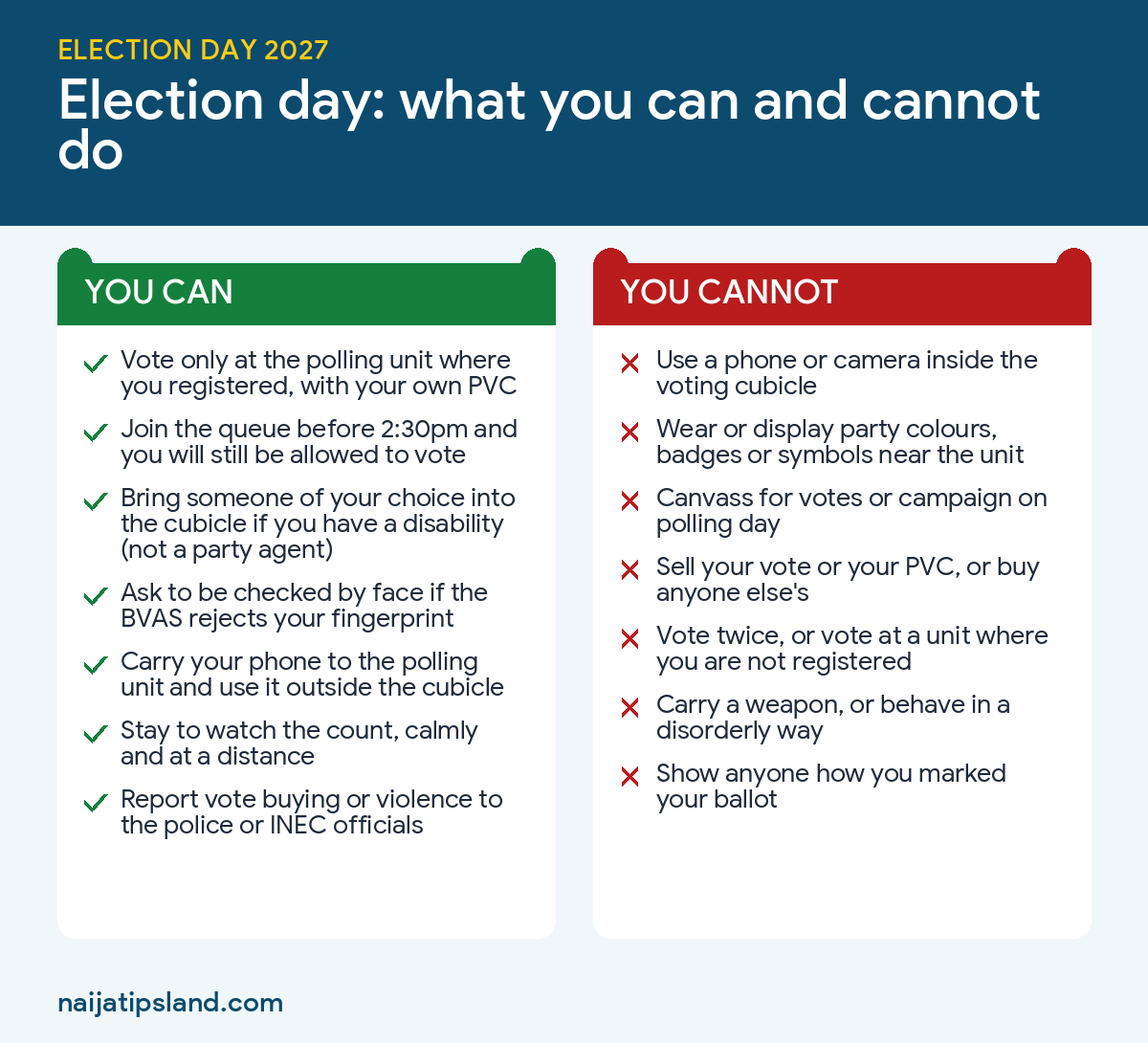
- You can vote at your own polling unit with your own PVC, join the queue up to 2:30pm, bring a helper if you have a disability, keep your phone with you outside the cubicle, and stay to watch the count.
- You cannot use a phone or camera in the voting cubicle, campaign or wear party colours near the polling unit, vote twice or at another unit, carry a weapon, or sell your vote.
- Vote buying and selling carry a fine of at least N5 million, at least two years in prison, or both, under section 22 of the Electoral Act 2026.
- Campaigning stops 24 hours before polling day. Publishing campaign material in that window or on polling day is an offence (sections 98 and 100).
Before you leave home
Bring
- Your own PVC. Section 47(1) requires you to present your Permanent Voter Card at your polling unit. Nobody else can vote with it, and you cannot vote with anyone else’s.
- Water, a snack and patience. Queues can be long, and you may want to stay for the count.
- Any glasses or mobility aids you need.
Leave at home
- Party clothing, caps, badges and stickers. Displaying party symbols near a polling unit on election day is an offence.
- Anything that could be seen as a weapon, including knives and cutlasses.
- Someone else’s voter card. Giving your PVC to another person, or holding more than one, carries a fine of up to N5 million, up to 12 months in prison, or both (section 121).
Expect restrictions on movement
In past general elections, the Inspector-General of Police has restricted vehicle movement on roads and waterways in states holding elections, usually from midnight to about 6pm on polling day. Essential services are exempt, including INEC officials, accredited observers, accredited journalists, ambulances and fire services. Expect a similar announcement before 16 January 2027, so plan to walk to your polling unit or to be close to it before the restriction starts. Remember also that using a government or public corporation vehicle or boat to carry voters to a polling unit is an offence under section 122, with a fine of up to N2 million, up to six months in prison, or both.
At the polling unit
- You can vote only at your own polling unit (section 56), and only in person (section 55). Nobody can vote on your behalf.
- Polls open at 8:30am, and accreditation and voting run until 2:30pm. Under section 59, once the poll closes no new voters are admitted, but anyone already on the queue may still vote. Join the queue before 2:30pm.
- Queues may be separated by sex where local custom requires it (section 49).
- The BVAS checks your PVC and then your fingerprint or face (section 47). If the device fails at your unit and is not replaced, the vote there is cancelled and a new poll held within 24 hours if the result could affect the outcome. Our guide to BVAS and IReV explains how this works.
- Your right to vote can be challenged. Candidates and polling agents may challenge a person’s right to vote (section 48), and the presiding officer can order the arrest of anyone reasonably suspected of being under 18 or of impersonating another voter (section 57).
- Obey the presiding officer. The presiding officer controls who is admitted to the polling unit and can have anyone who behaves in a disorderly way or ignores a lawful order removed. A person who is removed may not return that day without permission, and can be arrested without a warrant if charged with an offence (section 58).
The 300-metre zone: no campaigning near the polling unit
Nigeria’s electoral law has long treated the area around a polling unit as a campaign-free zone on election day. Within roughly 300 metres of a polling unit, it is an offence to canvass for votes, persuade people not to vote for a candidate, wear or display party badges, colours, symbols or posters, carry a weapon, or use vehicles in party colours or loud sirens. The 2026 Act sets out offences on election day in section 130.

Campaigning everywhere else also stops before polling day. Under section 98, public campaigning ends 24 hours before the vote; INEC’s timetable puts the end of the presidential and National Assembly campaign at midnight on 14 January 2027, and the governorship and State Assembly campaign at midnight on 4 February 2027. Section 100 makes it an offence to broadcast, publish or circulate material promoting or opposing a party or candidate within 24 hours of polling, or on polling day itself. The fine is N3 million to N5 million, and an individual can also be jailed for up to six months.
That covers newspapers, radio and TV, and it is wise to treat social media the same way. Sharing campaign posters, jingles or “vote for” messages on WhatsApp or X on polling day could expose you to the same law, and it can also break the rules of the 300-metre zone if you do it at the polling unit.
Inside the voting cubicle
- No phones or cameras. INEC has banned the use of phones and other electronic devices inside the voting cubicle since 2018 to stop vote buyers demanding photos of marked ballots. You may carry your phone to the polling unit and use it outside the cubicle; the restriction applies from when you collect your ballot until you drop it in the box.
- Your vote is secret. Voting is by open secret ballot (section 50): you mark your ballot in private, and drop it in the box in public view. Do not show anyone how you voted, and nobody may ask you to.
- Do not write anything on the ballot. A ballot marked in a way that could identify the voter is rejected (section 52). Use only your inked thumb, inside one box.
- Help for voters with disabilities. A voter who is visually impaired or has another disability may take a person of their choice into the cubicle to help (section 54). That person cannot be a party agent, candidate or party official, and must be made known to the presiding officer.
After you vote: watching the count
You are allowed to stay after voting and watch the counting at your polling unit. Votes are sorted and counted in public, the result is written on Form EC8A and announced, and a copy of the result is posted at the unit. Many voters photograph the posted result and check it later against the copy uploaded to IReV, which is a good way to help keep the count honest.
If you stay, keep calm, keep the distance the officials set, and do not interfere with election materials. Destroying or tampering with a ballot box, ballot papers or result forms, or removing them from a polling station, carries up to two years in prison under section 119. Snatching ballot boxes is one of the main causes of cancelled results and violence on election day.
Election offences and penalties
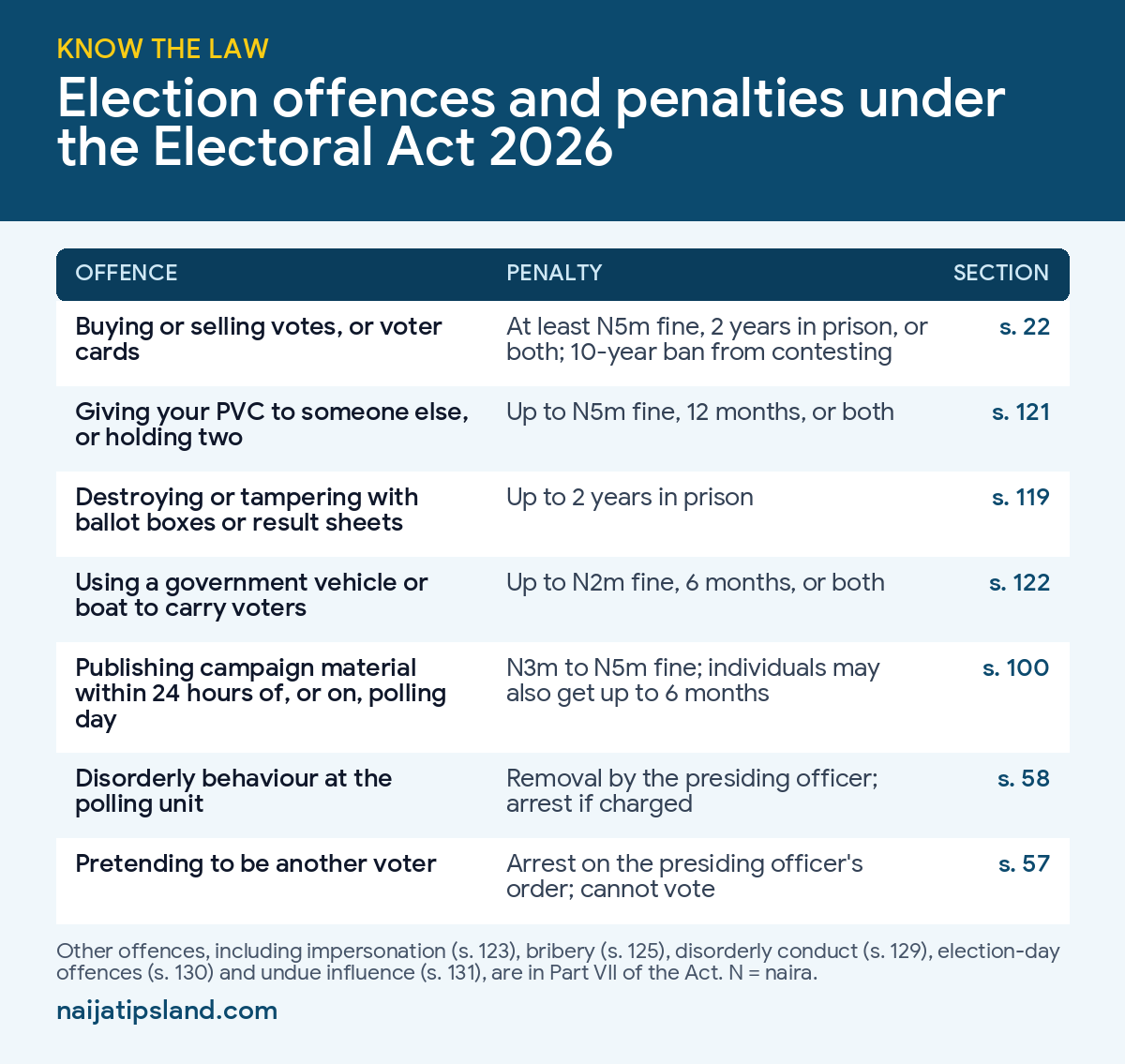
The Electoral Act 2026 lists a long range of offences. These are the ones ordinary voters are most likely to come across:
| Offence | Penalty | Section |
|---|---|---|
| Buying or selling votes, or buying, selling or possessing other people’s voter cards | At least N5 million fine, at least 2 years in prison, or both; barred from contesting elections for at least 10 years | 22 |
| Giving your voter card to someone else, using another person’s card, or holding more than one | Up to N5 million fine, up to 12 months, or both | 121 |
| Destroying, removing or tampering with ballot boxes, ballot papers or result forms | Up to 2 years in prison | 119 |
| Using a government vehicle or boat to carry voters | Up to N2 million fine, up to 6 months, or both | 122 |
| Publishing campaign material within 24 hours of, or on, polling day | N3 million to N5 million; individuals may also get up to 6 months | 100 |
| Registering more than once | At least N100,000 fine, at least 1 year, or both | 12 |
| Disorderly conduct at the polling unit | Removal by the presiding officer; arrest without warrant if charged | 58 |
Other offences in Part VII of the Act include impersonation and voting when not qualified (section 123), bribery and conspiracy (section 125), breaching the secrecy of voting (section 126), disorderly conduct at elections (section 129), offences on election day (section 130), undue influence (section 131) and threatening voters (section 132). Officials who break the rules face penalties too: a presiding officer who deliberately blocks electronic transmission of results faces a fine of at least N500,000, at least six months in prison, or both (section 60(6)).
Vote buying: what to do if you are offered money
Vote buying has become one of the biggest problems in Nigerian elections, from cash handed out near polling units to “stomach infrastructure” and bank transfers. Both sides commit an offence: the person who buys and the person who sells. Section 22 sets a minimum fine of N5 million, a minimum of two years in prison, or both, and anyone convicted is barred from contesting elections for at least 10 years.
- Refuse, and do not show anyone your ballot to “prove” how you voted.
- Note what you saw: the time, place and anyone involved.
- Report it to the police or INEC officials at the unit, or to accredited election observers. You can also report to the EFCC or ICPC, which have tracked vote buying in past elections.
- Do not confront vote buyers yourself if it could put you in danger.
Our guide to reporting cybercrime in Nigeria explains how the police and EFCC reporting channels work.
Sharing news and results on election day
Election day is also a peak day for fake results, edited videos and false claims of violence. Before you share anything:
- Check whether a “result” is a polling unit result (which you can check on IReV) or a claim about a final result, which only INEC returning officers can declare.
- Be wary of screenshots without sources, and of old videos presented as new.
- Do not post campaign material on polling day, for the reasons above.
Our guide to verifying news on Nigerian social media has a simple checklist.
Frequently asked questions
Can I take my phone to the polling unit?
Yes. You can carry your phone to the polling unit and use it outside the voting cubicle. INEC bans the use of phones and cameras inside the cubicle, from when you collect your ballot until you drop it in the box.
Can I take a photo of my ballot paper?
No. Photographing your marked ballot is how vote buyers check that a voter “delivered”, which is why INEC bans phones in the cubicle. Keep your phone in your pocket until your ballot is in the box.
Can I wear my party’s colours or cap to vote?
Not near the polling unit. Wearing or displaying party badges, colours or symbols near a polling unit on election day is an offence. Wear neutral clothing.
Can I stay to watch the votes being counted?
Yes. Counting happens in public at the polling unit, and voters may stay to watch, as long as they keep order and the distance officials set.
Can I vote at any polling unit if I am travelling?
No. Under section 56 you can vote only at the polling unit where you are registered.
Can someone vote for me if I am sick or abroad?
No. Section 55 requires every voter to vote in person, and there is no proxy or postal voting.
Can I drive on election day?
In past elections, police have restricted vehicle movement in states holding elections from midnight until the afternoon, except for essential services. Check for the official announcement in the days before the vote.
What happens if I am not on the queue by 2:30pm?
You will not be allowed to join after the poll closes. If you are already on the queue at 2:30pm, you can still vote (section 59).
Bottom line
The rules are simple once you know them: your own PVC, your own polling unit, neutral clothing, phone in your pocket in the cubicle, no money for your vote, and calm behaviour if you stay for the count. Keep our 2027 election deadlines page handy for the dates, and see who is on the ballot in our guide to the 2027 party primaries results.
Sources
- Electoral Act 2026 (full text, via PLAC): sections 12, 22, 47 to 60, 98, 100, 119, 121, 122 and Part VII
- TheCable: INEC says smartphones allowed at polling units but not inside the voting cubicle
- Daily Trust: INEC bans use of phones and cameras at polling booths
- Arise News: Police restrict movement on election day (March 2023)
- Pulse: Electoral offences that can get you into trouble on election day
- INEC: Voter education
This guide is general information, not legal advice. INEC can issue new regulations before polling day; check inecnigeria.org for the latest.