Last updated: 18 October 2026 · By Naijatipsland Editorial Team · Editorial policy
Nigeria’s presidential and National Assembly elections hold on 16 January 2027, and the governorship and State House of Assembly elections follow on 6 February 2027. Millions of people will vote for the first time, and many more have not voted since 2023. This guide walks you through election day from start to finish: what to bring, what happens at the polling unit, how the BVAS machine checks you, how to mark your ballot so it counts, what happens to your vote after you drop it in the box, and what to do if something goes wrong.
The rules here come from the Electoral Act 2026, signed in February 2026, and from INEC’s published election-day procedure. INEC can still issue new regulations before polling day, so check inecnigeria.org in the weeks before you vote. For every date in the run-up to the elections, see our 2027 election deadlines list and the 2027 Nigeria Election Hub.

The short answer
- Go to your own polling unit with your own PVC. You can only vote at the polling unit where you registered, and you must present your Permanent Voter Card (Electoral Act 2026, sections 47 and 56).
- Polls open at 8:30am and accreditation and voting run until 2:30pm. If you are already on the queue at 2:30pm, you can still vote.
- The BVAS checks your PVC and then your fingerprint or face. If both checks fail, you cannot vote.
- Thumbprint inside one box only, fold the ballot and drop it in the box in full view. Ink in more than one box, or marks that identify you, can get your ballot rejected.
- Do not sell your vote or your PVC. Buying or selling votes or voter cards carries a fine of at least N5 million, at least two years in prison, or both, plus a ban of at least 10 years from contesting elections (section 22).
Before election day: a short checklist
Most problems on election day start weeks earlier. Use this list to avoid them.
- Collect your PVC. Nationwide PVC collection has been running since 9 October 2026. If you registered or transferred recently, check with your INEC local government office whether your card is ready. INEC has said cards for people who registered between January and July 2026 were not all available when collection began, so ask rather than assume.
- Know your polling unit. Your PVC shows your polling unit code. Our guide to finding your INEC polling unit explains how to look it up and locate it before the day.
- Check you are on the register. INEC publishes the official Register of Voters on 15 December 2026. If you moved, read our guide on whether you can still transfer your PVC; transfers close well before polling day.
- Plan how you will get there. Movement is usually restricted on election day, so plan to walk, or to be close to your polling unit before restrictions start.
- Learn the candidates. The presidential ballot has 18 candidates. Read up before you go, not on the queue.
INEC has also said it plans downloadable PVCs for some voters whose collected cards were later lost or damaged, with complaints filed at least 90 days before an election. It has described this as a plan and a pilot, not a general replacement for the physical card, so do not rely on it. If your PVC is lost, contact your INEC local government office as early as possible.

Election day, step by step
Polling units open at 8:30am. Arrive early: queues are shortest in the first hour, and if anything goes wrong you have time to sort it out. Here is what happens once you reach the front of the queue.
- Join the queue at your polling unit with your PVC. Where local custom requires it, the presiding officer may arrange separate queues for men and women (section 49).
- An official scans your PVC on the BVAS. The Bimodal Voter Accreditation System (BVAS) confirms that the card is genuine and that you are registered at that polling unit.
- The BVAS checks your fingerprint. If your fingerprint does not match, the official uses facial recognition instead. If both fail, you cannot vote.
- Your name is ticked on the register and your finger is inked. Indelible ink goes on the cuticle of your finger to show you have voted.
- You receive your ballot paper. It should be stamped, signed and dated by the poll official. Check this before you walk away.
- Mark your ballot in secret. In the voting cubicle, place your inked thumbprint inside the box next to the party of your choice. Keep the ink off other boxes, and do not write anything that could identify you (section 52).
- Fold the ballot and drop it in the ballot box. Fold it vertically, inward, so the ink does not stain another box. The ballot goes into the box in full view of everyone present (section 50).
Accreditation and voting continue until 2:30pm. If you join the queue before 2:30pm, you will still be allowed to vote even if your turn comes later.

What the BVAS does, and what happens if it fails
The BVAS has two jobs. Before voting, it accredits voters by checking their PVC and biometrics. After counting, the presiding officer uses it to photograph the signed result sheet and upload it to INEC’s online results portal, IReV.
The Electoral Act 2026 gives the BVAS full legal backing. Section 47(2) says the presiding officer must use the BVAS, or any other technology INEC prescribes, to verify and accredit voters. Because accreditation is electronic, the number of accredited voters recorded on the BVAS becomes the limit for that polling unit. If more votes are cast than voters accredited, the presiding officer must cancel the result for that unit (section 51(2)).
If a BVAS stops working and no replacement is brought in, the election in that polling unit is cancelled. Under section 47(3), INEC must then hold a new poll there within 24 hours if the result could substantially affect the final outcome. If this happens at your unit, stay calm, keep your PVC with you, and listen for announcements from the presiding officer.
For a fuller explanation of the device and the results portal, including what went wrong in 2023, read what BVAS and IReV are and how they work.
Voters with disabilities, the elderly and others who need help
Section 54 of the Electoral Act 2026 lets a voter with a visual impairment or other disability bring a person of their choice into the voting cubicle to help them vote. That person must be made known to the presiding officer. A party agent, candidate or party official cannot be the helper.
The same section requires INEC to take reasonable steps to help voters with disabilities and other vulnerable voters, for example with Braille ballot guides, large print, electronic devices or sign language interpreters. In past elections INEC has also asked officials to give priority on the queue to persons with disabilities, the elderly and pregnant women. If you need help and do not see it offered, tell the presiding officer.
After you vote: counting and results
Once voting ends, the presiding officer sorts and counts the ballots in public at the polling unit. You may stay to watch, as long as you stay orderly and keep a reasonable distance; INEC’s guidance mentions staying up to 300 metres from the polling area.
The result is written on Form EC8A, signed and stamped by the presiding officer, and countersigned by polling agents who are present. It is announced at the polling unit. Section 60(3) then requires the presiding officer to transmit the result electronically to the IReV portal.
If electronic transmission fails, the signed Form EC8A remains the main record used for collation and declaration. A presiding officer who wilfully blocks transmission faces a fine of at least N500,000, at least six months in prison, or both (section 60(6)). Results then move up through ward, local government and state collation centres. A collation or returning officer who knowingly announces a false result faces at least 10 years in prison, with no option of a fine (section 62(9)).
You can follow your own polling unit’s result on IReV. Be careful with screenshots of “results” shared on WhatsApp and social media before INEC announces them; our guide to verifying news explains how to check them.
What you must not do on election day
For the full list of rules, from phones to party colours and the 300-metre zone, see what voters can and cannot do on election day.
These are some of the offences in the Electoral Act 2026 that ordinary voters are most likely to come across:
| Offence | What the law says |
|---|---|
| Selling your vote, or buying someone else’s | Fine of at least N5 million, at least 2 years in prison, or both, and a ban of at least 10 years from contesting elections (s. 22) |
| Buying or selling a voter card | Same penalty as vote buying (s. 22) |
| Voting more than once | Prohibited (s. 51); the extra votes can lead to the polling unit result being cancelled |
| Voting at a polling unit where you are not registered | Not allowed: you may vote only at your own polling unit (s. 56) |
| Pretending to be another voter | The presiding officer can have you arrested (s. 57) |
| Disorderly conduct at the polling unit | You can be removed and barred from returning that day (s. 58) |
| Campaigning, party adverts or campaign materials on polling day | Fines of up to N5 million and possible prison terms (ss. 98 and 100) |
INEC’s voter guidance also tells voters not to photograph their marked ballot in the cubicle. A photographed ballot is one of the ways vote buyers check that a voter “delivered”, so keep your phone in your pocket in the cubicle.
If something goes wrong
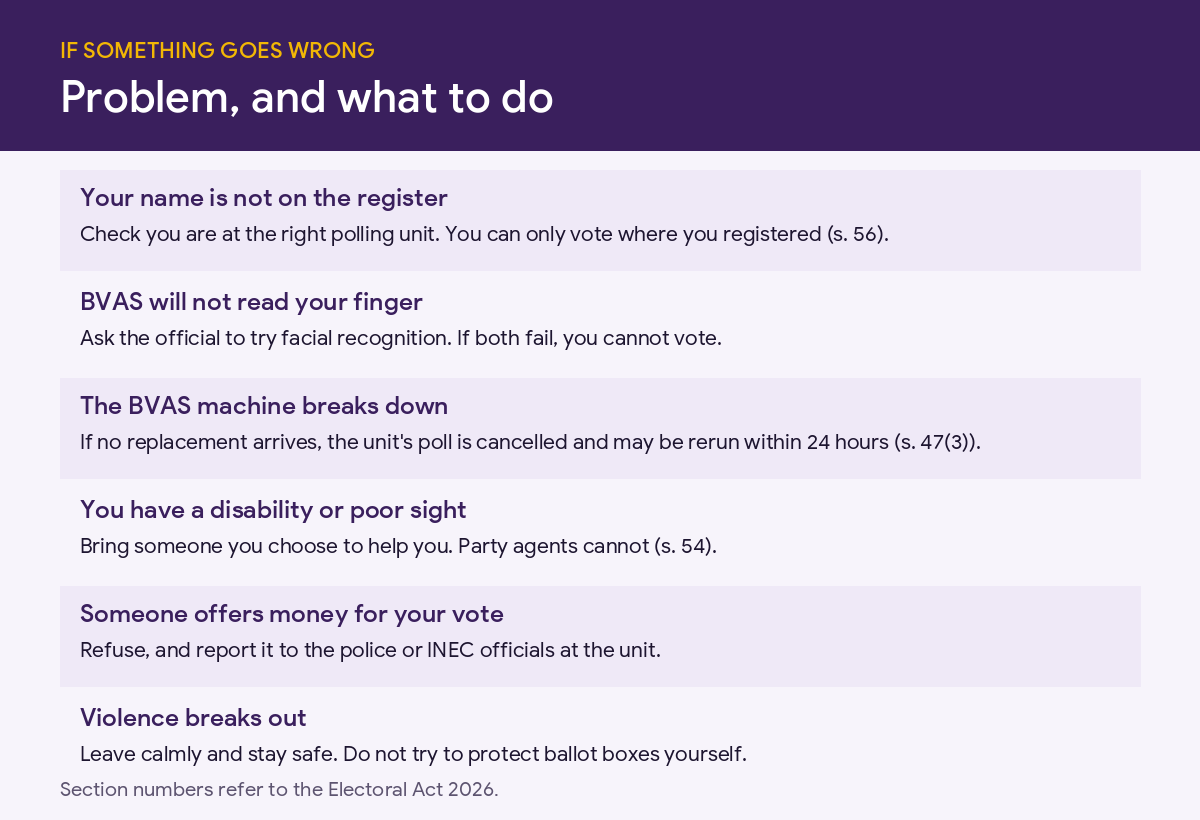
- Your name is not on the register. First check that you are at the right polling unit; the code is on your PVC. You cannot vote at another unit.
- The BVAS will not read your fingerprint. Ask the official to try facial recognition. Clean, dry hands help.
- Someone offers you money, food or gifts for your vote. Refuse, note what you saw, and report it to the police or INEC officials at the unit. Accredited election observers at the unit can also note it.
- Officials have not arrived or materials are missing. Stay patient and follow announcements from INEC. Do not leave if you can safely wait.
- Violence breaks out. Leave calmly and stay safe. Do not try to protect ballot boxes yourself; report what you saw to the police or INEC afterwards.
Frequently asked questions
What time does voting start and end in Nigeria?
Polling units open at 8:30am, and accreditation and voting run until 2:30pm. Anyone already on the queue at 2:30pm can still vote.
Can I vote without my PVC?
No. Section 47(1) of the Electoral Act 2026 requires you to present your Permanent Voter Card at your polling unit. INEC’s plan for downloadable PVCs covers only some voters whose collected cards were lost or damaged, and it has not been announced as a general replacement for the physical card.
Can I vote at any polling unit?
No. You can vote only at the polling unit where you are registered (section 56). If you have moved, check whether you can still transfer your registration before INEC’s deadline.
What if the BVAS rejects my fingerprint?
The official should try facial recognition. If both the fingerprint and face checks fail, you will not be accredited and cannot vote.
Can someone help me vote if I am blind or have a disability?
Yes. You can bring a person of your choice to help you in the cubicle, as long as the presiding officer is told. Party agents and candidates cannot be your helper (section 54).
How do I know my vote was counted?
Votes are counted in public at your polling unit and the result is written on Form EC8A and announced there. The result is also uploaded to INEC’s IReV portal, where you can check your polling unit.
Bottom line
Voting takes a few minutes once you reach the front of the queue, but it depends on preparation: your own PVC, the right polling unit and an early start. Know the steps, mark your ballot carefully, refuse any offer of money, and if you can, stay to watch the count. For every remaining INEC date, keep our 2027 election deadlines page handy, and get reminders by joining the Naijatipsland newsletter or our WhatsApp channel below.
Sources
- Electoral Act 2026 (full text, via PLAC): sections 22, 47, 49 to 58, 60 and 62
- INEC: Voter education and election-day procedure
- INEC: Election procedure guide (PDF)
- PLAC: From accreditation to declaration under the 2026 Electoral Act (April 2026)
- Technext: What the Electoral Act 2026 says if BVAS fails
- Blueprint: INEC moves to deploy downloadable PVCs ahead of 2027 polls (July 2026)
This guide is general information, not legal advice. Election rules can change; confirm details with INEC before polling day.