Last updated: 19 October 2026 · By Naijatipsland Editorial Team · Editorial policy
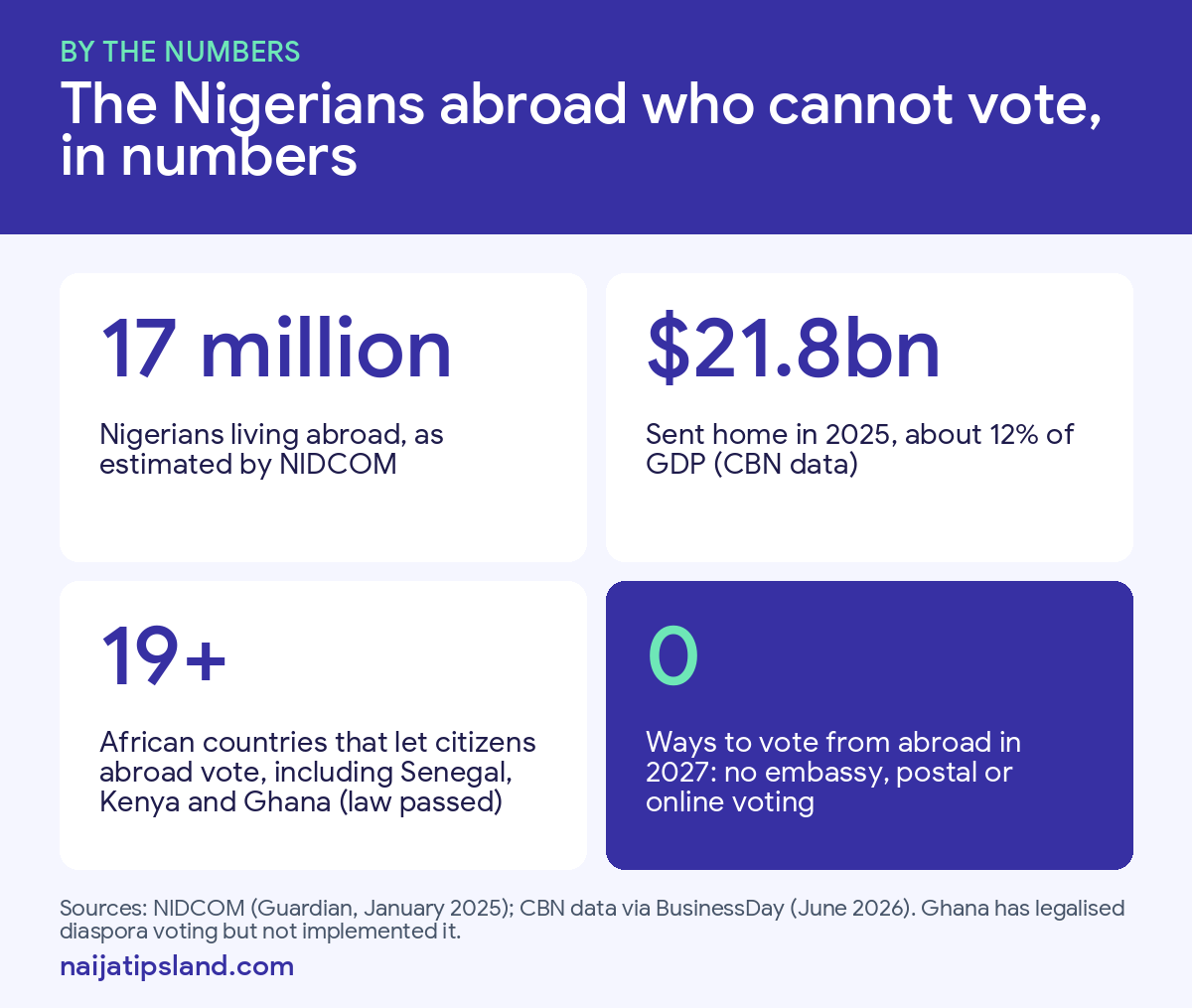
About 17 million Nigerians live abroad, according to the Nigerians in Diaspora Commission (NIDCOM), and in 2025 they sent home about $21.8 billion, close to 12% of the country’s GDP. Many of them follow Nigerian politics closely and want a say in who governs. So the question comes up every election cycle: can Nigerians abroad vote in 2027?
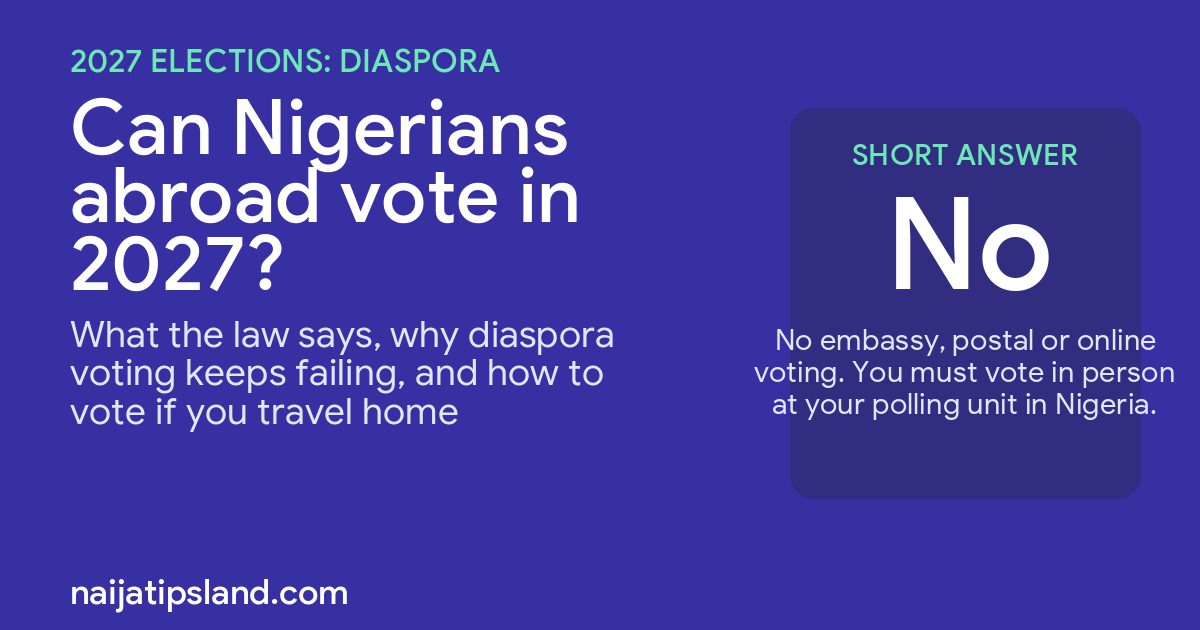
The short answer is no. There is no embassy, postal or online voting for the 2027 elections. This guide explains why, what the law says, how close Nigeria has come to diaspora voting, and what you can do if you live abroad and still want to vote on 16 January or 6 February 2027.
The short answer
- No diaspora voting in 2027. You cannot vote at a Nigerian embassy, by post or online.
- You must vote in person, in Nigeria, at the polling unit where you registered, with your own PVC (Electoral Act 2026, sections 47, 55 and 56).
- The Constitution is the main obstacle. It ties the right to register as a voter to residence in Nigeria, so diaspora voting needs a constitutional amendment, not just a change to the Electoral Act.
- Repeated bills have failed, most recently a 2022 constitution amendment rejected by both chambers. The Electoral Act 2026 did not add diaspora voting.
- If you are registered and have your PVC, you can travel home and vote.
Why Nigerians abroad cannot vote
The Electoral Act requires in-person voting at home
The Electoral Act 2026, signed in February 2026, keeps the old rules on where and how you vote. Section 47 requires you to present your Permanent Voter Card at your polling unit for BVAS accreditation. Section 55 says every voter must vote in person, so there is no proxy or postal voting. Section 56 says you can vote only at the polling unit where you are registered. All of Nigeria’s 176,000-plus polling units are in Nigeria.
The Constitution ties voter registration to residence
The bigger barrier is the 1999 Constitution. Its provisions on who is entitled to be registered as a voter, including sections 77(2) and 117(2), refer to citizens who have reached 18 and are residing in Nigeria at the time of registration. That is why INEC and most lawmakers say diaspora voting needs a constitutional amendment. A constitutional amendment must be passed by two-thirds of each chamber of the National Assembly and approved by at least two-thirds of the 36 state Houses of Assembly (24 states).
INEC says it is ready if the law changes
INEC has said for years that it supports diaspora voting in principle and would implement it once the law allows it, while stressing the logistics: verifying voters abroad, setting up voting points in other countries, and transporting and securing materials. Former INEC chairman Mahmood Yakubu said the commission was ready to integrate diaspora voting “once it is passed into law by the National Assembly”.
How close has Nigeria come to diaspora voting?
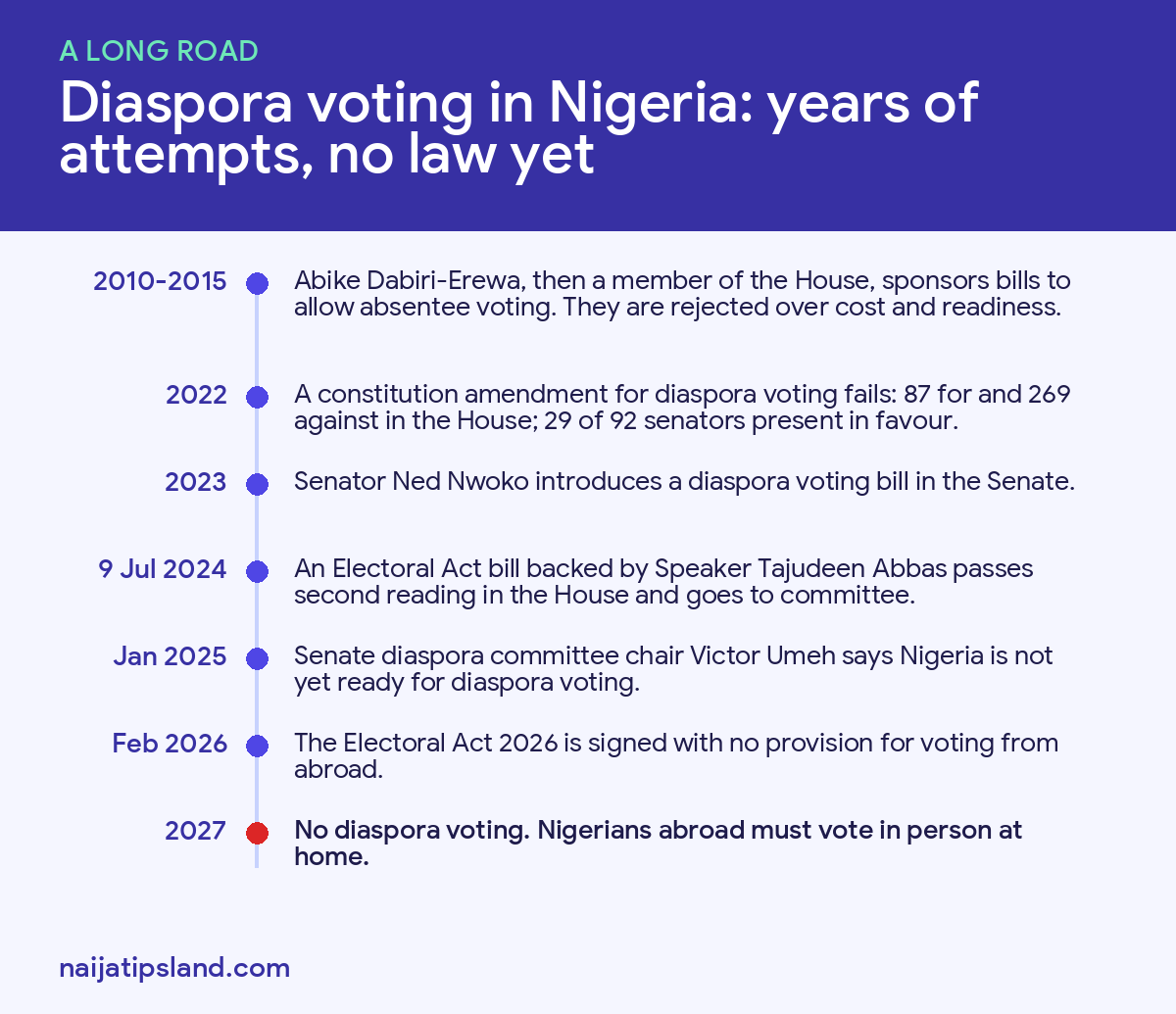
- 2010 to 2015: Abike Dabiri-Erewa, then chair of the House Committee on Diaspora and now chair of NIDCOM, sponsored bills to allow absentee voting. The House rejected them, citing cost and readiness.
- 2022: During the last constitution review, a diaspora voting amendment failed in both chambers. In the House, 87 members voted for it and 269 against; in the Senate, only 29 of the 92 senators present supported it.
- 2023: Senator Ned Nwoko introduced a new diaspora voting bill in the Senate.
- 9 July 2024: An Electoral Act amendment backed by Speaker Tajudeen Abbas, who said diaspora voting should be possible by 2027, passed second reading in the House and was sent to committee.
- January 2025: Senator Victor Umeh, chair of the Senate Committee on Diaspora, said Nigeria was not yet ready and should first fix problems in its domestic elections.
- February 2026: the Electoral Act 2026 was signed with no provision for voting from abroad.
- September 2026: the only constitution amendment bill sent to the state Houses of Assembly so far in the current review, according to reports, was the state police bill. NIDCOM’s media team has said it is likely too late for 2027.
Why it keeps failing
Supporters point to the money the diaspora sends home and to the fact that at least 19 African countries, including Senegal, Kenya, Benin, Rwanda and Côte d’Ivoire, allow citizens abroad to vote. Ghana has legalised diaspora voting but has not yet implemented it. Lawmakers and officials who have resisted it in Nigeria usually raise these concerns:
- Cost and logistics: setting up registration and voting in dozens of countries, with no reliable data on where Nigerians abroad live.
- Verification: how to confirm the identity and eligibility of voters abroad, and how to stop fraud.
- Domestic problems first: some argue Nigeria should fix its own polling units, results transmission and security before adding a diaspora vote.
- Political calculation: a diaspora vote of unknown size and leaning adds uncertainty for parties and incumbents.
What diaspora voting could look like
If Nigeria does change the law, it would have to choose how citizens abroad vote. Countries use a few common models, often in combination:
- In-person voting at embassies and consulates. Voters register and cast their ballots at diplomatic missions. Kenya, for example, has run presidential voting in a limited number of countries with large Kenyan communities, expanding the list over time.
- Postal voting. Ballots are mailed to registered voters and returned before polling day. This depends on reliable postal services and strong safeguards against fraud.
- Online voting. A handful of countries allow it, but security concerns make it the hardest model to trust.
- Diaspora seats. Some countries, such as Senegal, give citizens abroad their own representatives in parliament rather than counting their votes in home constituencies.
Most proposals in Nigeria have focused on presidential elections first, with voting at missions in countries with large Nigerian populations, such as the United Kingdom, the United States, Canada, South Africa and Ghana. Any of these models would also need a way to register voters abroad, since registration currently happens only in Nigeria, and a way to collate overseas results into the national count.
If you live abroad and want to vote in 2027
You can still vote, but only by being in Nigeria on polling day. Here is what you need to check before you book a ticket.
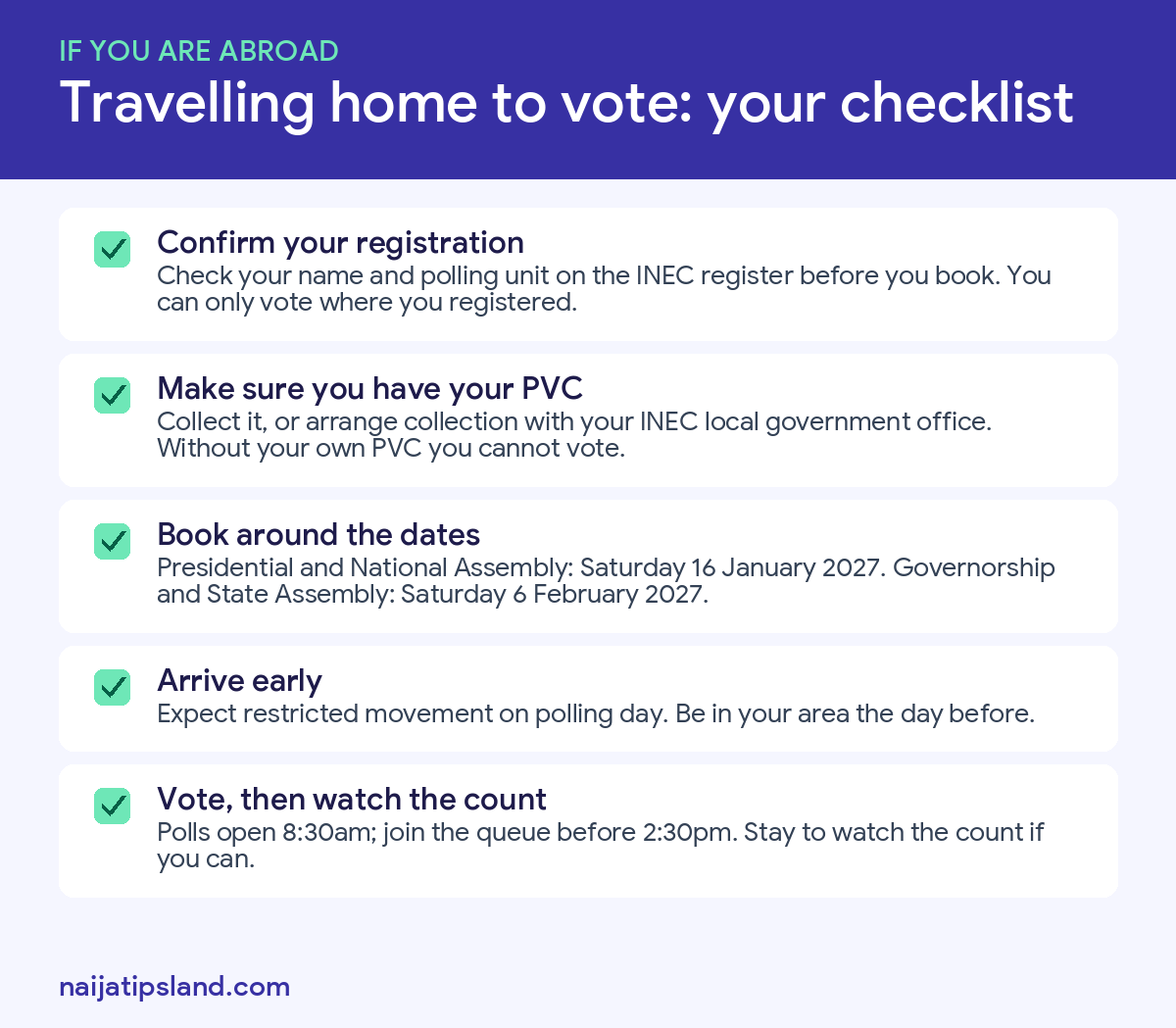
- Make sure you are registered. Registration for 2027 has closed; INEC’s continuous voter registration ended in July 2026, and the official register is due to be published on 15 December 2026. If you registered before, check that your name and polling unit are on the register.
- Get your PVC. You need your own Permanent Voter Card. If you registered but never collected it, family members cannot collect it for you; contact your INEC local government office about collection, which has been running since 9 October 2026. Our guide on checking if your PVC is ready explains how.
- Know your polling unit. You can only vote at the unit where you registered, wherever you now live. Use our guide to finding your polling unit.
- Book around the dates. The presidential and National Assembly elections are on Saturday 16 January 2027, and the governorship and State Assembly elections on Saturday 6 February 2027. Remember INEC has moved dates before, and you may want to plan for both.
- Arrive early. Movement is usually restricted on polling day, so be close to your polling unit the day before.
On the day, polls open at 8:30am and you must be on the queue by 2:30pm. Read our guides on how to vote on election day and what voters can and cannot do before you go.
Other ways to take part from abroad
- Follow the results on IReV. You can view scanned polling unit result sheets online from anywhere. Our guide to BVAS and IReV explains how to check your unit’s result.
- Help family vote. Remind relatives to collect their PVCs and check their polling units. You cannot vote for them, but you can help them get ready.
- Know the candidates. See our guide to the 2027 party primaries results and the 18 presidential candidates.
- Stay informed and avoid fake news. Our guide to staying informed about Nigeria from abroad lists reliable sources.
- Push for reform. Diaspora groups, NIDCOM and some lawmakers are still campaigning for diaspora voting. Contacting your senator and House member, and following the constitution review, is the only route to change the law.
Frequently asked questions
Can I vote at the Nigerian embassy or high commission?
No. There is no embassy or consulate voting for the 2027 elections.
Can I vote online or by post from abroad?
No. Section 55 of the Electoral Act 2026 requires voters to vote in person, and there is no postal or online voting.
Can someone vote for me in Nigeria with my PVC?
No. Giving your voter card to someone else is an offence under section 121, with a fine of up to N5 million, up to 12 months in prison, or both.
Can I register to vote while abroad?
No. Registration takes place in Nigeria, and the registration window for 2027 has closed. The next continuous voter registration exercise is expected after the 2027 elections.
Will diaspora voting be allowed in 2031?
Only if the Constitution and the Electoral Act are amended before then. Any change would need two-thirds support in both chambers of the National Assembly and the approval of at least 24 state Houses of Assembly.
Which African countries allow diaspora voting?
At least 19 do, including Senegal, Kenya, Benin, Cameroon, Botswana, Rwanda, Côte d’Ivoire and Egypt. Ghana and Togo have legalised it but not yet implemented it.
Bottom line
For 2027, the rule is simple: if you want to vote, you have to be in Nigeria, at your own polling unit, with your own PVC. Diaspora voting remains a live campaign, but it needs a constitutional amendment that has not happened. In the meantime, you can still follow the count online, help family members vote, and add your voice to the push for reform. For every remaining INEC date, see our 2027 election deadlines page and the 2027 Nigeria Election Hub.
Sources
- BusinessDay: Diaspora Nigerians shut out of voting despite yearly $21bn remittances (June 2026)
- The Guardian: National Assembly rejects diaspora voting as remittances hit $90b in five years (January 2025)
- Legit.ng: Can Nigerians abroad vote in 2027? (February 2026)
- WithinNigeria: INEC and National Assembly stance on diaspora voting (February 2026)
- PLAC Legist: Bill on diaspora voting passes second reading
- Daily Trust: Constitutional amendment, what was taken to state assemblies (September 2026)
- TryVote Nigeria: Can Nigerians abroad vote in 2027?
- Electoral Act 2026 (full text, via PLAC): sections 47, 55, 56 and 121