
Peter Obi’s 2027 Manifesto: His Plans for the Economy, Power and Youth (What Is Promised and What Is on Paper)

Last updated 15 November 2026. This guide is informational and neutral. It does not endorse any candidate or party, and it applies the same test to every candidate: what is in writing, what has been promised in speeches and what can be checked. Election news changes quickly, so check INEC and each party for the latest.
If you are asking what Peter Obi’s 2027 manifesto says, the honest answer has three parts. First, Obi is the presidential candidate of the Nigeria Democratic Congress (NDC), with Rabiu Kwankwaso as his running mate. Second, he presented a 2027 ‘governance agenda’ at a series of town halls from late October, built on unity, security, production, education, health and accountability. Third, as of 15 November 2026 we could not find a full, costed manifesto document that voters can download and read in one place. This page separates what has been promised from what is actually on paper, and compares it with the other main platforms.
For the wider picture, including dates, candidates and voting rules, see our 2027 Nigeria Election Hub. For the other two best-known platforms, read our guides to Atiku Abubakar’s 2027 manifesto and Tinubu’s 2027 promises.
The basics
- Election date: the presidential and National Assembly elections are set for 16 January 2027.
- The ticket: Peter Obi, a former Anambra State governor who came third in the 2023 presidential election, is the NDC candidate, with former Kano State governor Rabiu Kwankwaso as running mate. Reports say both joined the NDC on 3 May and that Obi was ratified as candidate on 30 May 2026.
- On the ballot: INEC’s final list, published on 12 September 2026, named 18 presidential candidates, and the Obi-Kwankwaso ticket is on it.
- The party’s legal history: reports say INEC registered the NDC in February 2026 after a court order, and that the Court of Appeal restored the party’s registration on 18 September by a 2-1 majority after a lower-court ruling in June had set it aside.
Is there an Obi manifesto?
This is where careful reading matters. On 25 October 2026 the Tribune reported that none of the three best-known candidates had released a detailed manifesto, and that a document being shared abroad by an Obi supporter had not been made public. Since then the picture has changed in one respect: the BBC reports that Obi unveiled his 2027 Governance Agenda on 10 November under the slogan ‘A New Nigeria is Possible’, and he has repeated its main points at town halls in Jos, Makurdi and Ikeja. Reports on the other parties vary: one assessment released on 29 October by a pro-democracy group said only one of the 18 candidates, Adewole Adebayo of the SDP, had submitted a comprehensive manifesto, while other coverage lists the NDC among parties with clear policy positions.
The fair summary is that Obi’s plans are on the public record as campaign commitments, repeated across several events, but they are not (in the sources we could find) a single costed policy document. That distinction matters, because a speech can be changed more easily than a published text. In 2023 Obi’s campaign published a manifesto titled It’s Possible: Our Pact with Nigerians on 4 December 2022, 82 days before that year’s election, so a written document may still follow this time.
What Obi has pledged so far
These points come from news reports of his speeches between 29 October and 13 November 2026. We quote them as pledges, not as achievements, and we have not verified that any of them is affordable.
Economy and jobs
- From consumption to production: his central economic line is to move Nigeria from a consumption economy to a production economy, arguing that more local production means more jobs.
- Credit for small businesses: he says he would make sure a portion of bank credit goes to small businesses, citing his past experience as a bank director and chairman. One report puts the figure at 20 per cent of bank lending for 40 million small businesses, which we could not match to a speech transcript, so treat it as unconfirmed.
- Youth: he has promised that young people will be helped to find a job or start a business when they finish school, with access to funding, and he has pointed to agriculture as a route to work. He calls youth unemployment unacceptable.
Electricity
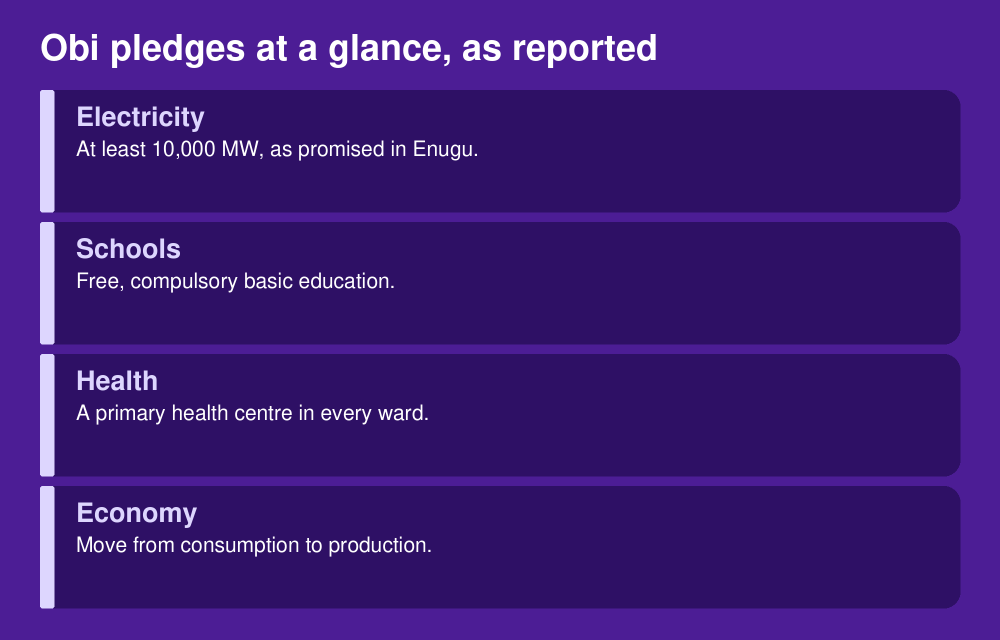
At a town hall in Enugu on 29 October he promised to generate, transmit and distribute at least 10,000 megawatts if elected, saying reliable power is needed to revive industry and jobs. One report puts current generation at about 5,403 MW, a figure we could not tie to an official source, so check NERC and grid operator data before relying on it.
Security and unity
Obi puts national unity first and security second. He has promised to strengthen the security architecture, confront kidnapping and violent crime, and ensure the safe return of internally displaced people to their communities. He has also said he would recruit more graduates into the police and improve officers’ welfare.
Education and health
- Schools: basic education would be free and compulsory, and he has spoken of declaring an emergency in education. He cites about 18 million out-of-school children and has said he would bring 30 per cent of them into school.
- Health: a functional primary healthcare centre in every ward, with a focus on cutting maternal and infant deaths, and care for the poor, the elderly and people with disabilities.
Corruption and borrowing
He has promised to declare an emergency on corruption, to use public money for public good, and to tell Nigerians what borrowed money is spent on. He has challenged President Tinubu to explain how foreign loans have helped Nigerians.
The numbers that can be checked
Obi’s most specific costing so far is on schools. In Lagos he said 30 per cent of out-of-school children could be put in classrooms by building 40,000 ‘moderate’ five-classroom blocks at N25 million each, a total of about N1 trillion. A simple check of those numbers shows they are at least consistent with each other:
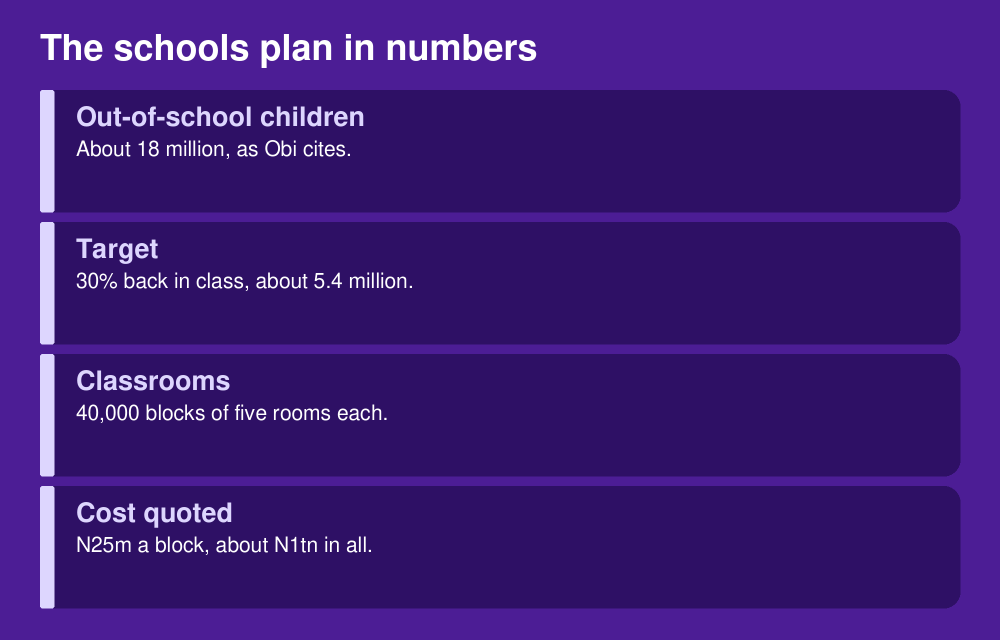
- 40,000 blocks multiplied by N25 million is N1 trillion, as stated.
- 40,000 blocks of five classrooms is 200,000 classrooms.
- 30 per cent of 18 million children is 5.4 million, or about 27 pupils per classroom, which is plausible on paper.
That arithmetic is ours, not Obi’s, and it covers construction only. It leaves out land, teachers, furniture, running costs and the question of where the blocks would be built. He also said the government claimed to have saved N15.8 trillion from removing the fuel subsidy and alleged that the money had been stolen. That is an allegation by a candidate, not an audit finding, and we have not seen evidence for it in the sources reviewed.
Where the reports differ or the facts are not yet clear
- The power deadline: one report says Obi promised 10,000 MW in four years, while another quotes the ticket promising it in two years. Ask for the written timeline.
- Fuel subsidy: Kwankwaso made fresh fuel-subsidy pledges on 15 October, and reports say Obi and Atiku have both spoken of restoring support, but no candidate has published the cost. Without a number, voters cannot judge the trade-off.
- One term: Kwankwaso said in July that two written agreements limit Obi to a single four-year term, with power returning to the North in 2031. Press reports say the documents are not public and Obi has not confirmed their details. Critics have attacked the idea, and supporters argue it shows a commitment to rotation. Both are opinions about a document nobody has published.
- Campaign conditions: police said Obi’s convoy was attacked in Calabar on 4 November, and suspected thugs disrupted an NDC town hall in Ikeja on 12 November. These are security incidents, not policy, but they affect how freely any candidate can present their plans.
How it compares with the other main platforms
We apply the same test to each: what is in writing, and what has been said on the trail. For details, follow the links to our separate guides.
| Candidate and party | What is in writing | Examples of headline commitments |
|---|---|---|
| Peter Obi, NDC | Governance agenda presented from late October; no costed document found as of 15 November | 10,000 MW of power, free basic education, a health centre in every ward, production-led economy |
| Bola Tinubu, APC | A 109-page manifesto launched on 10 November, reported under slightly different titles | 6 per cent annual growth by 2031, 78,000 more security personnel, 200,000 affordable homes (BBC) |
| Atiku Abubakar, ADC | A party manifesto adopted in April 2026, plus campaign pledges; the party leadership is in a legal dispute | See our Atiku guide |
No candidate has yet published a full fiscal impact for every promise, and the fuel subsidy is the clearest example. When you compare plans, look for the candidate who gives numbers, dates and funding sources, not the one who gives the best speech.
How to check any manifesto promise
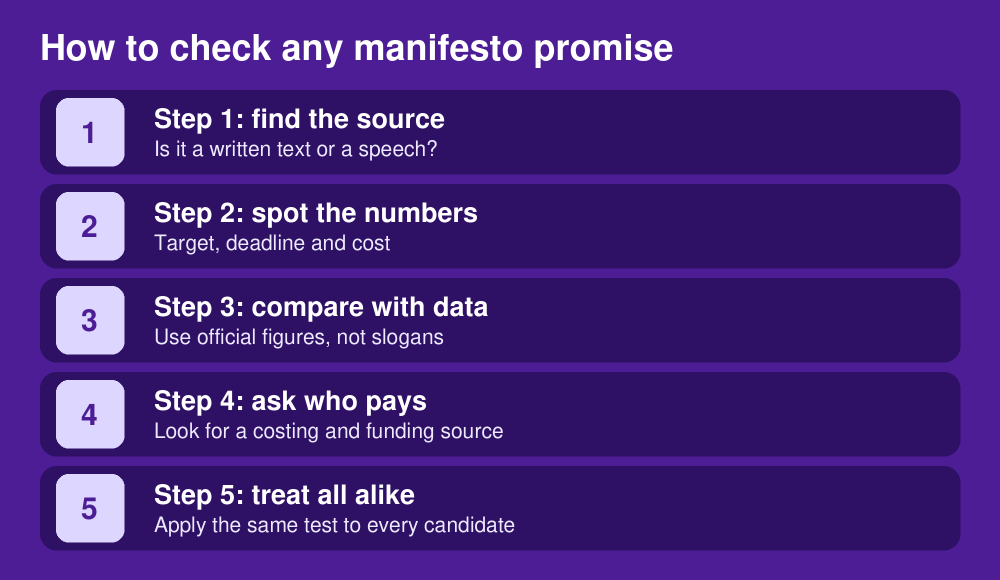
Use the same five steps for every candidate. Find out whether the promise is in a written document or only in a speech. Note the target, the deadline and the cost. Compare the number with official data, for example grid output, school enrolment or the federal budget. Ask who pays and from what source. Then apply the same test to the next candidate. Our guide to Nigeria’s run-off rules explains what happens if nobody wins outright, and our BVAS and IReV explainer shows how votes are counted and uploaded.
If you live abroad
Many readers in the UK, US and Canada follow the election closely. Check the rules in our guide on whether Nigerians abroad can vote in 2027 before you plan anything, and use the same neutral checks above when you read diaspora campaign events and fundraising claims.
Frequently asked questions
Has Peter Obi released a manifesto for 2027?
He has presented a 2027 governance agenda and repeated its main commitments at town halls. As of 15 November 2026 we could not find a single, costed manifesto document published for download. His 2023 manifesto, It’s Possible: Our Pact with Nigerians, was published on 4 December 2022.
Who is Peter Obi’s running mate?
Former Kano State governor Rabiu Kwankwaso. Both are on INEC’s final list of presidential candidates.
What is Obi’s plan for electricity?
He has promised to generate, transmit and distribute at least 10,000 megawatts. Reports differ on whether the deadline is two years or four, so look for a written timeline.
What is Obi’s plan for education?
Free and compulsory basic education, an emergency in education, and bringing 30 per cent of the roughly 18 million out-of-school children into class, using about 40,000 five-classroom blocks at N25 million each.
When is the 2027 presidential election?
16 January 2027, with governorship and state assembly elections following. Confirm dates on INEC’s website.
Is this article an endorsement?
No. It treats every candidate alike and does not tell you how to vote.
Sources
- New Telegraph: Obi unveils 2027 agenda, vows to tackle insecurity, poverty (10 November 2026)
- The Nation: Obi unveils agenda in Jos, vows to end insecurity (11 November 2026)
- AllAfrica: Peter Obi rolls out plans for Nigeria, challenges Tinubu on borrowing (30 October 2026)
- The Sun: Your sacrifices won’t be in vain, Peter Obi assures Nigerians (Ikeja town hall)
- The Guardian Nigeria: You are all candidates, Obi tells Nigerians (14 November 2026)
- Blueprint: Peter Obi in Benue promises to tackle insecurity and unemployment (12 November 2026)
- Tribune: 2027 presidency, campaign without manifestos (25 October 2026)
- The Point: Candidates shun manifestos as campaigns descend into attacks (10 November 2026)
- Rio Times: Nigeria Democratic Congress and the 2027 stakes (16 October 2026)
- Secrets Reporter: Road to 2027, Peter Obi (13 November 2026)
- Daily Asset: Thugs storm Obi-Kwankwaso town hall in Lagos (13 November 2026)
- AllAfrica: 2027 politics watch, from Atiku’s Sokoto rally to Obi’s convoy attack (5 November 2026)
Join the discussion
Have you tried this, or do you have a question we did not answer? 1 reader has already shared their view. Naijatipsland members help each other with real, first-hand experience.





Editor’s note: this guide is informational and neutral. It does not endorse any candidate or party, and it applies the same test to every candidate: what is in writing, what has been said on the campaign trail and what can be checked. Campaign news moves quickly, so confirm anything important with INEC and the candidate’s party. – Ade