
Check an X (Twitter) tracker first to catch where a topic started, then confirm its spread on Google Trends or TikTok’s Discover tab. WhatsApp broadcasts often carry a story further than any public tracker can measure. For a Nigerian angle already sorted from the noise, An online platform pulls these threads into one aggregated feed so you don’t have to hop between five apps to know what the country is actually talking about.
TL;DR:
- Twitter trackers like Trends24 provide early signals of trending topics by showing hourly hashtag movements and top tweets before stories peak elsewhere.
- WhatsApp broadcasts move stories rapidly through private groups, making them difficult to track publicly but critical for understanding grassroots discussions.
- Nigerian trends on platforms like TikTok and YouTube tend to last less than a day, with political and security topics sometimes extending over several days if developments occur.
- Disinformation spreads quickly through AI-generated videos and audio, emphasizing the importance of verifying claims via reverse image searches and official sources before sharing.
- Combining multiple sources such as Twitter, Google Trends, TikTok, and WhatsApp is essential for a comprehensive understanding of Nigeria’s dynamic online conversations.
Table of Contents
- Where to Find Live Nigerian Trends: Trackers, Tools, and Forums
- How Each Platform Shapes the Life Cycle of a Trend in Nigeria
- How to Verify a Trend and Spot Disinformation
- How to Set Up Alerts and Save Trending Searches
- Using Trends the Right Way as a Creator or Community Manager
- Naijatipsland’s Role in Curating Nigerian Trends
- Historical Overview of Past Major Trending Topics in Nigeria
- Cultural and Social Factors Behind What Trends in Nigeria
- What Trending Topics Mean for Nigerian Politics and Society
- Regional Variations in What Trends Across Nigeria
- How Long Nigerian Trends Actually Last
- Our Take: What This Guide Gets Right That Most Advice Misses
- Get Nigerian Trends Delivered Without the App-Hopping
- Sources
Where to Find Live Nigerian Trends: Trackers, Tools, and Forums
Every platform shows you a different slice of what’s trending in Nigeria, and knowing which one to open first saves you from chasing a story that already peaked hours ago.
- X (Twitter) trackers like Trends24 publish hourly timelines showing top hashtags, how long each one has held its position, and “most tweeted” scores. These are your best bet for catching a topic at its origin, before it spreads to bigger platforms.
- Google Trends (Nigeria) shows which search queries are rising fastest right now and often links directly to the news stories behind the spike, which makes it useful when you want context rather than just a hashtag.
- TikTok Discover and For You surface youth-driven cultural moments, comedy skits, and music trends that rarely show up on Twitter at all.
- Facebook groups and pages aggregate news commentary and local conversation, especially around politics and community issues.
- WhatsApp and Telegram broadcasts move stories fast through private channels, but they’re nearly impossible to track publicly since the activity happens outside searchable feeds.
- Nigerian forums such as Nairaland and local news aggregator pages still carry long-form discussion threads that trackers and short-form apps miss entirely.
Check X trackers and Google Trends in real time if a story feels urgent. Facebook and forums are worth a daily scan, while TikTok rewards checking a few times a day since its trends move fast and fade just as quickly.
How Each Platform Shapes the Life Cycle of a Trend in Nigeria
Not every platform plays the same role. Some ignite a story. Others carry it to millions who never saw the original post.
Nigeria counted roughly 47.8 million social media user identities in late 2025, about 44% of internet users in the country, with men making up 67.3% of that base. That scale is split unevenly across platforms, and each one does a different job in a trend’s life span.
- X (Twitter) has a smaller user base than Facebook or WhatsApp, but it’s usually where a topic breaks first. Journalists, activists, and public figures post there before anywhere else, which makes X your best signal for origin and framing.
- WhatsApp is Nigeria’s dominant daily communication tool, and its reach is enormous even though it’s nearly impossible to measure publicly. A story can blow up across thousands of family and community groups without ever trending on a public tracker.
- Facebook drives the largest share of measurable news traffic, acting as the aggregation layer where stories get discussed, shared, and argued over.
- TikTok is the fastest-growing cultural driver among young Nigerians, with 66% of 18 to 34-year-olds using it regularly and 71% of those checking it daily.
- YouTube and Google Search serve as depth hubs, where people go once they already know a topic exists and want the fuller story.
How to Verify a Trend and Spot Disinformation
A trending hashtag doesn’t mean a claim is true. It means a lot of people are talking about it, and that’s exactly the gap disinformation exploits.
- Check the timestamp and original poster. Find who posted first and when. A claim with no clear origin, or one that appeared simultaneously from dozens of new accounts, deserves suspicion.
- Look for corroboration. A real story usually gets picked up by at least two independent outlets within hours. If only one obscure page is running it, wait.
- Run a reverse image or video search. Old photos and clips get recycled with new captions constantly, especially around protests, accidents, and celebrity news.
- Check official statements for anything political or security related. INEC, the Nigeria Police, and the Presidency typically respond directly to major false claims within a day or two.
Watch for red flags: AI-generated audio or video with slightly off lip-syncing or robotic cadence, a burst of reposts from accounts created within the same week, and old footage reused with a caption claiming it’s happening “now.”
Nigeria has already seen this play out. A June 2026 social media listening report documented a fake audio clip mimicking President Bola Tinubu that circulated widely before officials debunked it and arrests followed.
AI-generated audio and video convincing enough to pass as real have moved from a theoretical risk to an active problem in Nigerian information spaces, with real consequences following the people who created and spread them.
Pro Tip: Before you share anything, do two quick checks on your phone: search the exact wording in Google to see if a fact-checker has already covered it, and zoom into any video for visual glitches around the mouth or hands, common tells of AI generation.
How to Set Up Alerts and Save Trending Searches
You don’t need to refresh five apps all day. A few saved searches and alerts will surface most of what matters automatically.
- Set up Google Alerts for terms you follow closely, and use Google Trends’ Explore tool filtered to Nigeria to catch rising queries before they peak.
- Save hashtags and build lists on X. Pin the searches you check most, and follow a small set of accounts known for breaking Nigerian news fast and accurately.
- Follow TikTok sounds and hashtags tied to topics you care about, and pay attention to your Following tab, not just For You, since that’s where niche creators post before a trend goes wide.
- Join a few trusted WhatsApp broadcast lists from established outlets rather than random forwarded groups, since verified channels carry less noise.
Casual readers can get by checking once or twice a day. Content creators and community managers should check X and TikTok every few hours, since Nigerian trends often rise and fall within a single day.
Using Trends the Right Way as a Creator or Community Manager
Jumping on a trend without a plan can backfire fast, especially if the topic turns out to be sensitive, political, or unverified. Decide first whether the moment calls for participation or quiet observation.
- Ask whether reacting adds real value or just noise before you post.
- Match format to platform: short native video for TikTok, a quick context note with a link for Facebook or WhatsApp, and a thread with background for X.
- Never build a call to action around a claim you haven’t verified, even if it’s trending hard.
- Track immediate engagement first, then check whether it translates into follower growth over the following days.
Pro Tip: Native, unscripted vertical video consistently outperforms polished repackaged ads on TikTok in Nigeria, so resist the urge to over-produce a trend response.
Naijatipsland’s Role in Curating Nigerian Trends
A platform exists to pull scattered Nigerian conversations, political commentary, entertainment updates, and community discussion into one forum, so readers spend less time jumping between apps.
- Users submit posts and discussion threads directly, which may get reviewed before wider circulation.
- The curation guide explains how editorial judgment shapes what surfaces on the front page.
- Members can comment, flag questionable posts, and push back on claims that don’t hold up.
- Creators looking to get featured can review the content submission process for what qualifies and how moderation works.
Historical Overview of Past Major Trending Topics in Nigeria
Nigerian trends tend to cluster around a handful of recurring categories: elections, security incidents, celebrity scandals, and viral comedy or music moments. The #EndSARS movement in 2020 remains the clearest example of a hashtag that moved from Twitter into real-world protest and policy conversation, and it’s still referenced whenever a new civic movement gains traction online.
Election cycles reliably produce some of the largest trend spikes the country sees, with results, allegations of irregularities, and candidate gaffes dominating timelines for days at a stretch. Entertainment has its own rhythm: reality show moments, particularly from Big Brother Naija, routinely dominate Twitter trends during the show’s run, often outpacing political news in raw volume of posts.
Naira volatility and fuel price changes have also triggered repeated waves of trending frustration, usually paired with dark humor that Nigerians use to process economic strain online. Viral comedy skits and music releases, meanwhile, tend to have shorter but more intense spikes, often driven by a single influential post rather than sustained news coverage.
What ties these moments together is speed. Nigerian social media has consistently shown a pattern of taking a local incident, whether political, economic, or cultural, and amplifying it into national conversation within hours, long before traditional media catches up.
Cultural and Social Factors Behind What Trends in Nigeria
Humor is Nigeria’s default coping mechanism online, and it shapes what spreads more than almost any other factor. A serious economic or political story will often go viral not through the original report but through the memes and jokes that follow it within the hour.
Ethnic and religious identity also plays a role in how fast a topic spreads and how it’s framed. A story that touches on regional or religious tension tends to fragment into multiple competing narratives rather than one unified trend, which is part of why verification matters so much in those cases.
Generational divides show up clearly in platform choice. Younger Nigerians drive TikTok’s cultural moments, from dance trends to slang that migrates offline within weeks, while older, more news-focused audiences remain concentrated on Facebook and WhatsApp. Diaspora Nigerians add another layer, frequently amplifying stories about home that domestic audiences might otherwise scroll past, particularly around governance and economic policy.
Celebrity culture, especially around music and Nollywood, generates some of the most consistent trending activity because it crosses class and regional lines in a way political news often doesn’t. A single tweet from a major artist can outtrend a government policy announcement within an hour, which tells you a lot about where public attention naturally gravitates.
What Trending Topics Mean for Nigerian Politics and Society
Trending topics have moved from background noise to a genuine pressure point in Nigerian governance. Officials and agencies now respond directly to hashtags that gain enough traction, sometimes within hours, because ignoring a viral claim has become riskier than addressing it.
#EndSARS remains the clearest case of a trend reshaping policy conversation, but smaller versions of that pattern repeat constantly around subsidy removals, insecurity incidents, and election disputes. A trend can pressure a state government into issuing a statement or a federal agency into opening an investigation faster than formal complaints ever would.
The downside is real. The same speed that holds power accountable also spreads unverified claims just as fast, and the deepfake incident targeting President Tinubu shows how quickly a fabricated clip can travel before anyone corrects it. That incident triggered arrests and an official debunk, proof that Nigerian authorities now treat viral disinformation as a real security matter, not just online chatter.
Socially, trending topics also function as a national mood gauge. Watching what dominates Nigerian Twitter or TikTok on a given week tells you more about public sentiment on fuel prices, insecurity, or entertainment than most formal surveys manage to capture in real time.
Regional Variations in What Trends Across Nigeria
Trending topics rarely look identical from Lagos to Kano to Port Harcourt. Lagos and the broader southwest tend to drive entertainment, tech, and startup culture conversations, partly because that’s where much of Nigeria’s media and creative industry is concentrated.
The north sees more sustained trending activity around security, agriculture policy, and religious commentary, reflecting the region’s different set of daily concerns. The south-south and south-east, meanwhile, often lead conversations tied to oil economics, restructuring debates, and regional political grievances that rarely make it onto national trending lists dominated by Lagos-based accounts.
Language plays a quiet but real role too. Pidgin-heavy posts tend to travel further and faster across regional lines than posts written in formal English, since Pidgin functions as a shared cultural code that resonates regardless of which part of the country someone is from. Hausa, Yoruba, and Igbo language content, by contrast, tends to trend more intensely within its own regional audience before crossing over, if it crosses over at all.
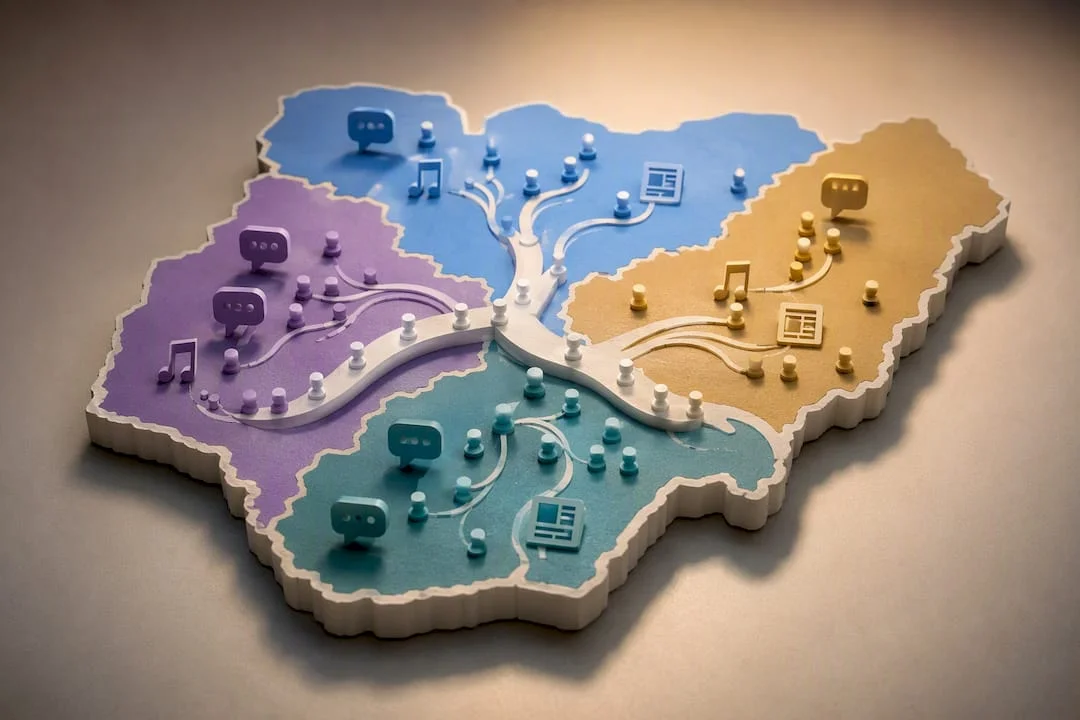
Diaspora-driven trends add a final layer of regional flavor, since Nigerians abroad frequently amplify stories tied to their specific home states or ethnic communities, which can push a fairly local story into national visibility within a day.
How Long Nigerian Trends Actually Last
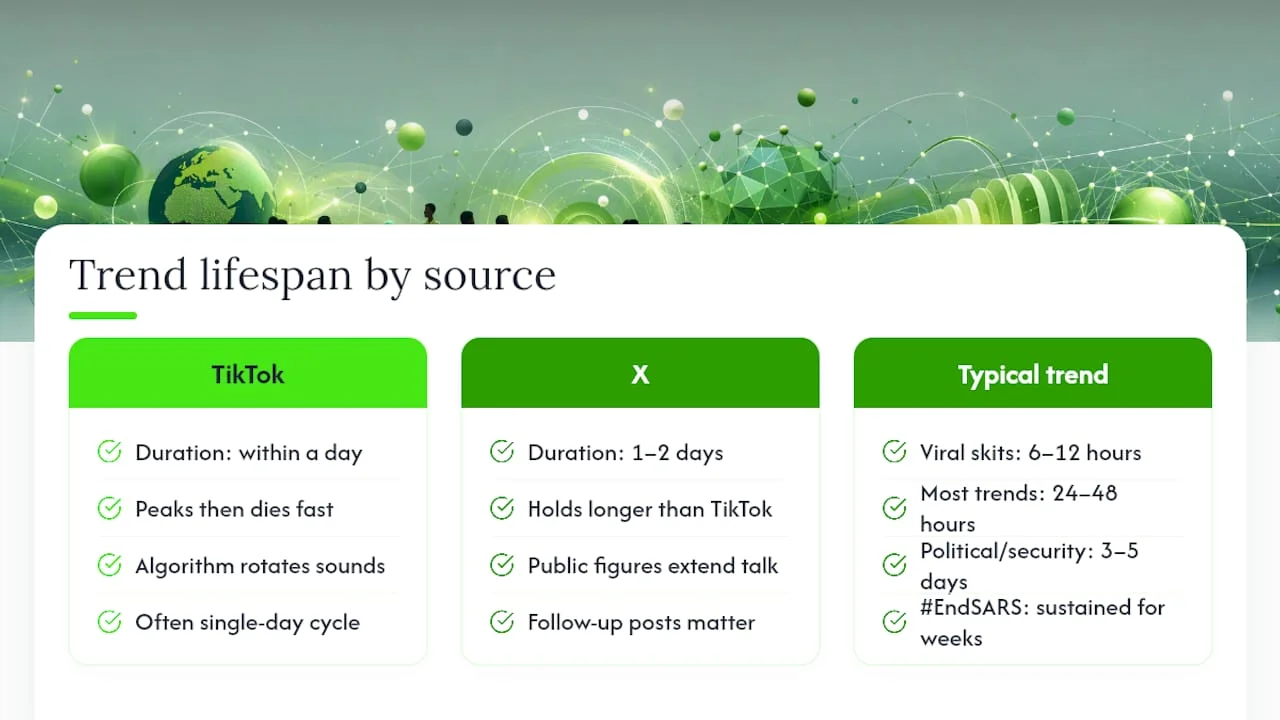
Most Nigerian trends peak and fade within 24 to 48 hours, and a large share burn out even faster than that. A viral comedy skit or celebrity moment often loses steam within six to twelve hours as attention shifts to whatever posts next.
Political and security trends tend to have a longer tail, sometimes stretching three to five days if new developments keep feeding the story, an arrest, an official statement, a follow-up investigation. #EndSARS is the outlier that proves the exception: sustained real-world action kept it trending for weeks rather than hours, which almost never happens with a purely online moment.
TikTok trends move on the fastest cycle of any platform, often peaking and dying within a single day as the algorithm rotates in newer sounds and formats. X trends generally hold steady longer, sometimes a full day or two, especially when public figures keep the conversation alive with follow-up posts.
Understanding this rhythm matters practically. If you’re checking trends once a day, you’re likely catching stories in their second half already, which is exactly why creators and community managers benefit from checking more frequently during active news cycles.
Our Take: What This Guide Gets Right That Most Advice Misses
Most guides to Nigerian trending topics stop at “check Twitter,” which misses most of the actual story. The real picture requires reading at least three platforms together, X for origin, Google Trends or TikTok for spread, and treating WhatsApp as a blind spot rather than an afterthought.
The conventional advice also underrates verification. Plenty of guides tell you where to look but say almost nothing about confirming what you’re looking at, which is a real gap given how fast AI-generated disinformation has escalated in Nigeria recently. A trending topic and a true one are not the same thing, and treating them as interchangeable is how false claims about politicians and public figures spread as fast as they do.
If there’s one priority for the average reader, it’s this: build the habit of checking a second source before sharing, not after. That single habit does more to protect you from embarrassment or harm than any tracker or alert setup ever will. Local curation, the kind Naijatipsland does daily, helps close that gap by filtering noise before it reaches your feed.
— Naijatipsland
Get Nigerian Trends Delivered Without the App-Hopping
The service gives you a single feed for Nigerian conversation instead of forcing you to cross-check five apps every time something breaks. Where a solo tracker only shows you one platform’s version of a story, a forum pulls in entertainment, politics, and community discussion side by side, curated by people paying attention to similar trends.
If entertainment and culture updates are what you check most, the entertainment updates page is a good place to start, and you can browse local entertainment coverage for the latest stories shaping conversation this week. Have something worth sharing yourself? Submit it through the creator submission process and get it in front of a community already primed to discuss it. Bookmark the forum now, and check back daily, since Nigerian trends rarely wait for a convenient time to break.
Sources
- Digital 2026: Nigeria — DataReportal – Global Digital Insights
- Top Trends 2026: TikTok Is Nigeria’s Largest Social Platform, Primary Cultural Driver – Brand Communicator
- Social Media Statistics In Nigeria 2026 Data Report | Krestel Digital
- Social media listening report: Wednesday, 10 June 2026 – BusinessDay NG