

Last updated: 18 October 2026 · By Naijatipsland Editorial Team · Editorial policy
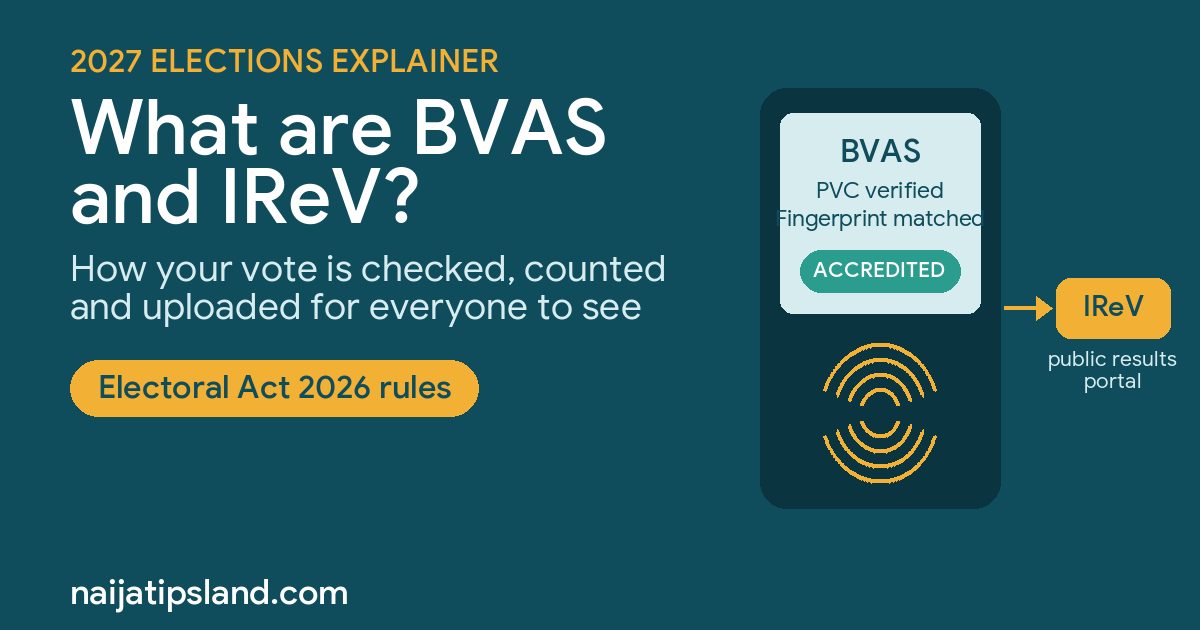
Two acronyms will come up again and again before Nigeria’s 16 January 2027 presidential and National Assembly elections and the 6 February 2027 governorship and State Assembly polls: BVAS and IReV. One is a device you will meet in person at your polling unit. The other is a website you can open on your phone that evening. Between them, they decide whether you get to vote and how the public gets to see the results.
This guide explains what each one is, what the Electoral Act 2026 says about them, what went wrong in 2023, what INEC says it has changed for 2027, and how you can use IReV yourself to check the result from your own polling unit. For the full election-day routine, read our step-by-step guide on how to vote on election day, and keep the 2027 Nigeria Election Hub bookmarked.
The short answer
- BVAS stands for the Bimodal Voter Accreditation System. It is a portable electronic device introduced by the Independent National Electoral Commission (INEC) to improve the transparency, credibility and accuracy of the electoral process. At the polling unit it checks your Permanent Voter Card (PVC) and then your fingerprint or face before you are allowed to vote.
- IReV stands for the INEC Result Viewing Portal. It is an online, public-facing platform run by INEC that lets anyone view scanned copies of official election results directly from individual polling units.
- The BVAS feeds IReV. After votes are counted, the presiding officer uses the BVAS to photograph the signed result sheet (Form EC8A) and upload it to IReV.
- Neither one declares winners. Results are still added up by hand at collation centres and announced by INEC returning officers.
- Both are now in the law. Section 47(2) of the Electoral Act 2026 makes the BVAS mandatory for accreditation, and section 60(3) requires results to be transmitted after Form EC8A is signed.
What is BVAS?
The Bimodal Voter Accreditation System is a handheld, tablet-like device that INEC officials carry to every polling unit. “Bimodal” means it can identify a voter in two ways: by fingerprint and by face. It replaced the older Smart Card Reader, which only read fingerprints and often failed to recognise them, and the separate Z-pad device INEC had trialled for uploading results. INEC first deployed the BVAS in 2021, including in the November 2021 Anambra governorship election, and used it nationwide in the 2023 general elections.
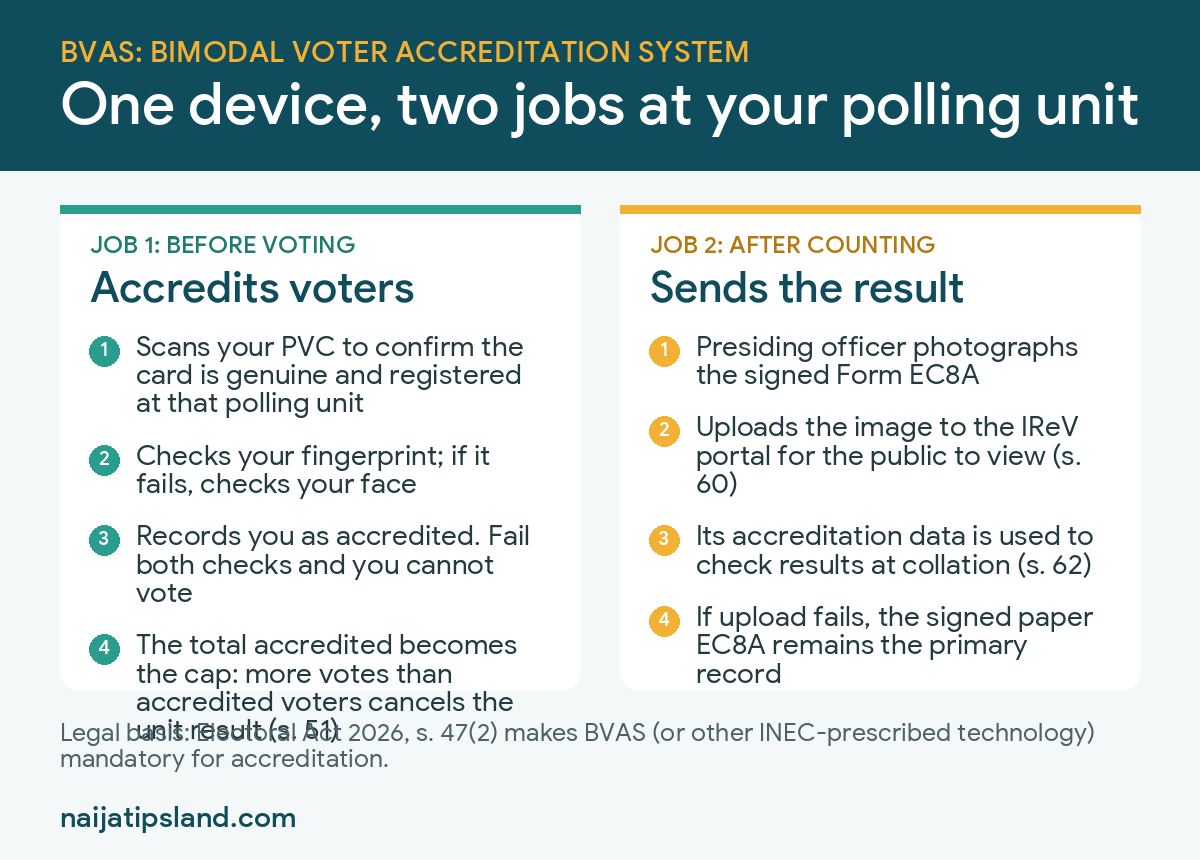
When you reach the front of the queue, an official uses the BVAS to scan the barcode or chip on your PVC. The device confirms that the card is genuine and that you are registered at that polling unit. It then asks for your fingerprint. If your fingerprint does not match, the official switches to facial recognition and takes your picture with the device. If both checks fail, you are not accredited and cannot vote.
The BVAS’s second job: sending the result
The BVAS is not only a voter-checking machine. After voting closes and the ballots are counted in public, the presiding officer fills in Form EC8A, signs and stamps it, and has the party agents present countersign it. The presiding officer then uses the BVAS camera to photograph that signed sheet and uploads the image to IReV.
The BVAS also records how many voters it accredited. That number matters. Under section 51(2) of the Electoral Act 2026, if the votes cast at a polling unit are more than the number of accredited voters, the presiding officer must cancel the result for that unit. This is how the law deals with over-voting: the BVAS figure becomes the ceiling. At collation, section 62 requires officers to check polling unit results against the accreditation data recorded on the BVAS.
What happens if the BVAS fails?
Section 47(3) of the Electoral Act 2026 says that if the BVAS at a polling unit stops working and is not replaced, the election in that unit is cancelled. INEC must then hold a fresh poll there within 24 hours if the result could substantially affect the overall outcome.
INEC Chairman Professor Joash Amupitan said in October 2026 that a failure at one polling unit will not stop collation elsewhere: voting at the affected unit is moved, and the rest of the process carries on. INEC also keeps technical support teams, known as RATECH, at registration area level to fix or replace faulty devices on the day.
What is IReV?
The INEC Result Viewing Portal is a public website, inecelectionresults.ng, where INEC posts the scanned result sheet from each polling unit. Anyone can use it: voters, party agents, election observers, journalists and researchers. It lets you compare the result announced at your polling unit with the copy INEC holds, and it makes it much harder to change figures quietly between the polling unit and the collation centre, because thousands of people can see the original.
INEC announced IReV in August 2020 and first used it at the Nasarawa Central State Constituency by-election on 8 August 2020. At the time, INEC was clear that the portal “does not constitute electronic collation of results”. That point still stands: IReV is a window for viewing results, not the system that adds them up.
How your vote travels from the ballot box to the declaration
It helps to see the whole chain at once. Your vote is counted at your polling unit, and the result then moves along two parallel tracks: the paper track, which decides the winner, and the electronic IReV track, which lets the public watch.

- Counting at the polling unit. Ballots are sorted and counted in public. You can stay and watch from a reasonable distance.
- Form EC8A. The result is recorded on Form EC8A, signed, stamped, countersigned by agents and announced at the unit.
- Upload to IReV. The presiding officer photographs the signed EC8A with the BVAS and uploads it (section 60(3)).
- Ward collation. The paper EC8A is taken to the ward collation centre, where results from all units in the ward are added up on Form EC8B.
- LGA and state collation. Ward totals are collated at local government and then state level, and checked against BVAS accreditation data (section 62).
- Declaration. The returning officer declares the result. For the presidential election, the returning officer is the INEC Chairman at the national collation centre in Abuja.
If electronic transmission fails, the signed paper Form EC8A remains the primary record for collation. A presiding officer who deliberately blocks transmission faces a fine of at least N500,000, at least six months in prison, or both (section 60(6)). A collation or returning officer who knowingly announces a false result faces at least 10 years in prison with no option of a fine (section 62(9)).
BVAS vs IReV: the key differences
The two are often mentioned in the same breath, which is why many people mix them up. This table sets them side by side.
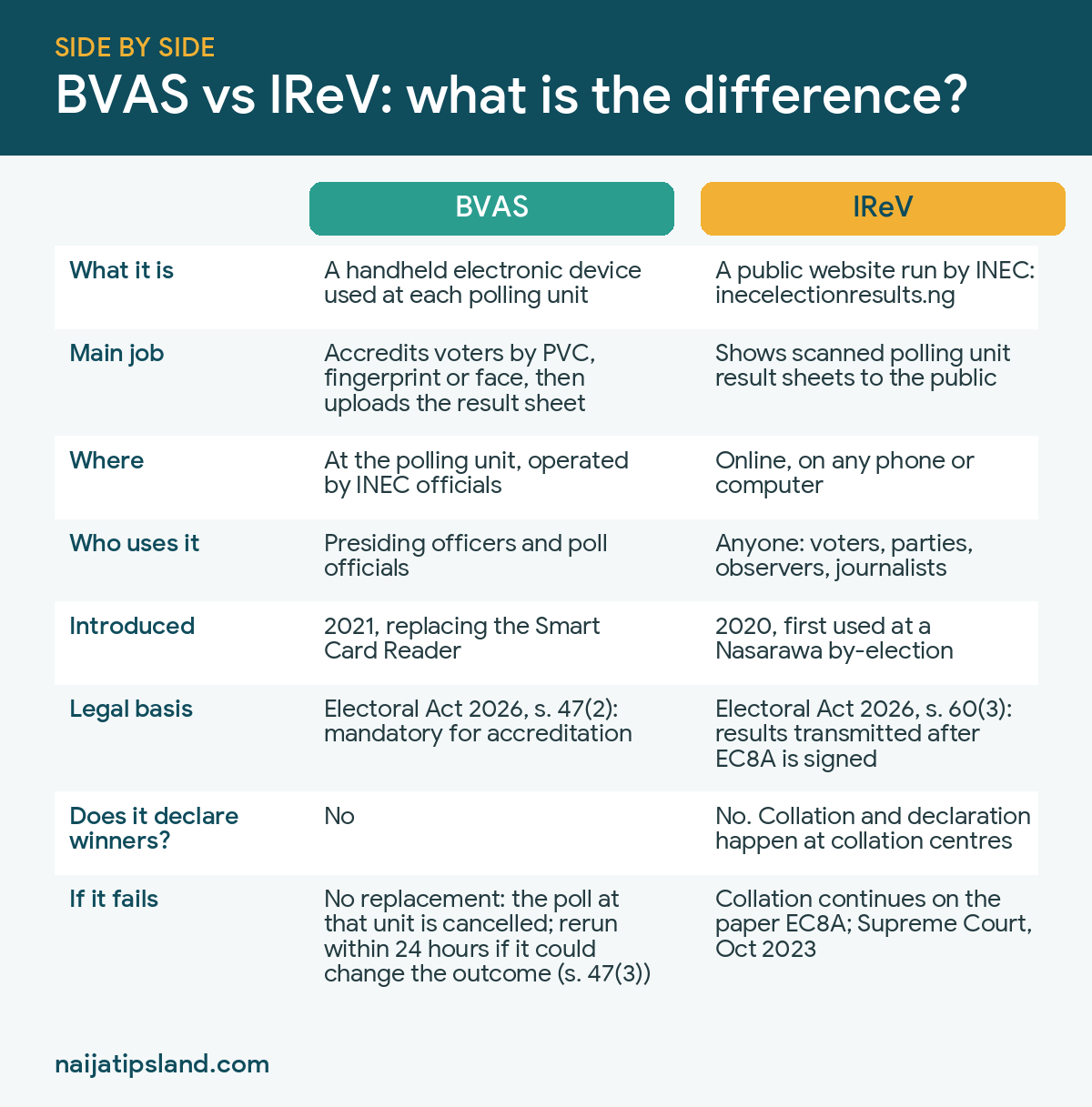
| BVAS | IReV | |
|---|---|---|
| Full name | Bimodal Voter Accreditation System | INEC Result Viewing Portal |
| What it is | A handheld electronic device | A public website (inecelectionresults.ng) |
| Main job | Accredits voters, then uploads the result sheet | Shows scanned polling unit result sheets |
| Who uses it | INEC presiding officers and poll officials | Anyone with an internet connection |
| First used | 2021 | August 2020 |
| Legal basis | Electoral Act 2026, s. 47(2) | Electoral Act 2026, s. 60(3) |
| If it fails | Poll at that unit cancelled; rerun within 24 hours if it could change the outcome | Collation continues using the paper Form EC8A |
What went wrong in 2023
The 2023 general elections were the first nationwide test of both systems, and they exposed their limits. On the day of the presidential election, 25 February 2023, accreditation with the BVAS largely worked, but uploads of presidential results to IReV stalled for hours while National Assembly results from the same polling units appeared normally.
In its 526-page review of the 2023 elections, published in February 2024, INEC blamed a configuration problem: presidential result sheets had not been mapped to any state in its database, so the system could not create the folders needed to store them and returned a server error. INEC built “hotfixes” to clear it, but by then some frustrated officials had switched off their devices and left. According to the report, the first presidential result sheet was uploaded at 8:55pm, about five hours after voting ended, and some uploads ran into the following days.
The delay became the centre of the legal challenges by Atiku Abubakar and Peter Obi. On 26 October 2023, the Supreme Court upheld President Bola Tinubu’s election. The court held that IReV is a viewing portal, not a collation centre, and that a failure to upload results to it does not by itself invalidate an election, because collation is done with the physical result sheets. The judgment also acknowledged that problems with IReV could reduce public confidence in the process.
What INEC says is different for 2027
At a stakeholders’ meeting in Abuja on 6 October 2026, marking 100 days to the elections, INEC set out its technology plans for 2027:
- 57,000 new BVAS devices. INEC said it has acquired 57,000 new, improved BVAS units, and has carried out inventory and functionality checks on its fleet, including GPS tracking.
- Upgrades to existing devices. The Chairman described the work as “software hardening”, better battery performance and refined biometric calibration, aimed at the fingerprint failures and dead batteries reported in past elections.
- A six-day stress test. All configured BVAS devices are to be stress-tested nationwide from 23 to 28 October 2026 under simulated election conditions.
- AI-assisted checks. INEC has set up an Artificial Intelligence Division in its ICT department, planning automated audit tools and anomaly detection for results. It says humans stay in charge and AI will not decide outcomes.
- A bigger register. The national register of voters now stands at over 103 million, which means more devices, more uploads and more pressure on both systems.
Plans are not results, and the true test will come on polling day. But the 2026 Act gives voters something they did not have in 2023: transmission to IReV is now a legal duty with penalties attached, not just an INEC guideline.
How to check your polling unit result on IReV
Checking your own polling unit is one of the most useful things you can do after you vote. You will need the polling unit details printed on your PVC. If you are not sure where your unit is, our guide to finding your INEC polling unit explains how to look it up.

- Go to the portal. Type inecelectionresults.ng into your browser yourself. Do not follow links in forwarded messages: fake “result portals” appear during every election.
- Create a free account. Sign up with your name and email address. If you already have an account from a past election, log in.
- Activate your account. INEC emails you a short activation code. Enter it to complete sign-up.
- Choose the election. Pick the election and the contest you want: presidential, Senate, House of Representatives, governorship or State House of Assembly.
- Find your polling unit. Select your state, local government area and ward, then your polling unit.
- Open the result sheet. View the scanned Form EC8A and compare the figures with what was announced at your polling unit.
Expect the portal to be slow on election night, when millions of people are using it. Results also appear unit by unit as presiding officers upload them, so a blank page early in the evening does not mean anything has gone wrong.
Common myths about BVAS and IReV
- “BVAS means we now have electronic voting.” False. You still vote on a paper ballot with your thumbprint. The BVAS checks who you are and sends a photo of the result sheet; it does not record your choice.
- “Whatever shows on IReV is the final result.” Not quite. IReV shows polling unit results. Winners are declared only after collation, by INEC returning officers.
- “IReV makes rigging impossible.” It makes rigging easier to spot, but figures can still be changed at collation. That is why agents, observers and voters comparing IReV with announced totals matter.
- “Only party agents can see IReV.” False. Anyone can register and view results.
- “If IReV is down, the election is invalid.” The Supreme Court ruled otherwise in 2023. Collation continues on the paper result sheets.
- “The BVAS never fails.” It can and has: fingerprint mismatches, flat batteries and network problems were all reported in 2023. The 2026 Act now spells out what happens when it does.
Screenshots of “IReV results” and “leaked BVAS figures” will circulate on WhatsApp long before official declarations. Check them against the portal yourself, and read our guide to verifying news on Nigerian social media before you forward anything.
Frequently asked questions
What is the full meaning of BVAS?
BVAS stands for Bimodal Voter Accreditation System. It is the electronic device INEC uses to accredit voters by fingerprint or face and to upload polling unit results.
What is the full meaning of IReV?
IReV stands for INEC Result Viewing Portal. It is the public website, inecelectionresults.ng, where INEC posts scanned polling unit result sheets.
Does BVAS record who I voted for?
No. You mark a paper ballot in secret. The BVAS records that you were accredited, not your choice.
Can I vote if the BVAS does not recognise my fingerprint?
The official should try facial recognition next. If both the fingerprint and face checks fail, you cannot be accredited.
Is IReV the same as electronic collation?
No. IReV only displays results. Results are still collated by hand at ward, LGA, state and national collation centres.
Is IReV free to use?
Yes. You only need an internet connection and an email address to create an account.
What happens if my polling unit’s result is not on IReV?
Uploads can be delayed by network problems. The paper Form EC8A remains the official record. Deliberately blocking transmission is an offence under section 60(6) of the Electoral Act 2026, so report any suspicious failure to INEC or accredited observers.
Bottom line
The BVAS decides who gets to vote at your polling unit, and IReV lets the whole country see what that polling unit decided. Neither is perfect, and neither declares winners, but together they make the count far easier to follow than it used to be. Bring your PVC, clean hands for the fingerprint check and a little patience, and after you vote, check your unit’s result on IReV yourself. For every remaining INEC date, see our 2027 election deadlines page.
Sources
- Electoral Act 2026 (full text, via PLAC): sections 47, 51, 60 and 62
- Technext: INEC to strengthen BVAS software and introduce AI for result verification (6 October 2026)
- ThisDay: National register of voters hits over 103m, says INEC (October 2026)
- New Dawn: INEC to subject BVAS to six-day stress test from 23 October (6 October 2026)
- The Will: INEC report explains why IReV failed to upload 2023 presidential results (February 2024)
- Arise News: Supreme Court on failure to upload results to IReV (October 2023)
- PLAC Legist: INEC introduces result viewing portal (August 2020)
- Legit.ng: How to view election results live on IReV (August 2026)
This guide is general information, not legal advice. Election rules and INEC procedures can change; confirm details with INEC before polling day.



