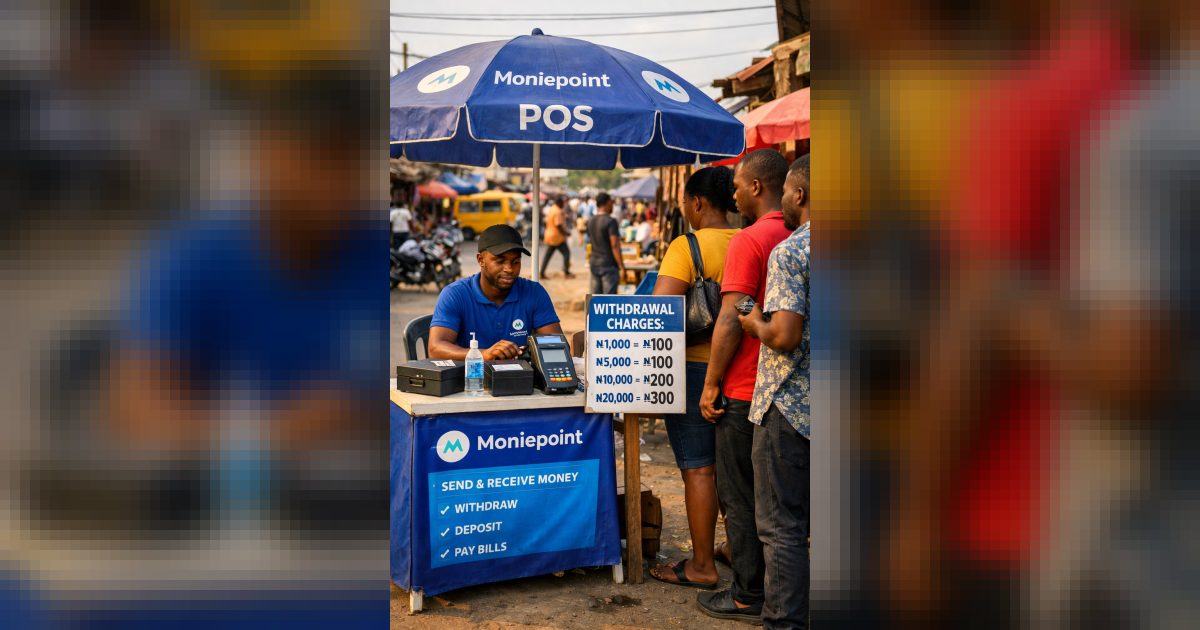
Last updated: 13 October 2026. Rules and commissions change, so confirm details with your chosen provider and the CBN. This is general information, not financial advice. We rewrote this guide around the current CBN agent banking framework.
In many villages and small towns the nearest bank branch is hours away, and a POS agent can be the only place to withdraw cash, send money or pay a bill. That makes the business useful, but the rules have tightened. The Central Bank of Nigeria issued new Guidelines for the Operations of Agent Banking on 6 October 2025, with some provisions effective from 1 April 2026. Know them before you spend a naira.
The rules you must know
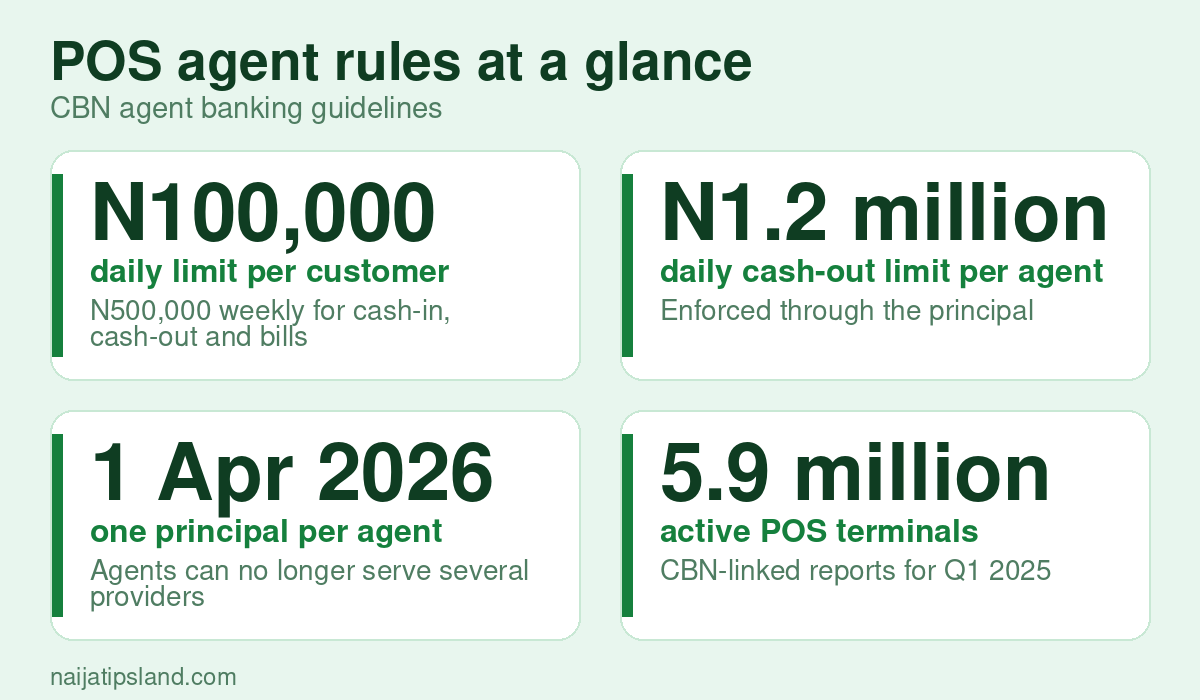
- Transaction limits: customers are limited to ₦100,000 a day and ₦500,000 a week for cash-in, cash-out and bill payments through agents. An agent’s cumulative daily cash-out limit is ₦1.2 million.
- One principal: from 1 April 2026 an agent may work with only one principal, such as a bank, mobile money operator, microfinance bank or payment service bank. Super agents also have restrictions.
- Dedicated account: all agent transactions must go through a dedicated agent account or wallet with the principal, not a personal account.
- Geo-fencing: devices must be registered and locked to your business location, and you must give notice before relocating or closing.
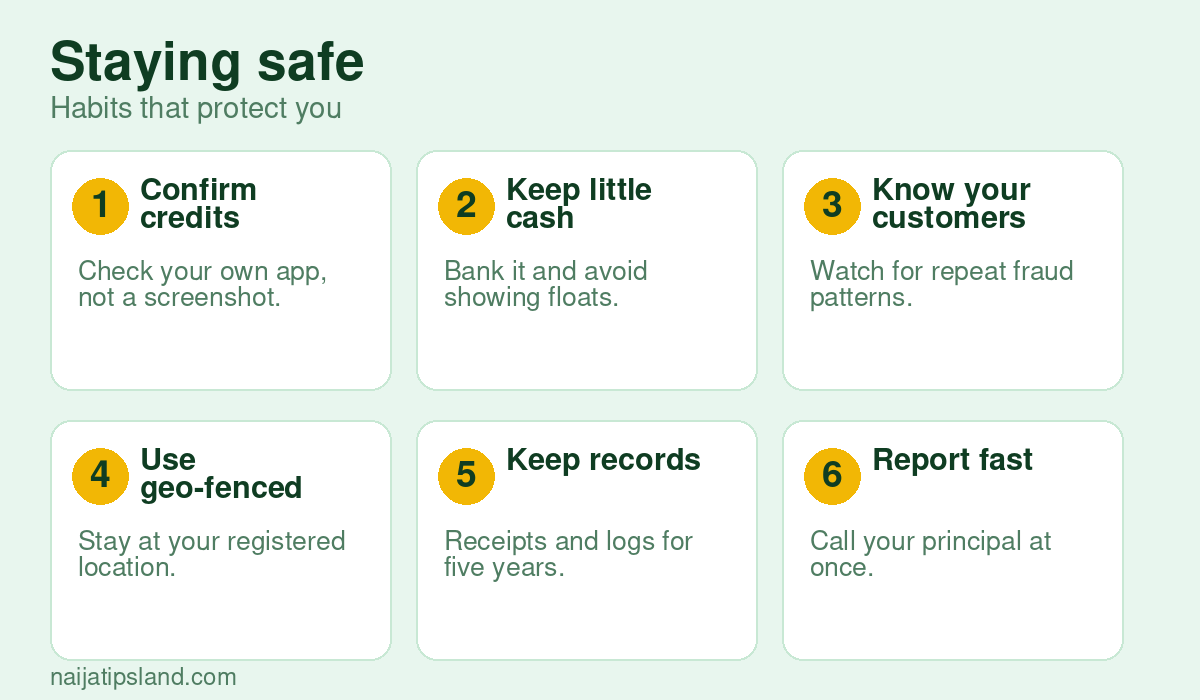
- Agent code and records: agent banking uses a separate merchant category code, 6010, receipts must show the agent’s name and location, and transaction records must be kept for at least five years.
- Sanctions: misconduct or fraud can lead to blacklisting and termination of your agreement.
Reports said that around 5.9 million POS terminals were active in 2025, and the CBN said the changes were meant to curb fraud and misuse. These rules are likely to push down the number of agents and raise fees in some places, so rural agents who stay can have less competition, but also a thinner customer base.
Is a rural POS business worth it?
Advantages: less competition, a clear community need, small start-up costs for the right provider and repeat customers on market days and pay days.
Challenges: weak network and power, low transaction volumes, higher cash-handling risk and slow settlement or frozen accounts if there is a dispute. Commission rates vary by provider and change, so ask for the current schedule in writing and calculate before you commit.
Step by step: how to start
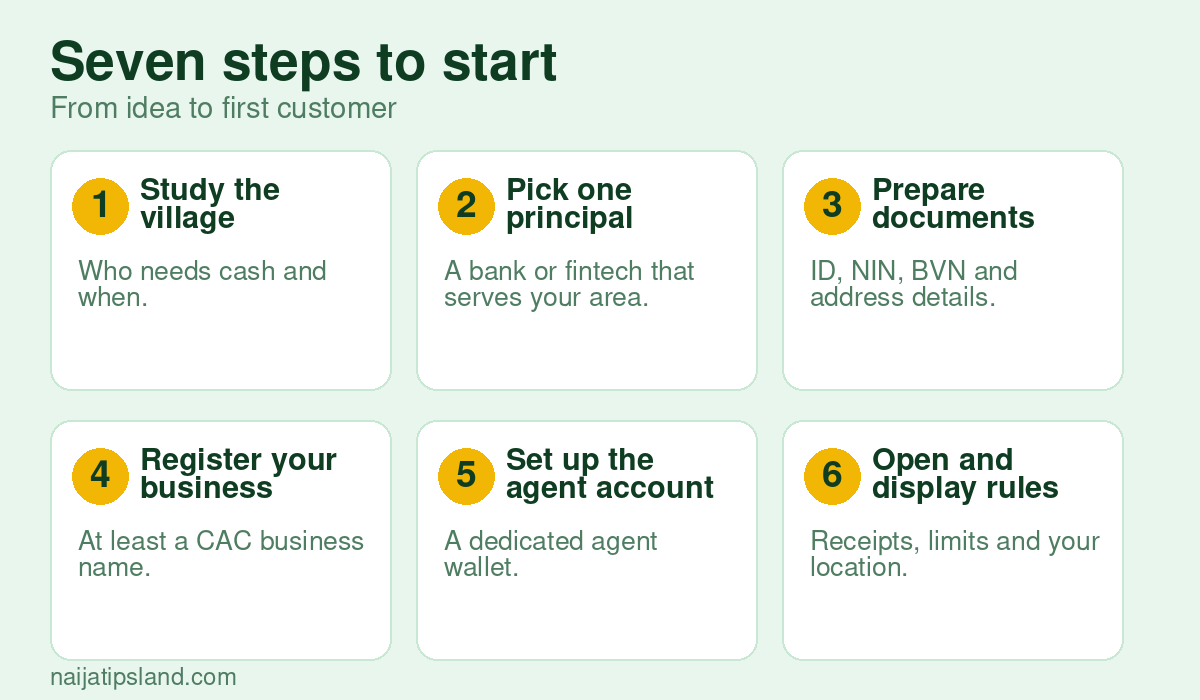
- Study the market. Count potential customers, market days, nearby banks and existing agents. Ask when people need cash: market days, month end, festivals.
- Choose one principal carefully. Compare network reliability in your area, commissions, settlement time, support and the quality of the agent app. Because you can only work with one, a bad choice is costly. Ask whether they are licensed and whether deposits are covered. See our fintech apps comparison for licence details.
- Prepare documents. Expect to provide a valid ID, your NIN and BVN, passport photographs, proof of address, a guarantor in some cases and details of your shop or kiosk. Do not give your documents to anyone who is not an official representative.
- Register your business. A registered business name helps with agent applications and banking. See how to register a business name and business structures.
- Get your terminal and agent account. You should receive a registered device linked to your location and a dedicated agent account or wallet. Never pay anyone who is not the principal or an authorised partner.
- Prepare your shop. A secure counter, good lighting, a backup power source, a power bank for the POS, a safe or lockbox and a visible display of your limits and charges.
- Plan your float. Start with an amount you can afford to protect. Keep most of your money in the agent account and restock cash regularly rather than holding large sums.
Costs to plan for
- Registration and agent onboarding costs, if any.
- Power: inverter, solar or power bank, and fuel.
- Data or network devices, and possibly a signal booster.
- Security: lockbox, lock, and in some places guards.
- Transport to restock cash, and sometimes bank charges.
- Your own wages. Count your time as a cost.
A worked example (hypothetical)
Suppose you serve 40 customers on a typical market day, each withdrawing ₦20,000, giving ₦800,000 in cash-out, well under the ₦1.2 million agent limit. If your commission were 0.5%, that day’s earnings would be ₦4,000 before power, transport and other costs. On quiet days you may handle only a fraction of that. The point is to do this sum with your own numbers and your provider’s actual rates before you invest.
Staying safe from fraud
POS fraud is a known risk, and electronic fraud losses were reported at ₦25.85 billion in 2025, down 51% from ₦52.26 billion in 2024. Common tricks include fake credit alerts and screenshots, reversed transactions, stolen cards and customers who ask you to send money first. Always confirm credits in your own app, do not release cash on the strength of a screenshot, and keep records of every transaction. Read our full guide on how to avoid POS agent fraud and our guide to internet scams.
Growing the business
- Offer related services allowed by your principal, such as bill payments and airtime.
- Add a small shop or phone charging service for extra income.
- Be reliable: open on time, treat customers politely and avoid overcharging.
- Reinvest slowly, and keep your personal money separate. See our small businesses that succeed and financial literacy checklist.
Frequently Asked Questions
Can I use more than one POS provider?
Not since 1 April 2026. Agents must now work with a single principal.
How much can a customer withdraw?
Up to ₦100,000 a day and ₦500,000 a week through an agent, under the CBN guidelines.
Do I need to register a business?
It is strongly advised, and principals may require it. A business name is the simplest route.
Is POS business profitable in a village?
It can be if you have steady demand, reliable network and power and good fraud controls, but income is modest and varies.
Sources
- BusinessDay: 10 things POS agents need to know under the CBN’s new guideline
- Techpoint Africa: CBN limits POS agents to one financial institution
- MSME Africa: CBN caps daily agent banking transactions at ₦1.2 million
- TechCabal: Agents must choose between Moniepoint, OPay and PalmPay by April 2026
- Daba Finance: CBN limits POS agents to one principal