

TL;DR:
- Online debates influence political opinions, social norms, and democratic participation among young people. Engaging thoughtfully through asynchronous formats, verifying evidence, and resisting platform biases can improve debate quality and societal impact. Building digital literacy and respectful norms is essential for meaningful online discourse and community reasoning.
Online debates are digital exchanges where individuals argue differing viewpoints across platforms like Reddit, Twitter, and community forums, and they directly shape how young people form political and social opinions. Understanding why online debates matter is no longer optional for students and young adults. These exchanges influence elections, shift social norms, and determine whose voice gets heard in public life. The challenge is that the same platforms enabling broad participation also reward outrage over accuracy. This article breaks down the real benefits, the structural problems, and the practical steps you can take to debate better online.
Why online debates matter for critical thinking and engagement
Online debates are one of the most accessible tools for developing real argumentation skills. When you write a response to a political post on Reddit or engage in a forum thread about social policy, you are forced to organize your thoughts, find supporting evidence, and anticipate counterarguments. That process builds critical thinking faster than passive reading ever will.
Asynchronous discussions produce more complex, formal, and evidence-based arguments than real-time conversations. This matters because most online debates happen asynchronously. You have time to think, research, and revise before you post. That window is an advantage most people waste by reacting emotionally instead of reasoning carefully.
The benefits of virtual discussions extend beyond individual skill-building. Platforms like Naijatipsland, Reddit, and Twitter expose you to perspectives you would never encounter in your immediate social circle. That exposure is the foundation of genuine civic literacy.
- Asynchronous formats give you time to research before responding
- Exposure to opposing views challenges assumptions and sharpens reasoning
- Writing out arguments forces clarity that verbal debates often skip
- Public threads create accountability for the quality of your claims
- Peer feedback on posts improves argument structure over time
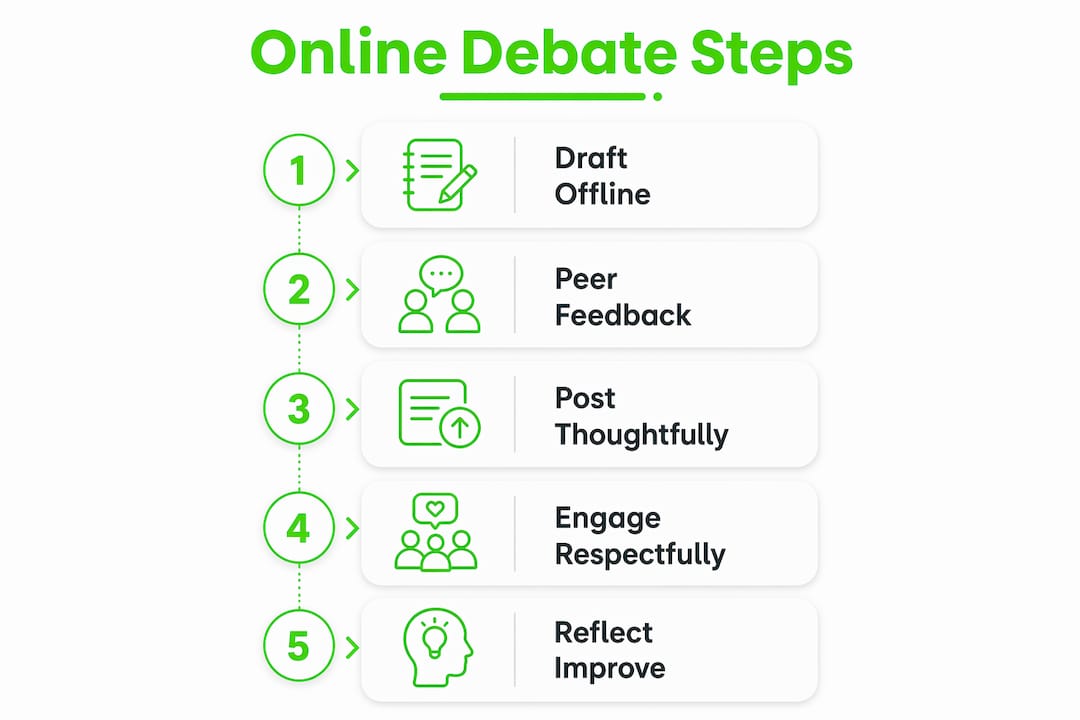
Drafting offline and revising with peer feedback before posting produces stronger, evidence-based contributions. This method separates participants who want to learn from those who just want to win. Students who apply it consistently report better grades in debate-based coursework and more productive online exchanges.
Pro Tip: Write your response in a notes app first. Read it after 10 minutes. If it still holds up, post it. If it reads as reactive, revise it before publishing.
What challenges do online debates face from platforms and human behavior?
The biggest obstacle to productive online debate is not bad logic. It is platform design combined with human psychology. Both work against nuanced discussion.
Digital platforms incentivize emotionally engaging content, which means sensational posts get amplified while careful, measured arguments get buried. Algorithms on platforms like Facebook, YouTube, and Twitter reward content that triggers strong reactions. That design choice turns debates into performance arenas rather than spaces for genuine inquiry. Understanding how tech platforms control information flow is now a prerequisite for anyone who wants to debate responsibly online.
The Oxford Internet Institute observes that online debates reinforce existing divisions in nearly all high-conflict digital threads. Participants defend identity-linked positions rather than seeking truth. This is confirmation bias operating at scale. When your political or social identity is tied to a position, losing the argument feels like losing part of yourself. That feeling shuts down genuine reconsideration.
The first-mover effect compounds this problem. Context-rich early information dominates debate narratives even when later corrections are more accurate. If a misleading claim appears first in a thread, it shapes how every subsequent message gets interpreted. Corrections posted later rarely undo that initial framing.
Synchronous vs. asynchronous debate formats
| Format | Strengths | Weaknesses |
|---|---|---|
| Synchronous (live chat, Twitter Spaces) | Fast, energetic, high engagement | Shallow arguments, emotional reactions, less evidence use |
| Asynchronous (forums, Reddit, Naijatipsland threads) | Deeper reasoning, time for research, longer posts | Slower pace, risk of disengagement, thread drift |
| Hybrid (moderated panels with Q&A) | Combines depth with real-time energy | Requires skilled moderation to prevent derailment |
Anonymity adds another layer of difficulty. When people are not accountable for their words, empathy drops and performative behavior rises. Trolling, bad-faith arguments, and personal attacks become more common. These behaviors do not just derail individual threads. They discourage thoughtful people from participating at all, which degrades the overall quality of public discourse.
How do online debates shape society and democratize discourse?
The societal impact of online debates is real and measurable. Online debate culture democratizes society by including voices traditionally excluded from mainstream media and political conversation. A young person in Lagos or Kano can now share a political analysis that reaches thousands of readers without needing a newspaper column or a television slot. That access is genuinely new and genuinely powerful.
The value of digital debates lies in their ability to surface perspectives that formal institutions ignore. Marginalized communities, students, and first-time voters can all participate in shaping public opinion through forums, comment sections, and social media threads. Platforms like Naijatipsland serve this function directly for Nigerian youth, providing a space where local political commentary reaches a national audience.
The risks are equally real. Online debate culture amplifies misinformation and polarization without digital literacy efforts and respectful moderation. Echo chambers form when algorithms feed users only content that confirms their existing beliefs. The result is not a more informed public. It is a more fragmented one.
Here is what separates productive online discourse from destructive noise:
- Diverse participation: Debates that include voices from different regions, classes, and backgrounds produce more accurate and complete pictures of public opinion.
- Misinformation awareness: Participants who fact-check claims before sharing them reduce the spread of false narratives.
- Moderation standards: Forums with clear community guidelines and active moderators maintain higher debate quality over time.
- Digital literacy: Users who understand how algorithms work are less likely to be manipulated by sensational framing.
- Respectful norms: Communities that enforce civil discourse attract more thoughtful contributors and retain them longer.
The role of online discourse in shaping social norms is also significant. When respectful, evidence-based exchanges become the visible standard in a community, new participants model that behavior. The opposite is also true. Toxic threads normalize hostility and drive away exactly the people whose contributions would improve the conversation.
How to engage effectively and responsibly in online debates
Effective participation in online debates requires a specific set of habits. These are not complicated, but they require consistent practice.
- Pause before responding. Taking 30 minutes before replying lowers reflexive identity defense and reduces emotional escalation. This single habit improves the quality of your contributions more than any rhetorical technique.
- Separate your identity from your argument. Your position on a policy issue is not who you are. Treating it as such makes you defensive and closed to new information.
- Collect evidence before you post. Search for credible sources, check publication dates, and verify statistics before citing them. Platforms like Google Scholar, AllSides, and PubMed give you access to reliable information quickly.
- Engage with the strongest version of the opposing argument. Steelmanning the other side forces you to think harder and makes your own argument more persuasive.
- Use AI tools as reasoning aids, not ghostwriters. Tools like ChatGPT or Gemini can help you stress-test your logic or find counterarguments. Rational debate requires new critical thinking literacy that accounts for AI-generated content and platform-driven argument manipulation.
Changing minds via online debate requires willingness to engage in the frustrating work of belief revision, supported by communities that emphasize evidence and systematic discussion. Niche, passion-driven communities that document evidence carefully show the most promise for genuine persuasion. General social media threads rarely change anyone’s mind. Focused, evidence-rich communities sometimes do.
Pro Tip: Before entering any political debate thread, read the three most upvoted comments on both sides. This gives you the strongest arguments already in play and prevents you from repeating points that have already been addressed.
Key takeaways
Online debates matter most when participants prioritize evidence over identity, choose the right platform format, and develop the digital literacy to recognize how algorithms shape what they see.
| Point | Details |
|---|---|
| Asynchronous formats build stronger arguments | Forum-style debates give you time to research and revise, producing more evidence-based contributions. |
| Platform algorithms distort debate quality | Emotional content gets amplified; understanding this bias is the first step to resisting it. |
| Democratization requires digital literacy | Broad participation only benefits society when users can identify misinformation and engage respectfully. |
| Identity protection blocks genuine persuasion | Separating your self-worth from your argument is the single most effective habit for productive debate. |
| First-mover framing shapes entire threads | Post context-rich, accurate information early to have the greatest influence on how a debate unfolds. |
Naijatipsland’s take on the future of online debate
I have watched online discourse evolve significantly, and the pattern I keep seeing is this: the people who complain most about online debates being pointless are often the ones who enter them without a clear goal. They want to win, not learn. That distinction matters more than any platform feature or moderation policy.
The death of old-school rational debate is real. Platform design rigs arguments toward engagement over accuracy, and AI can now generate endless plausible-sounding arguments on demand. That environment demands what researchers are calling Critical Thinking 2.0. You need to evaluate not just the argument in front of you, but the system that surfaced it and the incentives behind it.
What gives me genuine optimism is the growth of focused, evidence-driven communities. When a group of people cares deeply about a specific issue and commits to documenting their reasoning, the quality of debate rises noticeably. Naijatipsland sees this in threads where users cite sources, respond to specific points, and update their positions publicly. Those threads are rare, but they prove the model works.
The significance of debating online goes beyond winning arguments. It is about building the collective reasoning capacity of a community. Every time you post a well-sourced, respectful argument, you raise the standard for everyone reading it. That is not a small thing. It is how public discourse improves, one contribution at a time.
— Naijatipsland
Deepen your impact in online discussions

Understanding why debates matter is the starting point. The next step is building the skills to participate in ways that actually move conversations forward. Naijatipsland has put together practical resources specifically for Nigerian youth who want to engage with politics and social issues online without falling into the traps of toxicity and misinformation. Whether you are new to forum discussions or looking to sharpen your argumentation, these guides give you a clear path forward. Start with why online discussions matter for Nigerian communities, then explore the beginner’s guide to online discussions to build your foundation step by step.
FAQ
Why do online debates matter for students?
Online debates build critical thinking, argumentation, and research skills that classroom instruction alone rarely develops. Asynchronous debate formats in particular produce more complex, evidence-based reasoning than real-time discussions.

What makes online debates unproductive?
The Oxford Internet Institute finds that most high-conflict digital threads reinforce existing divisions because participants defend identity-linked positions rather than seeking truth. Platform algorithms that reward emotional content over accuracy make this worse.
How can I improve the quality of my online debate contributions?
Draft your response offline, verify your sources, and wait before posting. Offline drafting and peer revision consistently produce stronger, more evidence-based contributions than reactive posting.
Do online debates actually change anyone’s mind?
Rarely in open social media threads, but niche communities that document evidence systematically show real promise for genuine persuasion. The key factor is participants’ willingness to revise their beliefs when confronted with better evidence.
What is the role of digital literacy in online debate?
Digital literacy is the ability to identify misinformation, recognize algorithmic bias, and engage respectfully across different viewpoints. Without it, online debate culture amplifies polarization rather than building informed public opinion.