
Profitable Agricultural Businesses in Nigeria for Beginners (2026): Startup Costs, Prices and Risks

Last updated: 5 November 2026 · By Naijatipsland Editorial Team · Editorial policy
Agriculture is still the most accessible business for many Nigerians: you can start on a small plot, a backyard or even a few buckets, and food always sells. But the word “profitable” hides a lot of risk. Prices swing, inputs are expensive and some crops rot before you reach the market. This guide ranks the best agricultural businesses in Nigeria for beginners in 2026 by startup cost, speed of returns and risk, using fresh price data, so you can pick one that fits your money, space and patience.
How to read the figures: startup ranges below are indicative estimates from 2026 farm-business guides and market price reports (June to October 2026). They are not quotes or guaranteed profits. Costs differ by state, land access and season. I flag where sources are thin, and you should confirm local prices before you invest.
First, the reality check for beginners
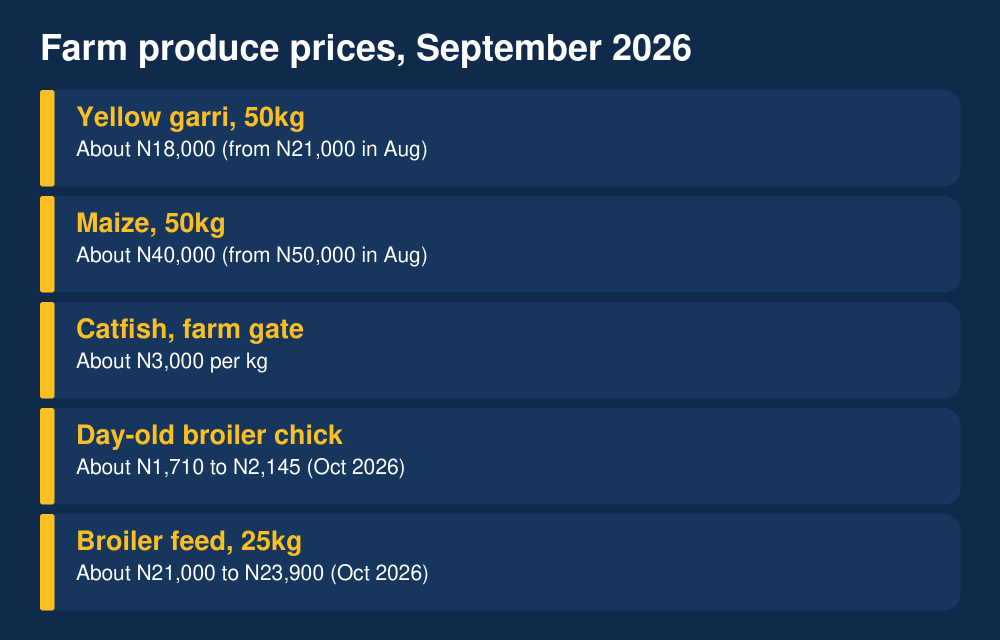
Food inflation was still 19.59 percent year on year in September 2026, even though prices of several staples fell that month. For farmers, that cuts both ways. Inputs such as feed, chicks and fertiliser stay expensive, while farm-gate prices can drop at harvest. For example, a 50kg bag of white or yellow maize was reported around N40,000 in September 2026, down from about N50,000 in August, and a 50kg bag of yellow garri around N18,000, down from about N21,000. A beginner who borrowed to plant at peak prices can be squeezed if they harvest into a falling market.
That is why the safest approach is: start small, pick a business with a ready buyer, learn for one cycle, then scale.
1. Vegetables (ugu, ewedu, waterleaf, pepper): fastest cash, lowest startup
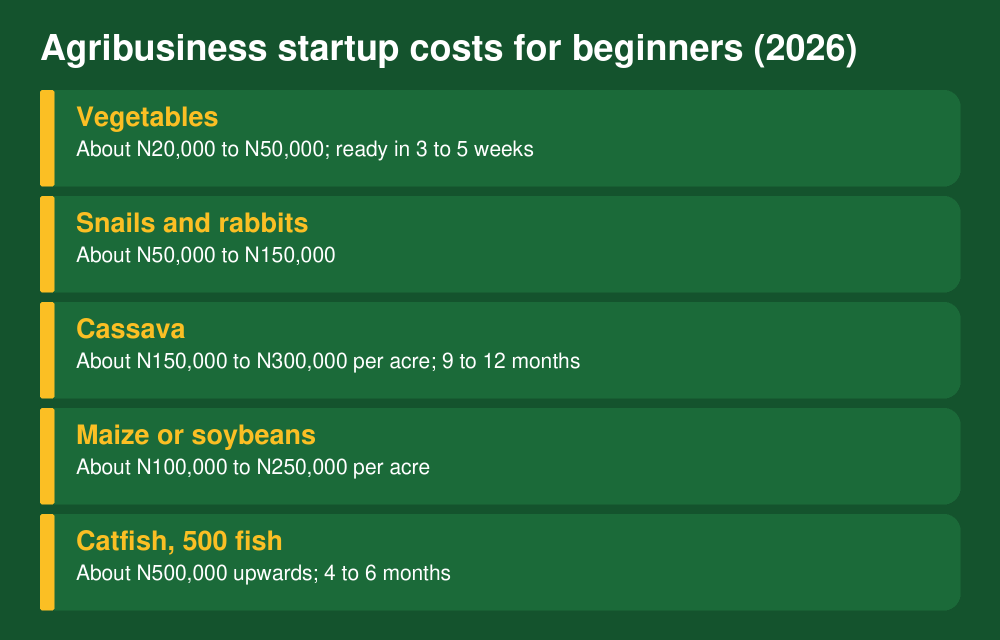
Leafy vegetables are ready in roughly three to five weeks, need little capital (a 2026 guide estimates about N20,000 to N50,000 to start small) and sell daily. The catch is low prices per unit and fast spoilage, so you need a nearby market, restaurants or a delivery arrangement. Tomatoes and peppers pay more but carry high post-harvest loss; a medium bag of pepper was around N40,000 and a large bag around N80,000 in September 2026, and tomato prices have moved sharply between months. Best for: people with limited land and a need for quick income. Risk: spoilage and price swings.
2. Poultry (broilers and layers): high demand, high running costs
Chicken and eggs sell all year, especially before festive seasons. But poultry is no longer a cheap start. On 14 October 2026, day-old broiler chicks were listed at roughly N1,710 to N2,145 each (cartons of 50 for about N85,500 to N107,250), and a 25kg bag of broiler feed was about N21,000 to N23,900. A guide that priced 100 broilers put chicks plus feed alone at about N613,785 to N667,650, before housing, vaccines, labour and power, and concluded a N50,000 start is not realistic for commercial broilers. Chick prices rose about 67 percent in three months to March 2026 according to a BusinessDay report, and feed is widely estimated at roughly 70 percent of production cost. Best for: people with at least a few hundred thousand naira, secure housing and a buyer network. Risk: feed costs, disease and mortality. Read our full guide to poultry farming in Nigeria before you start.
3. Fish farming (catfish): good returns, feed is the challenge
Catfish reaches market size in about 4 to 6 months and sells around N3,000/kg at the farm gate in 2026, with retail prices from roughly N2,650 to N4,400/kg in Lagos and Abuja. A small 500-fish setup in tarpaulin tanks can start from around N500,000 on lean assumptions, but feed (50 to 70 percent of costs) can push that above N1 million. See our detailed guide on how to start fish farming in Nigeria with low capital.
4. Cassava and garri processing: steady, patient money
Cassava is drought-tolerant and lower maintenance, but it takes about 9 to 12 months to harvest. A farm guide estimates N150,000 to N300,000 per acre in startup costs, which varies widely with land and labour. The better margin often comes from processing: packaged, clean garri sells at a premium. A 50kg bag of garri was around N18,000 to N19,500 in September 2026. Best for: people with land and patience. Risk: price drops when there is a cassava glut, and long waits between planting and income.
5. Maize and soybeans: big demand, thin margins
Maize and soybeans have constant demand from feed mills and oil processors. Estimated startup is about N100,000 to N250,000 per acre. The September 2026 maize price of about N40,000 per 50kg bag shows how quickly margins can move, so storage, selling in groups and contracts with buyers matter. Best for: people with several acres. Risk: price drops at harvest, and weather.
6. Snail, rabbit and quail farming: small-space livestock
These work on a small compound. A 2026 guide estimates around N50,000 to N100,000 for snails, N50,000 to N150,000 for rabbits and N30,000 to N80,000 for quail, which start laying in roughly six weeks. Margins can be decent if you secure buyers, but the markets are smaller and more local than chicken or fish. Best for: beginners who want to test farming cheaply. Risk: limited demand if you do not find regular customers.
7. Agro-processing and value-adding: often better margins than raw crops
Instead of just growing crops, many beginners earn more by processing or packaging: catfish smoking and packaging (about N150,000 to N400,000 to start), plantain chips (N50,000 to N150,000), packaged spices (N20,000 to N50,000) and garri processing (N500,000 to N1.5 million). You buy raw produce from farmers, add value and sell in supermarkets, online or to the diaspora. Check food safety registration needs (for example NAFDAC for packaged foods) before you scale. See the Start a Business in Nigeria hub for registration steps.
How to choose the right agribusiness
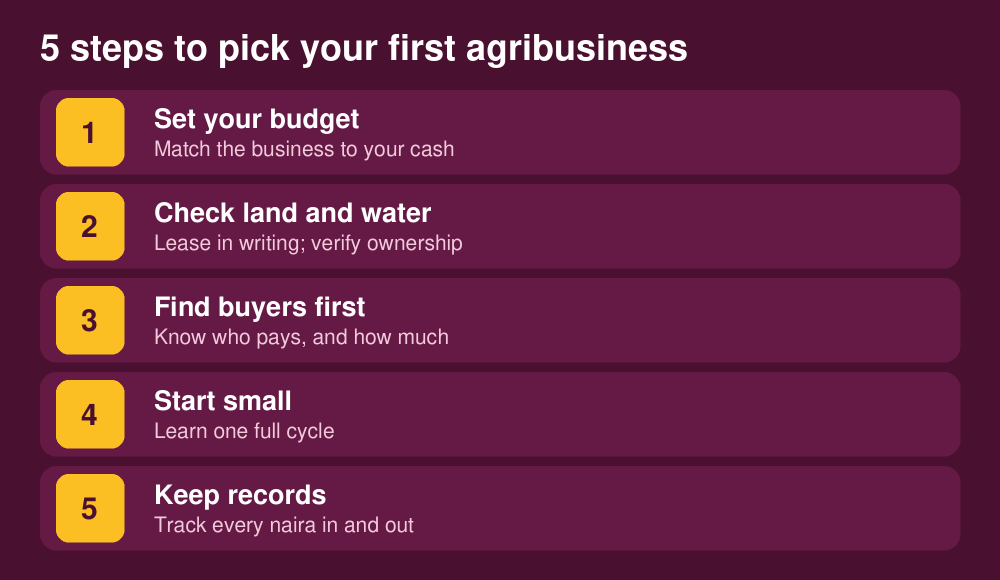
- Money: under N100,000, think vegetables, snails, rabbits or small processing. N300,000 to N1 million opens poultry, fish and small crop plots.
- Land and water: no land? Choose tanks, cages or processing. If you plan to buy or lease land, verify ownership first, as in our guide on verifying land ownership in Lagos State.
- Time to first income: vegetables in weeks, broilers in about 6 to 8 weeks, fish in 4 to 6 months, cassava in 9 to 12 months.
- Market access: never grow or stock without knowing who will buy and at what price.
- Your job: many beginners succeed by farming part-time while employed. See our ideas for side hustles for civil servants and businesses you can start from home.
Mistakes beginners make
- Starting too big with borrowed money before learning one cycle.
- No buyer lined up at harvest or market age.
- Ignoring storage and transport costs, which can eat a big share of margin.
- Buying cheap, unverified inputs such as chicks, seed or fingerlings of unknown quality.
- Keeping no records, so you cannot tell whether you are actually making a profit.
- Falling for “invest in farming and earn 50 percent in six months” schemes. Many are scams; visit the farm and check the company.
Frequently asked questions
What is the most profitable agricultural business in Nigeria for a beginner?
There is no single answer. Poultry and catfish farming can pay well but need more capital and care; vegetables and snail or rabbit farming need less money. Processing and packaging often give better margins than selling raw produce.
Which farming business needs the least money?
Leafy vegetables, snails, mushrooms and small-scale rabbit or quail farming usually need the least, roughly N20,000 to N150,000 depending on scale.
Can I start farming without owning land?
Yes. You can lease land, use tanks for fish, raise poultry or rabbits in a small shed, grow in containers, or start agro-processing and trading. Put any lease in writing.
How long does it take to make money from farming?
It depends on the business: vegetables in weeks, broilers in about 6 to 8 weeks, catfish in 4 to 6 months, and cassava in 9 to 12 months. Plan enough cash to cover your costs until the first sale.
Is farming still profitable with high feed and fertiliser prices?
It can be, but margins are tighter. Choose enterprises where you can control costs, sell close to buyers and add value, and avoid borrowing heavily for your first cycle.
Do I need to register an agribusiness?
Small farms often start informally, but registering a business name with the CAC helps you open a business account, win larger buyers and access some support programmes. Packaged foods may need NAFDAC registration.
Disclaimer: figures are indicative, drawn from dated third-party guides and market reports (June to October 2026), and are not guarantees of income. Verify local prices and get advice before investing.
Join the discussion
Have you tried this, or do you have a question we did not answer? 1 reader has already shared their view. Naijatipsland members help each other with real, first-hand experience.







Ade here. If you are new to farming, my advice is to pick one business, run one small cycle and keep every receipt before you scale. The biggest killers I see are no buyer at harvest and borrowing too much for the first batch. Tell us in the comments which of these you are thinking of starting and your state, and I will point you to the right guide. Prices quoted here were checked between June and October 2026 and will move. – Ade Adeniyi