
Best Investment Apps for Nigerians Living in the UK (2026): Fees, ISAs and Safety

Last updated: 4 November 2026 · By Naijatipsland Editorial Team · Editorial policy
If you are a Nigerian living in the UK, you are probably earning in pounds, sending some money home, and wondering whether your savings should be doing more than sitting in a current account. The good news is that UK investment apps have made it possible to start with as little as £1, inside tax-free wrappers like an ISA, without ever speaking to a broker. The bad news is that there are dozens of apps, and the “best” one depends on what you want to do. This guide explains how investment apps work in the UK, compares the main ones by fees and features, and shows how to choose safely. Checked 4 November 2026. Fees and offers change often, so treat every figure as a snapshot and confirm on the provider’s own pricing page. I am not a licensed financial adviser, and this is general information, not personalised advice.
Before you pick an app: the three things that matter most
Most people choose an app by looking at the logo or the sign-up bonus. A better approach is to ask three questions.
- What am I investing in? Index funds and ETFs (baskets of hundreds or thousands of companies) suit most beginners. Individual shares, US stocks and trading are a different game with a different risk level.
- Which wrapper do I need? A Stocks and Shares ISA, a Lifetime ISA, a pension (SIPP) or a plain general investment account each have different tax treatment.
- What will it really cost? Platform fees, trading fees, fund charges and currency conversion fees all add up over years.
Remember too that investing is not saving. The value of investments can fall as well as rise, and you can get back less than you put in. Money you may need within about five years usually belongs in savings, not the stock market.
UK tax wrappers explained (2026/27)
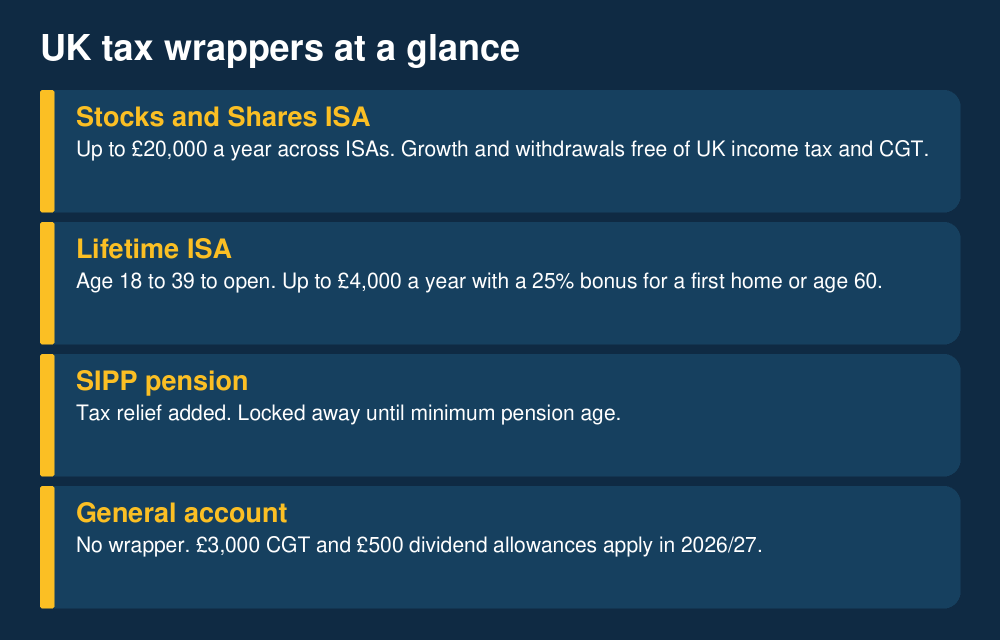
The biggest advantage UK residents have is tax-efficient accounts. Figures below are for the 2026/27 tax year and are confirmed by tax guides from providers such as Fidelity.
Stocks and Shares ISA
You can put up to £20,000 a year into ISAs in total. Growth, dividends and withdrawals from a Stocks and Shares ISA are free of UK income tax and capital gains tax. For anyone who expects investment growth to exceed the £3,000 capital gains allowance or the £500 dividend allowance outside an ISA, this is usually the first place to look. From April 2026, dividend tax rates outside ISAs and pensions rose to 10.75 percent for basic-rate taxpayers and 35.75 percent for higher-rate taxpayers, which makes the ISA even more valuable.
Cash ISA changes
The government has said it intends to cap annual cash ISA subscriptions at £12,000 for under-65s from 6 April 2027, keeping £20,000 overall. Rules could change before then, so check GOV.UK before relying on this.
Lifetime ISA
If you are aged 18 to 39 when you open it, a Lifetime ISA lets you save up to £4,000 a year and receive a 25 percent government bonus, for a first home or from age 60. Withdrawals for other reasons carry a penalty, so it is not for money you might need soon.
SIPP (personal pension)
A SIPP is a pension you invest yourself. Basic-rate tax relief is added automatically, and you generally cannot access the money until the minimum pension age. It is a long-term tool, not an emergency fund.
General investment account
This has no tax wrapper. Gains above your annual allowance and dividends above the dividend allowance are taxable, and you must report them. Use it after your ISA allowance is used up.
Can Nigerians in the UK open these accounts?
Generally yes, if you are 18 or over, a UK resident for tax purposes, and have a National Insurance number, a UK address and a UK bank account. Nationality does not matter. Visa holders on work, skilled worker and student routes are generally eligible while resident, although each provider sets its own identity checks, so confirm before applying. Citizens and residents of Nigeria without UK residence cannot use ISAs, which is a separate point for relatives back home. If you are moving between countries, tax residency can get complicated, so speak to a qualified UK tax adviser.
Main UK investment apps compared
The figures below come from a Forbes Advisor UK comparison and each provider’s published pricing. Always confirm current fees on the provider’s own site, because platform fees, FX charges and plans change several times a year. We are not paid by any provider listed and these are not recommendations.
Trading 212
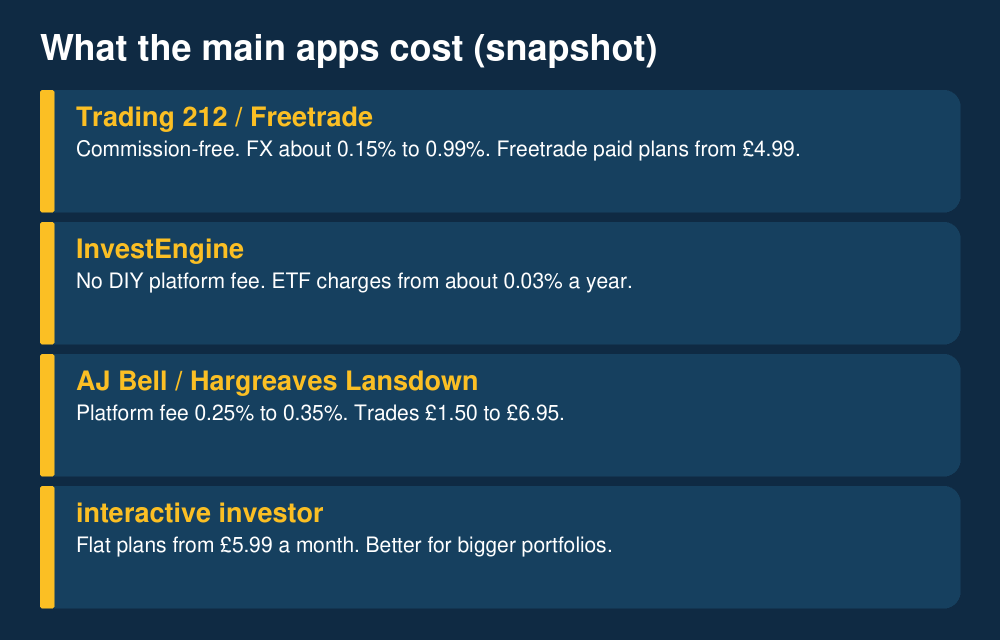
Commission-free investing, fractional shares, a Stocks and Shares ISA, and a £1 minimum. Foreign exchange on non-sterling trades is low at about 0.15 percent according to the comparison. Strong for beginners who want to start small. Research tools are lighter than at traditional platforms and there is no SIPP in the comparison I used.
Freetrade
No trading fee and a free Basic plan that includes an ISA, a SIPP and a general account. Paid plans cost £4.99 or £9.99 a month for extras. Foreign exchange costs about 0.99 percent on non-GBP trades. Covered by the FSCS up to £85,000 per person for eligible investment claims if the firm fails.
InvestEngine
An ETF specialist. DIY investing has no platform fee, which is unusual, and you pay only the ETF’s own charge, some as low as 0.03 percent a year. A managed portfolio option costs 0.25 percent a year. Minimum is £100 to open a portfolio. It does not hold individual shares, so it suits people who want a simple, low-cost index portfolio.
Hargreaves Lansdown
A well-known platform with strong research and a wide range of accounts, including ISA, Lifetime ISA and SIPP. It is generally more expensive: shares cost £6.95 a trade, funds £1.95, and the platform fee is 0.35 percent, capped at £150 a year, according to the comparison.
interactive investor
Uses flat monthly plans (Core £5.99, Plus £14.99, Premium £39.99 per the comparison) rather than a percentage. That can be cheaper for larger portfolios, less so for small ones. Includes ISA, Junior ISA and SIPP.
AJ Bell
Offers ISA, Lifetime ISA, Junior ISA and SIPP. Shares cost £5 a trade, funds £1.50, and the platform fee is 0.25 percent on both shares and funds (shares capped at £42 a year). Wide investment range but no fractional shares.
eToro, IG, XTB, Lightyear
eToro has social and copy-trading features and no account fees but a 0.75 percent conversion fee on UK deposits. IG and XTB are aimed at more active, experienced traders. Lightyear charges 0.1 percent on currency conversion, offers fractional shares and an ISA. Copy trading and leveraged products carry high risk and are not a good place to start.
Managed apps (robo-advisers)
Apps such as Nutmeg, Moneyfarm, Moneybox and Wealthify build a portfolio for you based on your risk level, for a percentage fee. They suit people who do not want to choose funds. Compare the all-in annual cost, including the underlying fund charges, against a DIY approach.
How to choose: a simple approach
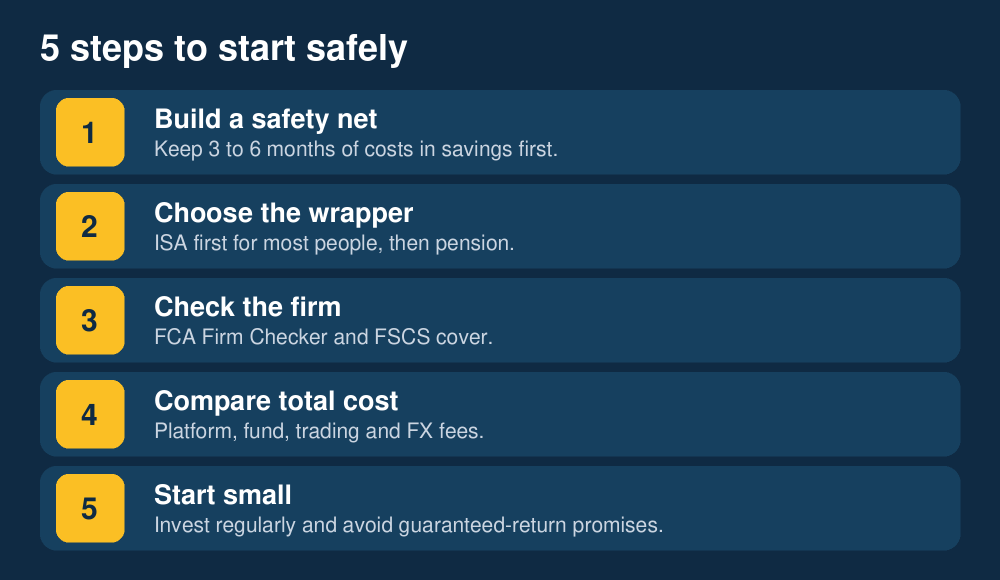
- Fill the right wrapper first. Most people consider a Stocks and Shares ISA, and a pension if they are building long-term wealth.
- Match the app to your style. Mostly ETFs and index funds? A low-fee ETF platform or a flat-fee platform may suit. Mixing in shares from time to time? A commission-free app with fractional shares may do.
- Add up the true cost. A 1 percent annual cost on £10,000 is £100 a year, every year, and it compounds against you.
- Check protection. Make sure the firm is FCA authorised on the FCA Firm Checker and see the FSCS cover that applies to it.
- Start small and learn. Open the account, invest a small amount, and watch how the price moves before committing bigger sums.
Special points for Nigerians in the UK
Do not let family obligations push you into risky bets
Many of us send money home every month. Build an emergency fund and keep remittances predictable before you invest. Our guide to the cheapest money transfer apps for Nigerians in the UK helps you cut the cost of those transfers, which is itself a guaranteed saving.
Beware the “investment” WhatsApp group
Fraudsters target the diaspora with promises of 20 or 30 percent monthly returns, often through WhatsApp, Telegram or social media “mentors”. Nigeria has seen several high-profile collapses of schemes that promised guaranteed daily or weekly returns. Real investments never guarantee returns. Check any firm on the FCA register and the FCA warning list before sending a penny, and never invest through a personal bank account.
Currency risk works both ways
If your long-term goal is to build a house or business in Nigeria, remember that your pound investments will have to be converted to naira at some point, and the exchange rate matters. See our guide to the dollar to naira exchange rate, and our guide to opening a Nigerian bank account from abroad if you want to hold money in Nigeria as well.
Declare it properly
Interest, dividends and gains outside a tax wrapper may need reporting on a Self Assessment tax return. ISAs and pensions are simpler. If you have income or investments in Nigeria too, UK residents are generally taxed on worldwide income, and a UK-Nigeria double tax treaty exists. Ask an accountant who understands diaspora tax.
Common mistakes to avoid
- Chasing last year’s winner. Past performance does not predict the future.
- Ignoring fees. Small percentages compound into large amounts.
- Investing emergency money. Keep three to six months of expenses in savings first.
- Using several apps without a plan. Spreading across too many accounts makes it hard to track allowances and costs.
- Panic selling. Markets fall regularly. Many long-term investors simply keep investing monthly.
- Trusting social media tips. Finfluencer promotions are often paid and rarely risk-free.
FAQ
What is the best investment app for Nigerians in the UK?
There is no single best app. Trading 212, Freetrade and InvestEngine are popular low-cost options for beginners, while Hargreaves Lansdown, AJ Bell and interactive investor suit people who want more research or a wider range. Pick based on what you invest in, the account type you need and the total cost.
Can I open a Stocks and Shares ISA if I am on a visa?
Generally you can if you are a UK resident for tax purposes, are 18 or over and have a National Insurance number. Each provider has its own identity checks, so confirm before applying.
How much money do I need to start investing?
Several apps allow you to start from £1. A sensible start is an amount you can leave alone for at least five years after your emergency fund is in place.
Are UK investment apps safe?
Check that the firm is FCA authorised and that client assets are held separately. The FSCS can pay up to £85,000 per person per firm for eligible investment claims if an authorised firm fails. It does not protect you against market losses.
Is it better to invest in the UK or in Nigeria?
They carry different risks. UK investments are in pounds with strong regulation; Nigerian investments may offer higher nominal returns but carry currency, inflation and liquidity risk. Many diaspora investors hold both. See our guide on how Nigerians in the diaspora can invest in Nigeria safely.
Do I pay tax on investments in the UK?
Not inside an ISA or pension. Outside them, you may owe tax on dividends above £500 and gains above £3,000 in 2026/27. Keep records and report where required.
Should I buy crypto through these apps?
Crypto is highly volatile and not protected by the FSCS. Read our explainer on cryptocurrency, Nigeria’s rules and how to stay safe before deciding.
Bottom line
The best investment app for a Nigerian in the UK is the one that fits your goals, keeps total costs low, is properly regulated, and helps you use your tax wrappers. Start with the basics, avoid anyone promising guaranteed returns, and only invest money you can leave alone. This article is general information, not financial advice, and I am not a licensed adviser. Consider speaking to an FCA-authorised adviser for personal advice.








Ade Adeniyi here. I wrote this because so many Nigerians in the UK ask me which app to use. My honest tip: fill your ISA wrapper, keep costs low and ignore anyone promising guaranteed returns. Which app are you using, and what do you like or dislike about it? Fees change often, so tell us if you spot an update. This is general information, not financial advice.