


TL;DR:
- Online surveys collect reliable, first-hand data faster and at lower costs than traditional methods. Proper design and multi-channel distribution enhance response quality, diversity, and trust while minimizing bias and response fatigue. Using appropriate metrics and maintaining respondent privacy ensure surveys effectively inform decision-making and community engagement.
Online surveys are structured digital tools that collect primary data directly from respondents, making them the most cost-effective and scalable method for market research, customer feedback, and organizational decision-making. Platforms like SurveyMonkey, Qualaroo, and VWO have made this process accessible to anyone with a browser and a clear research goal. Understanding why online surveys matter helps you move from guesswork to evidence in hours, not weeks. This article covers their core advantages, real-world applications, best practices, and the common pitfalls that reduce data quality.
Why online surveys matter more than traditional methods
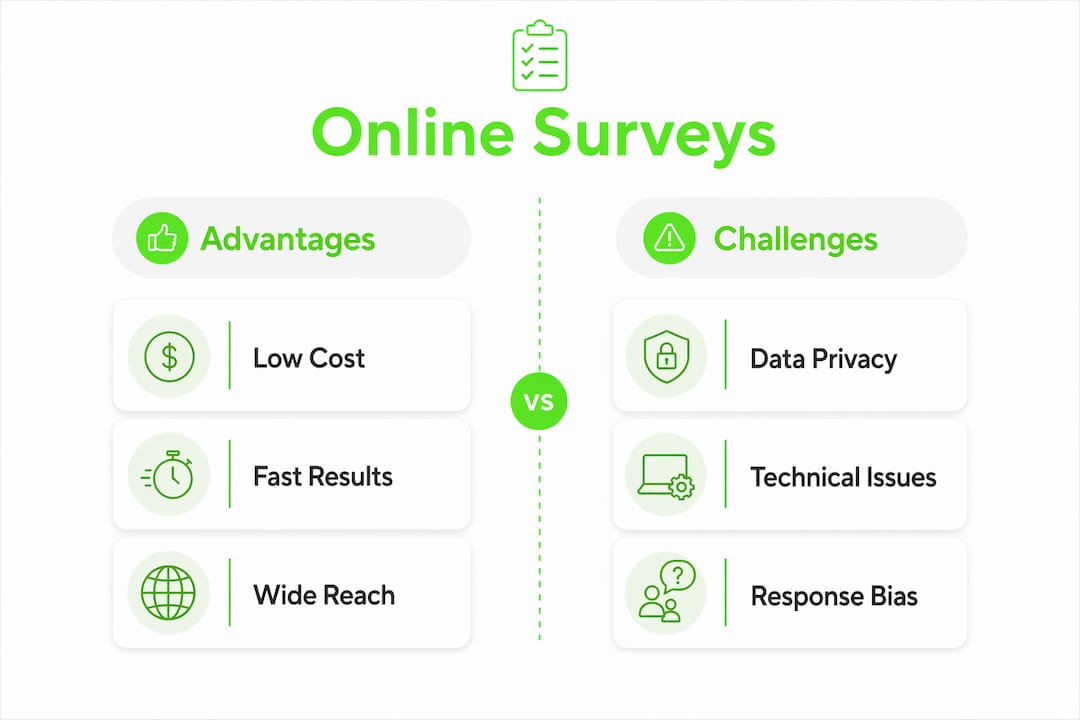
The importance of online surveys comes down to one measurable advantage: they deliver reliable, first-hand primary data faster and at lower cost than any conventional alternative. Online surveys collect structured data directly from your target individuals, making results more applicable to your research goals than second-hand sources like industry reports or analyst summaries. That directness is what separates survey data from inference.

Traditional surveys, whether paper-based or phone-administered, carry costs that add up quickly. Printing, postage, manual transcription, and data entry all inflate budgets before a single insight is produced. Online surveys eliminate these expenses entirely, and many platforms offer free plans for basic use. For Nigerian organizations operating with lean research budgets, this cost gap is significant.
Speed is the second structural advantage. Online surveys deliver insights within hours, not weeks, because responses arrive in real time and require no manual processing. A product team that launches a post-purchase survey on Monday can have statistically meaningful data by Tuesday morning. That feedback cycle simply does not exist with paper or phone methods.
Here is a direct comparison of the two approaches:
| Factor | Online surveys | Traditional surveys |
|---|---|---|
| Cost | Low to free; no printing or postage | High; printing, postage, and staff costs |
| Speed | Real-time data collection | Days to weeks for data processing |
| Reach | Global, multi-channel distribution | Limited by geography and logistics |
| Accuracy | Direct respondent input reduces transcription errors | Manual entry introduces human error |
| Response completeness | Higher response rates and fewer missing values in recent research | More incomplete responses common |
| Flexibility | Mobile, desktop, any device | Fixed format, fixed location |
Pro Tip: When switching from paper to online surveys, run a parallel test with a small sample first. This confirms that your digital format captures the same data points without introducing new ambiguity in question wording.
How online surveys turn feedback into decisions
The benefits of online surveys extend beyond data collection. They translate raw feedback into structured, analyzable information that guides specific business actions. SurveyMonkey identifies common applications including product launches, campaign effectiveness measurement, employee engagement tracking, and customer satisfaction analysis. Each of these use cases requires a different survey design but shares the same core advantage: you define exactly what you want to know, and respondents answer directly.
Real-time monitoring changes how organizations respond to feedback. Instead of waiting for end-of-month reports, teams can track responses as they arrive and act within hours. A marketing team running a campaign can deploy a mid-campaign survey, spot a messaging problem within 24 hours, and adjust creative before the budget is spent. That speed of response is not possible with traditional research cycles.
Integrating survey data with CRM platforms like Salesforce or analytics tools like Google Analytics multiplies its value. When a customer’s satisfaction score connects to their purchase history and support tickets, you see patterns that no single data source reveals alone. Survey data in isolation is useful. Survey data in context is powerful.
Choosing the right metric matters as much as asking the right questions. Matching NPS, CSAT, and CES to the appropriate customer journey stage prevents misleading signals and improves the quality of feedback you can act on. Net Promoter Score (NPS) measures loyalty over time. Customer Satisfaction Score (CSAT) captures immediate post-interaction sentiment. Customer Effort Score (CES) identifies friction in specific processes. Using NPS to measure a single support interaction, for example, produces data that is too broad to be useful.
The effectiveness of online surveys in shaping community and social outcomes is also well documented. Organizations that survey their communities regularly make better-informed decisions on resource allocation, communication strategy, and program design.
What challenges affect the effectiveness of online surveys?
The average online survey response rate sits at 20 to 30%. That number matters because low response rates introduce bias when non-respondents differ systematically from respondents. A customer satisfaction survey where only highly satisfied customers respond will overstate satisfaction. Understanding this risk is the first step toward designing surveys that attract a representative sample.
Survey design is the primary lever for improving data quality. Research confirms that survey quality depends more on design choices than on response volume alone. The following practices consistently improve both response rates and data reliability:
- Keep surveys under 10 minutes. Respondents who see a long survey abandon it before completing. Short, focused surveys produce higher completion rates and cleaner data.
- Optimize for mobile. A significant share of respondents will open your survey on a smartphone. If the layout breaks on a small screen, you lose those responses entirely.
- Personalize your invitation. Emails sent from a named individual rather than a generic address consistently outperform generic blasts. Include a clear statement of why the respondent’s input matters.
- Send no more than two to three reminders. One follow-up is standard. A second is acceptable. Beyond that, you create friction and damage your sender reputation.
- Limit survey frequency. Sending surveys too often to the same audience creates survey fatigue, which reduces both response rates and the honesty of answers.
- Balance incentives carefully. Offering rewards increases response rates but can attract respondents who are motivated by the reward rather than genuine engagement. Keep incentives modest and relevant.
Data privacy is not optional. Platforms like SurveyMonkey use encryption and comply with GDPR, HIPAA, and CCPA to protect respondent data. Transparent privacy practices build trust, and trust increases both response rates and the candor of answers. Respondents who believe their data is safe are more likely to answer sensitive questions honestly. Security and consent require clear respondent information and minimal collection of personal data to reduce harm and legal exposure.
Technical issues also affect data integrity. Bot responses, duplicate submissions, and incomplete entries all distort results. Use CAPTCHA verification, unique survey links, and response validation rules to filter out low-quality data before it reaches your analysis.
Pro Tip: Use branching logic and progress indicators in your survey design. Branching shows respondents only the questions relevant to their previous answers, which improves engagement and completion rates. Progress bars reduce abandonment by showing respondents how close they are to finishing.
How to maximize reach and sample diversity
The why use surveys online argument becomes clearest when you look at distribution. Online surveys reach audiences through email, SMS, social media, website embeds, and QR codes. Each channel attracts a different segment of your audience, and using multiple channels together produces a more representative sample than any single channel alone.
Device accessibility removes a major barrier to participation. Respondents can complete surveys on a desktop at work, a tablet at home, or a smartphone during a commute. That flexibility increases engagement because participation happens at the respondent’s convenience, not yours.
Here is a comparison of common distribution methods:
| Channel | Strengths | Limitations |
|---|---|---|
| High targeting precision, trackable | Requires existing contact list | |
| SMS | High open rates, fast delivery | Short message limits context |
| Social media | Wide reach, easy sharing | Self-selection bias risk |
| Website embed | Captures in-context feedback | Limited to existing site visitors |
| QR code | Works in physical environments | Requires smartphone and camera access |
For organizations that need to reach niche or global segments beyond their existing audience, platforms like SurveyMonkey Audience provide access to pre-screened respondent panels. This is particularly useful for product research where you need feedback from people who are not yet your customers.
Anonymity plays a specific role in data quality. Respondents are more likely to give honest answers on sensitive topics, such as workplace culture or political opinions, when they believe their identity is protected. Clearly communicating anonymity in your survey invitation increases both response rates and the reliability of sensitive data. Understanding how online trends shape audience behavior also helps you time and target your surveys more effectively for younger, digitally active respondents.
Key takeaways
Online surveys produce reliable, first-hand data faster and at lower cost than any traditional method, making them the most practical tool for research, feedback, and decision-making at any scale.
| Point | Details |
|---|---|
| Speed and cost advantage | Online surveys deliver real-time data and eliminate printing and postage costs entirely. |
| Design drives quality | Survey length, mobile optimization, and branching logic matter more than response volume alone. |
| Metric selection matters | Match NPS, CSAT, or CES to the correct customer journey stage to avoid misleading results. |
| Privacy builds trust | GDPR, HIPAA, and CCPA compliance increases respondent confidence and improves answer candor. |
| Multi-channel distribution | Using email, SMS, social media, and QR codes together produces more representative samples. |
Naijatipsland’s take on why surveys still get underused
From where Naijatipsland sits, the biggest missed opportunity is not that organizations skip surveys entirely. It is that they design them poorly and then blame the tool when results are inconclusive. A 30-question survey sent to a cold email list with no privacy statement is not a research instrument. It is noise.
The surveys that actually change decisions share three traits: they are short, they are specific, and they are honest about how the data will be used. Respondents in 2026 are more privacy-aware than ever. They read the fine print. If your survey does not clearly explain data usage, expect lower response rates and guarded answers.
One more observation worth sharing: organizations that measure engagement metrics consistently outperform those that survey reactively. Waiting until something goes wrong to ask your audience what they think is a costly habit. Build survey touchpoints into your regular operations, keep them brief, and act visibly on the results. When respondents see that their feedback produces real changes, response rates on your next survey go up automatically.
— Naijatipsland
Stay informed with Naijatipsland
Naijatipsland covers the stories, trends, and data that matter to Nigerian audiences and organizations navigating a fast-moving information environment. Whether you are tracking public opinion, measuring media impact, or researching audience behavior, the platform provides timely analysis and community-driven discussion to support your decisions.
For readers interested in how media shapes public opinion and audience feedback in Nigeria, Naijatipsland’s coverage of media and civic life offers direct insight into how data and community feedback intersect with cultural and policy outcomes. You will also find relevant context on digital news distribution for organizations thinking about multi-channel survey and content strategies. Visit Naijatipsland to explore more.
FAQ
Why do online surveys matter for market research?
Online surveys collect first-hand, structured data directly from your target audience, making results more reliable than second-hand sources. They also allow you to tailor questions precisely to your research objectives, which improves the applicability of findings.
What is a good response rate for an online survey?
The average online survey response rate is 20 to 30%. Response rate matters as a data quality indicator because low rates can introduce bias if non-respondents differ systematically from those who completed the survey.
How do online surveys protect respondent privacy?
Reputable platforms use encryption and comply with data protection regulations including GDPR, HIPAA, and CCPA. Clearly communicating these protections in your survey invitation increases respondent trust and improves the honesty of answers.
What metrics should you use in a customer satisfaction survey?
Match your metric to the customer journey stage. Use NPS for long-term loyalty measurement, CSAT for immediate post-interaction feedback, and CES to identify friction in specific processes. Using the wrong metric for the context produces data that is too broad to act on.
How can you improve online survey completion rates?
Keep surveys under 10 minutes, optimize for mobile, and use branching logic so respondents only see questions relevant to their situation. Adding a progress indicator reduces abandonment by showing respondents how close they are to finishing.