Last updated: 14 October 2026. Survey findings reflect the dates and methods noted, and public opinion changes. We replaced an earlier general essay with sourced data and practical steps.
Nigeria returned to civilian rule in 1999 and now has the longest unbroken run of democratic elections in its history. Democracy Day is marked on 12 June. But how do citizens judge it, and what would make it work better?
How the system works
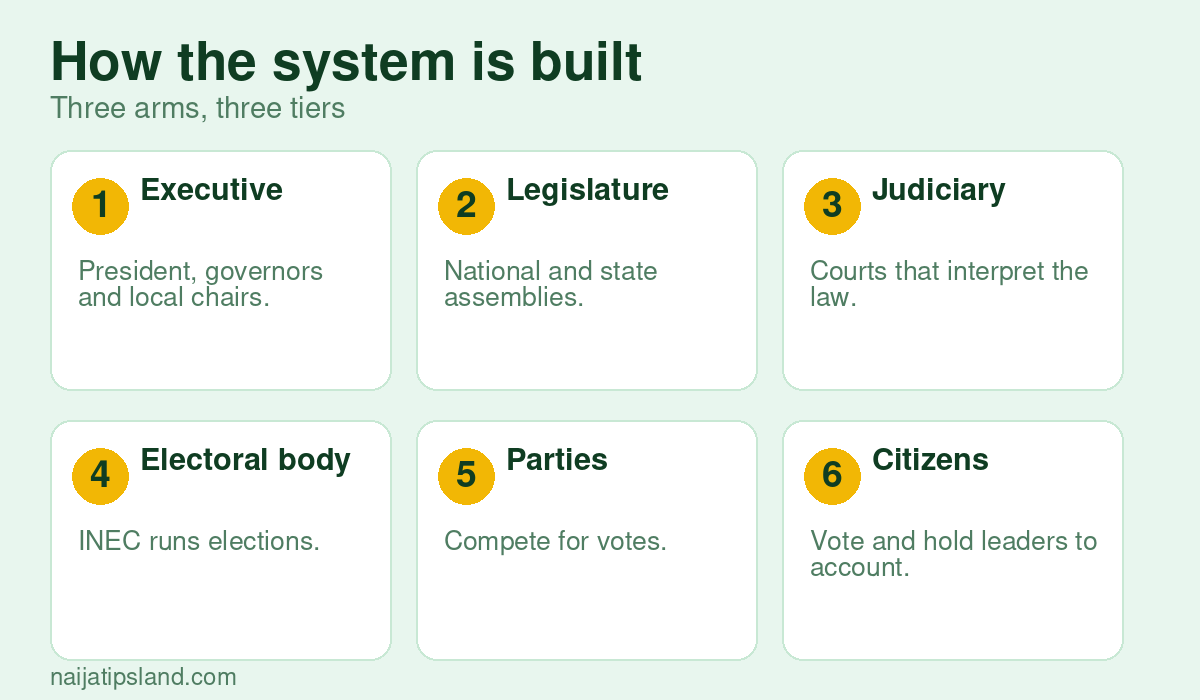
- Three arms of government: the executive (the President, governors and local government chairs), the legislature (the National Assembly and state houses of assembly) and the judiciary. See our guide to the National Assembly.
- Three tiers: federal, 36 states plus the FCT, and 774 local governments.
- An electoral commission: INEC registers parties and voters and runs most elections. See the 21 registered parties and voter registration.
- Elections: the next general elections are reported for 16 January and 6 February 2027. See our 2027 election hub and guide to the governors in 2026.
What Nigerians say
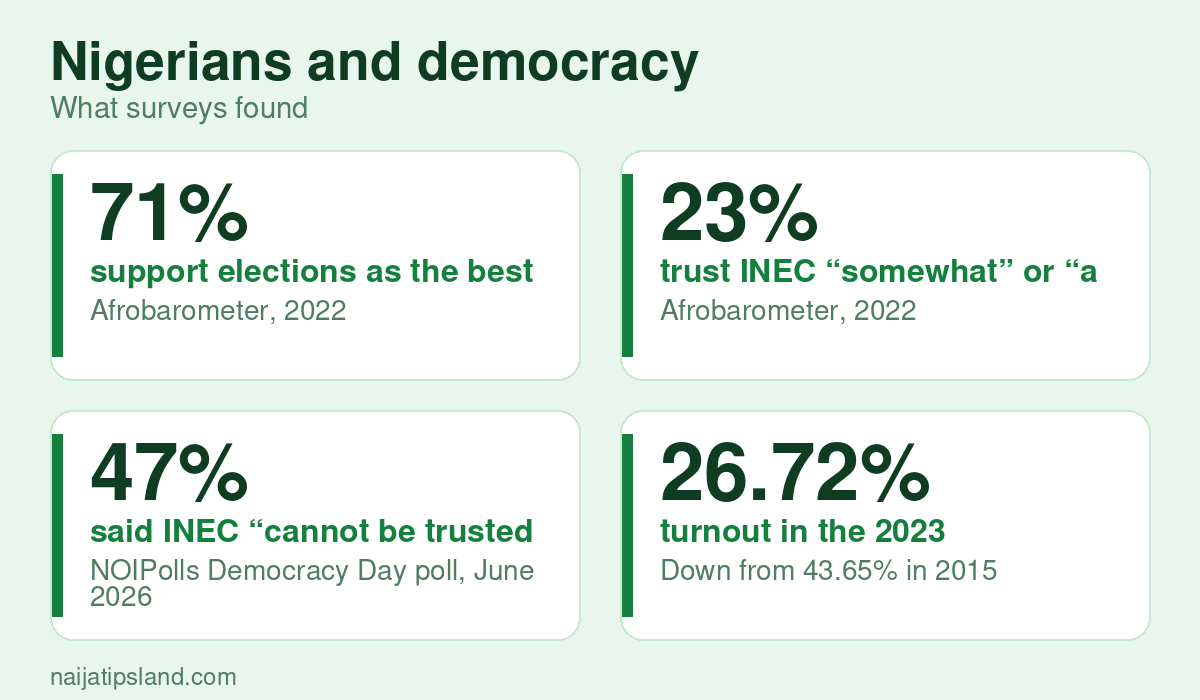
- Support for democracy is high. Afrobarometer’s 2022 survey of 1,600 adults, led by NOIPolls, found 71% back elections as the best way to choose leaders and 69% say Nigeria needs many political parties so voters have a real choice. An earlier survey found 74% said democracy is preferable to any other kind of government.
- Dissatisfaction is growing. Afrobarometer found that about half of Nigerians described the country as a democracy with major problems, and satisfaction with how democracy works has been falling.
- Trust is low. In 2022, only 23% said they trusted INEC somewhat or a lot, a drop of 12 points since 2017. A NOIPolls Democracy Day poll in the first week of June 2026 found INEC with the highest “cannot be trusted at all” rating at 47%, followed by legislators at 43% and the EFCC at 40%. Respondents cited insecurity and poor governance, each at 25%, as the main challenges to democracy. Among satisfied respondents, freedom of expression was the leading reason.
Turnout and apathy
Turnout in presidential elections was 43.65% in 2015, 34.75% in 2019 and 26.72% in 2023. Poll respondents cite lack of trust in politicians and in INEC as reasons for voter apathy. Low turnout can let a small share of voters decide for everybody, which is why registration and card collection matter. INEC said the national register had passed 103 million voters in October 2026, but only those who collect their cards and turn up can use that power.
What strengthens democracy
- Credible elections: transparent results, fair rules and prompt handling of disputes.
- Internal party democracy: INEC has repeatedly complained about leadership crises and litigation within parties.
- An informed public: accurate news and the ability to detect misinformation and deepfakes. See our guides on fake news and verifying news.
- Accountable institutions: legislatures, courts and agencies that are trusted because they are seen to work.
- Security and rule of law, so people can campaign and vote safely.
- Inclusion: women make up only about 4.5% of National Assembly members, and young people are under-represented.
Ways to take part
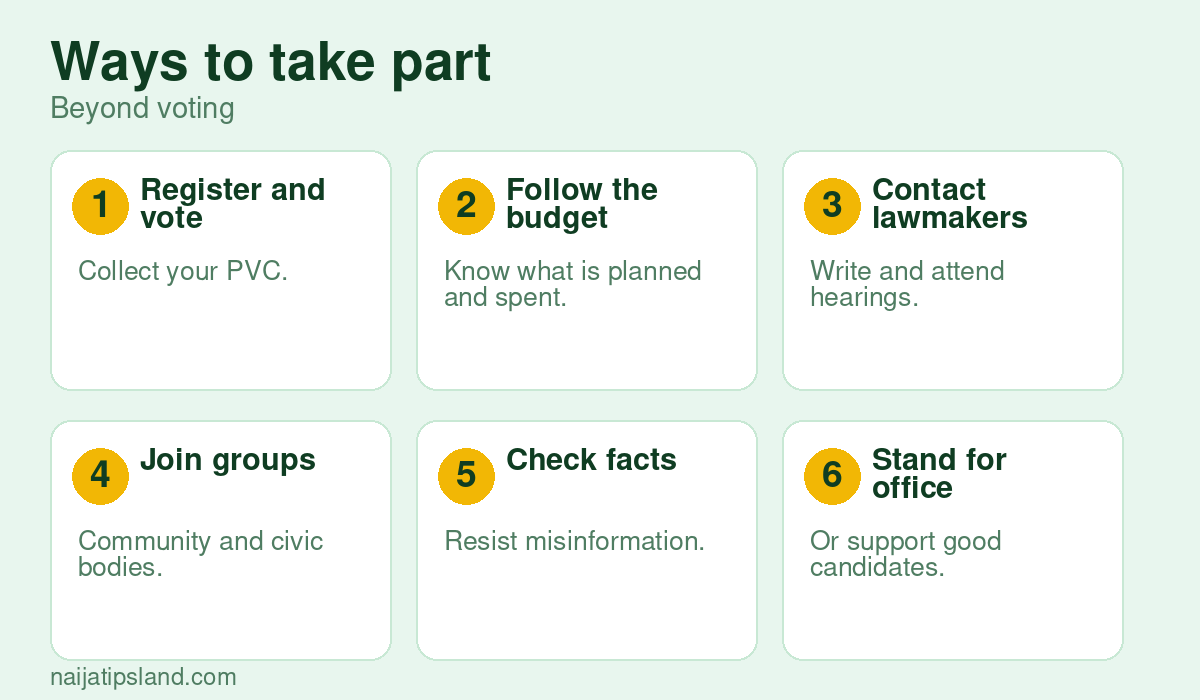
- Collect your PVC and vote. Never sell your vote.
- Learn the candidates and parties, read manifestos and ask for specifics.
- Follow public budgets and projects in your area, and ask questions.
- Contact your representatives and attend public hearings.
- Join community or civic groups, volunteer as a poll observer or join voter education.
- Share facts, not rumours.
For the broader link between politics and everyday life, read our guides on politics and national development and political commentary.
The 2027 Election at a Glance
- The presidential election is on 16 January 2027 and the governorship elections on 6 February 2027.
- Eighteen presidential candidates are on INEC’s final list, including two women, and 4,408 candidates are cleared for the National Assembly.
- INEC says the voter register is more than 103 million, and PVC collection began on 9 October 2026.
Beyond the Ballot Box
Democracy is more than elections. It also depends on a free press, independent courts, an active civil society and citizens who ask questions between elections. You can take part by attending community meetings, following budgets, joining or forming groups, volunteering as an election observer and supporting fact-checking.
Common Misconceptions
- “My vote does not count”: turnout has fallen from 43.65% in 2015 to 34.75% in 2019 and 26.72% in 2023, so every voter is a larger share of those who turn out.
- “Voting is only for politicians”: local government and state elections decide services you use daily.
- “All information is reliable”: election season brings rumours and deepfakes. See fake news in Nigeria.
Useful Terms
- Accreditation: checking that a voter is registered before voting.
- Collation: adding up results from polling units to wards, local governments and states.
- Running mate: the candidate for deputy.
- Manifesto: a party’s plan for office. See Nigeria’s political parties.
Frequently Asked Questions
When did Nigeria return to democracy?
In 1999, when civilian rule was restored after years of military government.
Do Nigerians support democracy?
Surveys show strong support for elections and for democracy in principle, alongside growing dissatisfaction with how it works.
Why is voter turnout falling?
Reasons given include distrust in politicians and the electoral commission, insecurity and a feeling that votes do not change much.
Sources
- Afrobarometer: Nigerians want competitive elections but don’t trust the electoral commission
- NOIPolls: Preference for democracy remains high, but dissatisfaction is growing
- NOIPolls: Democracy Day poll, June 2026
- Statista (Afrobarometer): Opinions on democracy in Nigeria
- Nairametrics: Nigeria’s voter register surpasses 103 million