
Last updated: 13 October 2026. Prices and services vary widely, so we do not quote fees. We removed unsourced claims from an earlier version. For a list of firms to know, see our companion guide, market research companies in Nigeria.
Hiring a market research agency is a way of buying answers, so the quality of the question decides the value of the answer. Many businesses spend money on studies that do not change any decision because the question was vague, the method did not fit or nobody acted on the findings. This guide shows how to avoid that.
Step 1: Start with the decision
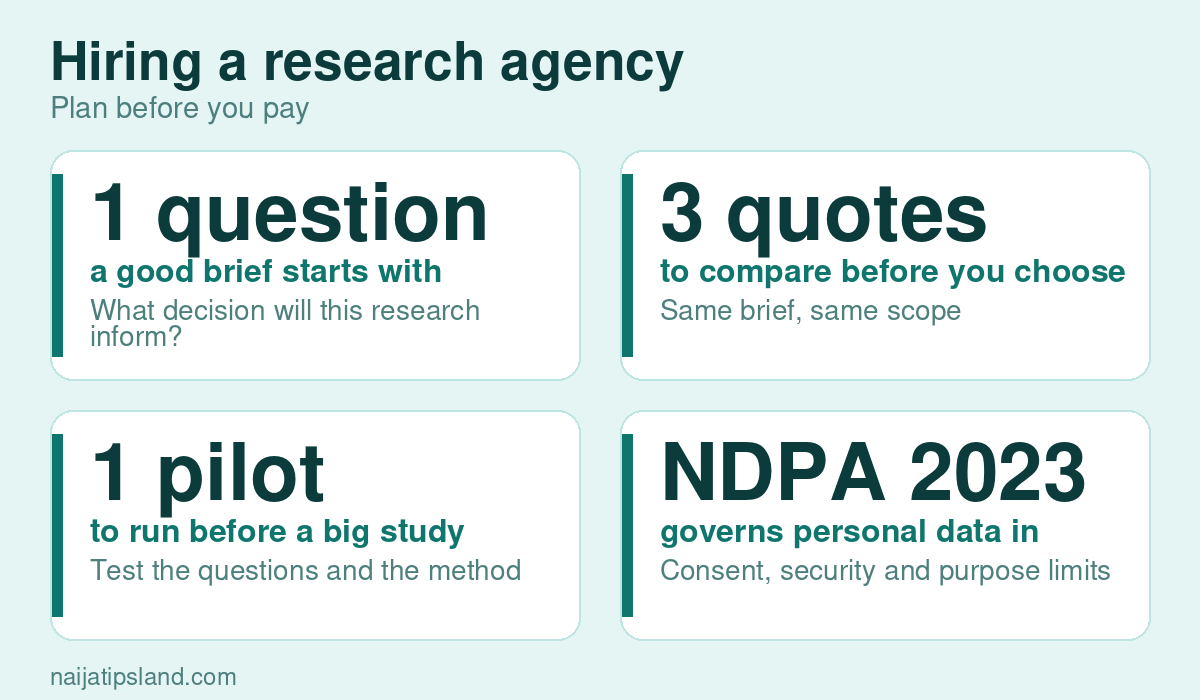
Write down what you will do differently depending on the findings. Examples: “We will launch in Abuja if at least 30% of target customers say they would buy at this price,” or “We will change our packaging if buyers find it hard to open.” If no result would change your actions, you do not need the study.
Step 2: Write a clear brief
- Background: your business, product and market.
- Objectives: two or three specific questions.
- Audience: who should be studied: age, location, income, behaviour.
- Method preferences: if you have any.
- Timeline and budget: deadlines and the range you can spend.
- Deliverables: the report, raw data, presentation or recommendations.
Step 3: Choose the right method
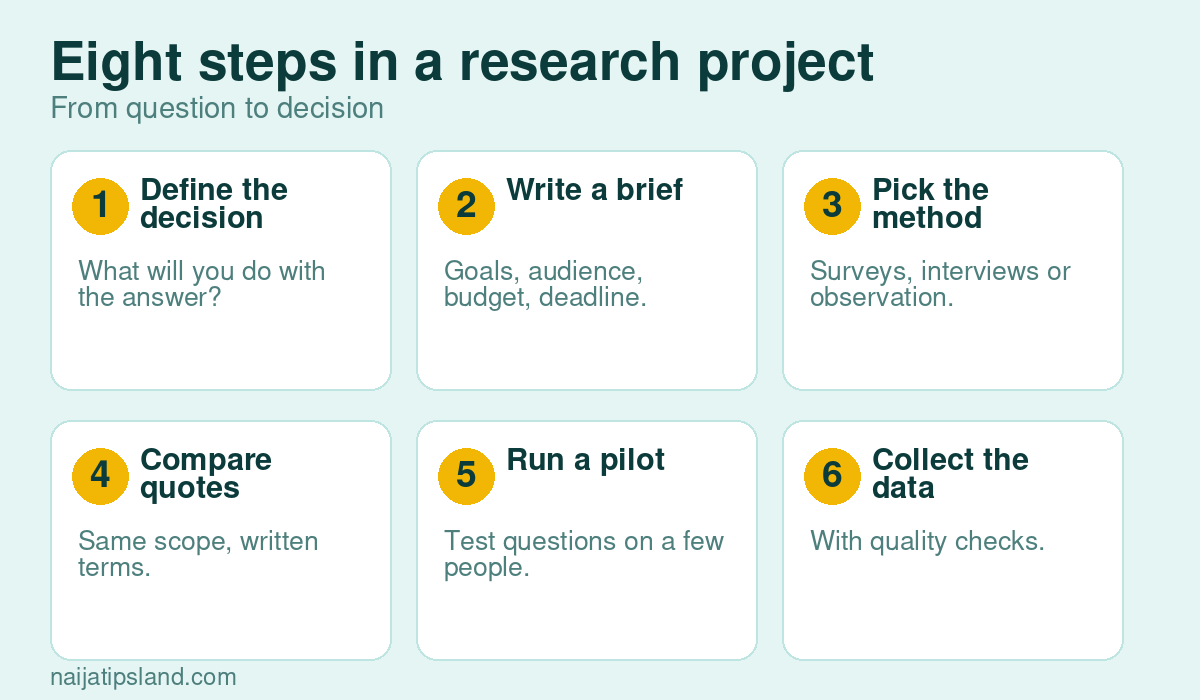
- Surveys tell you how many people think or do something. They work best with a clear, short questionnaire. See our guide to why online surveys matter.
- Interviews and focus groups explain why people behave as they do and are good for early ideas.
- Observation and mystery shopping show what people really do, not what they say.
- Desk research uses existing data. It is cheap and should come first.
Many studies combine two methods: interviews to find the right questions, then a survey to measure them.
Step 4: Compare agencies and quotes
- Send the same brief to at least three agencies.
- Compare their understanding of the problem, not just the price.
- Check CAC registration, past work and references.
- Ask who will actually do the work and where interviews will happen.
- Ask how they ensure quality: supervision, back-checks, minimum answer times and data cleaning.
Step 5: Protect people’s data
Surveys collect personal information. Under the Nigeria Data Protection Act 2023, you and your agency must have a lawful basis, explain how data will be used, keep it secure and avoid collecting more than you need. Agree in writing who owns the data and how long it will be kept, and ask whether results will be anonymised. See our guide to data privacy.
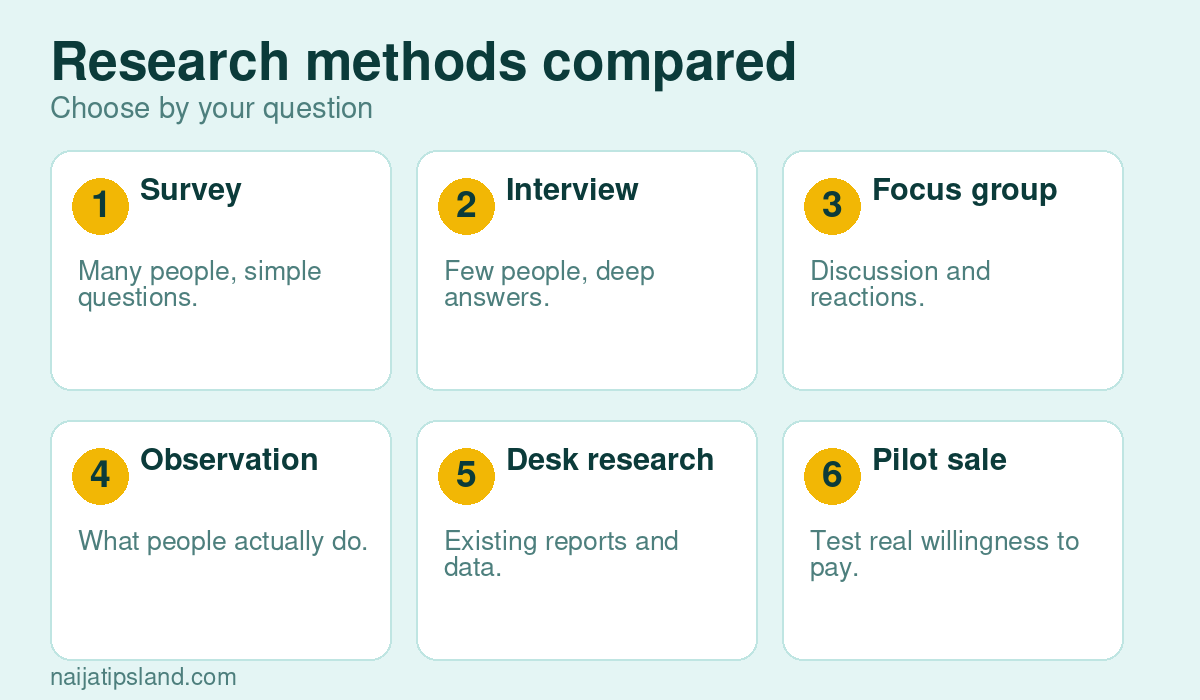
Step 6: Run a pilot and manage the project
Test the questionnaire on a handful of people to see if they understand it. Check progress during fieldwork, and ask for interim results. Be wary of leading questions that nudge people toward the answer you want.
Step 7: Turn findings into action
- Ask for a short summary with clear recommendations, plus the detailed data.
- Check the sample size, margin of error and who was missed.
- Share the findings with the people who must act on them and set a date for decisions.
- Track results afterwards to see whether the decision worked.
Doing it yourself on a budget
For small businesses, a simple approach can work: interview 15 to 20 customers, run a short online or phone survey, test a small pilot offer and use public data from the NBS, SMEDAN and others. The 2020 MSME survey, for instance, counted about 39.65 million small businesses. Read our guides on small businesses that succeed and entrepreneurship mistakes.
A Brief to Give Any Agency
- The decision the research must inform, in one sentence.
- The audience, location and sample size you need.
- The method you prefer, such as surveys, interviews or observation.
- The deadline and budget, and what you will do with the results.
Questions to Ask Before You Hire
- Can you see examples of similar work and speak to past clients?
- How will you recruit respondents, and how will you check data quality?
- Who owns the data, and how will you protect respondents’ privacy? See data privacy.
- What is included in the price, and what costs extra?
Red Flags
Be careful with agencies that promise guaranteed results, will not explain their sample, ask for the full fee upfront or deliver numbers without a method. See how to run an online survey.
Frequently Asked Questions
How long does a research project take?
From a couple of weeks for a simple survey to several months for large studies, depending on scope and fieldwork.
What sample size do I need?
It depends on how precise you need to be and how varied your audience is. Ask the agency to explain and justify its sample.
Who owns the data?
Whatever your contract says. Agree it in writing before the project starts.