Last updated: 16 October 2026 · By Naijatipsland Editorial Team · Editorial policy
A registered limited company gives your business its own legal identity, makes it easier to open corporate bank accounts, win contracts and raise money, and, as a general rule, separates the owners’ personal assets from the company’s debts. In Nigeria the Corporate Affairs Commission (CAC) handles the registration, and the process is now done online. This guide explains who needs a limited company, what you need before you file, the steps, what it costs, and what you must do after you receive your certificate, including annual returns and the CAC’s 2026 strike-off exercise.
Fees, forms and timelines at CAC change, and the agent sites that rank for this topic often quote different figures. We have therefore used the Companies and Allied Matters Act (CAMA) 2020 as summarised by law firms and CAC-related news, and we flag where only a commercial agent gave a number. Check the current schedule on the CAC portal before you pay. This is general information, not legal or tax advice.
The short answer
- You file online on the CAC portal: search and reserve a name, enter company, director and shareholder details, prepare the Memorandum and Articles of Association (MEMART), and pay.
- A private company needs at least one director and a registered office address in Nigeria. CAMA 2020 sets a minimum issued share capital of N100,000 for private companies.
- The official filing fee for a private company with share capital up to N1 million has been reported as N10,000, plus stamp duty and other charges. Agents add their own fees.
- You receive a Certificate of Incorporation with an RC number, plus status report and company documents.
- The work continues after registration: tax registration, a company bank account, annual returns and ownership disclosure. Skipping returns can get a company struck off.
Business name or limited company?
Many small traders start with a business name, which is cheaper and simpler, but it does not create a separate legal person. Our guide to registering a business name with CAC covers that route. A private limited company costs more to set up and comes with more ongoing duties.
| Business name | Private limited company | |
|---|---|---|
| Legal identity | None: owner and business are the same | Separate legal entity |
| Liability | Owner’s personal assets are exposed | Shareholders’ liability is limited |
| Owners | One person or a partnership | 1 to 50 shareholders, at least 1 director |
| Raising money | No share investors | Can issue shares |
| Paperwork | Lighter | Annual returns, records, ownership disclosure |
The comparison above follows one registration-agent guide, so treat the numbers of owners as a guide and confirm with CAC. Choose a limited company if you want to bid for larger contracts, take investors, protect personal assets or build something that outlives you. If you are just starting to test an idea, a business name may be enough.
What you need before you file

- A name. It must not be identical or confusingly similar to an existing name, and certain words such as “Federal”, “National” or “Government” need permission. Prepare two or three alternatives. Reservations are reported to last 60 days.
- Directors and shareholders. Full names, addresses, dates of birth, contact details and identity details such as NIN or BVN where the form asks for them. Agent guides list these as required, but the exact fields can change, so follow the portal.
- A registered office address in Nigeria where CAC can send notices.
- Share capital. CAMA 2020 abolished the idea of authorised share capital and uses issued share capital. A private company must have minimum issued share capital of N100,000 (section 27(2)); a public company needs at least N2 million. Some regulated sectors, such as banking and insurance, face much higher requirements set by their own regulators.
- A MEMART. The Memorandum states the company’s name, address and objects, and the Articles are its internal rules. The portal offers a standard template, and many founders adapt it with a lawyer’s help.
- Persons with significant control. Be ready to say who ultimately owns or controls the company. See the ownership section below.
Step by step
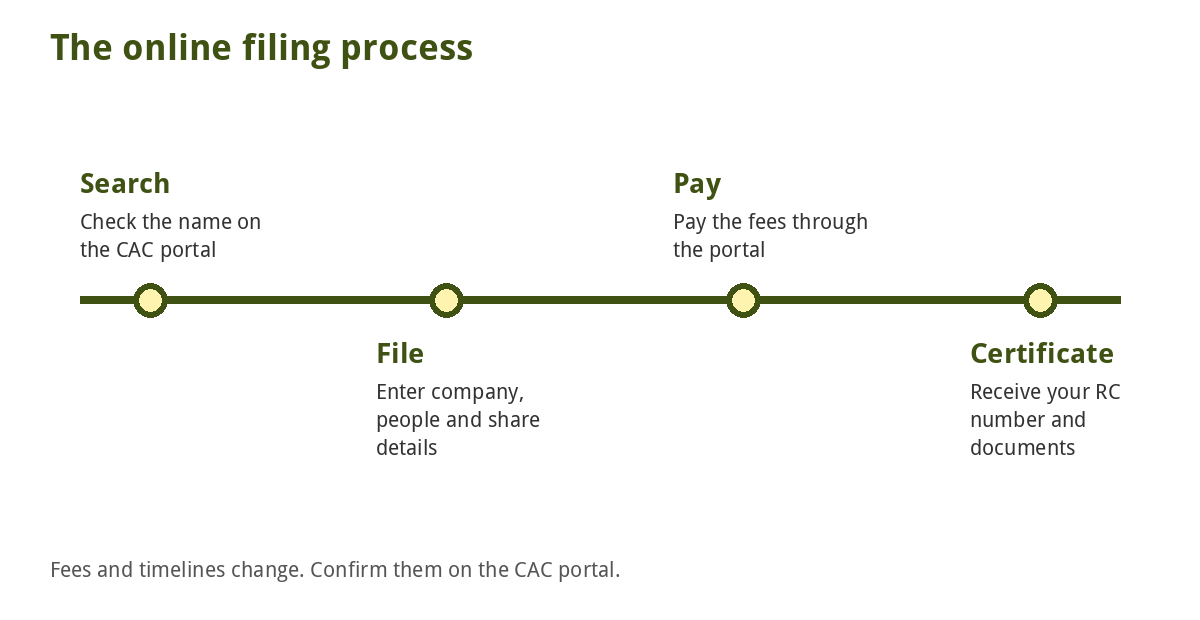
- Create an account on the CAC online portal using your email and phone number.
- Search for the name. Use the name availability search and reserve the one you want.
- Complete the incorporation form. Enter the company details, registered address, nature of business, directors, shareholders and share allotment.
- Prepare the MEMART. Use the portal’s template or upload a custom one.
- Upload documents the portal requests, such as identity details and signatures.
- Pay the fees through the portal’s payment gateway, including stamp duty where it applies.
- Wait for review. CAC may query the filing. Respond quickly to avoid delay.
- Download your documents, including the Certificate of Incorporation with your RC number.
Agent sites claim anything from 24 hours to about a week. Treat promised timelines as marketing unless CAC publishes a service standard, and expect delays if the name or details are queried.
How much does it cost?
Costs fall into three buckets.
- Government fees. A regulatory update reports that CAC’s schedule effective 1 August 2025 keeps the incorporation fee for a private company with share capital of N1 million or less at N10,000, with a flat N10,000 for each additional N1 million. Name reservation, stamp duty and portal charges are separate. One agent guide lists an all-in official total of about N28,000 for N1 million capital, while another quotes about N35,000 plus stamp duty, so the figures are not consistent. Check the CAC fee schedule.
- Agent or lawyer fees. Agent packages are commonly advertised at about N30,000 to N150,000 or more, depending on what they include. Ask exactly what the price covers.
- Later costs. Annual returns, accountant fees, tax filings, a company seal if you want one, and changes to directors or share capital.
The same regulatory update lists annual-return charges that rise with share capital: N5,000 for companies with share capital from N100,000 up to N100 million, then N100,000, N150,000 and N200,000 for the higher bands. A small company with modest capital should therefore think carefully before declaring a very large capital figure it does not need.
After you are incorporated

1. Tax registration
Agent guides say a company’s tax identification number is linked to the registration. Confirm your company’s TIN with the tax authority and keep it with your documents. Our guide to getting a Tax Identification Number explains the process for individuals and businesses, and personal income tax explains how owners are taxed on salary and dividends.
2. A corporate bank account
Banks usually ask for the certificate, the MEMART, status report and directors’ identity documents. If you will earn in foreign currency, see our guides to domiciliary accounts and dollar cards.
3. Annual returns
Companies must file annual returns with CAC. On 15 July 2026 CAC published a notice of its sixth batch of strike-offs, listing about 100,000 companies for failing to file outstanding annual returns or other mandatory documents under sections 692(3) and 692(4) of CAMA 2020. The notice gave companies 90 days to comply, which ran to roughly 13 October 2026, with no further extension. A struck-off company loses its legal status, so make filing a yearly habit. If you think your company is on the list, check the CAC website and contact CAC.
4. Persons with significant control
CAMA 2020 requires companies to identify the people who ultimately own or control them, the persons with significant control, and to file that information with CAC. The strike-off notice specifically mentioned disclosure of these persons. The ownership threshold is commonly summarised as 5 percent of shares or voting rights, but read the rules or ask a lawyer for your case.
5. Records and changes
Keep minutes, share registers and receipts. File changes of directors, address or share capital with CAC promptly. A company secretary is optional for small private companies under common summaries of CAMA 2020, but it helps with compliance.
Common mistakes
- Choosing a name that is already taken or too close to another company.
- Declaring huge share capital for show, which raises fees and annual-return charges.
- Using a stranger or an unregistered agent without checking they can deliver the certificate.
- Putting the wrong ownership details in the MEMART.
- Failing to file annual returns, then discovering the company is on a strike-off list.
- Mixing personal and company money.
- Forgetting that regulated businesses, such as fintech, schools and logistics, may need extra licences.
Frequently asked questions
Can one person register a limited company in Nigeria?
CAMA 2020 allows a private company to be formed by one person. Confirm the director and shareholder rules on the portal.
What is the minimum share capital?
CAMA 2020 sets minimum issued share capital of N100,000 for a private company and N2 million for a public company. Some sectors have higher regulator-set minimums.
Do I need a lawyer?
Not by law for a simple filing, but a lawyer helps with a custom MEMART, shareholder agreements and regulated businesses.
How long does registration take?
It depends on CAC’s review and whether the filing is queried. Agent guides advertise a few days to a week, but these are not official timelines.
What happens if I skip annual returns?
CAC can move to strike off non-compliant companies, as its July 2026 notice shows. Check your status and file outstanding returns.
Can a foreigner own a Nigerian company?
CAMA 2020 generally allows foreign ownership, though some sectors restrict it and some activities need extra approvals. Ask a lawyer.
Do I pay tax straight away?
Tax obligations depend on your income and company type, and small companies may qualify for reliefs. Speak to an accountant or the tax authority.
Bottom line
Register a limited company when you need a separate legal identity, a corporate account, contracts or investors. Search the name, prepare accurate director and ownership details, pay only official fees through the portal, and then treat compliance as a routine: tax details, annual returns and ownership disclosure every year. If you are building an online income first, our guides to earning online in Nigeria and remote work cover earlier steps.
Sources
- Mondaq: CAMA 2020, share capital
- Mondaq: Regulatory update, CAC issues new schedule of fees
- Legit.ng: CAC to strike off 100,000 companies, 90-day deadline (July 2026)
- Icesume: How to register a business in Nigeria (commercial agent)
- CACRegister: LLC registration guide (commercial agent; fee figures unsourced)
- Corporate Affairs Commission (official site)