
How to Start a Food Delivery Business in Nigeria (2026): Costs, Licences, Riders and Profit

Last updated: 5 November 2026 · By Naijatipsland Editorial Team · Editorial policy
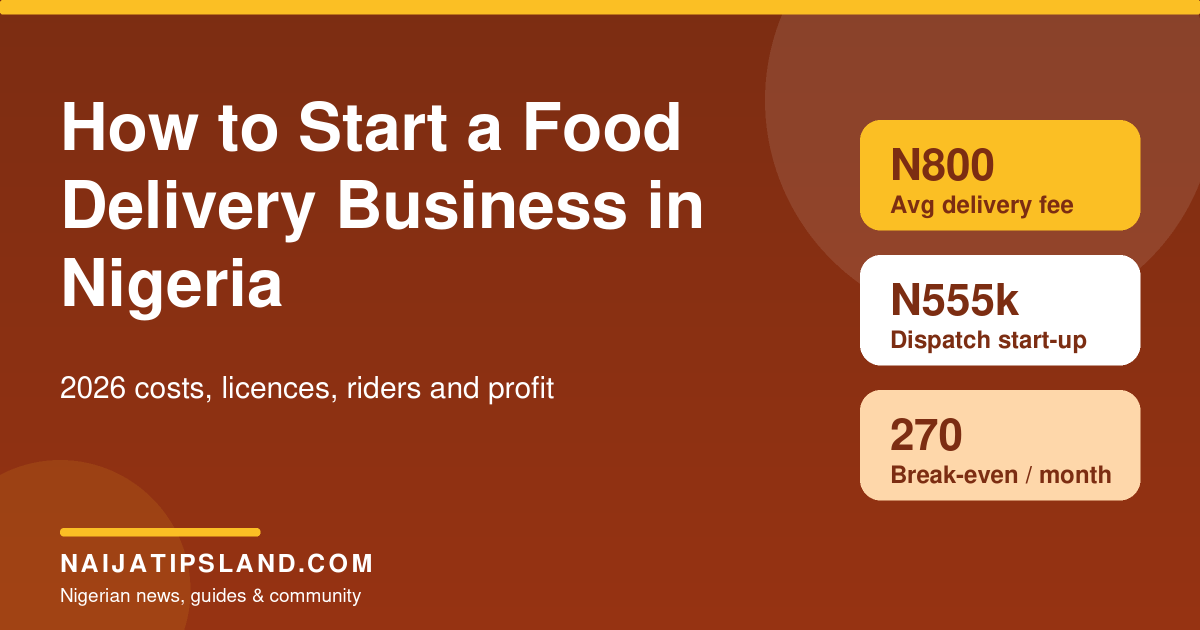
Food delivery is one of the few Nigerian businesses where demand is visible every evening: hungry people in traffic, restaurants that cannot afford their own riders, and customers who will pay for convenience. Apps such as Chowdeck and Glovo have proved the market, but they have also shown how hard the economics are. If you want to start a food delivery business in Nigeria in 2026, the good news is that you do not have to build an app or compete head on with the big platforms. You can start as a rider, a small dispatch company, a dark kitchen or a neighbourhood delivery service for local restaurants. This guide explains each route, the costs, the paperwork and the numbers that decide whether you make money.
How to read the figures: the cost ranges below come from a 2026 Nigerian business guide and from reporting by The Condia and Rest of World. They are estimates for planning, not quotes, and prices differ by city. Platform commissions and policies change often, so check them directly before you sign anything. This is general information, not financial or legal advice.
The market: big enough to be tempting, tough enough to be risky
The Condia reported in April 2026 that Lagos food delivery was valued at about $1.1 billion in 2025, and grew about 187 percent between 2021 and 2024 according to Paystack. Chowdeck now operates across 11 cities in Nigeria and Ghana with more than 20,000 riders and about 1.5 million customers, while Glovo has invested more than N37 billion in Nigeria. The same report says Bolt Food and Jumia Food had already left Lagos, a reminder that even well-funded players struggle. Chowdeck raised delivery fees after fuel subsidy removal and its CEO has said it will not subsidise prices because the unit economics are poor. The lesson: delivery is a volume and cost-control business. Your advantage as a small operator is lower overheads and local relationships.
Five ways to start (pick one)
1. Gig courier on an existing platform
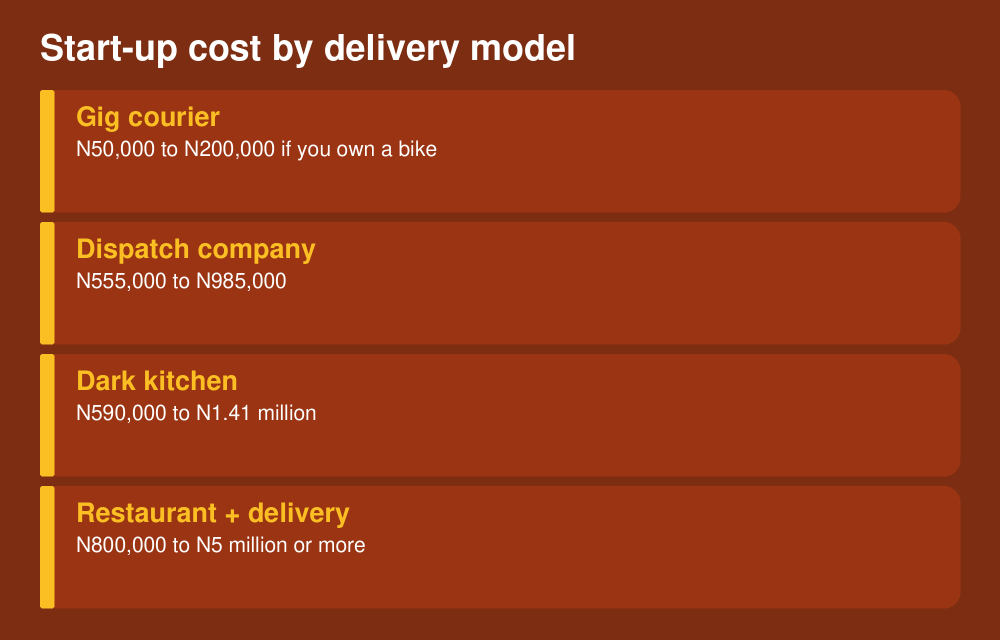
Lowest risk. You register as a rider on Chowdeck, Glovo or similar and use your own bike. The 2026 guide puts start-up costs at roughly N50,000 to N200,000 (gear, phone, registration) if you already have a bike, and typical earnings at about N300 to N700 per delivery plus surge bonuses, or roughly N60,000 to N120,000 a month. Good for testing the work before you invest.
2. Logistics-only dispatch company
You own a few bikes, hire riders and deliver for restaurants, shops and individuals. The guide estimates N555,000 to N985,000 to start, depending on bikes and riders. You do not cook, so you avoid NAFDAC for food production, though you must register the business and keep riders and vehicles properly licensed. This is the model I would suggest for most beginners with some capital.
3. Dark kitchen or home delivery
You cook and deliver your own food (jollof, small chops, grills, snacks) without a dining room. The guide estimates N590,000 to N1.41 million. You carry food production rules (food handler certificate, premises permit and NAFDAC for packaged products, which the guide says costs N50,000 to N200,000 per product category and can take three to six months).
4. Restaurant with delivery
Highest cost: N800,000 to N5 million or more, because of rent, equipment and staff. Delivery here is an add-on, not the business.
5. Grocery or market-run delivery
Customers send a list; you buy from the market and deliver. Margins come from a service fee, so you need trust and reliable pricing. It suits busy professionals and the diaspora ordering for relatives at home.
Step-by-step: how to launch a small delivery business
Step 1: validate before you buy anything
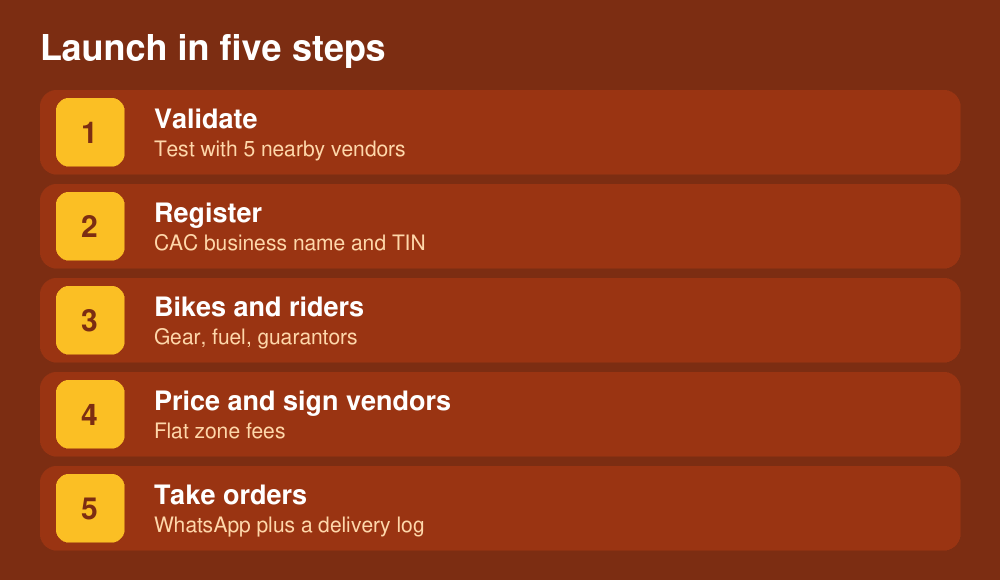
Spend two weeks visiting 15 to 20 restaurants, caterers and shops in one area. Ask how many deliveries they make daily, who delivers now, what they pay and what goes wrong. If five vendors will give you a trial, you have a business case. Stay inside one area at first because traffic and distance wreck margins; Lagos peak hours are roughly 7am to 10am and 4pm to 8pm.
Step 2: register the business
Register a business name or limited company with the Corporate Affairs Commission. The 2026 guide gives N10,000 to N25,000 for a business name (some sources say more, so confirm) and N50,000 to N150,000 for a limited company including legal fees. Use our guides to register a business name with CAC and register a limited company. Then get your Tax Identification Number, which is free, and open a business bank account. Check your local government area for signage and premises levies; the guide estimates N10,000 to N50,000 a year.
Step 3: get bikes, gear and riders
The guide prices a used dispatch motorcycle (such as a Honda CG 125 or Bajaj) at N350,000 to N600,000, helmet, protective gear and a delivery box at N35,000 to N60,000, and an Android phone at N60,000 to N120,000. Fuel is estimated at N5,000 to N8,000 per rider per week with petrol around N1,100 to N1,300 per litre. In-house riders usually earn N40,000 to N80,000 a month; outsourced dispatch riders are paid N500 to N1,500 per trip. Check riders’ licences, get guarantors, and note that some Lagos expressways bar commercial motorcycles, so plan routes.
Step 4: set prices and sign vendors
Charge a delivery fee by distance (flat zones are easiest) and agree a clear rate with vendors. The guide uses an average of N800 per delivery for its Lagos logistics model, with net margin of N500 to N2,000 per delivery. Rest of World and The Condia report Chowdeck customer delivery fees around N1,500 to N1,800 in Lagos, so your zone pricing must reflect real fuel and rider costs, not just app prices.
Step 5: take orders simply
You do not need an app on day one. Use WhatsApp Business for orders, a Google Sheet to log every delivery, and bank transfer or a payment link for payment. Direct WhatsApp orders carry no platform commission. Build an app only when you have steady volume.
The numbers: a worked example (illustrative)
Here is a simple monthly model for a two-rider logistics service, using the 2026 guide’s cost ranges. These are my planning assumptions, not guaranteed results.
- Rider pay: 2 riders at N55,000 = N110,000
- Fuel: 2 riders at N6,500 a week, about 4.33 weeks = about N56,000
- Maintenance, data and extras: about N30,000
- Admin and packaging: about N20,000
- Total monthly running cost: about N216,000
At an average of N800 per delivery, you break even at about 270 deliveries a month, roughly nine a day. At 550 deliveries a month (about 18 a day, or nine per rider) revenue is about N440,000 and net is about N224,000, close to the N226,000 the guide projects for a two-rider Lagos setup. The guide also suggests N500,000 to N700,000 net a month for four riders, but that depends on steady orders, low rider turnover and no major bike repairs. A single accident, a stolen bike or a fuel price jump can erase a month’s profit, so budget for insurance and repairs.
What platforms charge vendors (and why it matters to you)
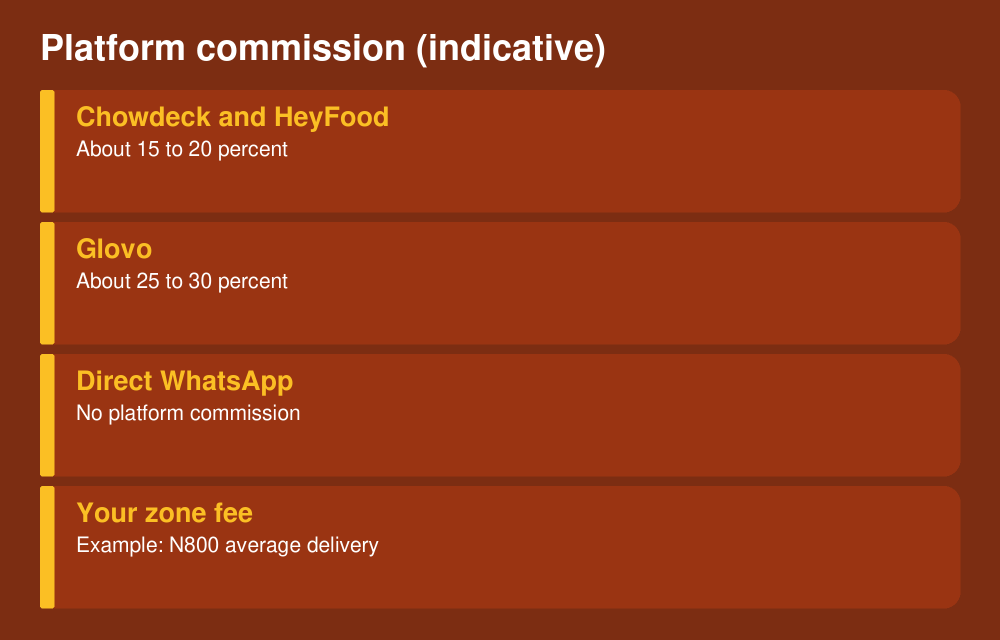
The 2026 guide lists commissions of about 15 to 20 percent for Chowdeck and HeyFood, and 25 to 30 percent for Glovo, while The Condia’s comparison gives lower headline commission figures for some platforms, so treat any number as indicative. Its point stands: restaurants dislike high commissions, which is your opening. Offer flat per-delivery pricing for orders that come direct via WhatsApp or Instagram, and you may win vendors who want to keep more of each sale.
Licences and rules to check
Beyond CAC and your TIN, confirm what your state requires for riders, vehicle roadworthiness and commercial motorcycle operation. If you cook, you need a food handler certificate and premises permit from the state health ministry, and NAFDAC registration for packaged products; see our NAFDAC registration guide. For wider planning, our start a business in Nigeria hub and the list of profitable businesses you can start from home may help.
Common mistakes to avoid
Do not buy several bikes before you have steady orders. Do not underprice deliveries to win customers, because fuel and repairs will drain you. Do not hire riders without guarantors and clear rules on cash handling. Do not ignore insurance. And do not cover too wide an area: shorter trips mean more deliveries per rider per day.
Frequently asked questions
How much does it cost to start a food delivery business in Nigeria?
Estimates for 2026 run from about N50,000 to N200,000 as a gig courier, N555,000 to N985,000 for a small dispatch company, N590,000 to N1.41 million for a dark kitchen, and N800,000 to N5 million or more for a restaurant with delivery.
Do I need NAFDAC to start food delivery?
If you only transport food for others, the 2026 guide says you generally do not need NAFDAC. If you prepare and sell packaged food, you may. Check with the agency and your state health authority.
Do I need to build an app?
No. Most beginners use WhatsApp Business, a spreadsheet and transfers. Build an app only when you have steady volume and a clear reason.
Is food delivery profitable in Nigeria?
It can be, but margins are thin. The 2026 guide estimates N500 to N2,000 net per delivery for logistics operators; the large platforms have said their own unit economics are hard. Profit depends on keeping deliveries per rider high and costs low.
Should I join Chowdeck or Glovo or start my own?
Joining as a rider is a low-cost way to learn the business. Starting your own works best if you have vendor relationships and a small local area you can serve better than the apps.
How many riders do I need to start?
Two is enough to test one area. Add riders only when your existing riders are fully busy during peak hours.
Sources and notes: 9jadirectory 2026 guide to starting a food delivery business in Nigeria (costs, registration, rider pay); The Condia, 26 April 2026 (market size, Chowdeck, Glovo, Swoop); Rest of World (Chowdeck). Figures are indicative planning ranges and not financial or legal advice.
Join the discussion
Have you tried this, or do you have a question we did not answer? 1 reader has already shared their view. Naijatipsland members help each other with real, first-hand experience.








Ade here. The biggest mistake I see in delivery businesses is buying bikes before proving orders. Start in one area with two riders, log every delivery in a sheet, and only add capacity when your riders are fully busy at peak hours. Are you planning to start as a rider, a dispatch company or a kitchen? Tell us below and readers may share local tips. General information, not financial advice. – Ade Adeniyi