Last updated: 16 October 2026 · By Naijatipsland Editorial Team · Editorial policy
If you make or sell packaged food, drinks, creams, soaps or other cosmetics in Nigeria, you will hear the same advice again and again: get your NAFDAC number. Without one, supermarkets may refuse your product, online platforms may remove your listing, and selling or advertising an unregistered regulated product can attract penalties. For a small business, the process feels confusing because guides disagree on fees, timelines and forms. This guide sets out what NAFDAC regulates, the documents you need, the steps in order, what the process costs, how long it takes, and how renewal works, and it marks which figures are unconfirmed.
The information comes from law-firm summaries published on Mondaq and by Banwo and Ighodalo, a NAFDAC registration guide dated 2025 and consultancy pages, plus a news report on NAFDAC’s fee cuts for small businesses. NAFDAC itself did not publish a fee schedule we could read, and the commercial sites disagree on some details. Check the current requirements on the NAFDAC portal before you pay anyone. This is general information, not legal advice.
The short answer
- NAFDAC must register your product before you sell it. Regulated products include food, drugs, cosmetics, medical devices, packaged water, chemicals and detergents.
- You apply online through NAFDAC’s portal. Guides name it as NAPAMS, and one guide refers to a NAFDAC Regulatory Information System, so use the link from the official NAFDAC website.
- Each product is registered separately. Different flavours, sizes or variants may need their own applications.
- The process includes document vetting, label review, a premises inspection and laboratory testing. You must not skip any stage.
- Timelines are measured in months. Law-firm guides cite 90 working days for food and 120 for drugs from a complete application, but sources warn that real timelines are often longer.
- Registration is valid for five years and must be renewed.
What NAFDAC regulates
NAFDAC regulates products people eat, drink, apply or use on the body. A law-firm guide lists foods, drugs, cosmetics, medical devices, packaged water, chemicals and detergents. For small businesses, the common groups are:
- Food and drinks: packaged snacks, sauces, spices, juices, flour, oils, baked goods and similar items.
- Cosmetics: creams, oils, soaps, hair products and other skincare items.
- Household products: some detergents and chemicals.
- Packaged water: sachet and bottled water.
Some guides say home-based producers can register at micro or kitchen scale, and one consultancy describes a micro-enterprise pathway for businesses with five or fewer employees, though the details are not confirmed. Dairy, meat, beverages and packaged water are described as excluded from that pathway. Restaurants and fast-food businesses are described as needing a different certificate, a Good House Practice certificate.
Get these ready first

- A registered business. Guides list a company registration certificate. See our guides to registering a business name and registering a limited company.
- Brand or trademark registration. Several guides list a trademark certificate among the documents, where applicable. Our guide to trademark registration in Nigeria explains the process, and one law-firm guide notes the registry’s acceptance letter can be used while a certificate is pending.
- Tax details. A consultancy guide says a company account on the portal needs CAC documents and a tax identification number.
- Suitable premises. You need a clean, organised production or storage space. NAFDAC inspectors check hygiene, equipment, staff, quality control and records.
- A label. Draft your label with the product name, ingredients, net content, manufacturer details, manufacture and expiry dates, storage and usage instructions and any warnings. NAFDAC adds the registration number after approval.
- Test evidence. A certificate of analysis from an accredited laboratory is commonly listed.
- Samples of the product.
Imported products need extra documents, including a power of attorney to a Nigerian agent and certificates of manufacture and free sale. Foreign manufacturers cannot apply directly and must register through a Nigerian entity. This guide focuses on local small producers.
Step by step
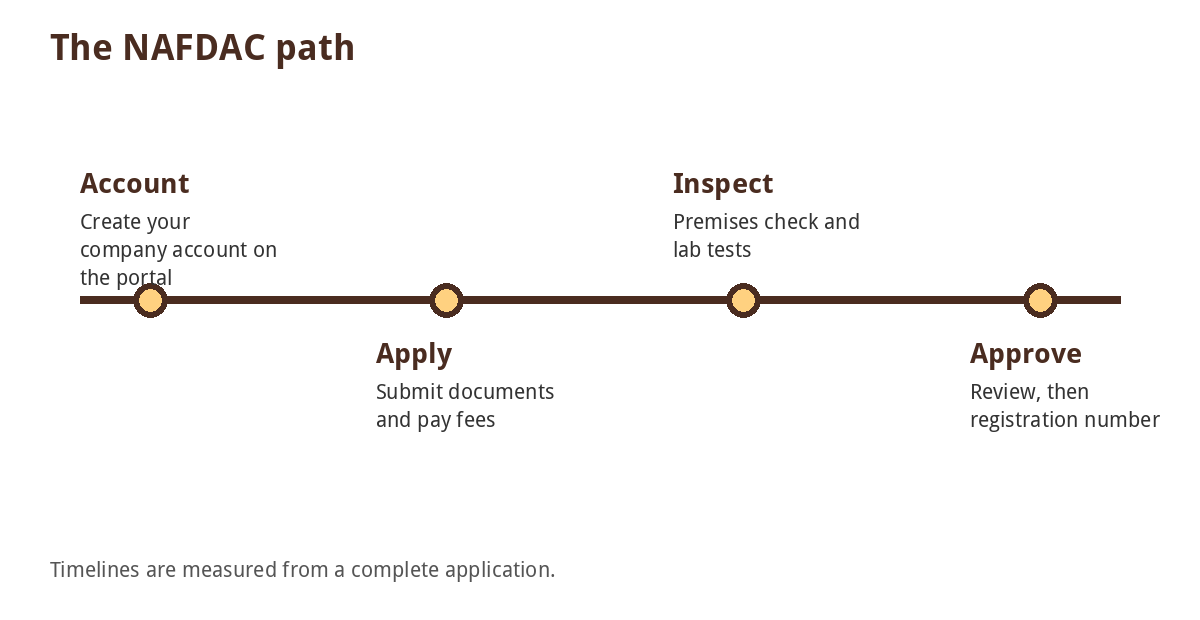
- Create a company account on the official NAFDAC registration portal using your business details.
- Prepare the application documents. These typically include an application letter to NAFDAC, the company and brand documents, product information, label samples, a notarised declaration and evidence of payment.
- Submit the application and pay the fees through the portal.
- Document vetting. NAFDAC checks that your papers are complete. One consultancy says the first review takes two to four weeks, but this is unconfirmed.
- Label review. NAFDAC checks that your label meets the rules. Non-compliant labels are rejected and must be corrected.
- Premises inspection. Inspectors visit your premises to assess hygiene and manufacturing practice. If you fail, you correct the problems and ask for another inspection.
- Laboratory analysis. NAFDAC takes or receives samples for testing. One law-firm guide says testing abroad is not accepted.
- Review and approval. A committee reviews the file. If it is approved, you receive a registration number and certificate.
- Use the number on your label. Print it exactly as issued.
How long does it take?
A February 2025 Legal 500 guide gives 90 days for food and 120 days for drugs from acceptance of an application, and a law-firm guide gives 90 working days for food and 120 for drugs. Another consultancy page estimates six to twelve months for food in practice, but gives no source. Delays are usually caused by missing documents, failed inspections, query responses and laboratory scheduling. One firm says no expedited route is available. Plan production, packaging orders and marketing around a long wait, and answer NAFDAC queries quickly.
How much does it cost?

Several guides, including one from May 2025, list the same registration fees: N50,000 for food and N50,000 for cosmetics, with higher or lower fees for drugs, chemicals and devices. Because no official schedule was available to us, treat these as guide figures and confirm them with NAFDAC. The total cost is higher than the registration fee, because you may also pay for:
- Premises inspection and related charges.
- Laboratory analysis and a certificate of analysis. One consultancy puts this at N30,000 to N200,000 or more, unsourced.
- Notarisation, packaging changes, fumigation or other certificates the guides mention, and VAT.
- Consultant or agent fees, if you use one.
One guide mentions about N36,000 for micro-scale food products, but it does not source this. A January 2024 news report said NAFDAC cut renewal fees for locally made products by 65 percent to N44,200 and cut the processing fee for foreign products by 45 percent to $450, as support for small businesses. Fee policies change, so ask for the current tariff before budgeting. Do not pay an agent who promises a guaranteed or very fast registration, and always pay through the official portal or approved channels.
After you are registered
- Renewal. Certificates are described as valid for five years. One law-firm guide says to start renewal within 90 days before expiry, while a consultancy suggests six months. Renew early. Late renewal can attract extra charges.
- Label changes. If you change the label, formulation or packaging, notify NAFDAC. A guide says changes involving a pack-size extension may need laboratory evaluation.
- Keep good practice. Inspectors can return. Keep premises clean and records tidy.
- Verify numbers. Buyers and retailers can check registration numbers on NAFDAC’s official verification tool, which guides call the Greenbook.
Penalties for selling unregistered products
Selling or advertising regulated products without registration is described as an offence. One law-firm summary says fines of up to N500,000, while a consultancy says NAFDAC can seize goods, close premises and prosecute. We could not confirm the exact penalties in the law, so ask a lawyer if you face enforcement. Beyond fines, an unregistered product cannot be sold safely through retailers or online marketplaces.
Common mistakes
- Printing a fake or borrowed NAFDAC number on a label.
- Starting the application before your company papers and brand are in order.
- Applying with a workshop that is not clean or ready for inspection.
- Skipping a certificate of analysis or using an unaccredited lab.
- Ordering thousands of labels before the label is approved.
- Assuming one registration covers every variant.
- Paying an “agent” who offers to get a number without inspection.
- Forgetting renewal.
Frequently asked questions
Do I need NAFDAC registration for homemade food?
If you sell packaged food to the public, you generally need it. Some guides describe micro or cottage-scale registration. Ask NAFDAC what applies to your product.
Can I use someone else’s NAFDAC number?
No. Each product needs its own registration. Using another producer’s number is a serious offence.
Do I need a company before I apply?
Guides list company registration documents, so register first. See our guides on business names and limited companies.
How long is a NAFDAC number valid?
Guides say five years, then you renew.
Can I register more than one product at once?
Guides say each product is applied for separately.
Is NAFDAC registration the same as SON certification?
No. SON is a different regulator, and our next guide explains when it applies.
How can a customer check a NAFDAC number?
Through NAFDAC’s official verification tools. Never rely on a number printed on a label alone.
Bottom line
Register your business, brand and premises first, prepare a compliant label and test evidence, apply through NAFDAC’s official portal, pay only through approved channels, and plan for a long process. Build the registration and renewal costs into your pricing, because a valid NAFDAC number is what lets a small food or cosmetic brand reach shops and customers with confidence. If you are building the business, our guide on earning money online in Nigeria has ideas for selling, and the business registration guides above are the best starting point.
Sources
- Banwo and Ighodalo: Overview of product registration at NAFDAC (FAQ)
- Mondaq (Firmus Advisory): Obtaining a license for your products in Nigeria (Feb 2026)
- Legal 500: NAFDAC registration in Nigeria, step-by-step (Feb 2025)
- Legit.ng: How much is NAFDAC registration (May 2025) (media guide; fees unsourced)
- EB Consults: NAFDAC registration guide (commercial consultancy; costs and timelines unsourced)
- Techeconomy: NAFDAC slashes renewal fees by 65% for MSMEs (Jan 2024)
Related: SON certification in Nigeria