
How to Start a Pure Water (Sachet Water) Business in Nigeria (2026): NAFDAC Registration, Machines, Costs and Real Profit

Last updated: 14 November 2026 · By Naijatipsland Editorial Team · Editorial policy
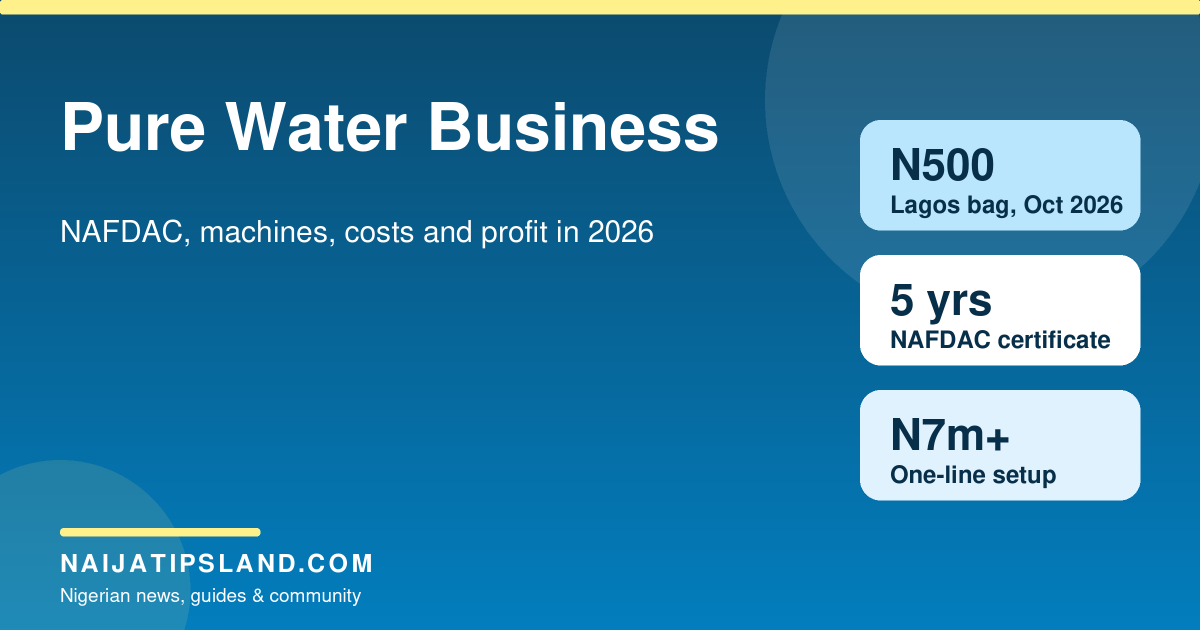
Pure water, as Nigerians call sachet water, is possibly the most visible small business in the country. It sits in every shop, bus park and event, and the same sachet that cost N5 to N10 a few years ago now sells for as much as N50 in some places. That price rise is the reason many people are asking whether a pure water factory is still worth starting in 2026. The honest answer is that it can be profitable, but margins are thin, power and packaging costs are high, and you cannot legally sell a single sachet without a NAFDAC registration number. This guide sets out the current prices, startup costs, equipment, registration steps and a realistic profit example, using NAFDAC guidelines and 2026 press and industry sources, as of 14 November 2026.
The short answer: expect to spend from a few million naira for a very small set-up to N10 million or more for a one-line factory, allow several months for NAFDAC approval, and budget carefully for diesel and nylon, which are the costs that squeeze producers most.
Is the pure water business still profitable in 2026?
Demand is steady because people need to drink every day, but 2026 has been a hard year for producers. Costs rose sharply in March, and prices followed:
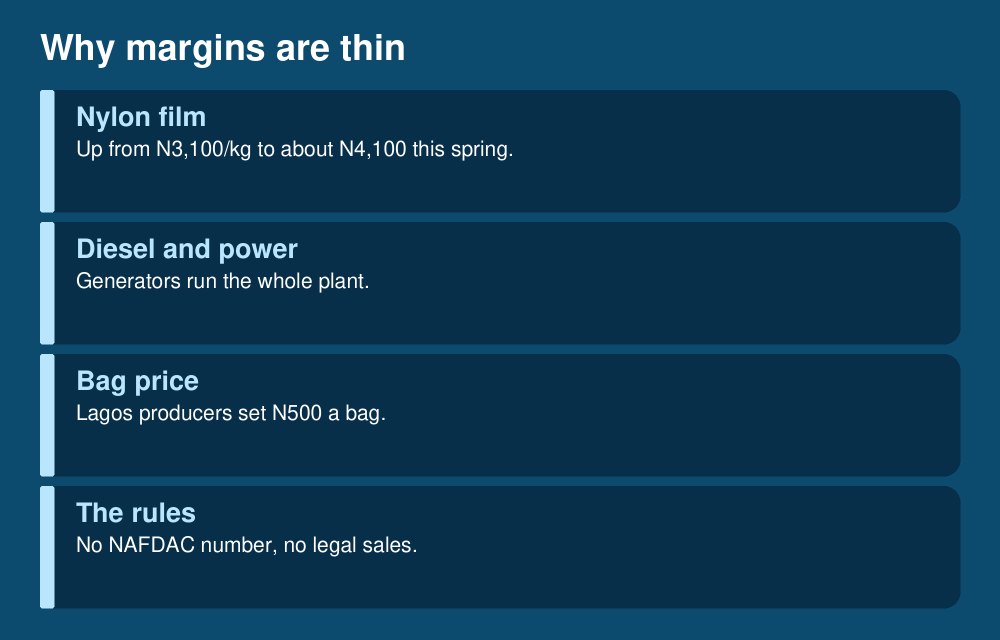
- Lagos: the Guardian reported in October 2026 that a bag was selling for as much as N500 in parts of Lagos, up from N350 to N450 earlier. A producer in Abule Aja said the Lagos producers’ association had adopted N500 as the standard selling price.
- Nylon: a roll producer told the Guardian that a kilogramme of sachet nylon rose from N3,100 in February to N4,100 in March 2026, then eased to N3,900. The head of the Hygienic Water Producers Association of Nigeria quoted figures close to N4,850 in some states in April.
- Kano: the state chapter of the Association of Table Water Producers announced in March that the bag price would rise from N220 to a minimum of N300, citing printing film at N3,700 a kilogramme and fuel at N1,500 a litre.
- Consumers: a November 2026 survey of price rises puts a bag at between N300 and N500 depending on location and brand.
A bag normally holds 20 sachets, so a producer who sells at N500 a bag earns about N25 a sachet at the factory gate. Everything depends on what it costs you to make that bag.
How much does it cost to start a pure water business?
Published estimates are very far apart, and the reason is scale. A tiny operation with a small second-hand style machine is a different business from a one-line factory with its own treatment plant. Here is how three 2026 guides compare:
- A machine supplier’s 2026 guide puts a single small-to-medium production line at N10 million to N15 million, with break-even in 4 to 12 months (a supplier’s claim, so treat it with caution).
- A March 2026 business guide estimates N7 million to N15 million for a basic one-line set-up and N20 million to N30 million for a standard factory.
- A September 2026 guide says a very small factory can be set up for N1.5 million to N3.5 million, using a machine of 1,000 to 2,000 sachets an hour.
A typical line-by-line budget for a one-line factory, from the supplier guide and the March guide, looks like this:
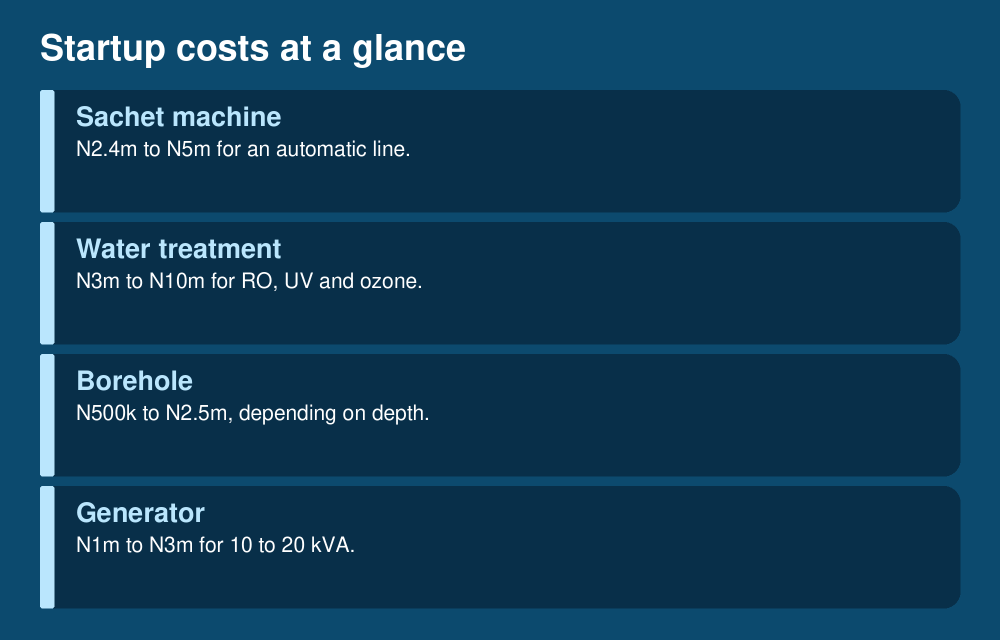
- Automatic sachet filling and sealing machine: N2.4 million to N5 million (entry-level machines are cheaper, and the popular 1,000 to 2,200 sachets an hour class sits around N2.4 million to N2.8 million)
- Water treatment (reverse osmosis, UV and ozone): N3 million to N10 million
- Borehole: N500,000 to N2.5 million, depending on depth and location
- Generator (10 to 20 kVA): N1 million to N3 million
- Factory rent and fit-out: N2 million to N10 million
- CAC, NAFDAC and permits: N150,000 to N800,000
- Nylon and working capital to start: N1 million to N3 million
Get at least three written quotes before you commit, ask for the machine’s actual output per hour and a warranty, and remember that many of these figures were set when the naira was weaker than today. One supplier says its prices are converted at N1,580 to the dollar.
The equipment you need
The NAFDAC guidelines for packaged water plants are about hygiene and control as much as machines. Your factory will need:
- A safe water source: usually a borehole with a pump and a storage tank. Test the water before you buy treatment equipment, because groundwater chemistry differs from one site to the next.
- A treatment train: typically sand or multi-media filtration, carbon filtration, a cartridge filter, reverse osmosis, then UV and ozone disinfection.
- An automatic form-fill-seal machine that makes the sachet from a roll of film, fills, seals, prints the batch details and cuts.
- A bagging station to pack 20 sachets into a bag.
- Power: a properly sized generator, plus a stabiliser and fuel storage. Power is one of the main costs, so ask installers about solar to cut diesel use, and read our guide to solar panel installation in Lagos for what systems cost.
- A clean production room with proper drainage, tiled surfaces and pest control, plus a place for staff to change and wash.
Legal requirements: CAC, TIN, trademark and NAFDAC
You cannot skip any of these. The NAFDAC guideline states that no packaged water may be produced, advertised, offered for sale or distributed in Nigeria unless it has been registered.
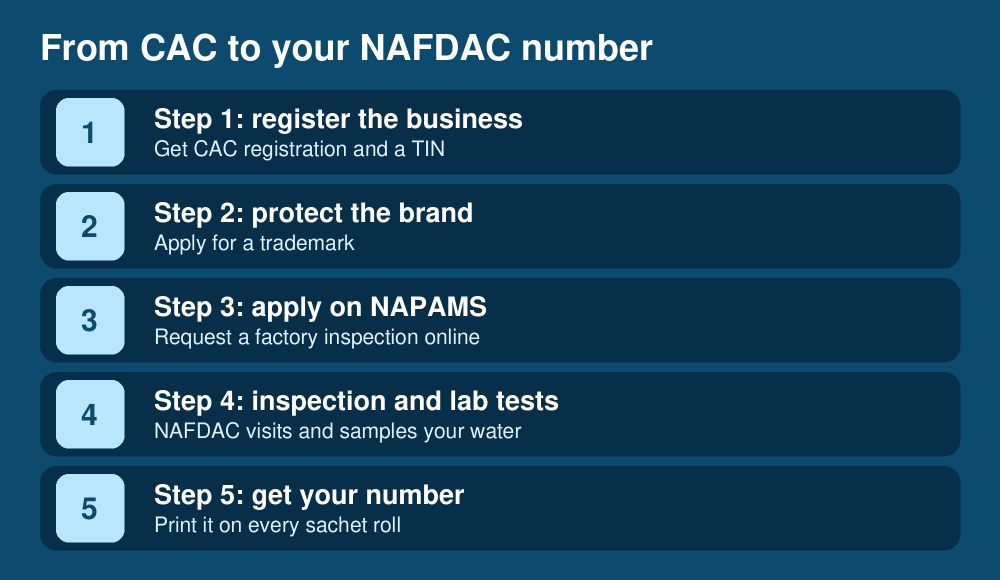
- Register the business. You need a registered business name or company at the Corporate Affairs Commission. See our step-by-step guide to registering a limited company with CAC, and get a tax number through our guide to getting a TIN.
- Protect your brand name. NAFDAC asks for evidence of trademark registration for the brand name.
- Apply on NAPAMS. The NAFDAC guideline says the application for a factory inspection is made online through the NAPAMS portal, with a letter giving the exact factory address (not a P.O. box). Documents include your label or artwork, proof of business registration, trademark evidence, the company organogram, a technical officer with at least an OND in a scientific subject, a certificate of analysis of the raw and treated water, and a current fumigation certificate for the factory, renewed every quarter.
- Staff medical certificates. Production staff need a food handler’s certificate covering sputum, hepatitis B, Widal, stool and urine tests.
- Pay through NAPAMS and Remita. The application is reviewed, a payment advice is generated on NAPAMS and you pay by Remita.
- Inspection and sampling. NAFDAC inspects the factory against good manufacturing practice, including the water source, treatment, sanitation and staff hygiene, and takes samples for laboratory testing.
- Registration. Once the inspection and lab results are satisfactory, the registration number is issued. NAFDAC’s guideline gives 60 working days from submission of samples to the registration number, if you comply fully. In practice, add the time for building the plant, getting documents and fixing any inspection findings, so plan for several months.
For the general process used for other products, our guide to NAFDAC registration for small food and cosmetic businesses is a useful companion, and our start a business in Nigeria hub links to the wider set-up guides.
What does NAFDAC registration for sachet water cost?
Be careful here, because published figures differ. NAFDAC’s published guideline for food and water lists sachet water registration at N30,000 plus 5% VAT, and its guideline for packaged water plants lists N10,000 each for production inspection and laboratory analysis of sachet water. Some 2026 guides quote N50,000 for packaged water registration. The only number that matters is the payment advice that NAFDAC generates for you on NAPAMS, so check that rather than paying a middleman, and add inspection, laboratory, medical test and fumigation costs. The guideline says the registration, once granted, is valid for five years.
Other approvals
Packaged water must meet the Nigerian Industrial Standard NIS 306:2008 set by the Standards Organisation of Nigeria (SON), and the label should carry the SON conformity (MANCAP) mark alongside the NAFDAC number. In Lagos, producers are also expected to comply with the Lagos State Water Regulatory Commission, which the Lagos table water producers’ association says it checks when it inspects neighbouring factories. Other states have their own water agencies and local council permits, so check yours before you drill.
Quality rules your water must meet
NIS 306:2008 covers quality, packaging and labelling. Published summaries give limits such as colour of 3 true colour units, turbidity of 5 NTU, fluoride of 1 mg/L, nitrate of 10 mg/L and a maximum pH of 8.5, with no E. coli or faecal coliform detectable in a 100 ml sample. The label must show the product name, brand, net volume, factory name and location, batch number, manufacture and best-before dates, and the NAFDAC registration number.
Quality is not a formality. A 2017 study of packaged water in Nnewi found lead above the guideline in 7 of 30 sachet samples and E. coli in 4 of 30, which is why NAFDAC has closed unregistered factories in the past and why the Lagos producers’ association runs sanitation and testing exercises. It is a small, older study, but it shows the risk. Test your water regularly and keep records.
A realistic profit example
Profit depends entirely on your own costs, so use this as a template and replace the numbers with your quotes. These are assumptions for illustration, not a forecast:
- Selling price: N500 a bag (the Lagos association price in October 2026)
- Your direct cost per bag, covering film, chemicals, fuel and labour: assume N420
- Margin: N80 a bag
- Output: 300 bags a day for 26 days, which is 7,800 bags a month
That gives a gross margin of about N624,000 a month (7,800 x N80), before rent, vehicle costs, loan repayments and equipment replacement. The sensitivity matters even more: every N20 rise or fall in your per-bag cost changes monthly margin by N156,000 (7,800 x N20). That is why a spike in nylon or diesel can wipe out a month’s profit. One 2026 guide estimates monthly running costs of N800,000 to over N2 million for a plant making 500 to 1,000 or more bags a day, covering fuel, consumables, staff, maintenance and transport.
Selling: where the bags go
Most producers sell by the bag or in bulk to shops, kiosks, vendors and event suppliers, and use their own delivery pickups or tricycles for regular routes. Join your state chapter of the Association of Table Water Producers of Nigeria (ATWAP) or the Hygienic Water Producers Association of Nigeria (HWAPAN). In Lagos the association coordinates the standard bag price, runs a ‘know your neighbour’ compliance check on nearby factories, and shares information on nylon and fuel prices. Price changes are decided state by state, so check what neighbouring producers charge before you set your price.
Main risks to plan for
- Input costs: film, diesel and chemicals can jump within weeks, and customers resist price rises.
- Power: unreliable electricity means fuel is a permanent cost.
- Unregistered competitors: backyard producers undercut registered ones, and an inspection can shut an unlicensed plant.
- Contamination: one bad batch can destroy your brand and your NAFDAC standing.
- Cash flow: distributors and shops may delay payment while you pay for film and fuel upfront.
A simple step-by-step plan
- Study the local market: who sells, at what price, and which brands are registered.
- Decide your scale and write a budget from real quotes.
- Register the business, get a TIN and apply for the trademark.
- Secure a proper site, test the water source and drill the borehole where the law allows.
- Buy and install the treatment train, machine, generator and tanks.
- Prepare documents, apply on NAPAMS and pass the inspection and lab tests.
- Order printed film that carries your NAFDAC number, batch and dates.
- Join the producers’ association and start with a small number of routes.
- Track cost per bag every week and adjust prices when inputs move.
FAQ
How much does it cost to start a pure water business in Nigeria in 2026?
Estimates range from about N1.5 million to N3.5 million for a very small operation to N10 million to N15 million for a one-line factory, and N20 million or more for a standard factory. The machine, water treatment, borehole and generator are the biggest items.
Do I need NAFDAC registration to sell pure water?
Yes. NAFDAC guidelines say no packaged water may be produced, advertised, sold or distributed without registration, and the registration number must appear on the label.
How much is NAFDAC registration for sachet water?
NAFDAC’s published guideline lists N30,000 plus 5% VAT for sachet water, and some 2026 guides quote N50,000. Inspection, laboratory and medical test fees are extra. Use the payment advice shown on the NAPAMS portal as the final figure.
How long does NAFDAC registration take?
The guideline gives 60 working days from submission of samples to the registration number, if you comply fully. Plan for several months overall, including documents and inspection.
How long is the NAFDAC certificate valid?
The guideline says registration is valid for five years. Renewal laboratory analysis is charged at 50% of the original rate.
Is the pure water business profitable?
It can be, but margins per bag are small and depend on nylon, diesel and volume. Work out your cost per bag carefully and treat any promise of quick riches with suspicion.
Can I run a pure water factory from my house?
NAFDAC inspects the factory against good manufacturing practice, including sanitation, drainage and pest control, and needs an exact address. A proper, dedicated production room is the safest route. Confirm with NAFDAC before you invest.
This article is general information and not financial, business or legal advice. Prices, fees and regulations change, so confirm current requirements with NAFDAC, SON, CAC and your state regulator before you spend money.
Sources
- NAFDAC: Guidelines for registration of food and water (manufactured)
- NAFDAC: Guidelines for inspection and requirements for packaged water facility in Nigeria
- NAFDAC: Guidelines for establishment of packaged water plant
- The Guardian Nigeria: Households lament as sachet water hits N500 per bag in Lagos (October 2026)
- Peoples Gazette: Price hike hits pure water in Lagos, Kano, Kwara, Oyo and others (April 2026)
- Nigeria World: Pure water producers announce increment in price of bag (Kano, March 2026)
- Legit.ng: Lagos pure water producers speak on 3-day shutdown (October 2026)
- Leadership: Nigeria’s cost of living crisis, 10 things that have become more expensive (November 2026)
- ZR Machine: How to start a sachet water business in Nigeria, 2026 guide (supplier source)
- Allenvest: How to start a pure water business in Nigeria (2026)
- Naijasabi: How to start a sachet water production business in Nigeria (2026)
- EB Consults: NAFDAC registration in Nigeria, step by step
- International Journal of Community Medicine and Public Health: Quality of sachet and bottled water in Nnewi (2017)
- P.M. Express: Pure water safety in Nigeria (November 2026)
Join the discussion
Have you tried this, or do you have a question we did not answer? 1 reader has already shared their view. Naijatipsland members help each other with real, first-hand experience.







Editor’s note: this guide is general information, not financial or legal advice. Equipment and startup costs come from supplier and press sources and vary widely by location, so get written quotes. Confirm NAFDAC fees and requirements on the NAPAMS portal before you pay anyone. – Ade