
How to Spot Fake Job Ads in Nigeria (2026): Red Flags and Where to Find Verified Vacancies

Last updated: 16 October 2026 · By Naijatipsland Editorial Team · Editorial policy
Job hunting in Nigeria has a second market running beside the real one: fake adverts that look like vacancies, ask for a small fee and then vanish. The scammers copy the names and logos of real employers, build lookalike portals and spread their messages on WhatsApp, Telegram and Facebook, where one forward can reach thousands of people. Government agencies have had to deny fake recruitment drives again and again in 2026. This guide shows you the red flags, how genuine government recruitment works, a quick routine for checking any advert, where verified vacancies are advertised, and what to do if you have already paid.
The warnings and procedures here come from official statements and news reports dated 2025 and 2026, plus advice published by job boards. Official websites and agency procedures change, so confirm an advert on the employer’s own verified channels before you pay or share documents. This is general information, not legal advice.
The short answer
- Do not pay to get a job. Jobberman’s rule is blunt: do not pay to get a job. The Federal Civil Service Commission (FCSC) warned on 21 August 2026 against anyone demanding money for recruitment forms, shortlisting, appointment letters or help securing a federal post.
- Check the channel, not the logo. The FCSC said that using its name, logo or branding does not make a message genuine.
- Government jobs have official portals. Federal civil service recruitment runs through the FCSC portal, and the Civil Defence, Correctional, Fire and Immigration Services Board (CDCFIB) runs recruitment for the security services. There are no private agents or middlemen in the process.
- A job offer without an interview, a free email address or a Telegram-only contact is a warning sign. Two or more red flags together mean walk away.
- If you have paid, stop sending money, keep proof, tell your bank and report to the Economic and Financial Crimes Commission (EFCC) or the police the same day.
Why fake job ads work
They work because the need is real and the price looks small. A BusinessDay commentary from May 2025 describes recruitment fraud as a multi-million-naira business and says reported fees range from N5,000 to N500,000 for things like processing, training, onboarding or medical tests. It lists three common patterns: fake job portals and social media ads promising high pay for few requirements; upfront payment scams; and impersonation of HR staff at well-known firms or of officials offering government slots. The same piece says some scammers stage fake interviews or rent offices to look real, and that some victims resign from real jobs before they discover the fraud. It cites an EFCC case in which a fraudster posing as a State House staff member allegedly took N22 million from job seekers.
The pressure is the point. Scammers want you to act before you think: a slot closes today, the fee is refundable, the interview is tomorrow. Jobberman’s advice applies here: do not let desperation drive your decisions, and tell a parent, guardian or friend where you are going for any interview.
Red flags that should stop you
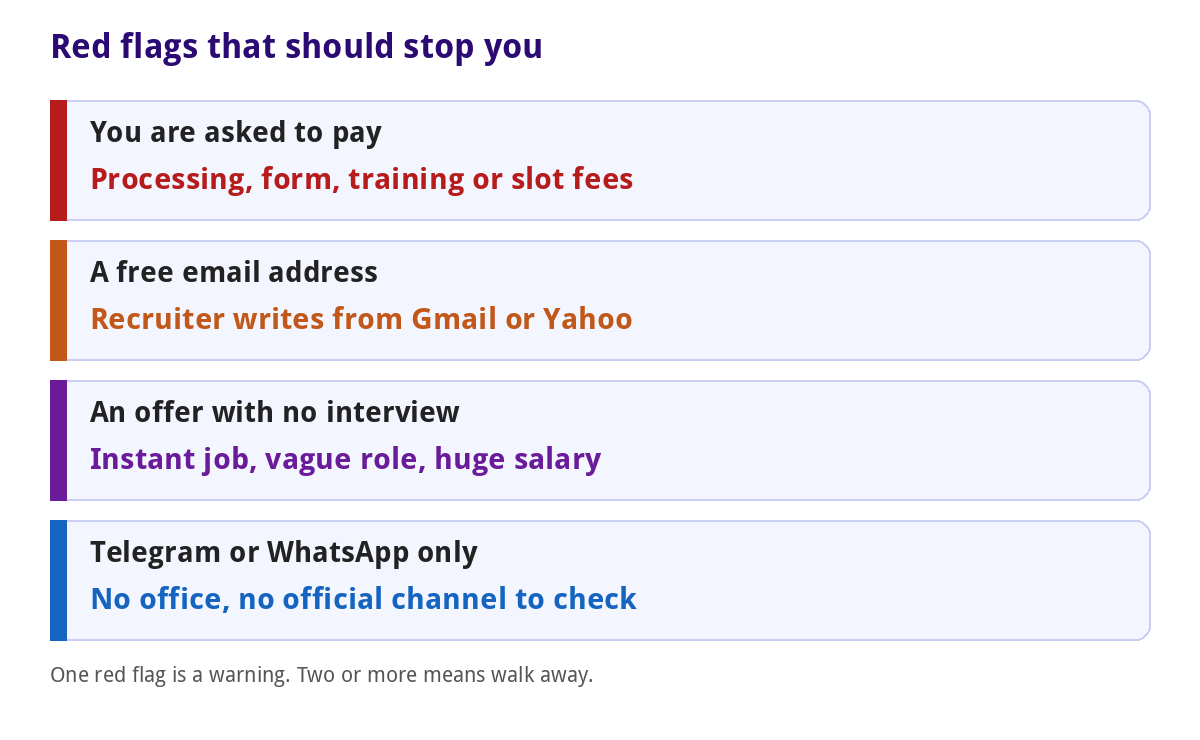
Putting together the advice from Jobberman, MyJobMag and BusinessDay, the main warning signs are:
- Any fee. Processing, registration, consultancy, training, uniform, medical or slot fees are all common labels for the same scam.
- A free email address. A recruiter from a real company usually writes from a company domain. Jobberman lists Yahoo and Gmail addresses as a flag, while noting that a small employer may still use one, so look at the other signs too.
- Offers with no interview. Instant employment, or a job briefing for a role you never applied for, or an invitation that refers to credentials or tests you never submitted.
- Vague adverts. No job title, no clear location, no company description, or experience requirements that span an absurd range such as 2 to 15 years.
- A strange venue. Interviews in unmarked buildings, hotel lobbies or outside an office, or at an address that does not match the company’s official one.
- SMS-only invitations. Jobberman notes that genuine employers usually combine a call, an email and a text. A detailed SMS that names the company and gives a contact number is the exception.
- Telegram, WhatsApp or private chat as the main channel. Africa Check flagged a fake ministry advert that told applicants to confirm on Telegram and to email a Gmail address.
- Salary that is too good. Very high pay for little experience is a classic hook.
- No trace online. No website, no LinkedIn page and no news coverage. Jobberman cautions that a few real firms have a thin web presence, so use this flag with the others, not alone.
How genuine government recruitment works
Many of the fakes use government names, so it helps to know the real process.
Federal civil service
In its 21 August 2026 statement, the FCSC said recruitment is regulated under the Public Service Rules. Appointments to grade levels 07 to 17 follow adverts in three national newspapers and on the FCSC website, with a stated closing date. Online applications must go through the designated portal, reached only through links in official FCSC announcements. The commission said genuine federal civil service recruitment is never conducted through private agents or middlemen, and warned that no officer can be appointed without an authorised establishment and the required waiver where applicable. It also warned that false declarations or forged certificates lead to disqualification.
Security and paramilitary services
The Nigeria Immigration Service said on 3 February 2026 that it was not running its own recruitment, and that any portal, link or advert outside the CDCFIB process should be disregarded. The CDCFIB portal named in that warning is recruitment.cdcfib.gov.ng. In July 2026 the Nigeria Customs Service called a viral recruitment announcement fake and said people should rely on its verified social media accounts.
Other agencies that have denied fake drives
The EFCC has denied claims of a secret recruitment, and NSITF and the Federal Airports Authority of Nigeria (FAAN) have also warned job seekers about fake recruitment. In April 2025 the Ministry of Foreign Affairs disclaimed an advert for posts in the ministry, saying it does not recruit directly and does not solicit or accept payment for applications or appointments, and pointed to the FCSC portal as the only route.
The pattern is the same each time: the agency posts a denial on its official site or social media account, and the scam spreads faster than the denial. If a message says an agency is recruiting, look on that agency’s own verified accounts and on the FCSC and CDCFIB portals before you do anything else.
A ten-minute check for any advert
- Find the employer yourself. Search for the company, open its official website and look for the same vacancy on its careers page. Do not use the link in the message.
- Check the sender. Does the email domain match the company website? Call the company’s published number, not the one in the advert.
- Look for the job on two independent channels. A real vacancy normally appears on the employer’s site, its verified LinkedIn page or an established job board.
- Check the address. Match the interview venue to the company’s official address, and tell someone you trust where you are going.
- Read what you are asked to pay. Any fee for being hired is a stop sign. A fee for a regulated exam or licence is a different thing; confirm it on the regulator’s official page, and never pay a person who says they can fix the result.
- Protect your documents. Send a CV, not your BVN, NIN, bank login or ID scans, until you have a verified offer and a reason. See how to check your BVN and how to keep your NIN and BVN safe.
- Wait. Real jobs survive a day of checking. Scams cannot.
Where to find verified vacancies
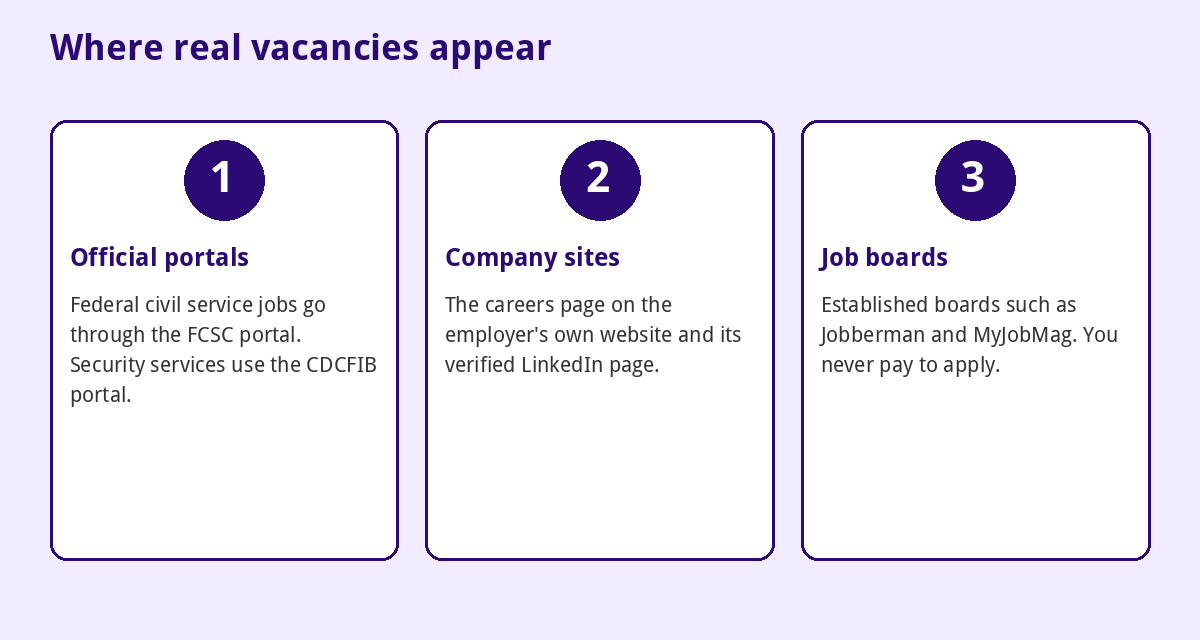
- Official portals. For federal civil service jobs, use the FCSC recruitment portal. For the security services, use the CDCFIB portal.
- Employer websites. The careers page of the company is the strongest proof that a vacancy exists. Save the page address.
- LinkedIn and established job boards. Boards such as Jobberman and MyJobMag publish advice on spotting scams and screen listings, but no board catches everything, so run the check above even on a listed job.
- Professional bodies and alumni networks. Many roles are filled through referrals; a message from a named person you can verify is safer than a forwarded broadcast.
Once you find a real vacancy, a strong application matters. Our guides to writing a CV for Nigerian jobs, job interview tips for young Nigerian adults, common interview questions and essential career tips cover the rest.
Fake jobs abroad
Offers of work in the Gulf, Europe or North America are a separate risk because the victim can lose both money and time. A genuine overseas employer or sponsor does not ask you to buy a visa from a stranger, send money to a personal account or travel on a tourist visa to work. Check what the destination really requires: for example, the UAE needs a visa that is approved before travel, as explained in our Dubai visa guide, and a tourist visa does not allow work. For general visa types see types of visas for Nigerians and the UK Skilled Worker visa guide, and compare any offer against what the official immigration site says.
If you have been scammed
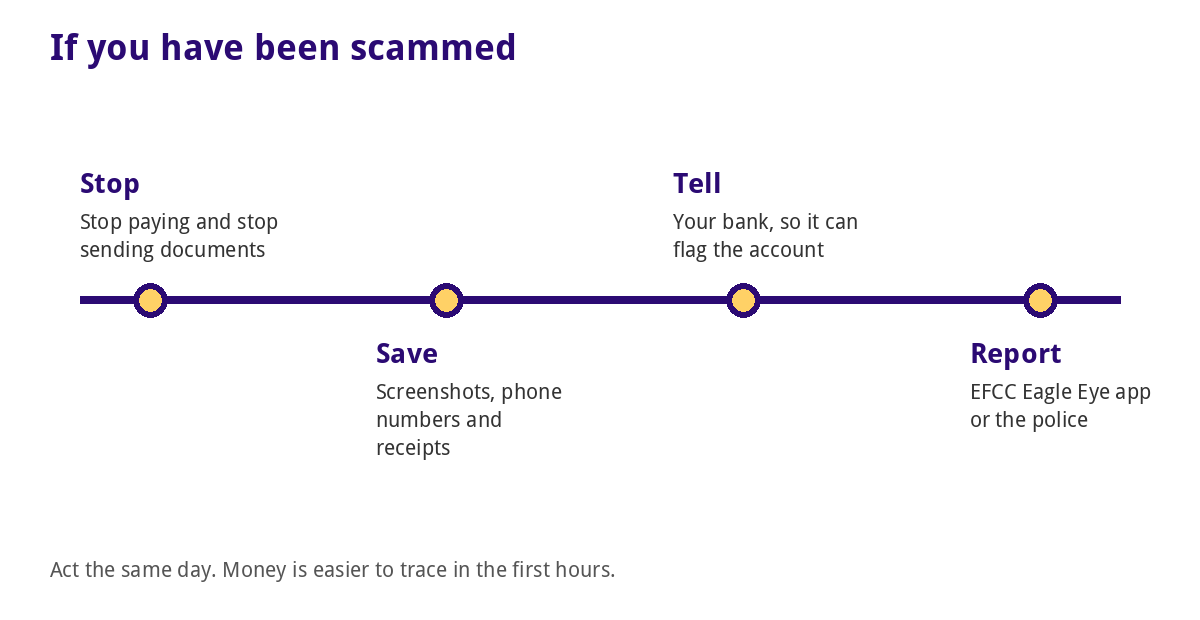
- Stop. Do not send more money, even a small amount to get your first payment back. That is a second trap.
- Save evidence. Screenshots of the advert, chats, receipts, account numbers, phone numbers and website addresses.
- Tell your bank or payment app right away. Ask it to flag or restrict the receiving account. See how to recover money sent to the wrong account and how to block your ATM card or bank account.
- Report. The EFCC launched its Eagle Eye mobile app in 2021 for reporting economic and financial crimes. It is available on Google Play and the Apple App Store and, according to the EFCC, guarantees anonymity. You can also report to the police and to the job board that carried the advert. If a fake page is using a government agency’s name, tell the agency through its verified accounts.
- Warn others. Share the scam in your groups and with the job board. A fake advert that gets exposed stops working.
Do not be ashamed. These scams are built to catch smart, hardworking people at a stressful time. For wider protection, read how to avoid internet scams in Nigeria and common WhatsApp scams in Nigeria.
Frequently asked questions
Do genuine employers charge for application or training?
Genuine employers and government recruiters say they do not charge. The FCSC warns against paying for forms, shortlisting or letters, and the Ministry of Foreign Affairs says it never accepts payment for applications. Jobberman’s rule is not to pay to get a job.
Is a Gmail address always a scam?
No, but it is a flag. Small businesses may use one. Look at the whole picture: fees, interview, venue and online presence.
How do I know a government recruitment is real?
Look for the advert on the agency’s own official site and on the FCSC or CDCFIB portal, with a closing date, and never use a link from a forwarded message.
Can someone get me a government job for a fee?
The FCSC says genuine recruitment is never conducted through private agents or middlemen. Anyone claiming to influence shortlisting for money is a red flag.
Where can I report a fake job advert?
Report to the EFCC, for example through its Eagle Eye app, to the police, and to the job board or platform that hosted the advert.
Is a job on Jobberman or LinkedIn always safe?
No. Job boards screen listings but cannot catch every fake, so verify the employer yourself.
Bottom line
Never pay to be hired, and never trust a logo, a forwarded message or a Telegram contact. Check the vacancy on the employer’s own site or the FCSC and CDCFIB portals, match the email domain, venue and phone number to what is published, keep your documents back until the offer is verified, and report any fake the same day.
Sources
- Nairametrics: FCSC warns Nigerians against fake recruitment messages and fraudulent links (21 August 2026)
- NAN: Nigeria Immigration Service warns public against fake recruitment websites (February 2026)
- Legit.ng: Nigeria Customs Service warning over viral recruitment message (July 2026)
- Africa Check: Beware of red flags in bogus job adverts for diplomatic posts (May 2025)
- Ministry of Foreign Affairs disclaimer of fake recruitment
- BusinessDay (opinion): The rise of recruitment fraud in Nigeria (May 2025)
- Jobberman: Fastest ways to identify fake jobs in Nigeria
- Voice of Nigeria: EFCC launches Eagle Eye app for reporting financial crimes
- Legit.ng: EFCC warns public over fake claims of secret recruitment
Related: Recruitment scams in Nigeria: red flags and how to report
Join the discussion
Have you tried this, or do you have a question we did not answer? 2 readers have already shared their views. Naijatipsland members help each other with real, first-hand experience.





The FCSC’s point is the one to remember: its name or logo on a message doesn’t make it genuine. Federal recruitment goes through its portal, never through agents. Have you received a fake government job offer recently, and what gave it away?
The cruellest part of these scams is that some victims resign from real jobs before they find out. If you’ve been targeted, did you report it to the EFCC or the police, and did anything come of it?