Last updated: 13 October 2026. Labour data change, and the latest Nigerian unemployment figures we could verify are from the first quarter of 2024. We removed unsourced claims from an earlier version.
Every year brings new lists of “hot skills”, and most of them are too vague to act on. The useful question is narrower: which skills will keep you employable, and how do you build them while you are already working or job hunting? This guide uses the World Economic Forum’s Future of Jobs Report 2025 and Nigerian labour data to answer it.
The big picture
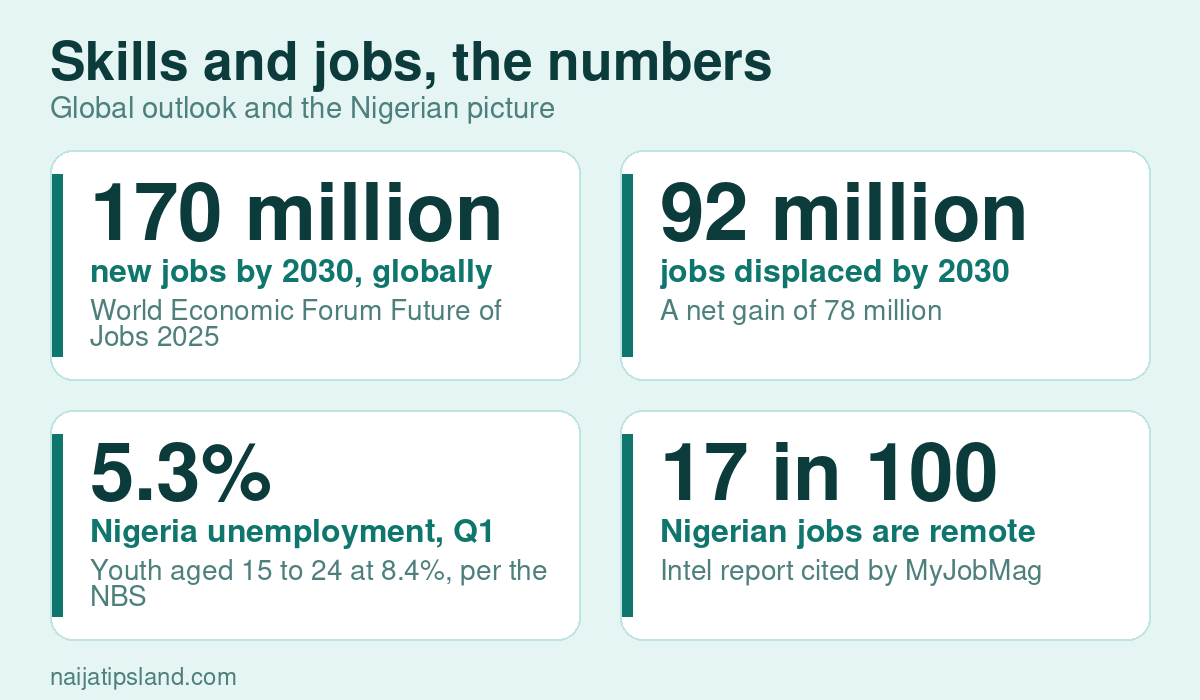
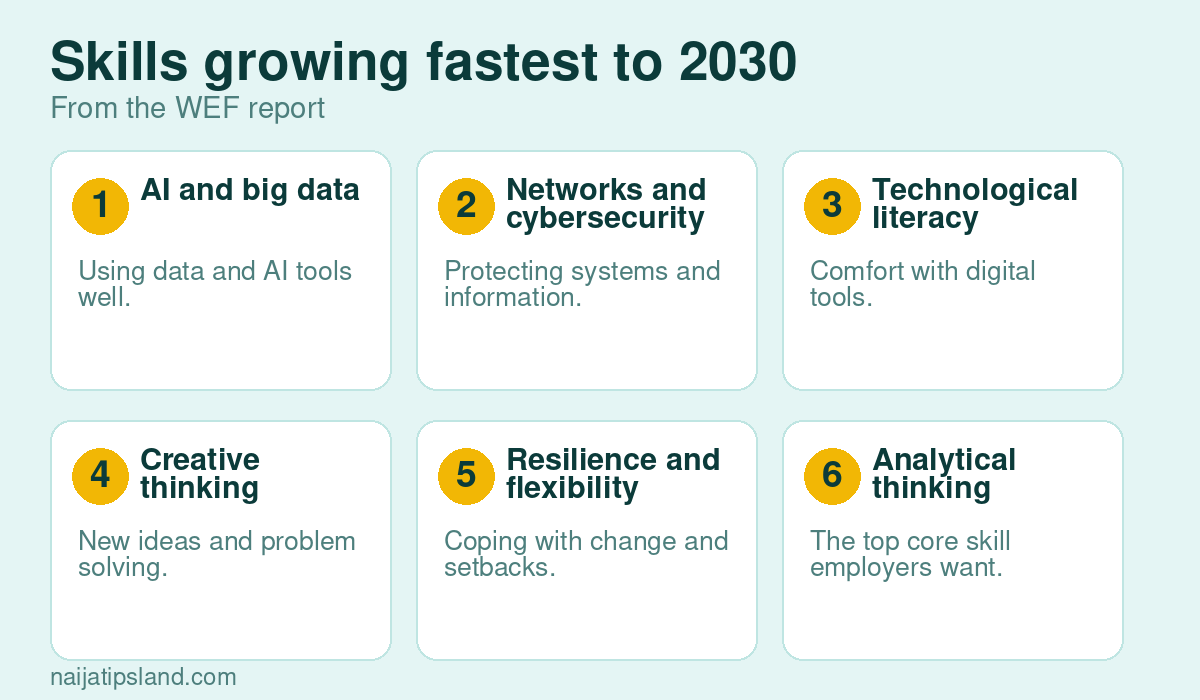
The WEF report, based on a survey of more than 1,000 employers in 55 economies, expects 170 million new jobs to be created globally by 2030 and 92 million to be displaced, a net gain of 78 million. It describes the real challenge as disruption of skills rather than the disappearance of work: it estimates that about 22% of jobs will be disrupted. Employers said technology skills in AI and big data, networks and cybersecurity, and technological literacy will grow fastest, while human skills such as analytical thinking, resilience, flexibility, leadership and creative thinking remain essential. Analytical thinking is the top core skill.
What it looks like in Nigeria
The NBS reported unemployment of 5.3% in the first quarter of 2024, with 8.4% among those aged 15 to 24 and time-related underemployment of 10.6%. Under the NBS definition, someone who does an hour of paid work in the survey week counts as employed, so the headline figure hides how many people are underemployed or in informal work. Research group NESG has pointed to a mismatch between what graduates learn and what industry needs. At the same time, ICT contributes a large and growing share of GDP, and the Intel workplace report cited by MyJobMag says about 17 in 100 Nigerian jobs are remote, which opens markets beyond your city. Government programmes also push skills: the 3 Million Technical Talent programme aims to train three million Nigerians, and the National AI Strategy aims for 70% of the youth workforce to have foundational AI skills. See our guide on responsible AI adoption.
Skills worth building
- Data and AI literacy: reading data, spreadsheets and dashboards, and using AI tools carefully for drafting, research and analysis while checking results.
- Cybersecurity awareness: every office needs people who spot phishing and handle data responsibly. See our guides on cyber security and data privacy.
- Digital tools: collaboration software, online meetings, payments and basic design or editing. Use our digital skills checklist.
- Analytical thinking and problem solving: breaking a problem into parts, weighing evidence and making a clear recommendation.
- Communication: clear writing, speaking and listening. See our guide to communication skills.
- Money and sales skills: pricing, negotiating, bookkeeping and customer service help in jobs and in business.
- Learning agility: the habit of picking up a new tool or method quickly.
How to build them without a big budget
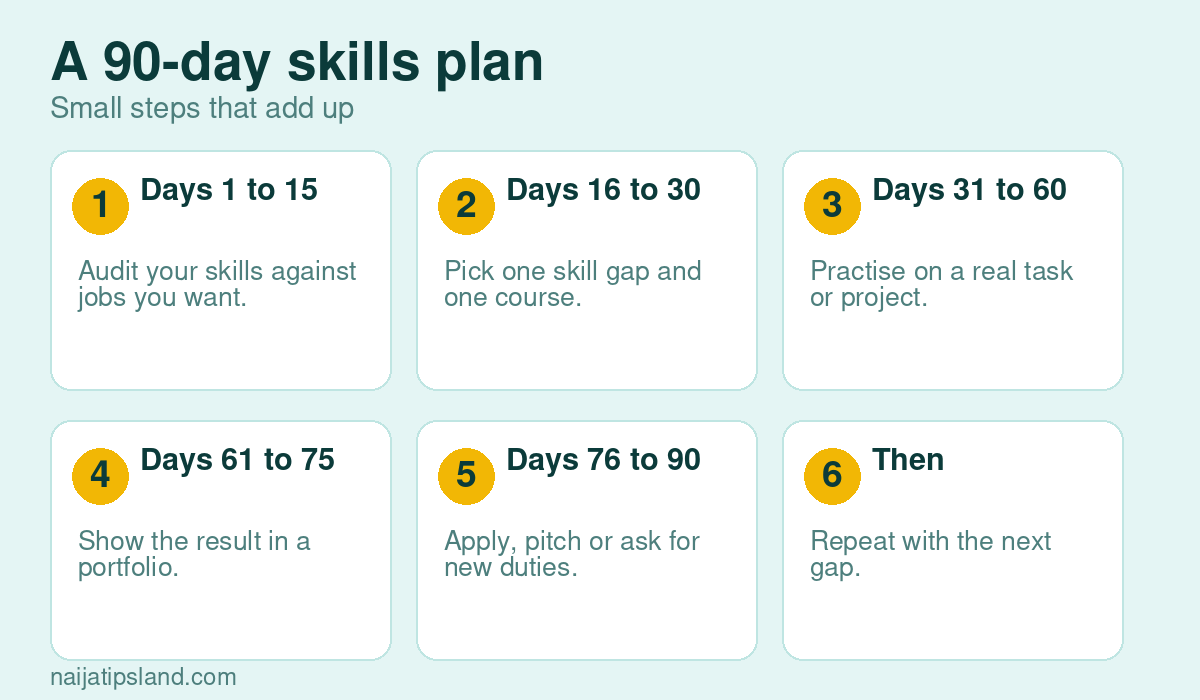
- Start from a target job. Read ten job adverts for the role you want and list the skills that repeat.
- Choose one gap at a time. A narrow skill learned properly beats five half-learned ones.
- Learn by doing. Use free courses and tutorials, then apply them to a real task at work or a small project.
- Keep proof. Save samples, dashboards, write-ups or certificates in a portfolio, and put the results on your CV. See our CV writing guide.
- Check certificates before you pay. Make sure a course is recognised by employers in your field.
Using skills to get hired
Show results, not just titles: what you improved, saved or built. Prepare examples for the interview, and read our guides on interview tips, common interview questions and the interview checklist. If you want to earn from your skills online, see how to earn money online.
Mistakes to avoid
- Paying for expensive courses that promise jobs.
- Collecting certificates without applying the skill.
- Ignoring basics such as writing and punctuality while chasing advanced tech.
- Waiting to feel ready before applying.
Skills by Career Stage
- Students and fresh graduates: focus on writing, spreadsheets, presentation, basic data skills and one practical skill such as design, coding or sales. Do internships and volunteer projects to get proof.
- Early-career professionals: deepen one technical or functional skill, learn to manage your time and projects, and ask for stretch assignments.
- Mid-career professionals: add leadership, negotiation, budgeting and data-driven decision making, and learn how AI tools change your field.
- Career changers: map the skills you already have to the new field, fill the biggest gap with a short course and a project, and use your network.
Proving a Skill in an Interview
Employers believe stories with evidence. Use a simple structure: the situation, the task you had, the action you took and the result. For example: “Our monthly report took two days to compile, so I built a spreadsheet template and a simple dashboard, which cut the time to three hours and reduced errors.” Prepare three such stories before an interview.
Types of Learning Resources
- Free online courses and tutorials, good for basics and for trying a field before you commit.
- Government and donor programmes, such as national tech talent and digital literacy initiatives, which may offer stipends or devices.
- Employer training, which you can ask for in your appraisal.
- Communities and mentors, where people review your work and share openings.
- Paid bootcamps and certifications, worth it only if employers in your field recognise them and you can check graduates’ outcomes.
Frequently Asked Questions
What skills are most in demand in Nigeria?
Digital and data skills, cybersecurity, sales, finance and strong communication are in demand, according to employer surveys and policy priorities. Check job adverts in your sector for specifics.
Will AI take my job?
Some tasks will change, and the WEF expects both job creation and displacement. Workers who learn to use the new tools and keep strong human skills are better placed.
Do I need a degree?
Many employers still ask for one, but skills, portfolios and experience matter more in technical and freelance work.
How long does it take to learn a new skill?
Basic competence can take weeks of steady practice, and real proficiency takes months.
Sources
- World Economic Forum: Future of Jobs Report 2025 press release
- NAN: Nigeria’s unemployment rate increased to 5.3% in Q1 2024
- MyJobMag: Remote work statistics 2026
Join the discussion
Have you tried this, or do you have a question we did not answer? Be the first to share your experience. Leave a comment below. Every comment is read by the editor before it appears.