
Pound to Naira Today (November 2026): Official vs Parallel Rate and the Best Time to Send

Last updated 15 November 2026. Exchange rates change every day and sometimes every hour. The figures below are reported rates from the dates shown, so treat them as a guide and check live numbers before you send money.
If you send money home from the UK, the number that matters is simple: how many naira does one pound buy today, and which rate are you actually getting? The answer is awkward, because there are two prices for the pound in Nigeria, an official one and a street one, and they sit a fair distance apart. This guide lays out where both stood in mid-November 2026, why they differ, what the Central Bank of Nigeria (CBN) changed this year for diaspora transfers, and how to get the most naira out of every pound without taking silly risks.
Pound to naira this week: the numbers
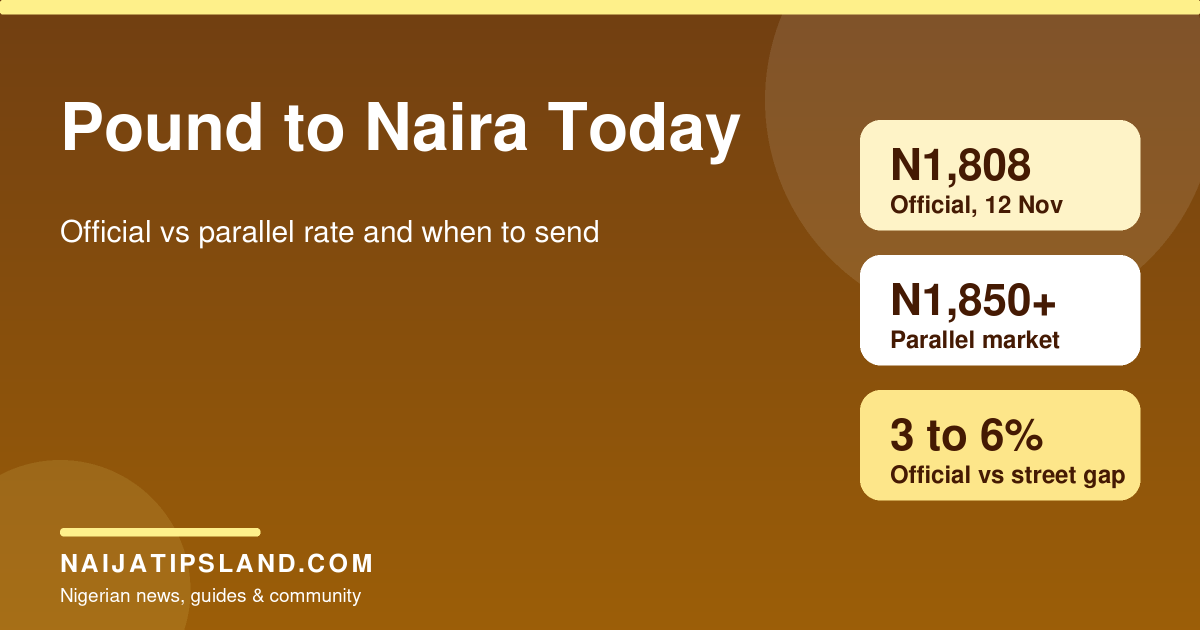
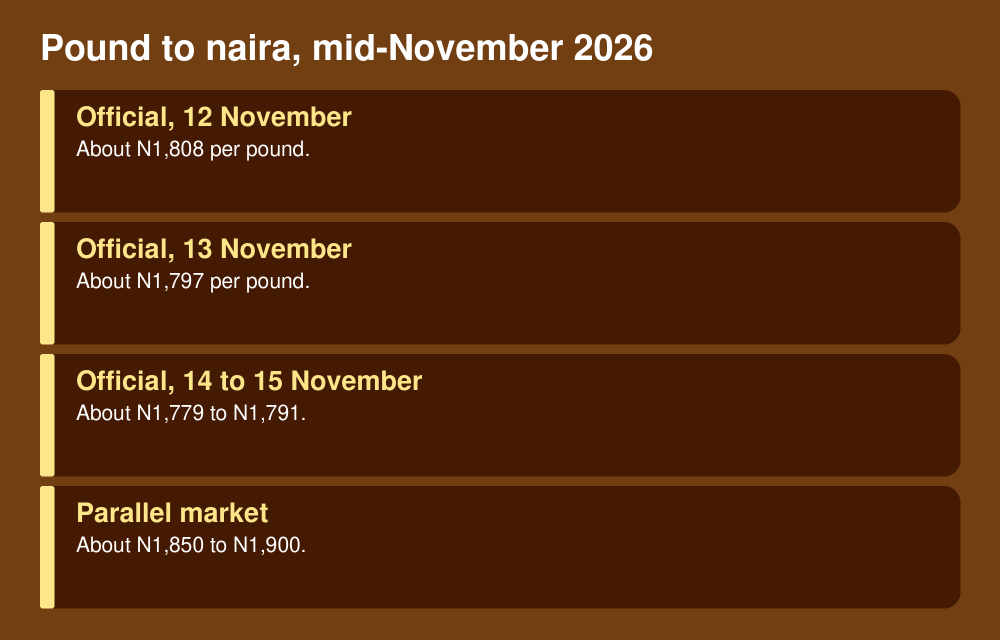
The official market is the Nigerian Foreign Exchange Market (NFEM). On 12 November 2026, Nairametrics reported the NFEM rate at ₦1,808.30 to the pound. CBN-published figures carried by Gatekeepers News that day listed the pound at about ₦1,807 to ₦1,808. By 13 November the CBN table showed roughly ₦1,797, and WithinNigeria put the official pound at ₦1,791.44 on 14 November. A table dated 15 November listed about ₦1,779 to ₦1,780.
The month so far has been a narrow range. Nairametrics said GBP/NGN began November around ₦1,802, touched an intraday high near ₦1,814 on 4 November, then settled back to roughly ₦1,783 to ₦1,788 before the 12 November bounce. So the official pound has drifted by about 2 per cent inside two weeks, which is small compared with the swings of earlier years.
On the street, dealers were quoting the pound at roughly ₦1,850 to ₦1,900 in the same week. Nairametrics put the parallel range at ₦1,870 to ₦1,900 on 12 November, and Gatekeepers News listed ₦1,851 to ₦1,895 on 15 November. Exact prices depend on the city, the dealer and the size of the deal.
Put the two side by side and the street rate is about ₦60 to ₦115 above the official one, which is roughly 3 to 6 per cent. That gap is the whole story behind most arguments about which rate to use.
Why the official and parallel rates are not the same
In simple terms, the parallel market is where people buy foreign cash with naira outside the banks, and it reacts fast to demand. The fourth quarter is a busy time. Nairametrics linked the current pressure to seasonal demand for foreign currency, with festive December flows still to come. School fees, travel, import orders and people topping up family accounts all push demand up at once.
The official market is tied to banks and licensed dealers, moves more smoothly and has narrowed the gap a lot compared with the extremes of a few years ago. A gap of 3 to 6 per cent is far smaller than the spreads Nigerians used to see, but it is still large enough that people notice it on a £1,000 transfer. At ₦1,790 the pound gives ₦1,790,000 on that amount, while at ₦1,870 it would be ₦1,870,000, a difference of ₦80,000 on paper. We will come to why that paper difference rarely reaches your family.
For the same story told in dollars, see our dollar to naira exchange rate guide and the weekly dollar to naira rate tracker.
What the CBN’s new remittance rules mean for you
This is the part many senders have not caught up with. On 24 March 2026 the CBN issued a circular titled Measures to Further Deepen Diaspora Remittances and Compliance, effective 1 May 2026. In plain language, it says the following:
- Licensed international money transfer operators (IMTOs) must open naira settlement accounts with authorised dealer banks in Nigeria and route all their transactions, including payouts to recipients, through those accounts.
- Those accounts can only be credited with remittance flows and with the proceeds of foreign exchange conversions made with authorised participants in the NFEM.
- IMTOs must use real-time market prices from Bloomberg’s BMATCH platform as guidance when pricing transactions.
- Media reports of the circular, including from AllAfrica and Prime Business Africa, describe the effect as naira-only payouts to recipients from May 2026.
What it means for you: when you send pounds through a licensed provider, your family receives naira, and the rate behind that payout is anchored to the official market. It is not the street rate. That is why a transfer app quoting you near ₦1,780 and a dealer in Lagos quoting ₦1,880 are not really competing offers. They are different markets with different rules.
Read the circular itself on the CBN website if you want the exact wording.
Which rate will your family actually get?
If you use an FCA-authorised app that pays out through a CBN-licensed operator, the answer is an official-linked rate, minus the provider’s margin and fee. The margin is the part people miss. A flat fee of £3 or £4 looks small, but a 2 to 3 per cent margin hidden in the exchange rate costs £10 to £15 on a £500 transfer.
Here is a real snapshot of how much that matters. A comparison site, Ratecurb, recorded these quotes for sending £1,000 from the UK to Nigeria on 8 November 2026:
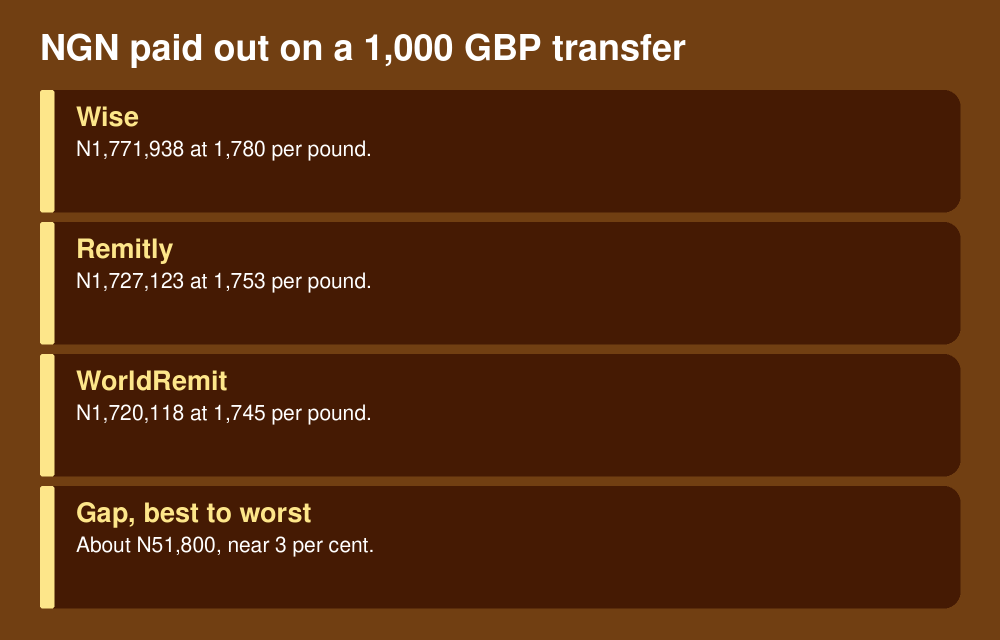
The best and worst of the three differ by about ₦51,800, or close to 3 per cent. These are one-day quotes from a third-party site, so do not treat them as a recommendation. Providers change their prices daily, run first-transfer offers and charge different fees at different amounts. The lesson is to compare in the same minute, not to memorise a winner.
Our guide to sending money to Nigeria safely covers limits, recipient checks and common problems in more detail.
Best time to send money from the UK to Nigeria
Everyone asks this, so here is the honest answer. Nobody can reliably time the pound against the naira for ordinary family transfers. Some sources suggest Tuesday to Thursday, when markets are most liquid, and that is a sensible habit. Others, like AfroTools, warn that chasing small moves usually costs more in stress than it saves. A few practical points do hold up:
- Avoid weekends for the rate. The NFEM does not trade on Saturday and Sunday, so providers are pricing off Friday’s market until Monday. Some also widen their margins when the market is closed.
- Watch the cut-off. One comparison site notes that transfers started after about 4pm UK time are usually processed the next business morning. Nigerian banks work Monday to Friday, so a Friday afternoon bank transfer can sit until Monday.
- Use a rate alert if you are not in a hurry. Wise, Remitly and other apps let you set a target rate and notify you when it is hit.
- Send in fewer, larger transfers if fees are flat. A £4 fee is a bigger share of £50 than of £500. Do not do this if it means holding cash you need to send urgently.
- Be careful around December. Demand for foreign currency is higher at the end of the year, and Nairametrics expects parallel premiums to stay under festive pressure. If you are paying school fees or rent that falls due in January, don’t leave the transfer to the last week.
How to get more naira per pound: five steps
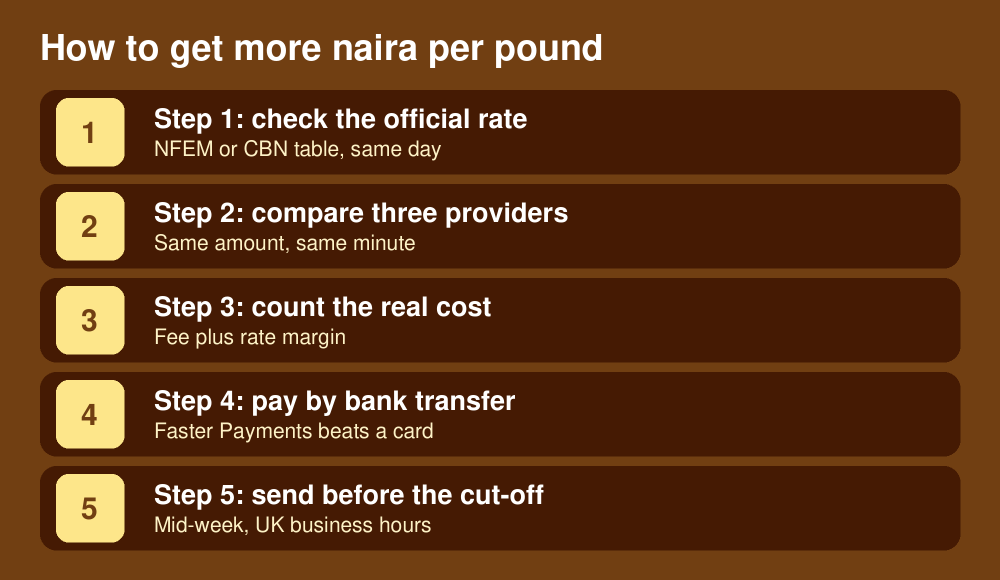
In practice that looks like this. First, look up the official rate for the day on a news site that quotes the NFEM or the CBN table, so you know what a fair number looks like. Second, put the same amount into at least three apps, ideally Wise, Remitly, WorldRemit, Sendwave or LemFi, whichever you trust. Third, ignore the headline fee and look at the final naira figure the recipient gets. Fourth, pay by UK bank transfer rather than card where the app offers it, because card payments tend to carry higher fees. Fifth, check the recipient’s name and account number twice, and send before the cut-off.
If you are comparing options for going the other way, the cheapest ways to send money abroad from Nigeria explains the outbound rules.
Warning signs to watch for
- A rate that is far above everyone else’s. If one app shows ₦1,900 when the market is near ₦1,790, ask what you are not being told, such as a delayed payout, a hidden fee or a promotional rate that expires.
- Informal arrangements. Handing pounds to a stranger in the UK who promises to pay your family in Lagos offers you no recourse if it goes wrong, and it may raise anti-money-laundering problems for you.
- Pressure to send now. Genuine providers do not need you to rush. Scammers do.
- Unlicensed providers. In the UK, check that a firm appears on the FCA register. In Nigeria, the CBN publishes the list of licensed IMTOs.
Some newer apps advertise rates close to the street price. They may be perfectly legitimate, but this is exactly where you should read the terms, confirm how the payout is made and keep records of every transfer. If something about a quote seems too good, test it with a small amount first.
The short version
In mid-November 2026 the official pound sat around ₦1,780 to ₦1,808 and the street price around ₦1,850 to ₦1,900. A licensed transfer pays out in naira at an official-linked rate, so the street figure is a reference point, not an offer. What you can control is the provider, the fee, the margin and the day you send. Compare every time, avoid weekends and Friday afternoons for bank deliveries, and keep your records.
This article is general information and not financial advice. Rates and fees change constantly and vary by provider, amount and payment method.
Frequently asked questions
What is the pound to naira rate today?
It changes daily. In the week to 15 November 2026 the official NFEM rate was reported between about ₦1,779 and ₦1,808 per pound, and parallel quotes ran from about ₦1,850 to ₦1,900. Check a live source before you send.
Why is the parallel market rate higher than the official rate?
Demand for foreign currency outside the banks is stronger, especially in the fourth quarter, so dealers charge a premium. The gap in mid-November 2026 was roughly 3 to 6 per cent.
Will my family get the black market rate if I use a transfer app?
Not through a licensed provider. Under the CBN circular effective 1 May 2026, operators route payouts through naira settlement accounts and price off official market data, so recipients get naira at an official-linked rate.
What is the best day to send money to Nigeria?
There is no guaranteed best day. Mid-week in UK business hours is a sensible default, while weekends and late Friday afternoons can delay bank payouts and give you less favourable pricing.
Which is cheapest, Wise, Remitly or WorldRemit?
It depends on the day, the amount and the delivery method. On one 8 November snapshot Wise paid out the most naira on £1,000, but that can change within hours, so compare before every transfer.
Can I send pounds as cash dollars to my family instead?
The CBN circular tells licensed operators to pay recipients in naira from May 2026. Ask your provider how it handles payouts, and never rely on informal cash arrangements.
Sources
- Nairametrics: Naira holds firm against British pound at N1,808/£ (12 November 2026)
- Gatekeepers News: Daily market update, 15 November 2026
- Gatekeepers News: Daily market update, 13 November 2026
- WithinNigeria: Dollar to naira today, 14 November 2026
- Central Bank of Nigeria: Measures to Further Deepen Diaspora Remittances and Compliance (circular, effective 1 May 2026)
- ThisDay: CBN directs IMTOs to open naira settlement accounts (26 March 2026)
- AllAfrica: CBN bans foreign currency payments for diaspora remittances from May 1
- Ratecurb: Send money from the UK to Nigeria, data summary of 8 November 2026
- AfroTools: Cheapest way to send money to Nigeria from the UK in 2026
Join the discussion
Have you tried this, or do you have a question we did not answer? 1 reader has already shared their view. Naijatipsland members help each other with real, first-hand experience.






Editor’s note: rates in this guide are reported figures from the dates shown and they move daily. Please check the live rate on your provider’s app before you send. This is general information, not financial advice. – Ade