Christmas in Nigeria means jollof, chicken, fried rice, moi moi and a full house, and every year families ask the same question in October and November: how much will it all cost this time? The good news for 2026 is that food prices have finally started to ease. Food inflation slowed to 19.59% in September 2026 and food prices actually fell month on month, according to the National Bureau of Statistics (NBS). The bad news is that December demand pushes prices up every year, and some items, especially tomatoes, egusi and vegetable oil, were still rising in September.
This guide sets out what the main Christmas food items cost in late 2026, what a basic Christmas Day meal for a family of five is likely to cost, how prices differ across the country, and how to buy early and save. For the bigger picture on household spending, see our guide to Nigeria’s cost of living in 2026.
Last updated: 21 October 2026. Prices below are averages and market quotes from September and early October 2026. They vary by market, city and quantity, and they usually rise in December. Use them as a budgeting guide, not a fixed price list.
The short answer
- A 50kg bag of rice averaged about ₦51,600 (Nigerian) and ₦54,300 (imported long grain) in September 2026, slightly cheaper than in August.
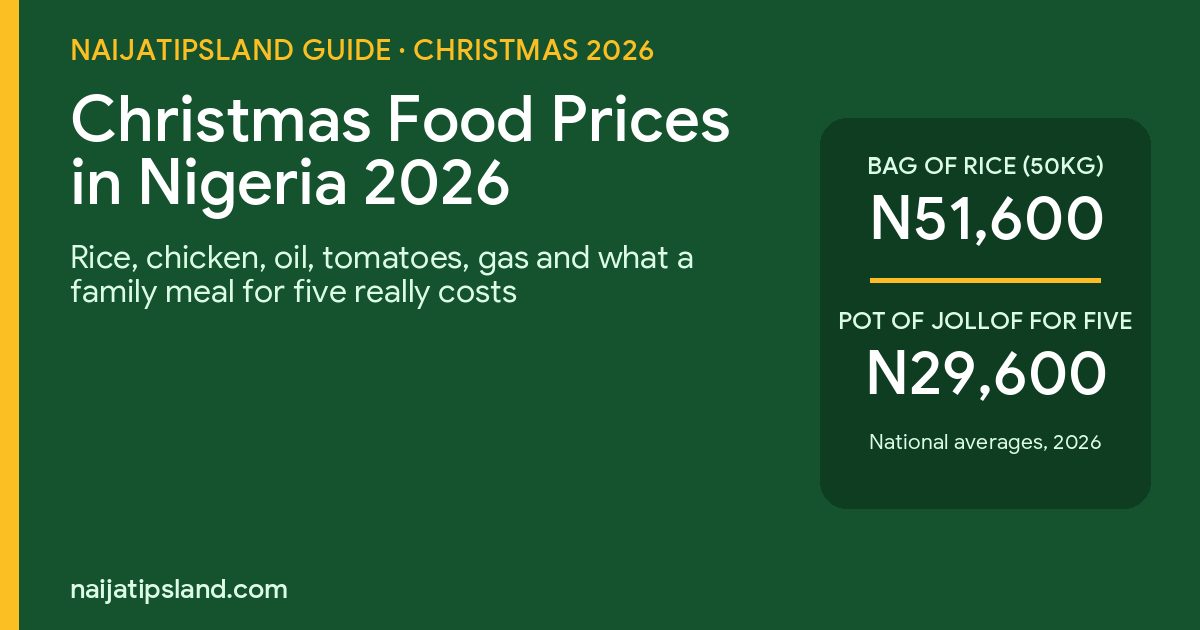
- A pot of jollof rice for a family of five cost about ₦29,600 on average nationwide in June 2026, according to SBM Intelligence’s Jollof Index, ranging from about ₦22,000 in Awka to almost ₦35,000 in parts of Lagos and Calabar.
- A live broiler sold for roughly ₦15,000 to ₦27,000 in Lagos in August 2026. Last December, adult broilers went for ₦18,000 to ₦30,000, so expect the top end again this Christmas.
- Cooking gas (12.5kg refill) averaged about ₦17,600 in September 2026.
- Our estimate for a basic Christmas Day jollof-and-chicken meal for five: about ₦55,000 to ₦90,000, before drinks, depending on where you live and how big your chicken is.
Are food prices going up or down this Christmas?
For most of 2026 the trend has been downward. Headline inflation fell to 14.63% in September 2026 from 15.39% in August, the fourth monthly decline in a row. Food inflation was 19.59% year on year, and on a month-on-month basis food prices fell by 1.55% in September after rising 1.02% in August. In plain terms, a basket of food in September cost a little less than the same basket in August.
A Nairametrics survey of 67 items in four Lagos markets (Mushin, Daleko, Mile 12 and Oyingbo) found that more items got cheaper in September than in August. Maize fell 20%, pepper fell 11% to 20% depending on bag size, garri fell 11% to 14%, and beans and rice also eased.
Not everything is cheaper, though. In the same survey, egusi (melon) jumped almost 30%, oval tomatoes rose about 14%, Power Oil rose nearly 11% and local vegetable and palm oil edged up. And December is always different from September: the festive rush, travel and transport costs push prices up in most markets in the final weeks of the year.
There is one hopeful sign for the biggest Christmas cooking cost, tomatoes and pepper. The Tomatoes and Orchard Producers Association of Nigeria (TOOPAN) said in June that new harvests from the north and south-west would bring prices down from October 2026. Pepper prices were already falling in September. Tomatoes remain the most unpredictable item on any Christmas shopping list.
Christmas food prices: what staples cost now
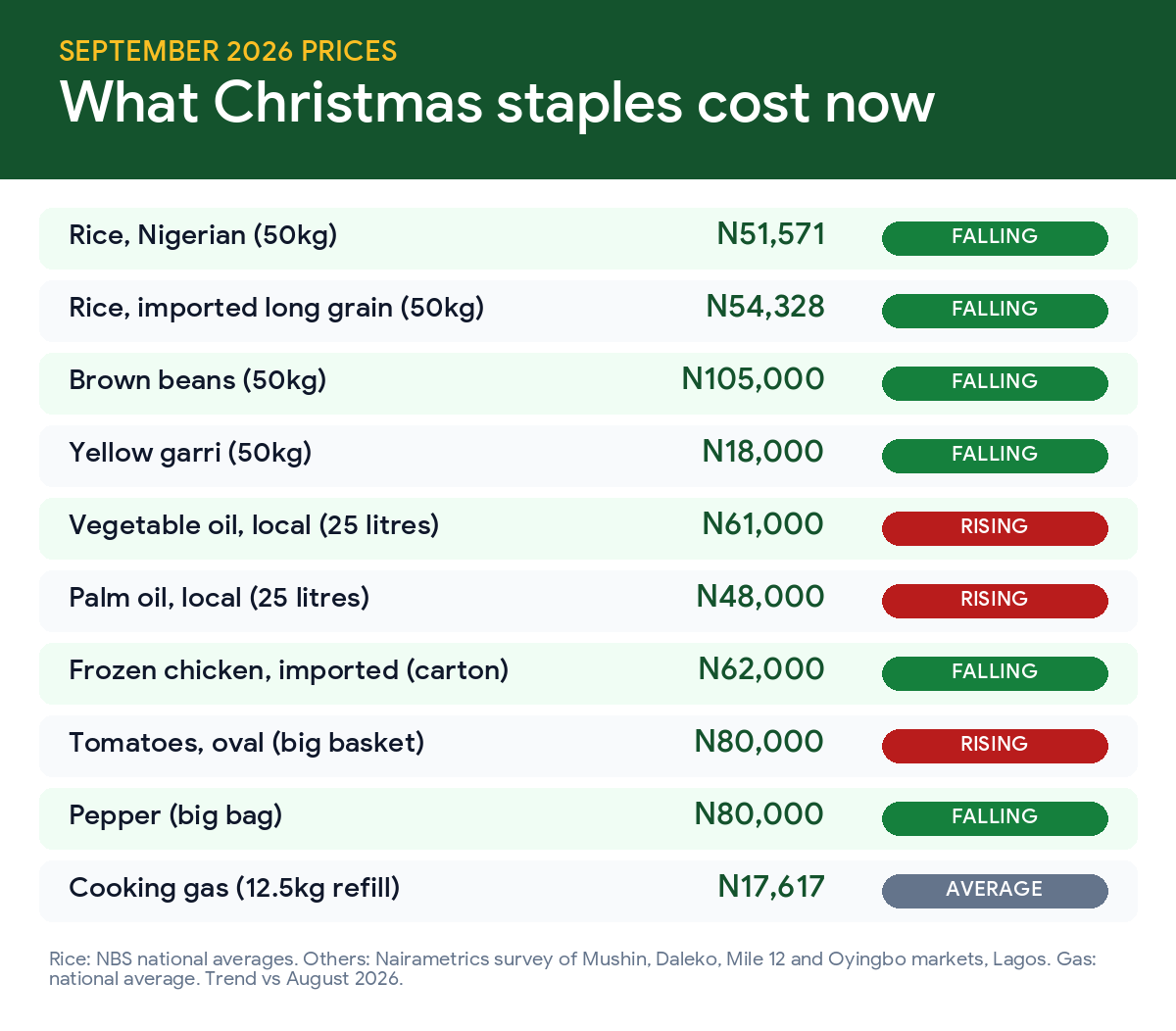
These are the latest prices for the items most families stock up on for December. Rice prices are NBS national averages; the others are from Nairametrics’ September 2026 survey of four Lagos markets unless stated otherwise.
| Item | Size | Price (Sept 2026) | Trend |
|---|---|---|---|
| Rice, Nigerian (national average) | 50kg bag | ₦51,571 | Down from ₦52,250 |
| Rice, imported long grain (national average) | 50kg bag | ₦54,328 | Down from ₦56,094 |
| Rice, Nigerian (national average) | 25kg bag | ₦25,804 | Down |
| Rice, Nigerian (national average) | “Paint” (about 4kg) | ₦4,356 | Down |
| Brown beans | 50kg bag | ₦105,000 | Down 4.6% |
| Oloyin beans | Bag | ₦75,000 | Down 8.5% |
| Yellow garri | 50kg bag | ₦18,000 | Down 14% |
| White garri | 50kg bag | ₦19,500 | Down 11% |
| Local vegetable oil | 25 litres | ₦61,000 | Up 1.8% |
| Local vegetable oil | 5 litres | ₦11,000 | Up 4.8% |
| Power Oil | 2.6 litres | ₦10,800 | Up 10.8% |
| Local palm oil | 25 litres | ₦48,000 | Up 2.1% |
| Local frozen chicken laps | Carton | ₦48,000 | Up 6.7% |
| Imported frozen chicken | Carton | ₦62,000 | Down 4.6% |
| Tomatoes (oval) | Big basket | ₦80,000 | Up 14% |
| Tomatoes (round) | Big basket | ₦45,000 | Up 12.5% |
| Pepper | Big bag | ₦80,000 | Down 20% |
| Egusi (melon) | Big bag | ₦480,000 | Up 29.7% |
| Honeywell wheat | 5kg | ₦6,220 | Down 5% |
| Indomie noodles | Carton (120g packs) | ₦15,800 | Down 4.2% |
| Cooking gas (national average) | 12.5kg refill | ₦17,617 | Range ₦15,000 to ₦20,625 |
Two cautions. First, Lagos market prices are for wholesale quantities in big markets; you will pay more per kilo buying small amounts from a neighbourhood shop. Second, frozen chicken cartons vary in weight by brand, so compare the weight printed on the carton, not just the price.
How much is chicken and turkey for Christmas 2026?
Chicken is usually the item that rises fastest in December. Here is what the latest figures show:
- Live broilers: about ₦15,000 to ₦27,000 in Lagos in August 2026, depending on size (24 Hours Market). Last December, adult broilers sold for ₦18,000 to ₦30,000, up from ₦15,000 to ₦25,000 a year earlier, according to a Nairametrics survey.
- Old layers: about ₦10,000 to ₦15,000 (cleaned) in Lagos in August 2026; last December, adult layers went for ₦10,500 to ₦20,000.
- Frozen chicken: ₦48,000 per carton for local chicken laps and ₦62,000 for an imported brand in Lagos in September 2026. Last December, frozen chicken sold for about ₦5,500 to ₦6,500 per kg.
- Turkey: prices vary too widely by size and seller for a reliable average. A live turkey usually costs several times the price of a broiler, so get two or three quotes from farms or markets before you commit.
Feed is the main driver. Poultry farmers in Bauchi and Jigawa told reporters in October 2026 that a bag of feed costs about ₦20,000 to ₦23,000, a little lower than earlier in the year, but they complained of weak sales. If feed prices hold, live bird prices this December may rise less steeply than last year, but farmers usually still add a festive premium. If you are thinking of raising birds yourself, see our guide to poultry farming in Nigeria.
What a Christmas Day meal for five costs
SBM Intelligence’s Jollof Index tracks the cost of cooking a pot of jollof rice for a family of five, using 12 ingredients: rice, vegetable oil, chicken or turkey, beef, tomatoes, pepper, onions, tinned tomatoes, salt, curry, thyme and seasoning cubes. In June 2026 the national average was ₦29,578, up 14.6% in eleven months and more than seven times what the same pot cost in 2016.
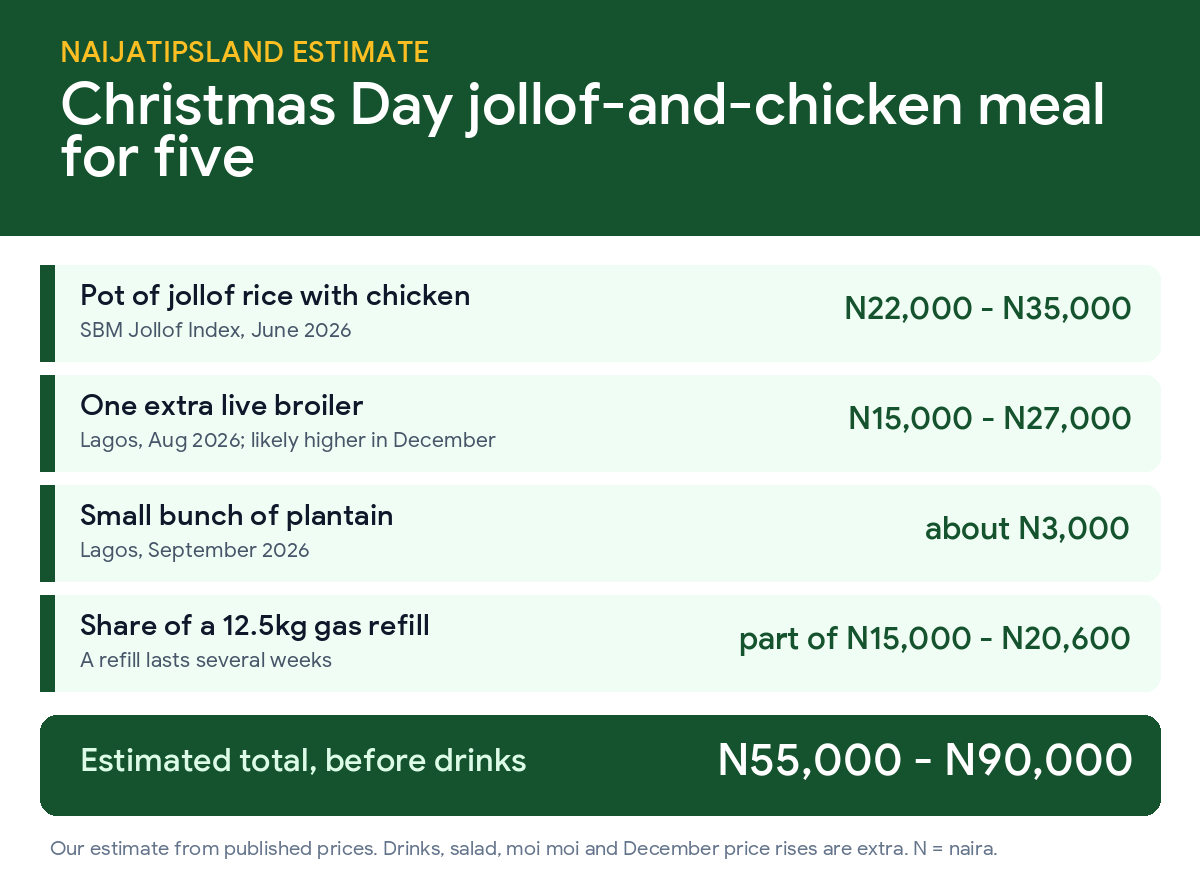
Using that as the core of the meal, here is our rough estimate for a simple Christmas Day lunch for five:
- Pot of jollof rice with chicken (Jollof Index): about ₦22,000 to ₦35,000, depending on your city.
- One extra live broiler for a proper Christmas portion: about ₦15,000 to ₦27,000, likely more in December.
- A small bunch of plantain for dodo: about ₦3,000.
- Cooking gas: a 12.5kg refill costs about ₦15,000 to ₦20,600, but it lasts a family several weeks, so only part of it goes on Christmas Day.
That puts the meal at roughly ₦55,000 to ₦90,000 before drinks, salad, moi moi or dessert, and before December price rises. This is our own estimate built from the sources above, not an official figure. Families in Lagos, Calabar and other high-cost markets should budget towards the top of the range; families in the South-East, where the Jollof Index is lowest, can aim lower.
Where food is cheapest and most expensive
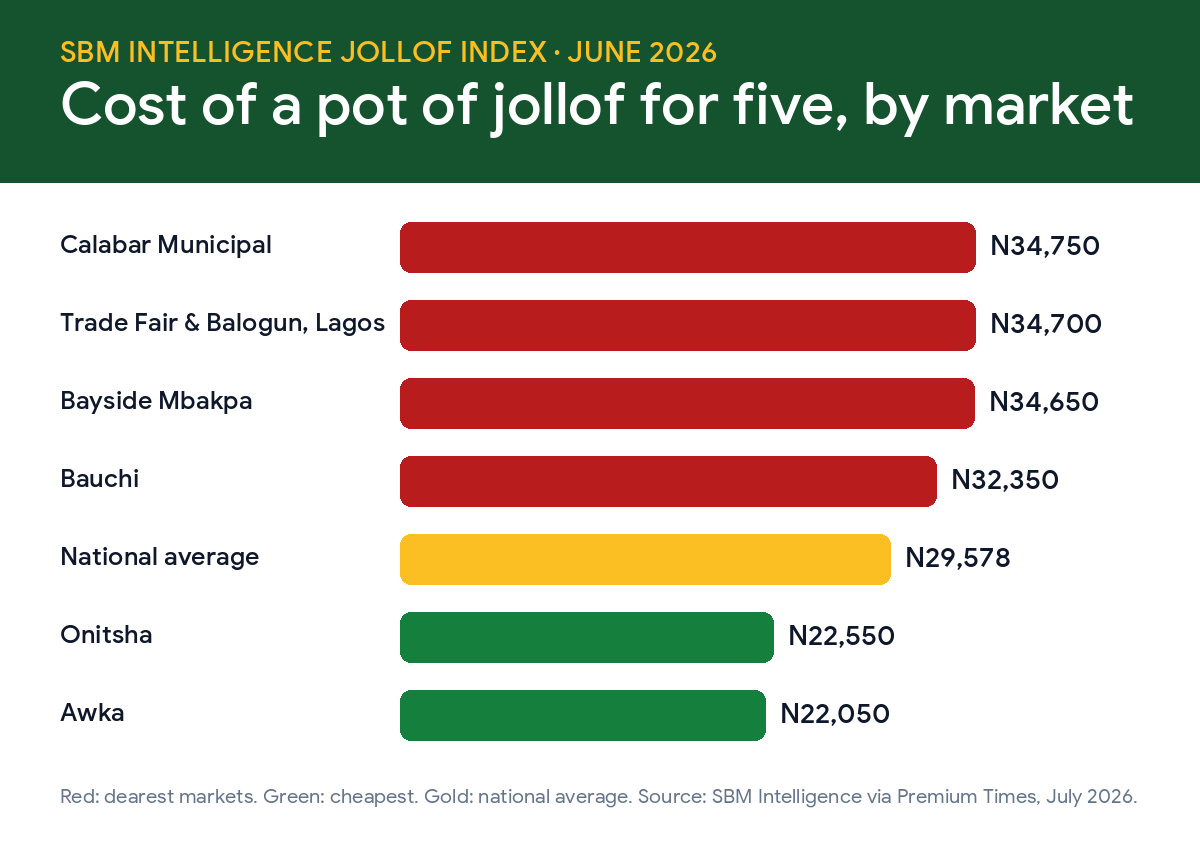
Prices differ a lot between cities. In SBM Intelligence’s June 2026 Jollof Index:
- Most expensive: Calabar Municipal (about ₦34,750), Trade Fair and Balogun markets in Lagos (about ₦34,700, up almost 50% in a year) and Bayside Mbakpa (about ₦34,650).
- Cheapest: Awka (about ₦22,050) and Onitsha (about ₦22,550), where prices barely moved.
- Biggest fall: Bauchi, where the pot fell by about 17%, from ₦38,850 to ₦32,350.
The gap between the cheapest and most expensive markets was about ₦14,700 for the same pot. If you are travelling home for Christmas, it can make sense to buy dry staples such as rice, beans and garri where they are cheaper, and fresh items like tomatoes and pepper locally. Check fares first with our Christmas travel fares guide.
How to save on Christmas food shopping
- Buy dry staples in early November. Rice, beans, garri, spaghetti, noodles, flour and oil keep well. Prices were falling in September and October; they usually climb from late November.
- Buy in bulk and share. A 50kg bag of rice works out cheaper per kilo than paint or derica measures. Splitting bulk bags with family, neighbours or colleagues gets you the wholesale price without the storage problem.
- Book your chicken early. Agree a price and collection date with a farm or seller in November, especially for turkey. Last-minute buyers pay the highest prices.
- Freeze what you can. If you have reliable power, buying frozen chicken or fish before the rush can save money. If power is unreliable, buy live birds closer to the day instead.
- Be flexible with tomatoes. If fresh tomatoes spike, mix a smaller amount of fresh tomatoes with tinned tomato paste and red bell pepper. If prices fall with the new harvest, buy extra and make tomato stew to freeze.
- Refill gas before December. Gas prices often rise in the festive season. Compare filling plants; the September 2026 spread was about ₦5,000 per 12.5kg refill between the cheapest and dearest outlets.
- Compare markets. Big wholesale markets such as Mile 12, Daleko and Oyingbo in Lagos are usually cheaper than supermarkets for fresh food and bulk staples.
- Watch out for online “Christmas promo” scams. Fake food hamper and bulk rice deals on WhatsApp and Instagram are common in December. Never pay in full to an unknown seller. Our Black Friday guide explains how to spot fake deals.
- Set a budget and stick to it. Write down the menu, list quantities and price everything before you go to the market. Festive overspending is one of the most common money mistakes families make.
Frequently asked questions
How much is a bag of rice now?
In September 2026, NBS data put the average 50kg bag of Nigerian rice at about ₦51,600 and imported long-grain rice at about ₦54,300. Popular brands in Lagos markets were around ₦49,000 to ₦56,000. Expect prices to rise somewhat in December.
Will food prices go up in December 2026?
Probably, but perhaps by less than in recent years. Food prices fell month on month in September 2026 and inflation has slowed for four months. Seasonal demand still pushes up chicken, tomatoes, oil and transport costs in December, so buying early remains the safest plan.
How much does it cost to cook jollof rice for five?
About ₦29,600 on average nationwide in June 2026, according to SBM Intelligence’s Jollof Index. It ranged from about ₦22,000 in Awka to about ₦35,000 in Calabar and Lagos’s Trade Fair and Balogun markets.
How much is a live chicken for Christmas?
A live broiler sold for about ₦15,000 to ₦27,000 in Lagos in August 2026. Last December, adult broilers went for ₦18,000 to ₦30,000. Expect a similar or slightly higher range this December.
How much is cooking gas now?
A 12.5kg refill averaged about ₦17,600 in September 2026, ranging from about ₦15,000 in parts of Ogun and Lagos to about ₦20,600 in some Abuja and Borno outlets.
Sources
- Nairametrics: Lagos food prices in September 2026 (2 October 2026)
- Nairametrics: Inflation slows to 14.63% in September 2026
- Voice of Nigeria: Headline inflation drops to 14.63% (15 October 2026)
- Legit.ng: Rice prices, August vs September 2026 (7 October 2026)
- Legit.ng: 10 food items that became cheaper (3 October 2026)
- Premium Times via AllAfrica: SBM Jollof Index, cost of jollof up 14.6% (22 July 2026)
- Legit.ng: Cooking gas refill prices by state (8 October 2026)
- Nairametrics: Chicken prices ahead of Christmas 2025 (2 December 2025)
- 24 Hours Market: Food prices in Lagos (2026)
- Peoples Gazette: Poultry farmers lament feed costs and poor market (20 October 2026)
- Food Business MEA: Tomato prices expected to fall from October 2026 (June 2026)