
Cost of Studying in Canada for Nigerian Students (2026/27): Tuition, Proof of Funds and Rules

Last updated: 15 October 2026 · By Naijatipsland Editorial Team · Editorial policy
Canada is one of the most searched study destinations among Nigerians, but the cost question is rarely answered in full. Tuition is only the first line. Canada also asks you to prove you can pay for living costs, and the amount went up again for applications made from 1 September 2026. This guide sets out what studying in Canada costs in 2026/27, what you must show for a study permit, and the rules that decide whether the money is worth spending.
Figures are in Canadian dollars (CAD) unless stated. Tuition averages come from Statistics Canada; visa amounts come from a Moving2Canada report of the new IRCC rules. Always confirm the final figures on the official IRCC website and the university’s own fee page before you pay anything.
The short answer
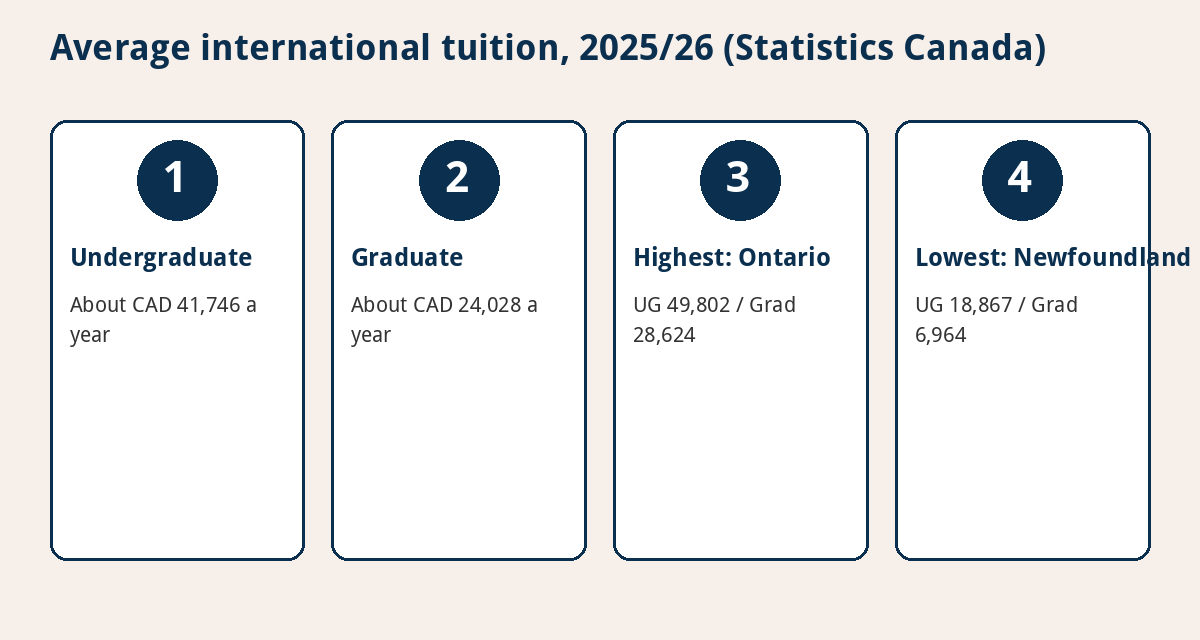
- The average international undergraduate pays about CAD 41,746 a year in tuition, and the average graduate student about CAD 24,028 (2025/26, Statistics Canada).
- Tuition varies by province: Ontario is highest (undergraduate average CAD 49,802), Newfoundland and Labrador lowest (CAD 18,867).
- From 1 September 2026, a single applicant outside Quebec must show CAD 23,448 for living costs, plus first-year tuition and travel costs.
- Most applicants need a provincial attestation letter (PAL) before they apply.
- Off-campus work is limited to 24 hours a week during term, so work cannot cover your fees.
Tuition: what international students pay
Statistics Canada’s preliminary figures for 2025/26 put average international undergraduate tuition at about CAD 41,746 a year, up about 2.5%, and graduate tuition at about CAD 24,028, up about 1.5%. The agency notes these are the highest levels in a decade, and the figures are in constant June 2025 dollars.
- Ontario: undergraduate average CAD 49,802; graduate CAD 28,624.
- Newfoundland and Labrador: undergraduate average CAD 18,867; graduate CAD 6,964.
- Examples reported for 2026: engineering at the University of Toronto about CAD 69,000, at Waterloo about CAD 77,000 and at UBC about CAD 68,000; McGill arts and science between about CAD 31,000 and CAD 46,000; Memorial University undergraduate about CAD 18,867.
Engineering, medicine, dentistry and business sit above the average, while arts and humanities sit below it. College diplomas generally cost less than university degrees, but check whether the programme is eligible for a post-graduation work permit.
Proof of funds: the number that blocks applications

For applications submitted on or after 1 September 2026, living-expense funds outside Quebec are:
- 1 person: CAD 23,448
- 2 people: CAD 29,192
- 3 people: CAD 35,888
- 4 people: CAD 43,572
- 5 people: CAD 49,419
- Each additional person: CAD 6,318
These amounts cover living costs only. You must also show first-year tuition (or proof that it is paid) and travel costs for yourself and any accompanying family. Quebec sets its own figure: from 1 January 2026 it was CAD 24,617 for a single applicant. Borrowed money cannot be used to meet the requirement.
A guaranteed investment certificate (GIC) from a participating Canadian bank is one accepted way to show funds. It is a refundable deposit paid back in instalments after you arrive, not a fee. Apply through the bank’s official site and be wary of anyone who sells “GIC” packages by social media.
Rough example: a single undergraduate at a CAD 30,000-a-year programme outside Quebec who applies after 1 September 2026 would need about CAD 53,448 (CAD 30,000 tuition plus CAD 23,448 living funds), plus flights. Calculate your own using your programme’s fee.
What else you should budget for
- Government fees: the study permit and biometrics fees, plus a medical exam if required. Nigeria is on IRCC’s list of countries where a designated-panel-physician exam can apply. Check amounts on IRCC’s site.
- Accommodation: the biggest living cost. It is far higher in Toronto and Vancouver than in smaller cities.
- Health insurance: rules and costs differ by province and by university plan.
- Winter clothing, books, phone and transport.
- Flights for you, and for family if they come with you.
One 2026 estimate put total annual cost at about CAD 35,000 to 45,000 in Atlantic Canada, and about CAD 72,000 to 96,000 for UBC plus Vancouver living. Treat these as rough guides and build your own budget.
Rules that affect Nigerian applicants

Provincial attestation letter
Since 22 January 2024, most study-permit applications need a PAL (or a territorial letter in the territories; Quebec uses a CAQ). Applications without one are usually returned. Exemptions include primary and secondary students and in-Canada extensions for the same programme. One source says master’s and PhD students at public universities became exempt on 1 January 2026, but another source did not list that exemption. Confirm with IRCC for your programme.
Student Direct Stream ended
The Student Direct Stream, and with it the Nigeria Student Express, closed on 8 November 2024. Nigerian applicants now use the regular process. Expect biometrics and possible visa application centre backlogs.
Working while studying
Off-campus work is capped at 24 hours a week during term (raised from 20 in November 2024; the temporary unlimited-hours policy has ended). On-campus work has no hour limit, and full-time work is allowed during scheduled breaks. You need a valid permit that allows work, a social insurance number and full-time study at a designated learning institution. Plan to pay your fees from your own funds, not from part-time pay.
Post-graduation work permit
The programme must generally be at least eight months and PGWP-eligible. The permit length matches the programme, up to three years. Bachelor’s, master’s and doctoral graduates are generally exempt from the field-of-study rule, while college graduates are not. Language requirements are CLB 7 for university graduates and CLB 5 for college graduates. Check IRCC’s current list before choosing a college programme.
How to keep the cost down
- Compare provinces. The gap between Ontario and Atlantic Canada averages is more than CAD 30,000 a year at undergraduate level.
- Consider graduate study. The average graduate fee is far lower than undergraduate.
- Look for scholarships and entrance awards from the university, and read the conditions. Few cover full costs.
- Choose smaller cities where rent is lower.
- Check eligibility first. Confirm the institution is a designated learning institution and the programme is PGWP-eligible.
Scams and mistakes to avoid
- Fake acceptance letters and PALs. Verify with the university and the province.
- Agents who guarantee a visa. No one can.
- Paying tuition to personal accounts. Use the university’s official payment channel.
- Last-minute “show money” arrangements, which can lead to refusals and bans.
- Using last year’s funds figure. The amount depends on your application date.
If you are weighing Canada against the UK, see our guide to the cheapest UK universities for Nigerian students.
Frequently asked questions
How much does it cost to study in Canada from Nigeria?
Tuition averages about CAD 41,746 a year for undergraduates and CAD 24,028 for graduates, plus living costs. For a permit you must show CAD 23,448 for living costs (single applicant, outside Quebec, from 1 September 2026) plus first-year tuition and travel.
Which province is cheapest?
Newfoundland and Labrador had the lowest average international tuition in the Statistics Canada data (CAD 18,867 undergraduate, CAD 6,964 graduate).
Do I need a GIC?
A GIC is one accepted way to show living funds. Other approved documents can also be used, so check IRCC’s list.
Can I work to pay my fees?
You can work up to 24 hours a week off campus during term, but that will not cover tuition.
Can I bring my family?
The funds amount rises with each family member (CAD 29,192 for two). Whether a spouse can get a work permit depends on your programme, so check IRCC’s current rules before applying.
Bottom line
Work out the total first-year number: tuition plus the proof-of-funds amount plus flights. Check the province, the designated-institution status and the PGWP eligibility, get your PAL, and verify every letter and payment channel yourself. A cheaper province with an eligible programme often beats a famous name you cannot afford to finish.
Sources
- Statistics Canada: Tuition fees for degree programs, 2025/2026
- Moving2Canada: Proof of funds requirement for Canadian study permit increasing from 1 September
- SI Laws: Study permit Canada 2026, PAL, proof of funds and complete guide
- GoFar Global: Tuition fees at Canadian universities for international students, 2026



