Last updated: 16 October 2026 · By Naijatipsland Editorial Team · Editorial policy
Registering your business name with CAC does not make it your brand in law. A CAC registration stops another company from registering an identical business name, but it does not by itself give you the exclusive right to use that name or logo on goods and services. A registered trademark does. If you sell products, run a brand online or plan to grow, registering your name or logo as a trademark protects the thing customers actually recognise. This guide explains what a trademark is, what can and cannot be registered, how the registration process works in Nigeria, how long it takes, what it costs and how renewal works.
Nigeria’s trademark system is run by the Trademarks, Patents and Designs Registry under the Federal Government’s ministry in charge of trade. The process below comes from law-firm guides published on Mondaq and other legal sites, plus agent guides. These sources differ on names, timelines and costs, and none gave us official fee amounts, so check the registry’s current requirements before you file. This is general information, not legal advice.
The short answer
- Search first. Check the register for identical or confusingly similar marks before you invest in branding.
- File one application per class. Goods and services are grouped under the 45-class Nice classification, and Nigeria is described as a single-class filing system.
- Use a trademark agent or lawyer. Guides describe a power of attorney authorising the agent to file for you.
- Expect publication and a two-month opposition window. After acceptance the mark is published in the Trademarks Journal, and others can oppose within two months.
- Allow a long wait. One agent guide says a straightforward application takes 12 to 24 months. Opposition or queries can add more.
- Registration lasts seven years, then renews in 14-year periods on payment of the prescribed fee.
Trademark, business name and company name
These three things are often confused:
- A business name or company name identifies the entity. See our guides to registering a business name with CAC and registering a limited company.
- A trademark identifies the goods or services: a brand name, logo, slogan or other sign customers use to recognise your products.
You can have a registered company and still lose a brand dispute if someone else owns the trademark. If your business name is your brand, register both.
What can be registered

A mark generally has to be distinctive, meaning it can tell your goods apart from other people’s. Guides describe an invented word, a logo or a similar device as the kind of mark that qualifies, and warn that a name which merely describes the goods or their quality is likely to meet objections. A mark that is confusingly similar to an existing one, or likely to mislead the public, may be refused or opposed.
- Strong: coined words, unusual spellings and distinctive logos.
- Weaker: ordinary words that describe the product, such as a plain name for what you sell.
- Risky: names that look or sound like famous brands, or that suggest government approval.
Words and logos can be protected separately. If you use both, think about whether to register the name first, since the logo may change later.
Before you file

- Do a clearance search. Ask the registry or an agent to search for identical and similar marks, and read the search report. Searching only on Google is not enough.
- Decide what to protect. The name, the logo or both, and the exact spelling.
- Pick the right class. Under the Nice system, goods fall in classes 1 to 34 and services in 35 to 45. Guides call a wrong classification a common and serious error, so get help if your business spans several classes. Each class needs its own application.
- Prepare a clear image of the mark. For logos, use a clean, high-resolution file.
- Gather applicant details: full name, address and nationality of the owner, which can be a person or a company.
- Sign a power of attorney authorising your agent to file.
How registration works
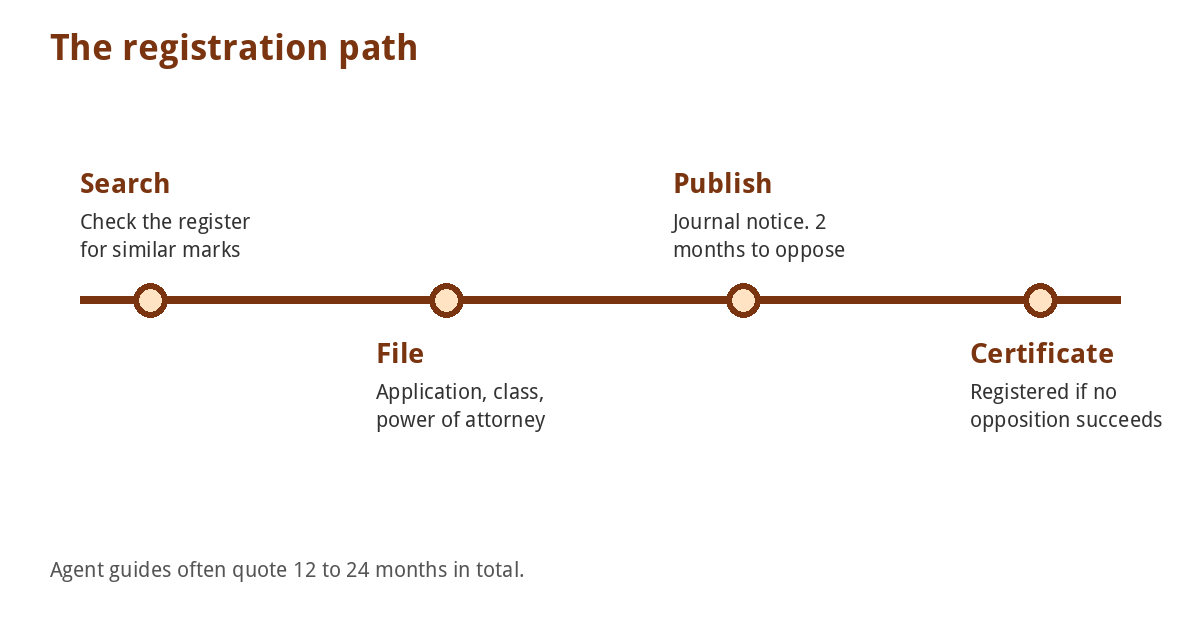
- Search. Before filing, check the register.
- File the application. Your agent submits the application with the mark, class and fee. You receive an acknowledgement letter, and the filing date marks when your application starts.
- Examination. The registry checks formalities and whether the mark is distinctive, descriptive or conflicts with earlier marks. It may raise objections you must answer.
- Acceptance. If satisfied, it issues a letter of acceptance. One law-firm guide notes this letter can be used for some purposes, including product registration with NAFDAC, while you wait for the certificate.
- Publication. The mark appears in the Trademarks Journal.
- Opposition period. Anyone with an objection has two months from publication to oppose. One source says this period cannot be extended. If there is an opposition, both sides file papers and the process takes longer.
- Certificate. If there is no opposition, or you win, the registrar issues the certificate of registration.
The registry is often described as Nigeria’s Trademarks, Patents and Designs Registry, under the Commercial Law Department of the ministry responsible for trade and investment. Names vary between guides, so make sure your agent is using the correct registry.
How long does it take?
Official processing times are not published in the sources we used. One agent guide says 12 to 24 months for a straightforward application, and notes that office actions or oppositions can extend it. Another source lists only the two-month opposition period and the stages. Plan on more than a year, and do not delay launching your brand because registration is pending. Filing early still establishes your application date.
How much does it cost?
We could not find an official fee schedule that is both current and complete. One agent guide estimates about N100,000 to N180,000 including the agent’s fee for a single class, with foreign-owned marks costing more, but it gives no date or breakdown, so treat it as a rough guide only. Costs usually include:
- Search fee and report.
- Official filing and publication fees for each class.
- Agent or lawyer fees, including responding to objections.
- Certificate and renewal fees.
Ask for a written quote that lists official fees and professional fees separately and says what happens if there is an objection or opposition.
After registration
- Duration and renewal. Registration is described as lasting seven years from the filing date, then renewable for 14-year periods. Renewal needs the prescribed fee, and one source describes a one-month grace period after the registry advertises non-payment, during which the renewal fee and a penalty can still be paid. Diary the date.
- Use the mark properly. Use it consistently, and use the registered symbol only once the mark is registered.
- Watch for copycats. Search the Journal and the market for similar marks, and act early if someone copies you.
- Keep records. Store your certificate, power of attorney and renewal receipts.
- Update details. Record changes of address, name or ownership with the registry.
- Protect your online brand. Match your social handles and domain name, and see our guide to earning money online in Nigeria if you sell digitally.
Common mistakes
- Registering the company name and assuming the brand is protected.
- Skipping the search and finding out later that a similar mark exists.
- Choosing a descriptive name that is hard to register.
- Filing in the wrong class, or only one class when you need several.
- Using an unqualified middleman with no power of attorney or receipt.
- Missing the renewal date.
- Paying for “guaranteed registration”. No agent can guarantee the registry’s decision.
Frequently asked questions
Do I need a trademark if I already registered with CAC?
CAC registration covers your business or company name. A trademark protects the brand on goods and services. They do different jobs.
Can I file by myself?
Guides describe filing through an agent or lawyer with a power of attorney. Confirm the current rules with the registry or a qualified practitioner.
Can I register a name and a logo together?
Yes, but think about registering the name and the logo separately so a later logo change does not leave the name unprotected.
How long does a trademark last in Nigeria?
Guides say seven years initially, then renewals of 14 years each.
Can someone oppose my application?
Yes. After publication in the Trademarks Journal there is a two-month window for opposition.
Does a trademark cover other countries?
No. A Nigerian registration protects you in Nigeria. For other countries, take advice on regional or international filings.
Can I use my brand while the application is pending?
You can use it, but you do not yet hold a registered right. A search before launch reduces the risk of a dispute.
Bottom line
Treat a trademark as part of building a brand, not an afterthought. Choose a distinctive name, search the register, file in the right class through a qualified agent, expect a wait of more than a year, and diary the renewal. If you are still choosing a structure, start with our guides to a business name or limited company, then protect the brand customers will actually ask for.
Sources
- Mondaq (Mandel Solicitors): The procedure for the registration of trademarks in Nigeria (Nov 2025)
- Adams & Adams: Nigeria intellectual property overview
- Ardnas Legal: Steps to trademark registration in Nigeria (law firm marketing; timeline unsourced)
- Nigerian Queries: How to register a trademark in Nigeria (commercial; fee range unsourced)
Related: NAFDAC registration step by step
Related: SON certification in Nigeria