

TL;DR:
- Open dialogue is a structured, seven-principle communication framework designed to foster shared understanding through inclusive, non-hierarchical conversations. Originating in Finland for mental health crises, it now extends to conflict resolution, community engagement, and organizational communication, emphasizing dialogue over expert-led solutions. Its core practice involves holding multiple perspectives without immediate resolution, prioritizing presence, tolerance of uncertainty, and collaborative meaning-making.
Open dialogue is defined as a collaborative, principle-driven communication approach that creates shared understanding by including all relevant people in an ongoing, non-hierarchical conversation. The term comes from a structured clinical framework developed in Finland in the 1980s, where it was used to treat severe mental health crises. Today, its seven foundational principles extend well beyond therapy into conflict resolution, community engagement, and organizational communication. If you want to understand what open dialogue means and how to use it in real life, this guide covers everything from its core structure to practical application.
What is open dialogue and how does it work?
Open dialogue is a structured clinical framework built on seven core principles, not simply a style of open or honest conversation. The distinction matters. Many people assume open dialogue means speaking freely or reaching consensus. It does not. The goal is to hold multiple, sometimes contradictory viewpoints in the same space until new shared meaning emerges naturally. That process requires discipline, presence, and a specific set of practices.
The approach originated in Western Lapland, Finland, where psychiatrist Jaakko Seikkula and colleagues developed it as a response to psychosis and mental health crises. It has since been adopted in the United Kingdom, Australia, Denmark, and the United States. The World Health Organization and researchers at institutions like King’s College London have studied its outcomes. The core idea is that healing and resolution happen through dialogue itself, not through expert diagnosis or prescribed treatment delivered to a passive recipient.
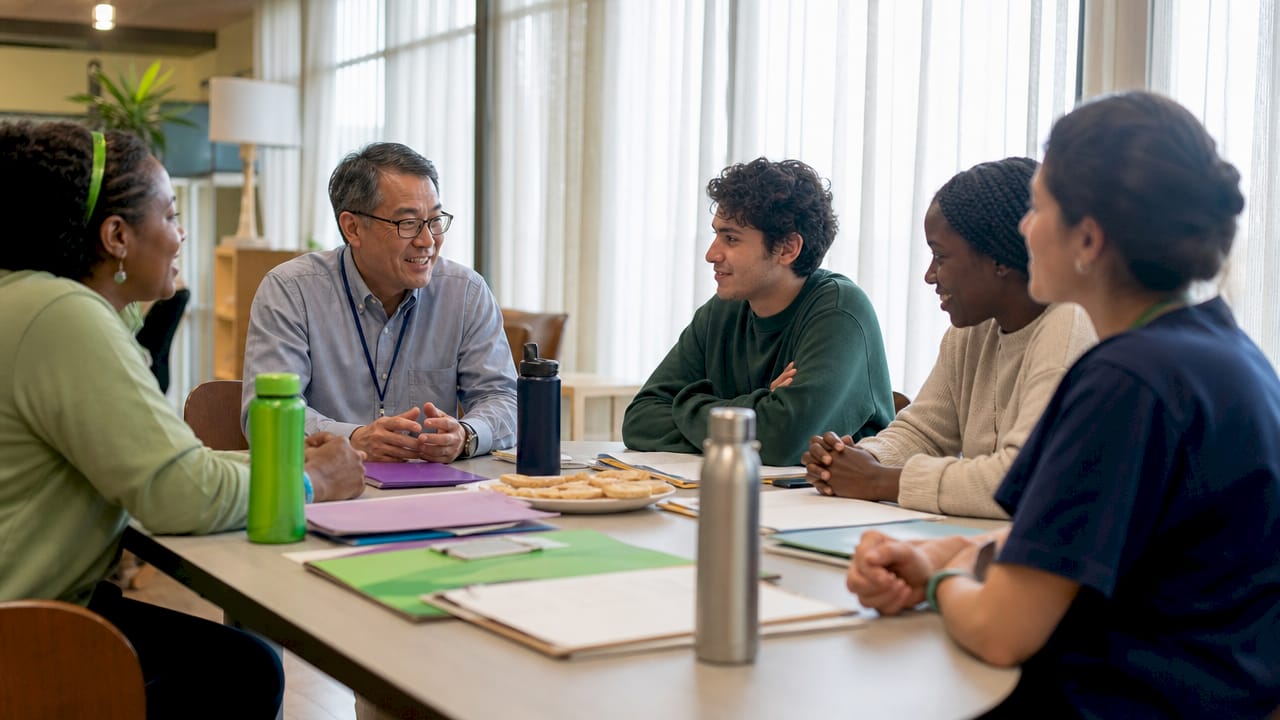
In practice, an open dialogue meeting brings together the person in distress, their family members, relevant community members, and a small team of professionals. No decisions are made about the person without them present. Every voice carries equal weight in the conversation. This is what separates open dialogue from most conventional communication models.
What are the seven core principles of open dialogue?
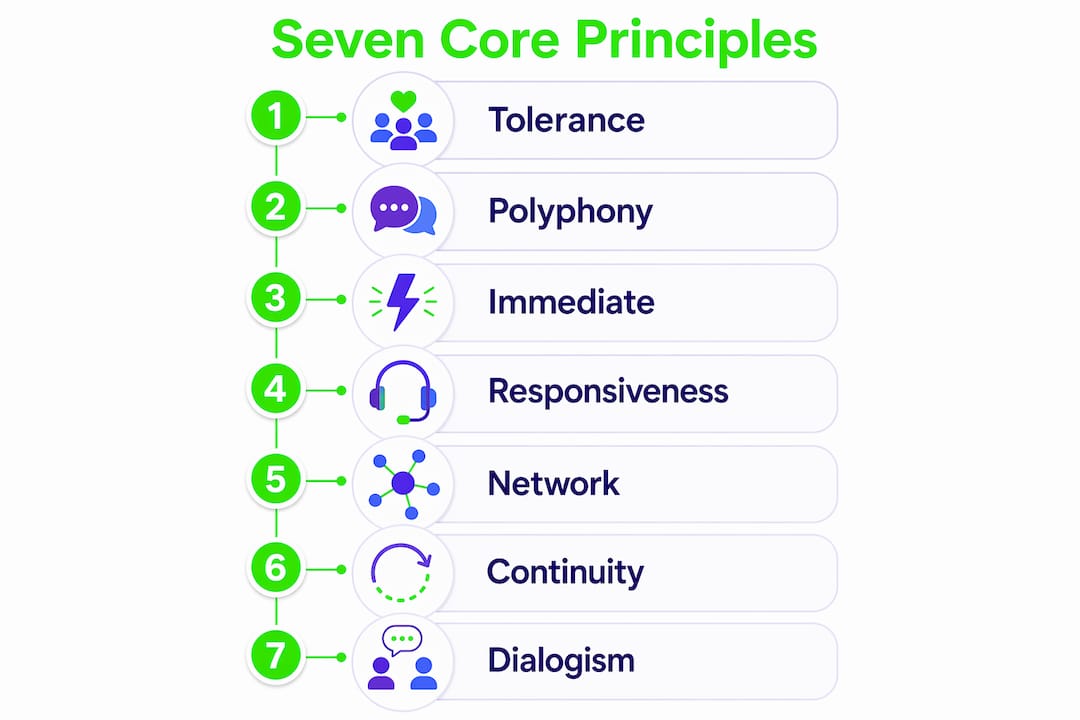
The seven core principles give the approach its structure and distinguish it from informal conversation. Each principle addresses a specific failure point in traditional communication.
- Immediate help. Response happens within 24 hours of a crisis or request. Delay allows distress to harden into fixed narratives, making dialogue harder to initiate.
- Social network perspective. Family members, friends, colleagues, and other relevant people are included from the first meeting. The person is never treated in isolation from their relationships.
- Flexibility and mobility. Meetings happen where the person feels most comfortable, often at home, not in clinical or institutional settings. The format adapts to the situation.
- Responsibility. A consistent professional team takes ownership of the process from start to finish. Handoffs between departments or specialists are minimized.
- Psychological continuity. The same team stays involved over time, building trust and maintaining a coherent understanding of the person’s situation.
- Tolerance of uncertainty. Professionals resist the pressure to diagnose quickly or offer premature solutions. The discomfort of not knowing is held deliberately.
- Dialogism. The goal is not agreement but the co-creation of meaning. Multiple perspectives are voiced, heard, and allowed to coexist without being resolved artificially.
Pro Tip: If you are applying these principles outside a clinical setting, start with tolerance of uncertainty. Most communication failures happen because someone rushes to fix or conclude before everyone has been genuinely heard.
The seventh principle, dialogism, draws directly from the work of Russian philosopher Mikhail Bakhtin, who argued that meaning is never fixed but always created between people in conversation. Open dialogue treats this not as a philosophical abstraction but as a practical operating principle.
How open dialogue differs from traditional communication methods
Most conventional communication models, whether in therapy, management, or conflict resolution, position one person as the expert and others as recipients of guidance. Open dialogue inverts that structure entirely.
| Feature | Traditional approach | Open dialogue approach |
|---|---|---|
| Role of professional | Expert who diagnoses and prescribes | Collaborative non-expert who facilitates |
| Goal | Reach a solution or diagnosis | Generate shared meaning |
| Use of silence | Avoided or filled quickly | Used intentionally as a reflective tool |
| Handling disagreement | Resolved toward consensus | Multiple views held simultaneously |
| Power structure | Hierarchical | Distributed and non-hierarchical |
Dr. Russell Razzaque, a leading clinician and trainer in the UK, describes the shift from expert to collaborative non-expert as the most difficult and most important transition for practitioners to make. Most professionals are trained to project authority and provide answers. Open dialogue asks them to do the opposite: to stay curious, to ask rather than tell, and to resist the pull toward premature resolution.
Silence in open dialogue is not an awkward gap to fill. Experienced facilitators use it as an active tool, creating space for the person and their network to process, reflect, and speak from a more authentic place. This is a direct contrast to most professional communication settings, where silence signals discomfort or incompetence.
Open dialogue is also not consensus-building. Many conflict resolution methods aim to find common ground and move all parties toward agreement. Open dialogue holds contradictory views in the room without forcing them to reconcile. The assumption is that new understanding will emerge from the process itself, not from a facilitator steering the group toward a predetermined outcome.
Pro Tip: In your next difficult conversation, try reflecting back what the other person said before responding. This single practice, drawn directly from dialogic principles, slows the conversation enough to prevent reactive communication.
What are the benefits and outcomes of open dialogue?
The evidence base for open dialogue has grown significantly since the original Finnish studies. Research now covers clinical settings in Denmark, the UK, and Australia, and the findings are consistent across contexts.
| Benefit | Evidence |
|---|---|
| Improved service-user outcomes | Danish adolescent studies and UK settings report enhanced collaboration and professional validation |
| Cost-neutral healthcare delivery | Open dialogue implementation does not increase healthcare costs despite more intensive early involvement |
| Better conflict resolution | Spoken interaction produces more constructive disagreement resolution than written communication |
| Greater attitude alignment | A study of 1,842 conversations found spoken dialogue fosters stronger attitude alignment between parties |
| Stronger social networks | Dialogic approaches are recognized as essential for social capital and reducing isolation in communities |
The 2026 Nature Communications study of 1,842 conversations with 1,432 observers is particularly significant. It confirms that spoken, dialogic interaction produces more constructive outcomes than written exchanges. This means the open dialogue preference for face-to-face conversation is not just philosophical. It is empirically supported.
The cost-neutral finding from UK and Danish settings challenges a common objection to open dialogue adoption. Critics often argue that the intensive early involvement of multiple professionals is too expensive. The evidence shows that front-loading support reduces long-term costs by preventing escalation. This makes the model financially defensible as well as clinically effective.
Beyond mental health, open dialogue principles are increasingly applied to community health, deliberative democracy, and organizational conflict. The social network perspective, in particular, translates directly to community engagement work, where including all affected voices from the start produces more durable outcomes than top-down decision-making.
How to apply open dialogue in everyday communication
You do not need clinical training to use open dialogue principles in personal, workplace, or community settings. The core practices are transferable and immediately useful.
- Practice active listening without preparing your response. Most people listen while simultaneously forming their reply. Open dialogue requires full presence. Listen to understand, not to respond.
- Invite perspectives before offering your own. Ask others what they think and genuinely wait for the answer before sharing your view. This shifts the dynamic from debate to dialogue.
- Use silence deliberately. After someone speaks, pause before responding. A three-to-five second pause signals that you are processing what was said, not just waiting for your turn.
- Name uncertainty openly. If you do not know the answer or are unsure how to proceed, say so. Transparency about uncertainty builds trust and models the tolerance of uncertainty principle.
- Avoid premature conclusions. Resist the urge to summarize or resolve a conversation before all perspectives have been voiced. Premature closure shuts down dialogue and creates resentment.
- Include the right people. Before a difficult conversation, ask who else should be in the room. Open dialogue’s social network principle applies directly to workplace conflict, family disputes, and community decisions.
Pro Tip: In group settings, try the “reflecting team” technique from open dialogue practice. Two or three people discuss what they heard while the original speaker listens without responding. Then the speaker reflects on what they heard from the observers. This structure prevents defensive reactions and deepens mutual understanding.
Understanding how digital communities shape dialogue is also relevant here. Online platforms often compress and flatten conversation in ways that work against dialogic principles. Applying open dialogue techniques in digital spaces requires extra intentionality around listening, pacing, and inclusion.
Key takeaways
Open dialogue is a structured, evidence-based framework that produces better communication outcomes by prioritizing inclusion, presence, and the deliberate tolerance of uncertainty over expert-led, solution-focused approaches.
| Point | Details |
|---|---|
| Core definition | Open dialogue is a seven-principle framework for collaborative communication, not just open or honest talk. |
| Origin and reach | Developed in Finland in the 1980s, now adopted in the UK, Australia, Denmark, and the US. |
| Key differentiator | Professionals act as collaborative non-experts, holding multiple views rather than directing toward consensus. |
| Evidence base | A 2026 study of 1,842 conversations confirms spoken dialogue produces more constructive outcomes than written exchange. |
| Practical application | Six core techniques including active listening, deliberate silence, and inviting perspectives transfer directly to non-clinical settings. |
Why open dialogue deserves more attention than it gets
Naijatipsland has followed the growth of open dialogue closely, and the honest observation is this: most people who encounter the concept underestimate it. They hear “open dialogue” and think it means being more transparent or holding more meetings. That misreading is the single biggest obstacle to its adoption.
The real challenge in open dialogue is unlearning. Specifically, unlearning the instinct to be the expert in the room. In Nigerian communities, as in most hierarchical cultures, authority is expressed through having answers. Open dialogue asks you to express authority through the quality of your listening. That is a genuinely difficult shift, and most training programs underestimate how long it takes.
The systemic resistance to open dialogue in institutional settings is real and well-documented. Hierarchies resist it because it distributes power. Timelines resist it because tolerance of uncertainty is slow. But the outcomes justify the friction. The communities and organizations that commit to dialogic practice consistently report stronger trust, lower conflict, and more durable decisions.
For anyone new to these ideas, the advice from Naijatipsland is to start small. Pick one principle, tolerance of uncertainty or deliberate silence, and practice it in your next difficult conversation. You will notice the difference immediately. Open dialogue is not a method you read about and then apply. It is a practice you build through repetition, discomfort, and genuine curiosity about other people’s experience.
— Naijatipsland
Explore more community dialogue resources on Naijatipsland
Naijatipsland covers communication, community engagement, and social dialogue topics that connect directly to the principles explored in this article.
If the ideas in this article resonated with you, the next step is understanding how dialogic communication connects to real community outcomes. Research shows that community engagement produces measurable mental health benefits, with some studies reporting up to 30% improvement in wellbeing among participants in structured community dialogue programs. Naijatipsland has compiled practical guides on how to build those kinds of networks in Nigerian and African contexts. You can also explore how online debate principles connect to open dialogue techniques for anyone engaging in public or digital forums.
FAQ
What does open dialogue mean in simple terms?
Open dialogue is a structured communication approach where all relevant people, including family, community members, and professionals, meet together to create shared understanding through conversation rather than expert-led decision-making.
Is open dialogue only used in therapy?
No. Open dialogue originated as a mental health framework in Finland but its principles now apply to community health, conflict resolution, organizational communication, and deliberative democracy.
What is the most important principle of open dialogue?
Tolerance of uncertainty is widely considered the most challenging and most important principle. It requires resisting the pressure to diagnose, conclude, or fix before all perspectives have been fully heard.
How does open dialogue differ from active listening?
Active listening is one technique within open dialogue. The full framework adds six additional principles including social network inclusion, deliberate use of silence, and holding contradictory views without forcing resolution.
Can open dialogue be used in online or digital settings?
Yes, though it requires extra effort. Digital platforms compress conversation and reduce presence, which works against dialogic principles. Applying open dialogue online means slowing down, inviting more voices, and resisting the pull toward quick reactions or written summaries.