
How to Verify Land Ownership in Lagos State (2026): Step-by-Step Checks Before You Pay


Last updated: 4 November 2026 · By Naijatipsland Editorial Team · Editorial policy
Buying land in Lagos is one of the most common ways Nigerians, at home and abroad, try to build wealth, and it is also one of the most common ways people lose money. Land fraud in Lagos is well documented: double sales, forged receipts, fake survey plans and plots sold inside government-acquired areas. The good news is that most of these losses are avoidable if you verify before you pay. This guide walks through how to verify land ownership in Lagos State step by step, which offices to deal with, what the documents actually mean, and the red flags that should make you walk away. It is written from a UK-based perspective for Nigerians in Lagos and in the diaspora who cannot easily visit offices in person.
It builds on our wider guide, How to Buy Land in Nigeria Without Getting Scammed, and focuses narrowly on one question: does this seller really own this exact piece of land, and can they lawfully sell it to me?
Important: this is general information, not legal advice. Fees, forms and procedures at Lagos State offices change, and several figures quoted online come from estate-agent marketing pages rather than official schedules. Always confirm current requirements with the relevant office and use a Nigerian property lawyer for the final checks.
Why verification matters more in Lagos than almost anywhere
Lagos has a layered land system. Under the Land Use Act 1978, land in each state is vested in the Governor, who holds it in trust for the people. Individuals therefore usually hold a right of occupancy rather than outright ownership, and transferring that right generally requires the Governor’s Consent. On top of this sit family and community (“Omo-onile”) claims, government acquisitions for infrastructure, and a history of land being sold more than once. A seller can honestly believe they own land that the state has acquired, or dishonestly sell land they never owned. Verification is how you separate those cases from a genuine title.
The documents a Lagos seller should be able to show
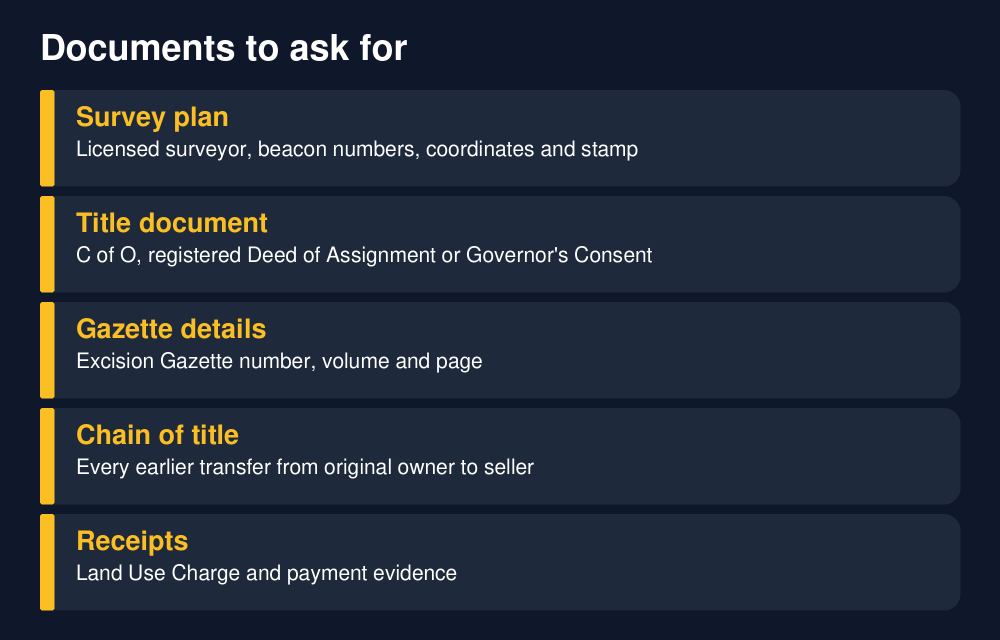
Ask for original documents, not photocopies or WhatsApp scans, and ask for them early. A genuine seller expects scrutiny. The key documents are:
- Survey plan: a plan drawn by a licensed surveyor, showing beacon numbers, coordinates, size and location. The surveyor’s registration and stamp should be checkable.
- Title document: this may be a Certificate of Occupancy (C of O), a registered Deed of Assignment with Governor’s Consent, a Governor’s Consent to assignment, or a Deed of Conveyance in older cases. Each tells you something different about how strong the title is.
- Excision and gazette details: if the seller says the land is “excised”, they should give the excision details and the Gazette number, volume and page.
- Receipts and the chain of title: evidence of every earlier transfer from the original allottee or family, so you can see an unbroken chain.
- Tax and land charge receipts: evidence that Land Use Charge and similar obligations have been dealt with where they apply.
A “Deed of Assignment” on its own is only a contract between two parties. It becomes much more meaningful once it is registered and carries Governor’s Consent. A “receipt” or “allocation letter” from a family or developer is weaker still.
Step-by-step: how to verify land ownership in Lagos State
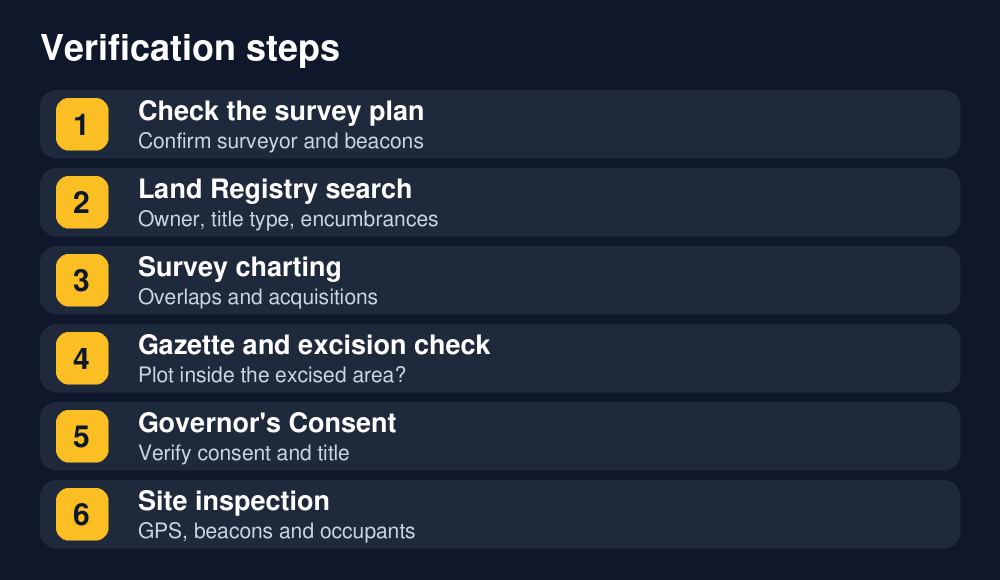
Step 1: Get a copy of the survey plan and check the surveyor
Insist on a legible copy of the survey plan before negotiating seriously. Check the beacon numbers at each corner, the coordinates, the local government area, and the licensed surveyor’s name and stamp. You can ask the Nigerian Institution of Surveyors (NIS) or the Lagos State Surveyor-General’s office to confirm the surveyor is registered. Fake surveyors who produce convincing but meaningless plans are a known fraud route.
Step 2: Run a search at the Lagos Land Registry
The Lagos State Lands Bureau and its Land Registry (based at the State Secretariat, Alausa, Ikeja) hold the official register of registered instruments. A registry search should show who the registered owner is, what type of title exists, whether there are encumbrances such as mortgages or caveats, and whether the chain of transfers matches what the seller told you. Lagos has an online land information portal for some searches, but not every record is digitised, so many buyers still use a lawyer to run a physical search. Reported cost ranges in estate-agent guides are roughly a few tens of thousands of naira for a basic search and more for a comprehensive one, with turnaround from days to a couple of weeks. Treat those figures as a rough guide only and confirm the current fee at the registry.
Step 3: Do a survey charting check at the Surveyor-General’s office
Charting compares the plan against the state’s master survey records. It tells you whether the land overlaps another plot, sits inside a government acquisition, or falls in a road setback, drainage channel or right of way. This is the step that catches a plan that looks perfect on paper but describes land that is already taken. It takes longer than the registry search; guides quote anything from about two to six weeks without rush service.
Step 4: Check the acquisition and excision position
Large parts of Lagos were acquired by the state for public purposes. Land can be committed (needed for a specific project and generally not lawfully saleable), uncommitted, or excised, meaning released from acquisition so that a community or individuals can regularise their holdings. A Land Information Certificate or equivalent search can tell you which category your coordinates fall into. If a seller claims excision, ask for the Gazette number, volume and page and verify it at the Lands Bureau. Also check that the community or family named in the gazette is the one selling. A very common trick is selling land that is merely next to a genuinely excised area as if it were inside it.
Be especially cautious about phrases such as “excision in process” or “on a file number”. A file number only shows that someone applied; it does not mean the application succeeded. Some online guides state that new excisions have been rare for years, so a promise that an excision is “coming” deserves serious scepticism.
Step 5: Verify Governor’s Consent and the title document
If the seller has a C of O or a registered title, your lawyer should confirm the file number, the signatures and stamps, and that the document appears in the official records. If the land has been transferred before, check that each earlier transfer received Governor’s Consent where it was required. Without consent, the transfer may be vulnerable to challenge.
Step 6: Inspect the site in person (or through a trusted representative)
Have a surveyor or trusted representative visit the site with the survey plan and a GPS device. Beacons should be physically present and roughly where the coordinates say. Check access roads, flooding, power lines and whether anyone is occupying, farming or building on the plot. If you live in the UK or elsewhere abroad, do not rely only on a video call from the seller; hire an independent professional. Our guide to investing in Nigerian real estate from abroad covers how to set up this kind of remote due diligence safely.
Step 7: Confirm family or community authority
For family or communal land, confirm that the person selling has the authority of the family head and principal members, and that outstanding community levies are settled. A written, signed letter with witnesses is normal. This does not replace government records, but it reduces the chance of an “Omo-onile” dispute after you buy.
Step 8: If the seller is a company, search the Corporate Affairs Commission
Check that the company is registered with the CAC, that the directors match those who signed, and whether there is a board resolution authorising the sale. For developers selling many plots, ask for the master title and confirm it covers the estate you are buying into.
Step 9: Use a lawyer and pay safely
Engage your own lawyer, not the seller’s, and let them handle searches, the sale agreement and registration. Pay by bank transfer to a verified account in the seller’s or company’s name, never cash, and get a signed receipt. After payment, complete the transfer: execute the Deed of Assignment, apply for Governor’s Consent, pay the required stamp duty and registration fees, and register the deed. Skipping the post-purchase registration is a frequent and costly mistake.
Red flags that should stop you
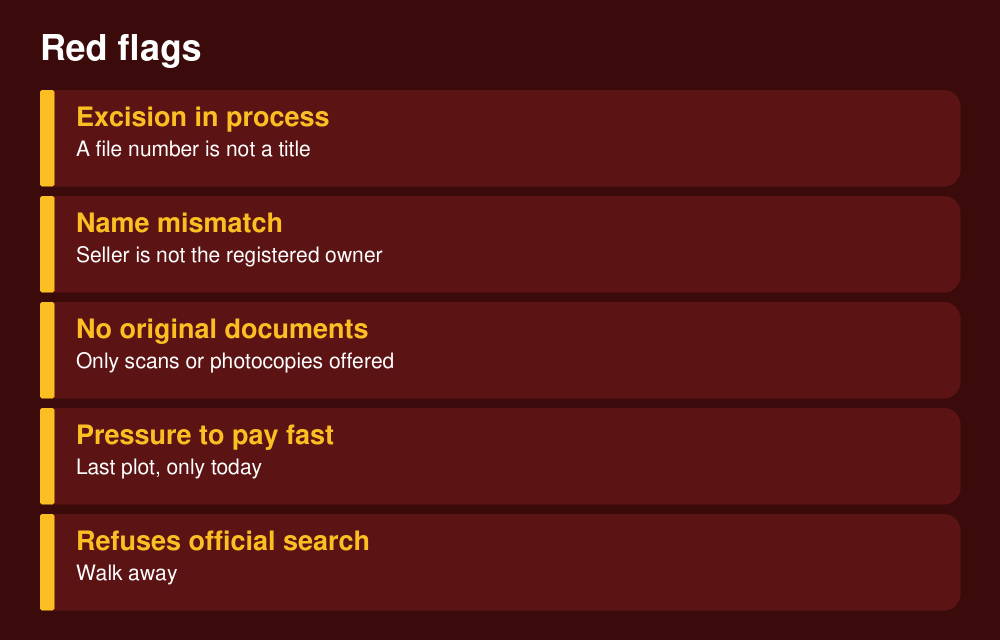
- The seller cannot or will not show original documents, or insists you pay before searches are done.
- The name on the title is not the name of the person selling, with no clear power of attorney or chain of transfer.
- Survey coordinates do not match the site, or the surveyor cannot be verified.
- The land is described as “excision in process”, “on file” or “government will release soon”.
- The price is far below nearby plots, or you are pressured with phrases like “last plot” or “only today”.
- The seller refuses to let your lawyer carry out an official search.
- Several people claim to be the real owner, or there are caveats, court cases or cautions on record.
How long does verification take and what does it cost?
Expect a proper verification to take several weeks, not days. A buyer doing it through a lawyer should budget for registry searches, survey charting, possible gazette checks, site inspection by a surveyor, and legal fees. Estate-agent guides online quote a wide spread of figures, and some of them are marketing for paid verification services, so do not treat any single number as official. Ask your lawyer for a written quote that itemises each government fee separately from professional fees, and compare that against the current schedule at each office. The cost of verification is small compared with the cost of buying land that cannot be registered.
What if the land is already registered to someone else?
Stop and take legal advice immediately. Do not confront the seller or hand over more money. Your lawyer can advise whether to report the matter to the police, ask the Lands Bureau to place a caution on the land, or pursue a refund. This is much easier if you have kept receipts, transfer evidence and messages.
Related reading
If you are still deciding where to buy, see our guide to buying land in Nigeria without getting scammed and our breakdown of the cost of building a house in Nigeria. For rental and affordability in the city, read cheapest areas to live in Lagos.
Frequently asked questions
Can I verify land ownership in Lagos online?
Some searches can be started through the Lagos State land information portal, but not every record is digitised and results should be cross-checked with the Land Registry and Surveyor-General’s office. Most buyers use a Lagos property lawyer to run and interpret the searches.
What is the difference between a C of O and Governor’s Consent?
A Certificate of Occupancy is evidence of a right of occupancy granted by the state. Governor’s Consent is the state’s approval for a transfer of that right from one person to another. A buyer typically needs a registered Deed of Assignment with Governor’s Consent to hold a secure title.
Is a survey plan proof of ownership?
No. A survey plan describes the land and its boundaries; it does not prove who owns it or that it is free of government acquisition. It must be checked against official records.
Is excised land safe to buy?
Genuinely excised and gazetted land can be bought, but you must verify the gazette details and that your plot falls inside the excised area. Avoid land described only as “excision in process”.
How do I verify a seller if I live in the UK?
Appoint your own Lagos lawyer and an independent licensed surveyor, give them the documents, and do not pay until the searches and site inspection are complete. Avoid relying only on videos or documents sent by the seller or an agent.
Should I register the land after I buy it?
Yes. After purchase, your lawyer should obtain Governor’s Consent where required, pay stamp duty and register the deed so that your title appears in the official records.
Disclaimer: this article is for general information and is not legal advice. Consult a qualified Nigerian property lawyer before buying land.
Join the discussion
Have you tried this, or do you have a question we did not answer? 1 reader has already shared their view. Naijatipsland members help each other with real, first-hand experience.









Thanks for reading. If you are buying land in Lagos, run every check in this guide before you pay a kobo, and use your own lawyer rather than the seller’s. Fees and procedures change, so confirm them with the Lagos offices. Questions on a specific document? Ask below and I will point you in the right direction. – Ade Adeniyi