


Last updated: 2 November 2026 · By Naijatipsland Editorial Team · Editorial policy
Checked 2 November 2026. “Which cream will give me glowing skin?” is one of the most common beauty questions in Nigeria, and also one of the riskiest. Market stalls and Instagram pages are full of “glow”, “toning” and “carrot” creams that promise results in two weeks. Some are fine. Others contain strong hydroquinone, steroids or even mercury, which can damage your skin for good.
This guide explains which ingredients are widely recommended for healthy, even skin in hot and humid weather, what commonly sold products cost in naira right now, how to check a NAFDAC number before you buy, and why bleaching creams are not the shortcut they look like. It is general information, not medical advice. If you have acne, eczema, melasma, dark patches that are spreading, or a reaction to a product, see a dermatologist.
What “glowing skin” really means
Healthy glowing skin is even, hydrated and calm. It is not lighter skin. Dermatologists generally point to the same few habits for brown and dark skin in tropical weather: protect it from the sun, keep the skin barrier healthy, avoid harsh products that cause irritation, and treat dark marks gently and patiently. Irritation is a big cause of dark marks on melanin-rich skin, which is why aggressive scrubs and strong creams often make things worse.
Ingredients that work in hot, humid weather
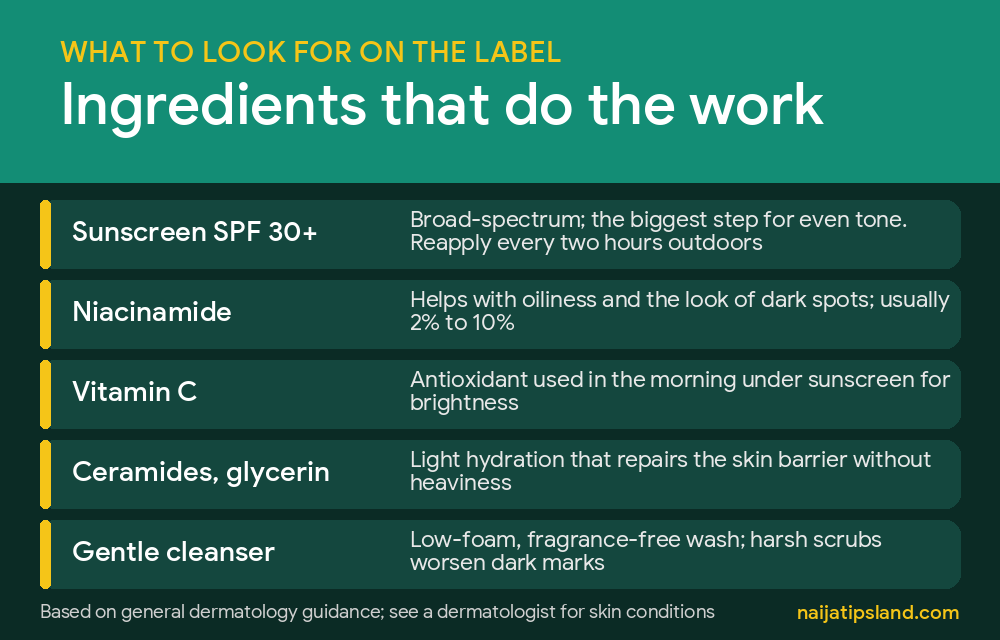
- Sunscreen (broad-spectrum, SPF 30 or higher). Melanin gives some natural protection, but it does not stop sun-driven dark spots, uneven tone or ageing. Daily sunscreen is the most useful single product for an even complexion. Look for “broad spectrum” and choose gel, fluid or “invisible” textures that do not leave a white cast.
- Niacinamide. Also called vitamin B3. It is widely used to help with oily skin, enlarged-looking pores and the look of dark marks. Serums usually contain 2% to 10%. Start with a lower strength if your skin is sensitive.
- Vitamin C. An antioxidant often used in the morning under sunscreen. Products vary a lot in strength and stability; a brown, oxidised serum has lost much of its effect.
- Light moisturisers with ceramides or glycerin. Even oily skin needs moisture. In Lagos, Port Harcourt or Calabar humidity, a gel-cream or lotion usually feels better than a heavy cream.
- A gentle cleanser. Twice a day is enough. Harsh soaps and gritty scrubs strip the skin and can trigger more dark marks.
Other ingredients such as azelaic acid, alpha arbutin, retinoids and exfoliating acids are also used for uneven tone, but they are stronger. Ask a dermatologist or pharmacist before combining them, especially if you are pregnant or breastfeeding.
Widely sold brands and 2026 naira prices

These are examples of products that are widely available in Nigeria, with prices from online listings we checked on 2 November 2026. Black Friday discounts are running on many platforms, so prices will move. We have not tested these products and their inclusion is not an endorsement.
| Product | Type | Size | Price seen |
|---|---|---|---|
| Dr Rashel Moisture Sun Cream | Budget sunscreen | 60g | about ₦4,560 |
| Nivea Sun UV Face Shine Control SPF 50 | Sunscreen | 50ml | about ₦7,795 (was ₦10,920) |
| SKIN1004 Madagascar Centella Air-fit Sunscreen SPF 30 | Sunscreen | 50ml | about ₦15,200 |
| Eucerin Photoaging Control Sun Fluid SPF 50 | Premium sunscreen | 50ml | about ₦20,515 |
| Bioderma Photoderm Xdefense SPF 50+ | Premium sunscreen | 40ml | about ₦39,799 |
| CeraVe Moisturising Lotion | Body/face moisturiser | 473ml | about ₦9,499 – ₦9,999 on sale |
| CeraVe Moisturising Cream | Moisturiser | 454g | about ₦11,999 (was ₦16,000) |
| The Ordinary Niacinamide 10% + Zinc 1% | Serum | 30ml | about ₦15,000 – ₦29,000 |
Sources: Jumia Nigeria listings and GoMed product page, checked 2 November 2026. Prices vary between sellers and change often.
A realistic starter routine of cleanser, moisturiser and sunscreen can cost around ₦20,000 to ₦35,000 and last two to three months. You do not need ten products. If buying imported brands online, check the seller carefully; our guides to Black Friday deals in Nigeria and buying from foreign stores explain how to avoid fake discounts and delivery problems.
How to check a NAFDAC number
Cosmetics sold in Nigeria, including creams, lotions and soaps, are regulated by NAFDAC. A genuine product should carry a NAFDAC registration number on its pack. To check it:
- Find the number on the label, usually written as “NAFDAC Reg. No.” followed by a code.
- Search the product or number on the NAFDAC Greenbook (greenbook.nafdac.gov.ng) or the registered products database on nafdac.gov.ng.
- Check that the product name, company and pack size match what you are holding.
- If there is a scratch panel, use NAFDAC’s Mobile Authentication Service (MAS) by SMS.
- Report suspicious or unregistered products to NAFDAC.
Not every imported product bought through informal channels will appear, and a number on a jar is not proof by itself, because numbers can be copied. If the product, the company and the number do not line up, do not use it. If you are making your own skincare to sell, read our guide to NAFDAC registration step by step and the SON certification guide.
The dangers of bleaching creams
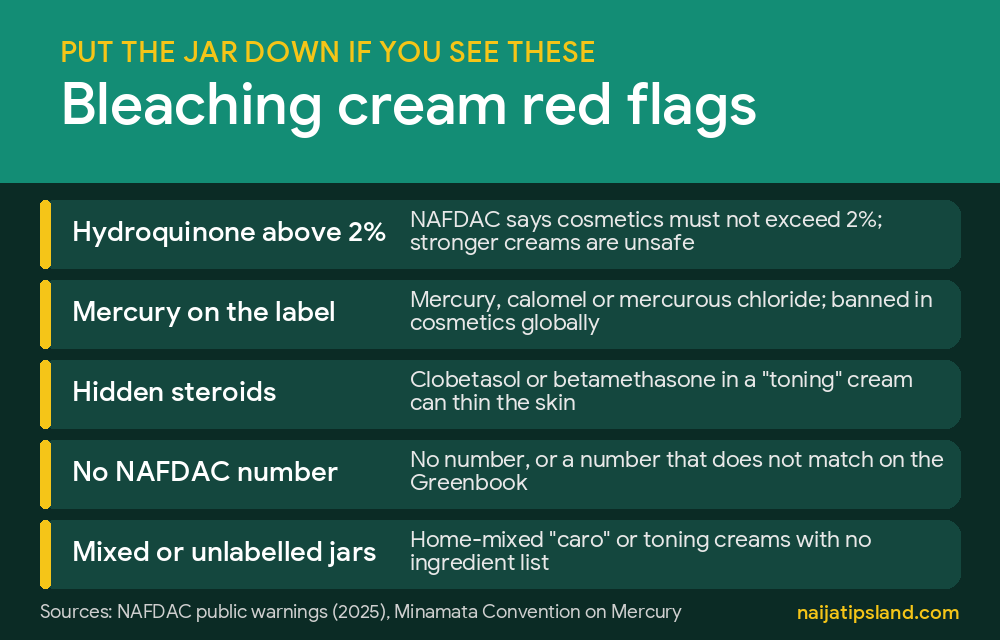
NAFDAC has repeatedly warned Nigerians about bleaching creams. In July 2025 the agency said hydroquinone in cosmetics must not exceed 2% and that stronger creams are dangerous, linking long-term misuse to serious conditions including cancer and warning that bleaching reduces the skin’s natural protection from sunlight. It also warned against mixing creams at home or letting untrained people mix them.
- Strong hydroquinone can cause irritation and, with long use, a blue-black darkening of the skin that is very hard to treat.
- Mercury is banned in cosmetics above trace levels under the Minamata Convention on Mercury. It can be absorbed through the skin and damage the kidneys and nervous system. Watch for “mercury”, “mercurous chloride” or “calomel” on labels.
- Steroid creams such as clobetasol are prescription medicines. Hidden in “toning” creams they can thin the skin, cause stretch marks and acne, and slow wound healing.
- Unlabelled mixed creams are the riskiest of all because nobody can tell you what is inside.
If a product burns, causes patches, or you have used bleaching creams for a long time and want to stop, see a dermatologist or a doctor rather than switching to another strong cream. See our overview of affordable health insurance in Nigeria if cost is a worry, as some HMO plans cover specialist visits.
A simple routine by skin type
| Skin type | Morning | Night |
|---|---|---|
| Oily or acne-prone | Gentle gel cleanser, niacinamide serum, light gel moisturiser, matte SPF 30+ | Cleanser, light moisturiser |
| Dry | Cream cleanser, moisturiser with ceramides, SPF 30+ | Cleanser, richer cream |
| Combination | Gentle cleanser, niacinamide or vitamin C, lotion, SPF 30+ | Cleanser, lotion; heavier cream only on dry areas |
| Sensitive | Rinse or mild cleanser, fragrance-free moisturiser, mineral SPF | Mild cleanser, fragrance-free moisturiser |
- Introduce one new product at a time and patch-test it on your inner arm or jawline for a few days.
- Give a product six to eight weeks before judging it.
- Reapply sunscreen if you are outdoors, especially between 10am and 4pm.
- Sleep, water, and not picking at spots matter more than any jar.
For broader wellbeing, see our guide to common health issues among young Nigerians and our honest look at natural remedies and when to see a doctor.
How to avoid fake and expired skincare
Popular imported brands are widely copied, and fakes are often sold at prices that look like a bargain. A fake sunscreen is especially risky because you think you are protected when you are not.
- Buy from accountable sellers. Licensed pharmacies, supermarkets, brand-authorised stores or the official store sections of large platforms give you someone to complain to. Be careful with Instagram and WhatsApp vendors who only accept transfers to personal accounts.
- Check the packaging. Look for spelling errors, blurred print, missing batch numbers, broken seals and labels stuck over the original text.
- Check the dates. Look for an expiry date or the open-jar symbol (for example “12M”, meaning use within 12 months of opening). Heat speeds up spoilage, so do not leave products in a hot car or in direct sun.
- Compare the price. If a premium sunscreen is selling for a third of the usual price, ask why.
- Watch for miracle claims. Words like “7-day white”, “permanent glow”, “caro” or “super toning” usually signal a bleaching product.
- Keep receipts and photos of the product and label in case you need to report a reaction or a fake to NAFDAC or the seller.
Should I stop using a cream if my skin reacts?
Yes. Stop the product, rinse with cool water and use only a plain moisturiser. If there is swelling, blistering, spreading rash or eye irritation, see a doctor promptly.
Frequently asked questions
What is the best cream for glowing skin in Nigeria?
There is no single best cream. For most people, the combination that helps most is a gentle cleanser, a light moisturiser and a daily broad-spectrum sunscreen, with niacinamide or vitamin C if you want extra help with dark marks.
Do dark-skinned people need sunscreen?
Yes. Melanin offers some protection, but sun exposure still worsens dark spots and uneven tone. Daily sunscreen is widely recommended for all skin tones.
Is hydroquinone banned in Nigeria?
NAFDAC says hydroquinone in cosmetics must not exceed 2%. Stronger concentrations should only be used under medical supervision, if at all.
How do I know if a cream contains mercury?
Check the label for mercury, mercurous chloride or calomel, and avoid creams with no ingredient list or NAFDAC number. You cannot see or smell mercury in a cream.
How long does it take to see results?
Expect six to twelve weeks for gentle products to visibly improve tone. Anything that “lightens” in days should raise suspicion.
Disclaimer: this article is general information based on NAFDAC public warnings, dermatology guidance and online prices checked on 2 November 2026. It is not medical advice and does not diagnose or treat any condition. Products named are examples, not endorsements. See a qualified dermatologist for skin problems or before starting stronger treatments.









One tip from the guide: before buying any cream, search its NAFDAC number on the Greenbook and check the company name matches the pack. Which products have worked for your skin in this weather?