
How to Start a Cosmetics and Skincare Brand in Nigeria (2026): Formulation, NAFDAC and Branding

Last updated 17 November 2026. NAFDAC fees and timelines change, so check the amount on your payment advice before you pay anything.
Skincare is one of the easiest businesses to start in Nigeria and one of the easiest to get wrong. You can mix a shea butter balm in your kitchen on Saturday and have orders by Monday. The trouble comes later, when a customer gets a rash, a NAFDAC officer asks for your registration number, or the Instagram page you built over a year gets reported because the cream in the jar was never approved.
This guide goes through the route in order: how you will make the product, registering the business, getting NAFDAC approval, the ingredient rules, labels, a startup budget and selling. I used NAFDAC statements, a March 2026 report on the national cosmetics safety policy, a Legal 500 note on NAFDAC labelling, and several 2025 and 2026 business guides. Where the guides disagree on numbers, I say so.
Decide how you will make the product
There are three practical routes, and the one you pick changes your NAFDAC application more than most people expect.
The first is making it yourself. You buy shea butter, oils, emulsifiers and preservatives, and produce small batches. This costs the least to begin and gives you control, but you carry all the responsibility for hygiene and safety, and NAFDAC will inspect your production space.
The second is a contract manufacturer. A licensed cosmetics factory makes your formula, or one of theirs, in your packaging. You pay more per unit and there is usually a minimum order, but the factory should already have a clean production line.
The third is private label, where you choose an existing product from a manufacturer and put your brand on it. It is the fastest way to get something on the shelf. The catch is that you depend on that factory for every batch, so ask to see their NAFDAC certificate and confirm the number before you pay a deposit.
Whichever route you choose, learn the basics of skin types and ingredients first. One startup guide puts cosmetic training at ₦30,000 to ₦150,000, though that page carries no date, so treat the range as rough.
Register the business first
NAFDAC asks for CAC registration documents, so do this before anything else. A registered business name is the cheaper and quicker choice for a one-person start. A limited company makes more sense if you plan to bring in investors or supply shops. Our guides to registering a business name with CAC and registering a limited company cover the steps. The same startup guide estimates registration at ₦15,000 to ₦30,000 for a simple start, but check the CAC portal for current fees. Open a separate business bank account too, so customer payments do not mix with your own money.
How NAFDAC registration works for cosmetics
One blog suggests NAFDAC approval matters mainly if you sell through supermarkets and pharmacies. Other guides, including a Brandlistry skincare seller guide, describe registration as mandatory for skincare products. Do not rely on the softer reading. If you sell skincare to the public, plan to register.
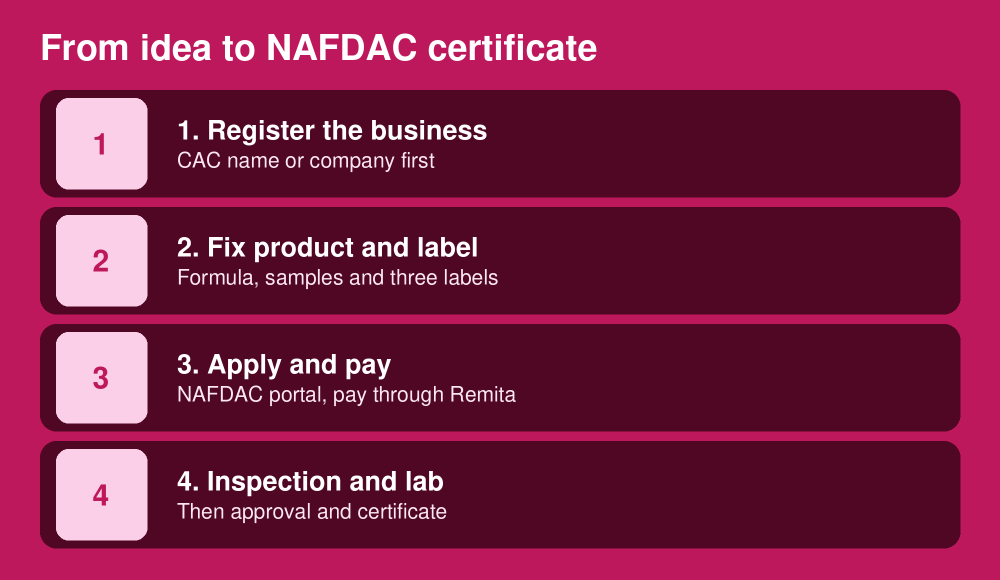
The process runs through NAFDAC’s online portal at registration.nafdac.gov.ng. In order, you create a company account, upload your documents, pay, wait for label vetting, book a factory inspection, have your samples tested in the laboratory, and then your file goes to the registration committee for a decision. When it is approved you receive a certificate and a registration number. You do not need an agent to apply, and the desk officer issues a payment advice with the exact amount, which you pay through Remita.
Documents
For a micro-scale business, one 8 November 2026 guide lists CAC registration papers, a site use agreement where it applies, a fumigation certificate for the production area, a medical fitness certificate for production staff, one vetting sample, three labels and your payment receipt. Trademark approval is optional at micro scale. Small-scale applicants need more, including standard operating procedures, quality assurance papers and a list of raw materials and where they come from. Each uploaded file should stay under 500KB.
Fees
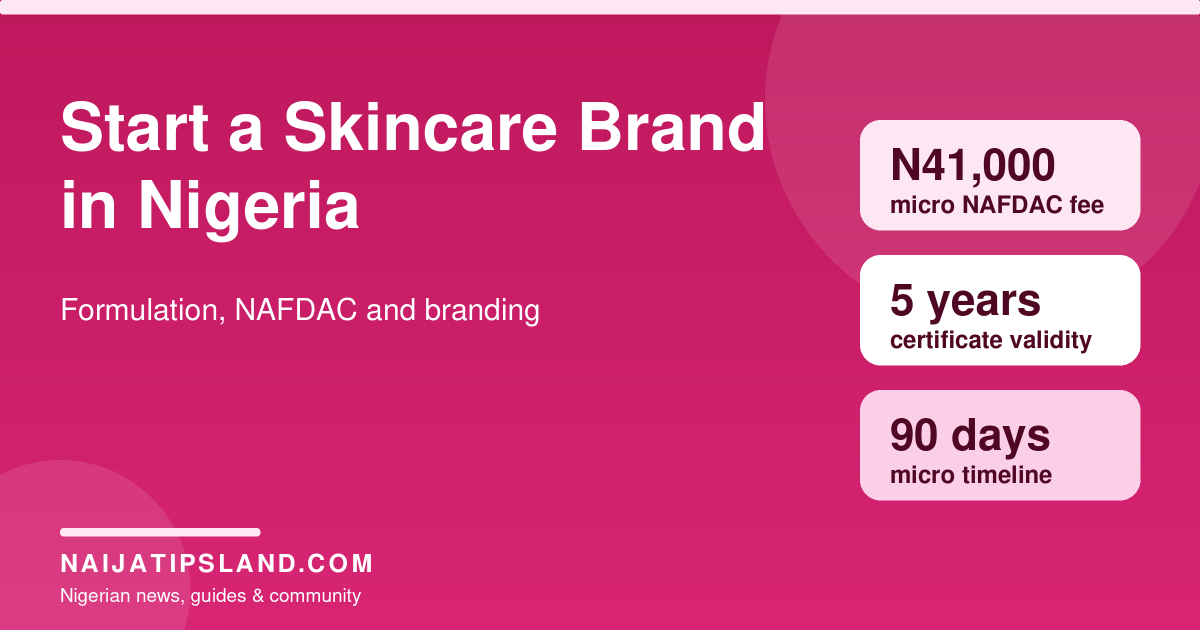
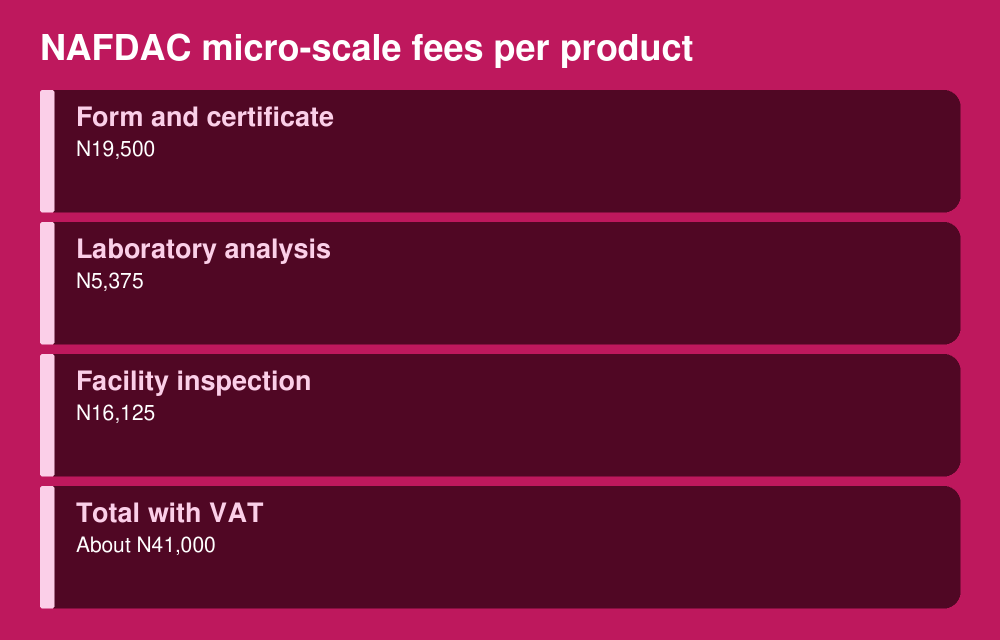
The same guide gives these micro-scale cosmetic fees per product, VAT included: ₦2,500 for the form, ₦17,000 for the certificate, ₦5,375 for laboratory analysis and ₦16,125 for inspection. That comes to ₦41,000. For small-scale producers the total is ₦105,250 per product. It says the tariff has been in force since 31 January 2020 and that nothing changed for cosmetics in 2026.
A different guide lists ₦50,000 as the fee for cosmetics and personal care, and estimates that factory inspection and lab work can cost far more in practice. Because the sources differ, treat the payment advice from NAFDAC as the only number that counts. Fees are per product, so a range of five creams at the micro-scale figure comes to about ₦205,000 before your own costs.
How long it takes
The 8 November guide gives 90 working days for micro-scale applicants and 90 to 120 working days for small and medium firms. Another guide gives longer realistic windows for inspection and lab work, up to 16 weeks each. Plan for several months, and do not print thousands of labels or promise customers a launch date until the certificate is in your hand.
A certificate is valid for five years. Start the renewal at least six months before it expires, because renewal can take months. If you change the formula, packaging or label, tell NAFDAC, because you may need a variation approval. Our NAFDAC registration steps guide covers the wider process for food and cosmetic businesses.
Ingredients and safety rules
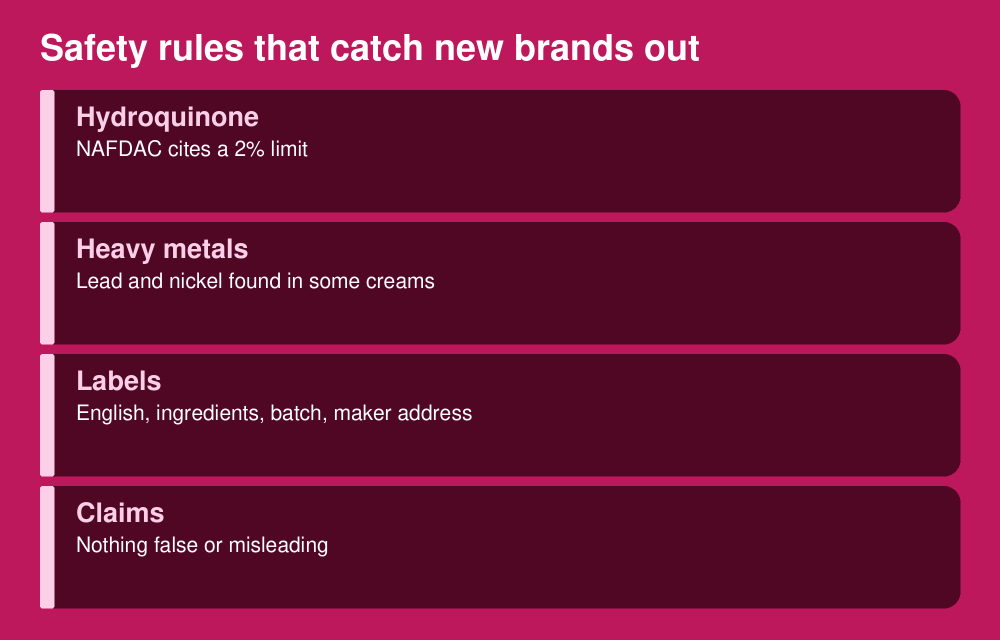
This is the section that matters most for your customers. In July 2025 a NAFDAC state coordinator in Bauchi said the permitted limit for hydroquinone in cosmetics is 2 per cent, and warned that creams above that level are harmful. He also warned against people with no training mixing creams, which is exactly what a rushed home start can look like.
A March 2026 report says Nigeria has adopted its first national policy on cosmetics safety, launched at the National Council on Health in Calabar. It aims to set up one system covering how cosmetics are made, imported, sold, used and thrown away, plus an early warning system to catch harmful products. The policy links to Nigeria’s commitments under the Minamata Convention on mercury, and the report notes that lead, cadmium and nickel were found above safe limits in some products. It also tells industry to follow national safety standards, so expect inspections to get tighter.
For you, that means a few habits. Work with a trained cosmetic formulator or a licensed factory, especially for anything that claims to lighten or brighten skin. Buy raw materials from suppliers who can show a certificate of analysis. Any product that contains water needs a proper preservative, or bacteria and mould will grow in it. Test small batches on a few people before you sell anything. If you are still choosing which products to stock or compare, our guide to creams for glowing skin explains the ingredients and the ones to avoid.
Labels and packaging
A Legal 500 note on NAFDAC labelling, published in October 2024, sets out what a cosmetic label must carry. The wording must be in English. The product name goes on the inner and outer labels. Ingredients are listed in order of how much of each there is, with fragrance and colour ingredients using their international names or codes. Net content is given in metric units, and the maker’s name and full address go on the label with the country of manufacture. A batch number is required.
Small containers of 10cm or less have to carry the brand name, product identity, batch number, net content, expiry date, maker’s name and address and the NAFDAC registration number. Labels must also not be false, misleading or suggest a connection to another product. So claims such as “cures eczema” or “removes dark spots in three days” are a legal and a customer-safety risk.
You only add the NAFDAC number after approval. Never print a number you were not given. Label design costs vary a lot, from ₦20,000 to ₦50,000 in one guide and ₦30,000 to ₦150,000 in another. If you are buying jars and bottles from abroad, read our guide to importing goods from China to Nigeria first, because packaging orders are a common place to lose a deposit.
What it costs to start
One undated startup guide puts a small, home-based start at ₦200,000 to ₦600,000. Its breakdown is raw materials ₦50,000 to ₦150,000, equipment ₦40,000 to ₦100,000, packaging ₦50,000 to ₦120,000, logo and labels ₦20,000 to ₦50,000, marketing ₦30,000 to ₦80,000, registration ₦15,000 to ₦30,000 and training ₦30,000 to ₦150,000. Because the guide treats NAFDAC as optional, add the registration fees above on top.
For pricing, Brandlistry gives a worked example from July 2025. A turmeric scrub costs ₦600 to produce, ₦200 for packaging and ₦150 for the label. Add about 10 per cent platform fee (₦100) and ₦150 for marketing, and ₦400 profit, and you reach a price of ₦1,600. Another guide says a face cream that costs about ₦1,500 to make can sell for ₦4,000 to ₦6,000. Prices have moved since those were written, so redo the sum with today’s quotes. The point to copy is the method: add every cost before you choose a price, or you will underprice.
Branding and selling
Start small. Three to five products is plenty, and a tight range is easier to register. Pick one customer first, such as oily skin, sensitive skin or men’s grooming, and write your product names and photos for that person.
Brandlistry suggests starting on its marketplace and adding Instagram, WhatsApp Business and a simple shop on Bumpa. Instagram and TikTok work well for how-to videos, customer reviews and behind-the-scenes clips. Offer pay on delivery to new buyers using GIG, NIPOST or a local dispatch rider, reply within 24 hours, and offer an exchange for damaged items. Our guide to growing an Instagram page in Nigeria organically has a 90-day plan you can adapt.
Mistakes that cost new brands money
The first is selling before approval and hoping nobody checks. The second is paying a stranger who promises a NAFDAC number in a week. The portal does not require an agent, so be wary of anyone who sells you a shortcut. The third is copying another brand’s ingredient list and label, which does not make your formula safe or your product different. The fourth is paying a contract manufacturer a deposit without checking their certificate. The last is setting a price that leaves no room for returns, delivery and ads.
A 90-day plan
In the first month, pick your route, take a short formulation course or find a formulator, and register the business name. In the second month, finalise two or three formulas, order samples and packaging, design the label, and prepare your documents. In the third month, submit the NAFDAC application, book the inspection, and build your Instagram and WhatsApp Business pages while you wait. Sales come after the certificate, so use the waiting time to collect email addresses and feedback from the people you will sell to.
If this is your first business, our start a business in Nigeria hub pulls together the CAC, tax and growth guides in one place.
Frequently asked questions
Do I need NAFDAC registration to sell skincare in Nigeria?
Plan on yes. Guides describe it as mandatory for skincare products, and an unregistered product is a legal risk for you and a safety risk for your customers.
How much does NAFDAC cosmetic registration cost?
One November 2026 guide lists about ₦41,000 per product at micro scale and ₦105,250 at small scale, VAT included. Another lists ₦50,000. Pay only the amount on your NAFDAC payment advice.
How long does registration take?
A November 2026 guide gives 90 working days for micro-scale applicants. Realistic timelines are often longer, so plan for months.
Can I register from home?
Micro-scale applicants can start from a small production space, but NAFDAC inspects it and asks for a fumigation certificate and a site use agreement. The space has to be clean and fit for production.
How long does the certificate last?
Five years. Start renewing at least six months before it expires.
What is the hydroquinone limit?
A NAFDAC state coordinator said in July 2025 that the permitted limit in cosmetics is 2 per cent. If you are unsure, ask a qualified formulator or NAFDAC before you use it.
Should I use a skin condition claim on my label?
No. Labels must not mislead. If a customer has a skin condition, rash or reaction, they should see a doctor or pharmacist, and you should say so on your page.
Sources
- Naijasabi: NAFDAC registration cost 2026 (8 November 2026)
- EB Consults: NAFDAC registration in Nigeria, step-by-step guide (2026)
- Legal 500 / Firmus Advisory: NAFDAC labelling requirements for cosmetic products (October 2024)
- Voice of Nigeria: NAFDAC warns against high hydroquinone skin creams (July 2025)
- WHO Africa: Nigeria adopts national policy to strengthen cosmetics safety (March 2026)
- Brandlistry: How to start selling skincare products online in Nigeria (July 2025)
- 9japolytv: How to start a profitable skincare business in Nigeria (undated)
- NAFDAC registration portal









Editor note: if you are building a skincare brand, tell us which part is hardest for you right now, the formulation, the NAFDAC paperwork or finding customers. We read every comment and use them to decide what to cover next. – Ade