Last updated: 16 October 2026 · By Naijatipsland Editorial Team · Editorial policy
Many small producers ask the same question after they hear about NAFDAC: do I also need SON? The answer depends on what you make, where it is made and what it is. The Standards Organisation of Nigeria (SON) certifies a long list of products, from electrical items and building materials to packaging and many consumer goods, to check that they meet Nigerian Industrial Standards. Locally made products go through a scheme called MANCAP, and imported goods go through SONCAP. This guide explains the difference, how MANCAP works, what the official charges are, and how SON certification relates to NAFDAC and your business registration.
Unlike the earlier guides in this series, we could read SON’s own pages for this topic: its MANCAP FAQ and its published MANCAP administrative charges. We have used them for the process, validity and fees, and used a consultancy guide for the wider comparison, flagging where it is unsourced. Rules and lists change, so confirm your product with SON before you spend money. This is general information, not legal advice.
The short answer
- MANCAP (Mandatory Conformity Assessment Programme) is SON’s certification scheme for locally manufactured products, under the SON Act 2015.
- SONCAP applies to regulated imported products and is handled before shipment.
- You apply through your nearest SON state office, then pass inspections and product tests. SON says it takes about 60 days from receipt of the application at the MANCAP division if all requirements are met.
- A MANCAP certificate is valid for three years, with SON state offices inspecting the factory quarterly.
- NAFDAC and SON are different regulators. One consultancy says a food product can need both, and each applies its own standards.
MANCAP and SONCAP: which one is yours?
| MANCAP | SONCAP | |
|---|---|---|
| Applies to | Locally manufactured regulated products | Regulated imported products |
| Where it is checked | At your Nigerian factory, by SON | In the country of manufacture, before shipment |
| When | Before you sell or export | Before customs clearance |
| Who applies | The manufacturer | The importer or exporter |
The comparison table follows a consultancy guide that cites the SON Act but no other source, so treat the SONCAP detail as general. If you manufacture in Nigeria and also import components or finished goods, you may meet both schemes for different products.
Do you need SON certification?
SON certifies products against Nigerian Industrial Standards (NIS), and certification is mandatory only for products on the regulated list. One consultancy gives examples such as electronics, electrical equipment, building materials, tyres, food packaging, protective equipment and toys, but the list changes, so always ask SON about your exact product. For imports, check your product’s HS code against SON’s regulated products list before you ship.
Questions to ask yourself:
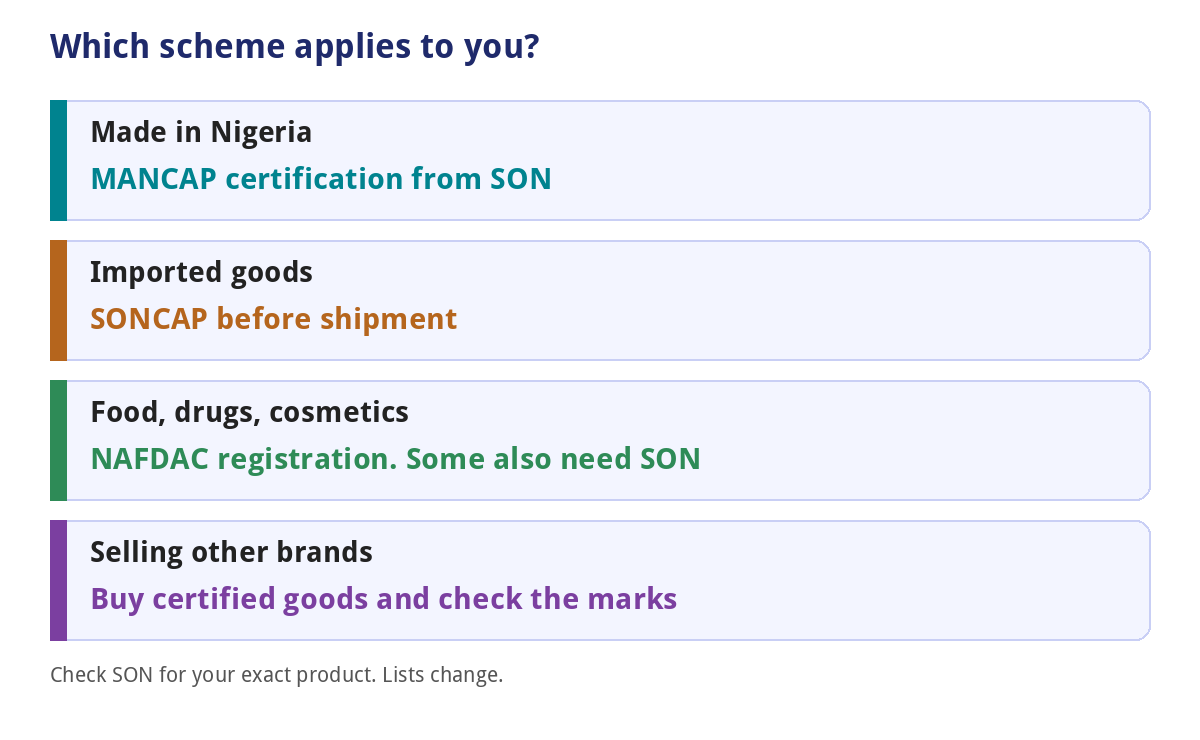
- Do I manufacture the product in Nigeria? If yes, ask SON whether it is a regulated product that needs MANCAP.
- Do I import it? If yes, check whether it needs SONCAP before shipment.
- Is it a food, drug or cosmetic? You will need NAFDAC registration. See our guide to NAFDAC registration step by step. Whether SON also applies depends on the product, so ask both agencies.
- Am I only reselling? You do not usually certify other people’s products, but you should buy certified goods, since selling substandard regulated goods can lead to seizure.
How MANCAP works

The following comes from SON’s own MANCAP FAQ:
- Enquire. Contact your nearest SON state office and get the application form.
- Apply. Submit the form with a CAC certificate of incorporation, proof of payment for the form and for certification, and a product test report. The test can be an on-the-spot test, a SON laboratory report or a report from an accredited laboratory (IPAN) if the on-the-spot test is not comprehensive.
- Inspection. SON requires a minimum of two quarterly inspections before certification, and your products must conform to the relevant Nigerian Industrial Standard.
- Certificate. You receive a MANCAP certificate and a logo with a unique identification number, which you can put on each unit or on the label.
- Surveillance and renewal. SON state offices inspect your factory quarterly during the three-year validity, and you must be recertified at the end.
A consultancy guide also describes registering on SON’s portal with your CAC registration number, and says the process can take three to six months. That range is unsourced, so rely on SON’s own 60-day figure for a straight run and expect delays if inspections or tests need repeating. SON says MANCAP-certified products can be exported to any West African country.
MANCAP Fast Track for small businesses
SON describes a Fast Track as a verification exercise, not a full certification. It checks your production and quality assurance capability and issues a MANCAP logo with a number valid for six months, aimed at helping micro, small and medium businesses trade. Full MANCAP certification is expected within that six-month period. Apply through your nearest SON state office.
What does it cost?

SON’s published MANCAP administrative charges list the certification fee by business size. Certification for one to five products costs:
| Business size | Certification (1 to 5 products) | Revalidation (1 to 5 products) | Factory inspection and testing |
|---|---|---|---|
| Cottage or micro | N7,500 | N7,500 | N5,625 |
| Small | N37,500 | N37,500 | N22,500 |
| Medium | N97,500 | N97,500 | N65,000 |
| Large | N195,000 | N195,000 | N130,000 |
For more than five products, the schedule lists N300,000 (medium) and N450,000 (large) for certification, with revalidation at N260,000 and N390,000. The document also lists the application form at N5,000 but notes that there are no charges with the electronic MANCAP system operating, and it lists optional fast-track logo number charges that do not map clearly to business sizes. The document does not state an effective date and says the charges are to be reviewed every five years. Ask your state office for the current figures and how they define cottage, small, medium and large.
Remember other costs: laboratory testing where required, packaging changes, your own quality-control improvements, transport and any consultant fees. Pay only through approved channels and be wary of anyone selling a certificate without an inspection.
How SON relates to your other registrations
- CAC. SON asks for your company certificate. See our guides to registering a business name and a limited company.
- NAFDAC. Food, drugs, cosmetics and packaged water need NAFDAC registration. SON certification may also apply to some products, and each agency applies its own standards.
- Trademark. Your brand mark is separate. See trademark registration in Nigeria.
- Tax. Keep your tax records in order. See getting a Tax Identification Number.
What happens if you skip it
A consultancy guide says selling uncertified regulated products is illegal and can lead to seizure and prosecution, and that regulated imports can be seized at customs. It gives no fine amounts, and we could not find the penalties in a source we could read, so ask SON or a lawyer if you face enforcement. SON market surveillance teams are also described as raiding markets and seizing non-compliant goods.
Common mistakes
- Assuming NAFDAC registration replaces SON certification, or the other way round.
- Not checking whether your product is on the regulated list.
- Applying before your company registration is in order.
- Using a logo number you were not issued.
- Ignoring quarterly inspections and then failing recertification.
- Importing regulated goods without the required certificate.
- Believing agents who promise certification without inspection.
Frequently asked questions
What does MANCAP stand for?
Mandatory Conformity Assessment Programme, SON’s scheme for locally manufactured products.
How long does a MANCAP certificate last?
Three years, with quarterly factory inspections during that period, then recertification.
How long does MANCAP take?
SON says about 60 days from receipt of the application if all requirements are met. Real timelines can be longer.
Is there a route for small businesses?
SON’s Fast Track issues a six-month logo number after a verification exercise, and the fee schedule has lower charges for cottage and micro businesses.
Do I need MANCAP for food?
Food needs NAFDAC registration. Ask SON whether your specific product also needs MANCAP.
What is SONCAP?
SON’s conformity scheme for regulated imported products, done before shipment.
Where do I apply?
Through your nearest SON state office or SON’s official channels.
Bottom line
First find out whether your product is regulated. If you make it in Nigeria, apply for MANCAP through your nearest SON office with your CAC certificate, test report and fees, expect inspections, and plan around three-year recertification. If you make food or cosmetics, treat NAFDAC and SON as separate checks. Keep your company, brand and tax records in order and confirm all fees with the agencies before you pay.
Sources
- Standards Organisation of Nigeria: MANCAP FAQ (official)
- Standards Organisation of Nigeria: MANCAP administrative charges (official; effective date not stated)
- EB Consults: SON certification in Nigeria, MANCAP and SONCAP (commercial consultancy; timelines and some detail unsourced)